Choosing between white label SEO, a freelancer, or an in-house team determines how fast a business grows organic traffic and how much control it keeps over strategy. Each model delivers SEO differently, at different costs, with different risk levels. Business owners who pick the wrong fit often waste months and budget before realizing it.
Getting this decision right shapes traffic growth, lead volume, and marketing spend efficiency for years. A mismatched model quietly drains budget while competitors pull ahead in search rankings.
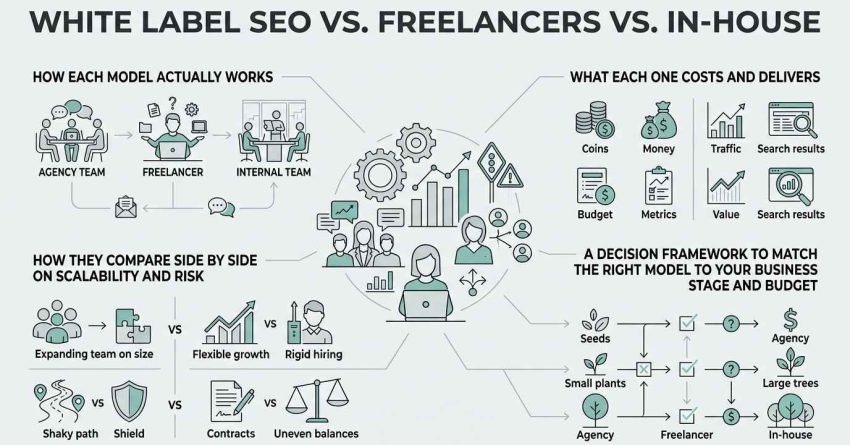
I’m covering how each model actually works, what each one costs and delivers, how they compare side by side on scalability and risk, and a decision framework to match the right model to your business stage and budget.
What Is White Label SEO, Freelance SEO, and In-House SEO?
White label SEO, freelance SEO, and in-house SEO are the three primary delivery models businesses use to execute search engine optimization, each differing in who does the work, who manages the relationship, and how much oversight the business retains. I break down each one below because the terminology gets confused constantly, and the wrong assumption here leads to the wrong hire.
What Is White Label SEO?
White label SEO is a service model where one company performs SEO work technical audits, content, link building, reporting under another company’s brand name. Agencies and consultants typically use white label providers to deliver full SEO services to their own clients without building an internal production team. The end client usually never knows a third party executed the work, since reporting and communication happen under the reselling agency’s identity.
What Is Freelance SEO?
Freelance SEO is when an independent contractor, rather than an agency or team, handles some or all of an SEO campaign directly for a business. Freelancers often specialize in one or two areas technical SEO, content, or link building rather than covering the full discipline. Vetting matters enormously here, since quality and reliability vary widely from one independent contractor to the next.
What Is In-House SEO?
In-house SEO is an internal team, sometimes a single hire, sometimes a full department, employed directly by the business to manage search strategy full-time. This model gives the business direct oversight and institutional knowledge that outside providers can’t replicate. Building this function from scratch requires budget for salaries, tools, and a ramp-up period before results appear.
How Does White Label SEO Work?
White label SEO works through a reseller relationship where an agency sells SEO services to its client while a specialized provider executes the technical work behind the scenes. The reselling agency handles client communication, strategy approval, and billing, while the white label partner handles audits, on-page changes, content production, and link acquisition.
Most agencies use this setup to expand service offerings without hiring specialists in-house. The client relationship, pricing, and reporting format stay fully controlled by the agency, while execution capacity scales up or down based on the white label partner’s bandwidth. This structure works especially well for agencies managing multiple clients with varying SEO needs.
What Are the Pros and Cons of White Label SEO?

White label SEO offers agencies scalability and specialized execution without hiring overhead, but it introduces a layer of dependency on a third party’s quality and communication. I’ve watched this model work brilliantly for growing agencies and fall apart when the provider relationship isn’t managed closely.
Advantages of White Label SEO
White label SEO lets an agency scale service delivery instantly without hiring, training, or managing specialists directly. Costs stay variable rather than fixed, since agencies pay per client or project rather than carrying salaried staff. Access to a full team of specialists technical, content, link building comes bundled rather than requiring five separate hires.
Disadvantages of White Label SEO
Quality control sits one step removed, since the agency didn’t directly hire or train the people doing the work. Communication delays can happen when questions have to pass through an extra layer before reaching the person actually executing the strategy. Margins shrink compared to in-house delivery, since a portion of the client’s fee pays the white label provider.
What Are the Pros and Cons of Hiring an SEO Freelancer?
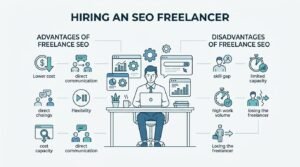
Hiring an SEO freelancer offers low overhead and direct communication, but reliability and skill breadth vary far more than with an agency or team. Freelancers work well for narrow, well-defined projects and poorly for businesses needing a full, ongoing strategy across multiple disciplines.
Advantages of Freelance SEO
Freelance SEO typically costs less than agency or in-house options, since there’s no overhead for account management or a full production team. Direct communication with the person doing the work removes the layers of handoff common in agency setups. Flexibility to start or stop engagements quickly suits businesses testing SEO before committing to a bigger budget.
Disadvantages of Freelance SEO
A single freelancer rarely covers technical SEO, content, and link building at an equally high level, creating gaps in the strategy. Capacity is limited to one person’s working hours, which slows delivery once the workload grows past a certain point. Losing a freelancer to another client or a career change can halt a campaign with no backup plan in place.
What Are the Pros and Cons of an In-House SEO Team?
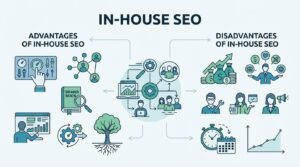
An in-house SEO team gives a business full control and deep product knowledge, but it comes with the highest fixed cost and the longest ramp-up time of the three models. This option makes the most sense for businesses with SEO as a core, long-term growth channel rather than a supplementary tactic.
Advantages of In-House SEO
An in-house team develops deep familiarity with the product, customers, and brand voice that no outside provider can match immediately. Direct oversight means priorities shift instantly without contract negotiations or scope discussions. Institutional knowledge compounds over time, since the same people carry strategy context from one quarter to the next.
Disadvantages of In-House SEO
Salaries, benefits, and tool subscriptions make in-house SEO the most expensive model on a monthly basis regardless of output. Hiring the full range of skills technical, content, outreach usually requires multiple employees rather than one generalist. Ramp-up time before a new hire produces results adds months before the investment shows a return.
How Much Does Each SEO Model Cost?
SEO costs vary substantially by model, with freelancers typically charging the least and in-house teams carrying the highest fixed monthly cost. A 2024 industry survey from Ahrefs found the average monthly SEO retainer among agencies ranges from $1,500 to $5,000, while freelancer rates commonly fall between $50 and $150 per hour.
| Model | Typical Monthly Cost | Cost Structure |
| White Label SEO | $1,000–$4,000 per client (agency markup added) | Variable, per-client or per-project |
| Freelance SEO | $500–$3,000 | Hourly or flat project rate |
| In-House SEO | $4,000–$12,000+ (salary + tools + benefits) | Fixed monthly, regardless of output |
Tool subscriptions add further cost regardless of model, since platforms like Google Search Console are free, but keyword research and rank tracking tools typically run $100–$500 monthly per license.
White Label SEO vs. Freelancers vs. In-House: Side-by-Side Comparison

Comparing white label SEO, freelancers, and in-house teams across cost, scalability, and control reveals that no single model wins on every dimension, which is exactly why the right choice depends on business stage. The table below shows how each model performs across the factors that matter most to a growing business.
| Factor | White Label SEO | Freelancer | In-House |
| Cost | Medium | Low | High |
| Scalability | High | Low | Medium |
| Skill Breadth | High (full team) | Low–Medium | Depends on hires |
| Speed to Start | Fast | Fast | Slow (hiring + ramp-up) |
| Control | Medium | High | Highest |
| Risk of Disruption | Low | High (single point of failure) | Medium |
Which SEO Model Scales Best for Growing Businesses?
White label SEO scales best for businesses experiencing fast growth, since capacity expands with demand instead of requiring new hires for every additional client or project. An agency selling SEO services to twenty clients this year and forty next year can lean on a white label partner’s existing team rather than doubling headcount.
Freelancers scale the worst of the three models, since one person’s time is the hard ceiling on output. In-house teams scale in steps rather than smoothly, since each capacity increase requires a new hire, onboarding, and salary commitment before output actually increases.
How Does Quality and Expertise Compare Across SEO Models?
Quality varies more by the specific provider than by the model itself, but white label partners and in-house teams generally offer more consistent expertise than a single freelancer working alone. Established white label providers have processes, quality checks, and specialists across disciplines built into their standard delivery.
In-house teams develop expertise specific to one business’s niche and product over time, which outside providers take longer to match. Freelancer quality swings the widest, since skill, experience, and workload capacity differ enormously from one independent contractor to the next.
What Are the Risks of Each SEO Model?
Every SEO delivery model carries a distinct risk profile, with freelancers carrying the highest single-point-of-failure risk and in-house teams carrying the highest financial commitment risk. A freelancer disappearing mid-project halts campaign momentum immediately, since no backup person knows the account history.
White label arrangements carry communication risk, since the agency reselling the service depends on a partner it doesn’t directly manage day-to-day. In-house teams risk sunk cost if the hire underperforms or leaves, since the business has already committed to months of salary before seeing results.
How Long Does It Take to See Results With Each Model?
Results timelines run similar across all three models, since SEO itself typically takes four to twelve months to produce meaningful organic traffic growth regardless of who executes the strategy. The delivery model affects how fast a team gets started and how consistently work gets done, not how fast Google indexes and ranks the changes.
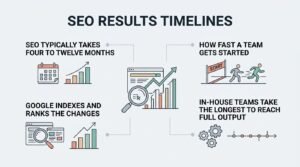
In-house teams often take the longest to reach full output, since hiring and onboarding delay the actual start of SEO work by one to three months. White label and freelance models typically start executing within one to two weeks of signing, giving them a head start on the same twelve-month runway.
Who Should Choose White Label SEO?
Agencies without in-house SEO specialists, and businesses wanting full-service execution without managing multiple vendors, are the best fit for white label SEO. This model suits marketing agencies expanding their service menu, web design firms adding SEO as an upsell, and businesses that want one point of contact managing a full strategy.
Who Should Hire a Freelance SEO Specialist?
Small businesses with a narrow, well-defined SEO need and a limited budget are the best fit for a freelance SEO specialist. This model works well for a single technical audit, a content sprint, or a specific link-building campaign rather than an ongoing, multi-discipline strategy.
Who Should Build an In-House SEO Team?
Businesses treating SEO as a permanent, core growth channel with sufficient budget for salaries and tools are the best fit for an in-house team. Companies with unique products requiring deep subject-matter expertise, or those generating enough revenue to justify a dedicated department, see the strongest return from this model.
How Do You Choose the Right SEO Model for Your Business?
Choosing the right SEO model depends on matching business size, available budget, growth stage, and internal resources against what each model delivers best. A startup with a tight budget and no existing marketing team fits differently than an established company with a marketing department but no SEO specialist.
Budget constraints point toward freelancers or white label arrangements, since both avoid the fixed cost of full-time salaries. Growth stage matters too, since a business scaling client volume fast benefits from white label capacity, while a business scaling its own product benefits from in-house institutional knowledge. Internal resources, meaning whether marketing leadership exists to manage a freelancer or provider relationship, often decide the outcome more than budget alone.
Can You Combine SEO Models for Better Results?
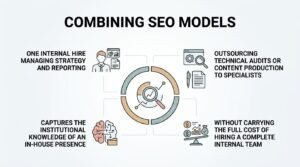
Combining SEO models works well in practice, with many businesses running an in-house strategist alongside a white label or freelance execution team for specialized tasks. A common hybrid setup keeps one internal hire managing strategy and reporting while outsourcing technical audits or content production to specialists.
This combination captures the institutional knowledge of an in-house presence without carrying the full cost of hiring a complete internal team. Agencies frequently use this exact structure, keeping strategy and client relationships internal while white label partners handle production-heavy work like content and link building.
Common Mistakes to Avoid When Choosing an SEO Delivery Model
The most common mistake businesses make is choosing based on cost alone without factoring in the risk of disruption or the time required to see results. A freelancer at half the price of an agency looks attractive until they disappear three months into a campaign with no handoff plan.
Another frequent mistake is expecting in-house hires to produce agency-level results immediately, ignoring the ramp-up period every new hire needs. Businesses also underestimate how much oversight a freelancer or white label relationship requires, assuming the work runs itself once a contract is signed.
Conclusion
White label SEO, freelancers, and in-house teams each solve SEO differently, balancing cost, control, and scalability in distinct ways. No single model wins universally.
The right choice depends on your growth stage, budget, and internal capacity, and many businesses eventually blend two models as needs evolve.
We help businesses build sustainable organic growth through the right delivery model. Contact White Label SEO Service to find your best fit.
Frequently Asked Questions
Is white label SEO the same as outsourced SEO?
White label SEO is a type of outsourced SEO where the work is rebranded under the hiring agency’s name. Not all outsourced SEO is white label, since some outsourcing is done under the provider’s own name.
Is it cheaper to hire a freelancer or an agency for SEO?
Freelancers are typically cheaper than agencies, with rates around $50–$150 per hour versus agency retainers of $1,500–$5,000 monthly. Cost savings often come with reduced skill breadth and capacity.
Can a small business afford an in-house SEO team?
Small businesses can afford one in-house SEO hire, but a full team covering technical, content, and outreach usually exceeds small business budgets. Most small businesses start with a freelancer or white label arrangement instead.
How do agencies use white label SEO providers?
Agencies use white label SEO providers to execute client work behind the scenes while the agency manages the client relationship and billing. This lets agencies offer SEO services without hiring specialists directly.
What size business should build an in-house SEO team?
Businesses generating enough revenue to justify $4,000–$12,000+ in monthly salary and tool costs are best suited for an in-house team. This typically means established mid-size to large companies.
Do freelancers offer the same results as agencies?
Freelancer results depend heavily on the individual’s skill and workload capacity, and rarely match the breadth of an agency’s specialized team. Results can be comparable for narrow, single-discipline projects.
What is the biggest risk of relying on one SEO freelancer?
The biggest risk is losing all campaign momentum if the freelancer becomes unavailable, since no backup person holds the account history. This single point of failure is the primary reason larger businesses avoid relying solely on one freelancer.