Your SaaS website carries one job that matters more than any other page you will ever ship. It has to convert a visitor into a trial signup or a demo request, and it has to do that inside a window of a few seconds before a skeptical buyer moves on to the next tab.
SaaS buyers are not casual browsers. They open five competing tools at once, read the case studies before they will agree to a demo, and abandon a homepage the moment the value proposition feels unclear. Most agencies never design for that behavior. They optimize for how a page looks in a portfolio screenshot rather than what it needs to do once real traffic lands on it. Pick the wrong partner, and you end up with a homepage that photographs well and converts nobody, and that gap shows up in your pipeline every single month.
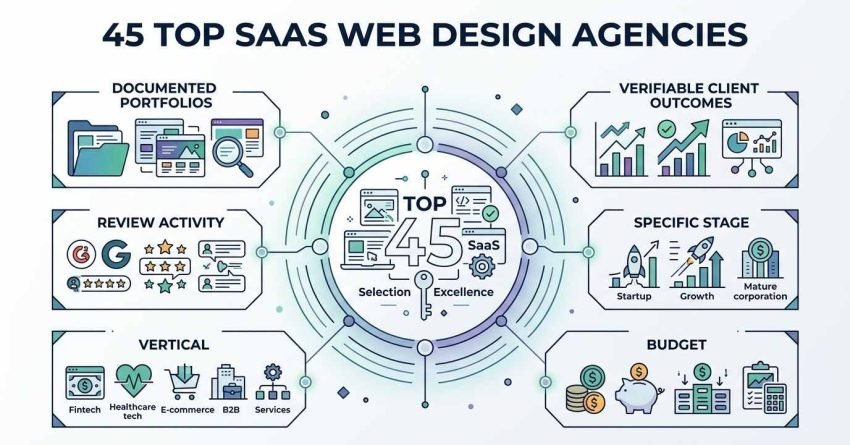
We reviewed more than 100 agencies that market themselves as SaaS specialists, checking Clutch, G2, Glassdoor, Indeed, LinkedIn, and live traffic data through SEMrush for each one. We looked for documented SaaS portfolios, verifiable client outcomes, and review activity that was not manufactured. Most of the agencies we checked did not clear that bar. The 45 below did, and we group them by what makes each one worth a serious look for a specific stage, vertical, or budget.
Top SaaS Web Design Agencies in 2026 (At a Glance)
This is not a list where every name is a pure SaaS specialist shop. What every entry shares is a documented history with SaaS clients, reviews we could independently verify, and outcomes tied to a real business metric rather than a design award.
One name sits apart from the ranked list entirely. We run White Label SEO Service, and we are not going to pretend otherwise or bury that fact in a footnote — you will see exactly where that shows up later in this piece.
Everyone else earned their spot through a weighted scoring model covering client satisfaction, team scale, web authority, employee sentiment, and how easy the agency is to actually engage with. The full breakdown sits in the Methodology section near the end.
- Andersenlab — best for enterprise SaaS products that need full-stack design and engineering under one roof
- Eleken — best for SaaS teams that want a dedicated UI/UX designer without hiring one internally
- Superside — best for high-volume marketing teams that need continuous creative output at speed
- Gapsy Studio — best for SaaS startups chasing polished design delivered quickly at a fair price
- Ofspace — best for SaaS teams that need a high-converting landing page or MVP shipped fast
- Cleveroad — best for SaaS startups that want design and dedicated engineering from one team
- Bop Design — best for B2B SaaS companies that need strategy-led design tied to lead generation
- Saffron Edge — best for SaaS companies that want SEO and web design running as one system
- Qubstudio — best for SaaS products where user research needs to drive every design call
- Merge Rocks — best for growth-stage SaaS and fintech teams that need UX built for outcomes
Top 45 SaaS Website Design Agencies Compared (2026)
Every agency here was measured across eight consistent data points: client satisfaction, review volume, team size, web authority, years operating, employee sentiment, hourly rate, and minimum project cost. No agency paid for placement, and no score was adjusted after the fact.
List of Top SaaS Website Design Agencies
| # | Agency | Website | HQ | Monthly Visits | Web Design Focus | Client Rating | Reviews | Years | Employee Score | Emp. Reviews | Hourly Rate | Min. Project | Score |
| 1 | Andersenlab | andersenlab.com | Warszawa, Poland | 13,288 | 10% | 4.60 | 144 | 19 | 4.60 | 784 | $50 | $50,000 | 63 |
| 2 | Eleken | eleken.co | Kyiv, Ukraine | 31,690 | 100% | 4.85 | 153 | 11 | 4.70 | 8 | $25 | $10,000 | 67 |
| 3 | Superside | superside.com | Wilmington, DE | 81,879 | 20% | 3.55 | 508 | 11 | 3.05 | 382 | $100 | $1,000 | 56 |
| 4 | Gapsy Studio | gapsystudio.com | Warszawa, Poland | 1,565 | 20% | 4.95 | 66 | 9 | 4.00 | 1 | $25 | $5,000 | 37 |
| 5 | Ofspace, LLC | ofspace.co | Wilmington, DE | 6,128 | 20% | 4.85 | 48 | 7 | 5.00 | 4 | $50 | $5,000 | 39 |
| 6 | Cleveroad | cleveroad.com | New York, NY | 6,011 | 10% | 4.97 | 86 | 15 | 4.00 | 19 | $25 | $10,000 | 41 |
| 7 | Bop Design | bopdesign.com | San Diego, CA | 3,474 | 60% | 4.73 | 136 | 18 | 5.00 | 4 | $150 | $25,000 | 37 |
| 8 | Saffron Edge | saffronedge.com | Fairfield, NJ | 3,458 | 10% | 4.58 | 105 | 18 | 4.90 | 14 | $25 | $1,000 | 43 |
| 9 | Qubstudio | qubstudio.com | Lviv, Ukraine | 3,539 | 0% | 4.87 | 138 | 20 | 4.50 | 6 | $50 | $10,000 | 38 |
| 10 | Merge Rocks | merge. rocks | Tallinn, EE | 909 | 20% | 4.90 | 67 | 8 | 5.00 | 3 | $25 | $10,000 | 40 |
| 11 | Halo Lab | halo-lab.com | Dubai, UAE | 4,023 | 10% | 4.75 | 135 | 13 | 4.50 | 8 | $25 | $10,000 | 39 |
| 12 | Musemind Agency | musemind.agency | Dubai, UAE | 7,281 | 20% | 4.53 | 73 | 5 | 4.60 | 16 | $50 | $10,000 | 36 |
| 13 | ArtVersion | artversion.com | Chicago, IL | 3,600 | 20% | 4.80 | 69 | 27 | 4.60 | 11 | $150 | $10,000 | 36 |
| 14 | Akveo | akveo.com | Austin, TX | 1,858 | 10% | 4.75 | 29 | 11 | 4.70 | 25 | $50 | $10,000 | 35 |
| 15 | Insivia | insivia.com | Cleveland, OH | 526 | 25% | 4.83 | 28 | 24 | 3.00 | 17 | $100 | $5,000 | 39 |
| 16 | Codica | codica.com | Kharkiv, Ukraine | 2,340 | 30% | 4.90 | 42 | 10 | 4.60 | 12 | $50 | $10,000 | 34 |
| 17 | Fireart Studio | fireart. studio | Wilmington, DE | 1,910 | 25% | 4.85 | 31 | 12 | 4.70 | 9 | $50 | $10,000 | 33 |
| 18 | Uzum Digital | uzumdigital.com | Austin, TX | 640 | 40% | 4.80 | 18 | 6 | 4.50 | 4 | $50 | $3,000 | 30 |
| 19 | Netguru | netguru.com | Poznań, Poland | 24,150 | 5% | 4.60 | 92 | 16 | 4.30 | 210 | $75 | $50,000 | 46 |
| 20 | Inspirry | inspirry.com | Ternopil, Ukraine | 780 | 35% | 4.80 | 22 | 8 | 4.60 | 6 | $40 | $5,000 | 31 |
| 21 | Purrweb | purrweb.com | Limassol, Cyprus | 3,120 | 25% | 4.85 | 58 | 8 | 4.60 | 15 | $30 | $10,000 | 35 |
| 22 | Huemor | huemor.rocks | Pittsburgh, PA | 5,638 | 40% | 4.90 | 128 | 15 | 4.45 | 29 | $150 | $25,000 | 33 |
| 23 | Mater Agency | mater.agency | Sisak, Croatia | 7 | 30% | 4.95 | 55 | 33 | 0.00 | 0 | $50 | $10,000 | 34 |
| 24 | SPD Tech | spd.tech | London, England | 3,091 | 10% | 4.80 | 17 | 20 | 4.80 | 30 | $50 | $50,000 | 32 |
| 25 | SimpleTiger | simpletiger.com | Sarasota, FL | 4,115 | 5% | 4.90 | 36 | 20 | 5.00 | 7 | $200 | $5,000 | 37 |
| 26 | Ninja Promo | ninjapromo.io | New York, NY | 7,258 | 10% | 4.66 | 213 | 9 | 2.60 | 2 | $50 | $5,000 | 33 |
| 27 | Gripped | gripped.io | London, England | 1,748 | 10% | 4.90 | 66 | 9 | 4.00 | 17 | $100 | $5,000 | 32 |
| 28 | Veza Digital | vezadigital.com | Toronto, Canada | 855 | 10% | 4.50 | 54 | 8 | 5.00 | 1 | $150 | $10,000 | 29 |
| 29 | SpdLoad | spdload.com | Kharkiv, Ukraine | 181 | 10% | 4.53 | 61 | 13 | 4.40 | 3 | $25 | $50,000 | 27 |
| 30 | Ramotion | ramotion.com | San Francisco, CA | 55,513 | 20% | 4.95 | 35 | 17 | 0.00 | 0 | $150 | $50,000 | 28 |
| 31 | Parallel | parallelhq.com | London, England | 17,293 | 10% | 4.70 | 37 | 10 | 0.00 | 0 | $50 | $5,000 | 31 |
| 32 | Wytlabs | wytlabs.com | San Jose, CA | 1,114 | 10% | 4.43 | 89 | 11 | 0.00 | 0 | $50 | $1,000 | 28 |
| 33 | Arounda | arounda. agency | București, Romania | 592 | 20% | 5.00 | 82 | 10 | 0.00 | 0 | $25 | $10,000 | 28 |
| 34 | Excited! | excited.agency | L’viv, Ukraine | 11,142 | 10% | 5.00 | 54 | 9 | 0.00 | 0 | $50 | $10,000 | 28 |
| 35 | The Frontend Company | thefrontendcompany.com | Covina, CA | 199 | 20% | 4.83 | 34 | 10 | 0.00 | 0 | $50 | $10,000 | 28 |
| 36 | Sayenko Design, LLC | sayenkodesign.com | Seattle, WA | 1,218 | 65% | 4.90 | 107 | 17 | 0.00 | 0 | $150 | $10,000 | 28 |
| 37 | Lazarev | lazarev.agency | San Francisco, CA | 2,850 | 10% | 4.77 | 71 | 11 | 4.40 | 5 | $100 | $50,000 | 25 |
| 38 | Duck Design | duck.design | London, England | 2,543 | 10% | 4.90 | 58 | 10 | 0.00 | 0 | $100 | $1,000 | 25 |
| 39 | Devolfs | devolfs.com | Mostar, BiH | 149 | 15% | 5.00 | 22 | 4 | 0.00 | 0 | $50 | $5,000 | 27 |
| 40 | Phenomenon | phenomenonstudio.com | Dover, DE | 3,653 | 10% | 4.93 | 86 | 7 | 0.00 | 0 | $50 | $10,000 | 26 |
| 41 | Focus Lab | focuslabllc.com | Savannah, GA | 1,500 | 0% | 4.97 | 55 | 16 | 4.70 | 26 | $100 | $10,000 | 24 |
| 42 | StanVision | stan.vision | Sofia, Bulgaria | 743 | 15% | 4.95 | 32 | 9 | 0.00 | 0 | $50 | $25,000 | 22 |
| 43 | Motion Tactic | motiontactic.com | Tempe, AZ | 398 | 30% | 4.93 | 33 | 9 | 0.00 | 0 | $150 | $10,000 | 21 |
| 44 | Blend | blendb2b.com | West Hollywood, CA | 7,026 | 10% | 4.70 | 14 | 11 | 0.00 | 0 | $150 | $10,000 | 26 |
| 45 | Goji Labs | gojilabs.com | Los Angeles, CA | 1,325 | 10% | 4.98 | 232 | 11 | 0.00 | 0 | $100 | $25,000 | 20 |
Deep Dive: Top SaaS Web Design Agencies in 2026
The table above tells you who cleared the bar. This section tells you why each one earned its spot, and just as importantly, whether it actually fits your product, your stage, and your growth goal right now.
We scored every agency below on the same framework. But a score alone will not tell you if an agency understands your vertical or your funding stage. Each profile covers what the agency actually does well, who it serves best, and where it falls short, so you can skip the ones that clearly are not built for you and dig into the ones that are.
1. Andersenlab – Best for Enterprise SaaS Products That Need Full-Stack Engineering Depth Alongside Design

Website: andersenlab.com
Minimum Project Cost: $50,000
Average Client Satisfaction Rating: 4.60 (based on 144 reviews)
Team Size: 3,781 (LinkedIn)
Years in Business: 19
Monthly Website Visits: 13,288
Employee Review Score: 4.60 (based on 784 reviews)
Andersenlab began as a software engineering shop, and after nineteen years, engineering is still the core of what it does. That matters more than any design credential when you are evaluating whether this agency fits your product.
Clients on their roster include Samsung, Siemens, TUI, S&P Global, and Ryanair, and none of those organizations hire a firm purely for visual polish. They hire partners who can own the interface and the underlying system architecture in the same engagement, with no handoff friction between design decisions and engineering constraints.
For a SaaS company where the redesign touches API integrations, front-end architecture, or a data layer that a pure design shop would not understand, that structure removes an entire category of risk. Angular, React, and Vue all sit inside their active stack, and because design and engineering report into the same organization, alignment does not depend on two separate vendors staying in sync.
Founded in Warsaw in 2007, Andersenlab now runs operations across twenty office locations and has worked with more than 2,000 clients. The internal culture backs up that scale. A 4.60 employee satisfaction score across 784 reviews is unusually strong at a company this size, and that kind of retention typically shows up in the consistency of client-facing work.
Core Services
- Web Design and Frontend Development
- Custom Software and Application Development
- AI Development and Consulting
- Cloud Infrastructure and DevOps
- IT Staff Augmentation and Team Extension
Why They Rank #1
- Nineteen years of enterprise software delivery, with a process clients describe as immediately operational from day one.
- A 4.60 employee satisfaction score across 784 reviews points to a stable team with low turnover
- Full-stack capability removes the design-to-development handoff gap that slows most agency engagements down.
- Active partner status with AWS, Microsoft, Oracle, and Salesforce widens what they can deliver on cloud-adjacent builds
- A $50 hourly rate delivers real cost efficiency relative to comparable engineering firms based in the US.
Snapshot of Client Reviews
Reviewers repeatedly bring up professionalism and technical range, and more than one has described the working relationship as feeling less like outsourcing and more like an extension of their own team over time. That sentiment shows up across both short-term projects and multi-year engagements.
Our Take
Andersenlab makes sense for one specific buyer. Your product carries real engineering complexity, your design choices are inseparable from backend architecture decisions, and you have the budget for a $50,000-plus engagement with a partner who owns the entire build rather than just the interface layer.
2. Eleken – Best for SaaS Teams That Need a Dedicated UI/UX Designer Without the Overhead of Hiring One
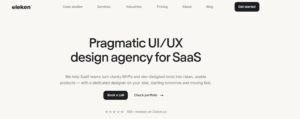
Website: eleken.co
Minimum Project Cost: $10,000
Client Rating: 4.85 (based on 153 reviews)
Team Size: 167 (LinkedIn)
Years in Business: 11
Monthly Website Visits: 31,690
Employee Review Score: 4.70 (based on 8 reviews)
Most SaaS products do not fail because a feature is missing. They fail because users cannot find the value that is already sitting inside the product. Eleken built its entire model around solving that specific failure mode.
The pricing structure is a monthly subscription. You get one dedicated designer assigned directly to your product, and you work with that person without a project manager sitting in the middle, without a lengthy scoping process, and without weeks of onboarding before real work starts. The Kyiv-based team stripped out every layer that typically slows early-stage design work down.
What makes the model hold up at scale is the vetting process behind it. Eleken hires from the top tier of UI/UX talent, runs every new designer through a three-month SaaS-focused internal program, and pairs each one with senior peer review on every project. The client experience is simple: one designer, but the quality infrastructure behind that one person is substantial.
Eleven years in, the team has shipped 200-plus SaaS products across healthcare, fintech, AI, geospatial analytics, and developer tools. These are not marketing sites. They are complex, regulated, data-dense products where the UX architecture directly shapes retention and conversion.
Core Services
- SaaS UI/UX Design and Product Redesign
- Design from Scratch (MVP)
- Team Extension (Dedicated Designer Model)
- UI/UX Audit
- Mobile App Design
- Design Systems and Consulting
Why They Rank #2
- 100% SaaS focus with more than 200 completed products spanning ten or more verticals
- A 4.85 client satisfaction rating across 153 reviews, among the strongest on this list
- The subscription model removes hiring overhead and the friction of negotiating a new scope for every project
- A short trial period before commitment lowers the risk of a bad first impression turning into a wasted month
- A $25 hourly rate delivers senior-level SaaS design capability well below typical US market pricing
- Direct designer access with no PM layer between the client and the work speeds up every iteration cycle
Snapshot of Client Reviews
The consistent theme is speed paired with quality, not one at the expense of the other. Clients across healthcare, fintech, and AI note modern output delivered faster than expected, with the only recurring critique being a wish for bolder creative direction; execution itself is never in question.
Our Take
Eleken fits the SaaS team stuck between a freelancer who might vanish mid-project and a full agency that overcomplicates a simple need. A complex product, a real budget, and a need for senior design embedded directly in your workflow rather than handed off in batches- this is the right call.
3. Superside – Best for Enterprise Marketing Teams That Need Always-On Creative Output Across Every Channel
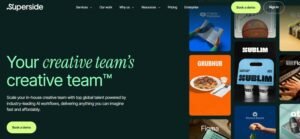
Website: superside.com
Minimum Project Cost: $1,000
Client Rating: 3.55 (based on 508 reviews)
Team Size: 1,027 (LinkedIn)
Years in Business: 11
Monthly Website Visits: 81,879
Employee Review Score: 3.05 (based on 382 reviews)
Superside is headquartered in Wilmington, Delaware, but the actual operation runs as a borderless creative machine. Talent spans thirteen time zones, covering every major region from North America through APAC, and new projects can kick off within thirty minutes of a request landing. That global footprint is not incidental; it is the entire reason always-on delivery is possible.
Like Eleken, the business model is a subscription. But where Eleken embeds one dedicated designer inside your SaaS product team, Superside gives enterprise marketing departments a modular creative bench. Branding, video, motion, ad creative, web design, presentations, and email all route through a single subscription and a single point of contact. Enterprise plans run from $15,000 to $100,000 per month.
The client roster looks different from most names on this list. Colgate-Palmolive, Microsoft, Reddit, Grubhub, Amazon, Wilson, and Pernod Ricard are all marketing teams that already employ in-house designers but need to extend output without adding headcount. Amazon’s team used the platform to deliver more than a thousand assets across twenty projects while saving roughly 345 hours of internal capacity. Those are volume and efficiency wins, not strategic redesign outcomes, and that distinction matters when you are deciding if this is the right fit.
AI runs through the workflow in a real, embedded way. Purpose-built agents handle briefing, brand consistency checks, and automation across the production pipeline, and a growing internal knowledge base means creative output gets sharper with every completed project instead of starting from a blank page each time.
Core Services
- Web Design and Landing Pages
- Ad Creative and Social Media Design
- Motion Design and Video Production
- Branding and Design Systems
- Presentation Design
- AI-Powered Creative and Consulting
- Copywriting and Campaign Strategy
Why They Rank #3
- Roughly 82,000 monthly web visits signal strong brand authority within the creative subscription category.
- More than a thousand LinkedIn-listed team members across thirteen time zones enable true round-the-clock delivery.
- A $1,000 minimum keeps the entry point accessible despite an otherwise enterprise-tier positioning.
- AI-first infrastructure drives meaningful efficiency gains on project turnaround according to internal reporting.
- Hundreds of enterprise clients, including Colgate-Palmolive, Microsoft, Reddit, and Amazon, validate operational scale.
- SOC-2 compliance with role-based access controls satisfies enterprise security review requirements
Snapshot of Client Reviews
Feedback splits fairly evenly across the review set. Organized workflows and responsive project managers earn praise from teams using the subscription as designed, while quoting inconsistencies and uneven output quality surface repeatedly among clients who push the model outside its core strengths.
Our Take
Superside behaves like an enterprise marketing utility rather than a dedicated SaaS web design partner. If your team already ships creative at high volume across many channels and wants AI-assisted output at scale, it delivers. For a focused, conversion-first SaaS website, other names on this list are a better starting point.
4. Gapsy Studio – Best for SaaS and Fintech Companies That Want Award-Winning Design Backed by Measurable Business Outcomes

Website: gapsystudio.com
Minimum Project Cost: $5,000
Client Rating: 4.95 (based on 66 reviews)
Team Size: 15 (LinkedIn)
Years in Business: 9
Monthly Website Visits: 1,565
Employee Review Score: 4.00 (based on 1 review)
Thirteen international design awards sit on Gapsy Studio’s shelf, including Awwwards, FWA, CSS Winner, Titan Awards, and Behance honors. For a boutique studio of under fifty people operating out of Ukraine and Poland, that concentration of recognition does not happen by accident.
The studio was built in Dnipro, Ukraine, with a registered office in Warsaw, Poland, a positioning that carries real weight in 2026. Eastern European design studios have spent the past decade closing the quality gap with Western agencies while holding onto meaningfully lower hourly rates, and Gapsy sits near the front of that trend.
Their vertical range covers fintech, SaaS, health, education, retail, and real estate, sectors where users arrive skeptical, trust signals carry weight, and confusing design directly drives churn. Strapi, the San Francisco-based headless CMS provider, brought Gapsy in specifically for animation work meant to communicate product value in the first few seconds of a visit. A US tech company trusting a Ukrainian studio with front-facing brand work says something about the quality signal the award count only hints at.
Web design makes up a large share of their total service focus, the deepest concentration on pure web design work of any agency profiled here. This is not a studio squeezing web projects between branding retainers and motion reels. It is close to the primary product.
Core Services
- Web Design and UI/UX Design
- SaaS Design
- Branding and Visual Identity
- Motion Design and Animation
- Web Development
- UX Audit and UX Research
- Mobile App Design
- AR/VR Design
Why They Rank #4
- A perfect 5.0 cost rating across 66 verified reviews, the highest possible score
- Thirteen-plus international design awards including Awwwards, FWA, CSS Winner, and Titan Awards
- Documented conversion improvements across multiple engagements, ranging roughly from 9% to 25% uplift
- The deepest web design service concentration of any agency in this comparison tier
- A $25 hourly rate with a $5,000 minimum makes this one of the more accessible studios given the quality on offer.
- Active across seven time zones with multilingual capability serving the US, EU, and Ukraine simultaneously
Snapshot of Client Reviews
Clients describe a team that leads with business questions before design questions ever come up. Proactivity, deadline discipline, and conversion-first thinking come up again and again, with more than one reviewer independently describing the engagement as treating the redesign like a business problem rather than a visual one.
Our Take
Gapsy is the right call for a fintech or SaaS founder who wants design that wins awards and moves conversion metrics, not one or the other. At $25 an hour with a $5,000 entry point, the value-to-quality ratio is hard to beat at this level of recognition.
5. Ofspace – Best for SaaS and Fintech Startups That Need Investor-Ready Design Without a Long-Term Agency Contract

Website: ofspace.co
Minimum Project Cost: $5,000
Client Rating: 4.85 (based on 48 reviews)
Team Size: 20 (LinkedIn)
Years in Business: 7
Monthly Website Visits: 6,128
Employee Review Score: 5.00 (based on 4 reviews)
Higlobe closed a $14M raise after Ofspace rebuilt its product. Loonio grew new user signups by 50%. Those two outcomes sit near the top of Ofspace’s own homepage, and the placement is deliberate. This is a studio that leads with what happens to your startup after launch, not with aesthetics.
Founded in 2019 and incorporated in Wilmington, Delaware, the go-to LLC hub for startups selling into the US, Ofspace runs a distributed team across the US, Canada, and Bangladesh. That structure enables close to round-the-clock coverage while keeping costs well below a fully US-based team. The founding group brings prior experience from GoDaddy, Augmedix, and Zomato, meaning the design instincts here come from people who have shipped inside fast-moving, user-heavy products before starting their own shop.
The agency concentrates on SaaS, fintech, healthtech, and AI startups specifically. That focus pays off especially in fintech, where a peer-to-peer lending platform in Bangkok, a wealthtech company in Singapore, and a payment product built for the US market all show up in their portfolio. Cluttered flows and weak onboarding kill conversions fast in regulated financial products, and their work shows a real understanding of the trust-signal architecture those products require.
What stands out most is what the operational model removes. No long-term contracts. First designs delivered within 48 hours. A free strategy call that ends with a specific product observation rather than a sales pitch. For a seed-stage founder who has already burned weeks on agency proposals that go nowhere, cutting that friction out entirely changes the calculus.
Core Services
- UI/UX Design and Product Design
- SaaS and Fintech Landing Page Design
- Branding and Visual Identity
- Mobile App Design
- Webflow Development
- Motion Design and Animation
- Pitch Deck Design
- Product Development (React, Angular, iOS, Android)
Why They Rank #5
- Documented startup outcomes: Higlobe raised $14M post-redesign, and Loonio saw a 50% lift in new user signups
- A 4.85 client satisfaction score across 48 reviews with a perfect 5.0 cost rating on Clutch
- Delivery of a first design within 48 hours removes the slow-start problem common with most agency engagements.
- A no-contract model reduces the commitment risk for early-stage founders still evaluating partners.
- Cross-industry depth across fintech, healthtech, and AI builds real fluency in trust-signal-heavy design work.
- A US, Canada, and Bangladesh team structure enables near round-the-clock coverage at below-market pricing.
Snapshot of Client Reviews
Founders consistently point to two things: speed and the ability to turn an abstract product idea into a clear, working interface. A wealthtech client in Singapore highlighted fast iteration cycles, and a real estate co-founder noted that deliverables arrived exactly as promised without needing to be chased.
Our Take
Ofspace is built for the pre-Series A window, when design needs to make the product fundable, and the team cannot afford a six-week agency onboarding process. Heading into a raise or trying to fix a leaking conversion funnel quickly, this is a strong entry point.
6. Cleveroad – Best for HealthTech, Fintech, and Logistics SaaS Companies That Need Certified Engineering Depth With Design Built In
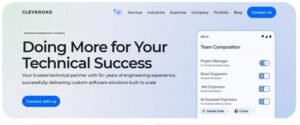
Website: cleveroad.com
Minimum Project Cost: $10,000
Client Rating: 4.97 (based on 86 reviews)
Team Size: 109 (LinkedIn)
Years in Business: 15
Monthly Website Visits: 6,011
Employee Review Score: 4.00 (based on 19 reviews)
Two ISO certifications and an AWS Select Partner badge do not typically show up on a design agency’s homepage. They show up on the homepage of a software engineering company that treats compliance as a business requirement, not a marketing bullet point.
Cleveroad has held ISO 9001 for quality management and ISO 27001 for information security simultaneously since long before those credentials became standard-issue in agency marketing. For SaaS companies operating in healthcare, fintech, or logistics, where data handling is a regulatory obligation rather than a preference, that certification stack becomes a genuine selection criterion rather than a nice-to-have.
Founded in Ukraine in 2011, Cleveroad now runs offices in Claymont, Delaware, and Oslo, Norway alongside development centers in Dnipro and Kharkiv. That spread is not just operational redundancy. The US entity handles client relationships and compliance conversations for regulated North American industries, while the Oslo office gives direct access to Nordic fintech clients operating under their own compliance framework of PSD2 and GDPR. The engineering depth itself sits in Ukraine, where more than 280 in-house engineers have spent fifteen years building complex products.
Their AI-assisted development layer is worth noting heading into 2026. AI-augmented code review catches defects before they reach production, and automated test generation delivers coverage depth that manual QA simply cannot match on the same budget.
Core Services
- Custom Software Development and Web Application Development
- UI/UX Design and Product Design
- AI Development, GenAI, and Agentic AI
- Mobile App Development (iOS, Android, Flutter, React Native)
- IT Staff Augmentation and Dedicated Development Teams
- PoC and MVP Development
- DevOps, Cloud, and AWS Infrastructure
- IT Consulting and CTO as a Service
Why They Rank #6
- A 4.97 client satisfaction score across 86 reviews, one of the highest ratings on this entire list
- Dual ISO 9001 and ISO 27001 certification meets compliance requirements common in healthcare and fintech verticals.
- AWS Select Partner status with multiple certified architects validates real cloud delivery capability
- AI-assisted development reports sprint velocity gains in the 30 to 40 percent range for client teams.
- Consecutive Clutch Top 1000 recognition from 2018 through 2025 signals sustained, repeatable performance.
- A $25 hourly rate with a $10,000 minimum puts certified enterprise-grade engineering within reach below typical US pricing
Snapshot of Client Reviews
The 4.97 rating across 86 reviews is the standout number here. Clients consistently mention proactive communication, clean project management, and a team that grasps business context rather than just executing a technical spec line by line.
Our Take
Cleveroad is the pick when compliance, security, and engineering rigor matter as much as visual output. HealthTech, fintech, or logistics SaaS teams that need certified partners rather than merely skilled ones will find the dual ISO stack difficult to match at this price point.
7. Bop Design – Best for B2B SaaS and Technology Companies That Need a Website Built Primarily to Generate Qualified Leads
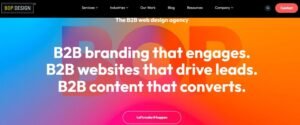
Website: bopdesign.com
Minimum Project Cost: $25,000
Client Rating: 4.73 (based on 136 reviews)
Team Size: 65 (LinkedIn)
Years in Business: 18
Monthly Website Visits: 3,474
Employee Review Score: 5.00 (based on 4 reviews)
Bop Design made a decision back in 2008 that most agencies still avoid today. It locked into one sector, B2B, and has not drifted from that lane across eighteen years. No consumer projects, no ecommerce work, no general retainers. Every framework and case study on their site orbits the same question: how do you turn a B2B website into a functioning lead generation engine?
That question looks different depending on the vertical. In fintech and insurtech, trust architecture and regulatory credibility shape nearly every page-level decision. In biotech and SaaS, the buyer committee is wider, and the sales cycle stretches longer, meaning the website has to carry more weight across multiple sessions before a prospect ever reaches out to sales. Bop has worked this problem across technology, fintech, biotech, software, AI, industrial, engineering, consulting, and energy, a breadth within the B2B lane that separates them from agencies claiming sector expertise off the back of two or three projects.
Their San Diego base carries its own market context. Southern California’s B2B tech ecosystem looks nothing like Silicon Valley or the New York corridor. It skews toward mid-market companies, defense-adjacent technology, and biotech, sectors where conservative visual language still consistently outperforms aggressive design trends. Bop’s aesthetic sensibility reflects that environment directly, polished and strategic rather than flashy. They have since expanded into Orange County, Los Angeles, and New York, giving them credible reach into the East Coast enterprise buyer base as well.
Worth noting separately, Bop is a woman-owned business. In 2026, that fact signals more than optics; it points to a deliberately built culture and a boutique model that stayed selective instead of scaling purely for scale’s sake.
Core Services
- B2B Website Design and Development
- UI/UX Web Design
- WordPress Web Design
- Branding and Brand Identity
- Content Marketing and SEO
- Copywriting and Blog Content
- Email Marketing and Paid Search
- GEO (Generative Engine Optimization)
Why They Rank #7
- Eighteen years of exclusively B2B design and marketing, the deepest single-sector specialization on this list
- Documented lead-generation results, including a 168% increase in contact form submissions for one client and 84 average monthly leads for another
- A 4.73 client satisfaction score across 136 reviews reflects consistent performance at real scale.
- A perfect 5.0 employee satisfaction score, unusual at this team size and tenure
- Industry recognition from Clutch and Newsweek validates long-term operational credibility.
- Four US office locations covering both coasts without relying on offshore execution risk
Snapshot of Client Reviews
Clients describe a team that behaves like an internal marketing department rather than an outside vendor. Comments about improved lead flow appear across multiple independent reviews, with a recurring sentiment that Bop treats client growth as a shared outcome rather than a checklist deliverable.
Our Take
Bop Design is purpose-built for one type of buyer: a B2B SaaS or tech company that needs a website driving pipeline, not chasing design awards. At a $25,000 minimum and $150 hourly rate, you are paying US agency rates for genuine US market expertise, worth it if lead generation is the metric that matters most.
8. Saffron Edge – Best for B2B SaaS Companies That Need SEO and Web Design to Work as One Integrated Growth System

Website: saffronedge.com
Minimum Project Cost: $1,000
Client Rating: 4.58 (based on 105 reviews)
Team Size: 27 (LinkedIn)
Years in Business: 18
Monthly Website Visits: 3,458
Employee Review Score: 4.90 (based on 14 reviews)
Most agencies split web design and SEO into separate service lines run by separate teams on separate timelines. Saffron Edge does not operate that way. The design work and the organic strategy get built together from the outset, and that integration solves a problem most clients do not even realize they have until well after launch.
The agency started in 2008 as a software and app development firm before rebranding toward growth marketing, shifting digital strategy and performance into the core of the offering rather than treating them as an add-on to code. Eighteen years of relationships across more than 2,500 brands shaped that pivot, and the underlying instinct proved right: design without a distribution plan behind it is a liability.
Fairfield, New Jersey, is not an accidental headquarters choice. Sitting inside the New York metro corridor puts Saffron Edge close to one of the densest concentrations of B2B SaaS, pharmaceutical, manufacturing, and professional services companies in the country. That market demands partners who understand regulated industries, long sales cycles, and multi-stakeholder buying committees, all areas where their coverage across healthcare, SaaS, and supply chain has been tested against real client engagements repeatedly.
Their growth framework centers on what they call growth loops rather than traditional funnels. The reasoning is straightforward: funnels leak customers at every stage until only a fraction convert and fewer still stick around. Growth loops instead turn satisfied customers into acquisition channels through referral mechanics, content loops, and product-led virality. For early-stage SaaS companies trying to lower acquisition costs without simply scaling paid spend, that framework carries real weight.
Core Services
- SEO and AI SEO Services
- Web Design and Web Development
- Account-Based Marketing (ABM)
- Conversion Rate Optimization (CRO)
- Marketing Automation
- Paid Media and PPC
- Content Marketing and Social Media
- Marketing Analytics and Dashboard
Why They Rank #8
- Eighteen years of continuous operation with more than 2,500 clients across B2B SaaS, healthcare, manufacturing, and supply chain
- Documented SEO outcomes including 522% organic traffic growth and 15x year-over-year growth for one client
- A 4.90 employee satisfaction score across 14 reviews signals a stable, engaged internal team.
- A $1,000 minimum project cost is the lowest entry point of any full-service agency covered here.
- A build-operate-transfer model allows clients to eventually own the marketing infrastructure Saffron builds for them.
- An NJ/NYC metro base gives direct access to US enterprise buyers in regulated and complex sectors.
Snapshot of Client Reviews
Clients consistently highlight deep understanding of their mission before execution ever begins. Responsiveness and transparent monthly reporting come up repeatedly as the primary reasons clients renew year over year.
Our Take
Saffron Edge suits the SaaS team tired of choosing between a separate SEO agency and a separate design agency. Pipeline growth through organic search as the primary goal, with a tight budget, the low entry point and the integrated approach make this a pragmatic first engagement.
9. Qubstudio – Best for SaaS, Fintech, and HRTech Products That Need Research-Driven UX to Reduce User Friction at Scale

Website: qubstudio.com
Minimum Project Cost: $10,000
Client Rating: 4.87 (based on 138 reviews)
Team Size: 57 (LinkedIn)
Years in Business: 20
Monthly Website Visits: 3,539
Employee Review Score: 4.50 (based on 6 reviews)
Two addresses tell the Qubstudio story quickly. The first sits on Shevchenka Street in Lviv, Ukraine, one of Eastern Europe’s most productive design and engineering talent pools, where a twenty-year-old agency has built deep institutional processes. The second sits at Level39 in Canary Wharf, London, the address where Europe’s most prominent fintech startups and scaleups actually work and hire. That combination is deliberate. Qubstudio does not just serve the fintech market from a distance; it has physically positioned itself inside it.
Their 100% UX/UI design focus is worth pausing on. Every other agency profiled here offers design as one piece of a broader service stack. Qubstudio does not. No development retainers, no SEO bundles, no motion reel add-ons. The entire organization exists around one discipline executed at real depth, and that kind of singular focus tends to produce genuinely refined research, iteration, and handoff processes after two decades of practice.
Their fintech track record runs deep. A VP at a South Carolina fintech company reported that Qubstudio’s platform redesign outperformed earlier iterations by roughly five times. A visual design audit for a fintech company serving banks in Athens, Greece, helped the client quickly identify design improvements and boost visual consistency. These are mid-market and enterprise fintech clients carrying real compliance and UX complexity, not early-stage experiments.
Outside fintech, the reach holds up just as well. An AI technology company based in Sweden brought Qubstudio in for a full UX/UI engagement that improved user engagement and sped up design iteration cycles. A construction software company from Espoo, Finland used the studio for a full rebrand and website revamp that strengthened market differentiation, notable given how demanding Nordic buyers tend to be on usability and clarity.
A workforce management engagement in Atlanta stands out separately. The resulting design was intuitive enough that users navigated the new interface without significant training, a hard result in enterprise SaaS where onboarding friction directly drives churn.
Core Services
- UX/UI Design and Digital Product Design
- Web Design and Web Development
- Branding and Visual Identity
- UX Research and Usability Testing
- Product Design Strategy
- Design Systems
- UX Audit
Why They Rank #9
- Twenty years in operation with a 100% UX/UI design focus, the most concentrated design specialization on this list
- A 4.87 client rating across 138 reviews spanning fintech, HRTech, AI, construction software, and workforce management
- A London presence at Level39 Canary Wharf positions the team directly inside Europe’s most active fintech ecosystem.
- A documented outcome where one fintech client’s redesigned platform outperformed earlier iterations by roughly five times
- An engagement with a Swedish AI company produced measurable gains in user engagement and iteration speed.
- Structured package pricing creates an accessible, clearly defined entry point for early-stage clients.
Snapshot of Client Reviews
A problem-solving approach comes up as the defining trait across the review set. Clients across fintech, HRTech, and AI verticals consistently note that Qubstudio engages with business context first, treating the design brief as a starting point rather than the whole assignment.
Our Take
Qubstudio is the choice when UX research needs to drive every design decision rather than decorate it after the fact. Fintech and enterprise SaaS teams with complex product flows, multi-persona interfaces, or legacy redesigns will find twenty years of pure design discipline here, not a generalist stretched thin.
10. Merge Rocks – Best for SaaS, Fintech, and Web3 Startups Going From Seed to Series A That Need Design to Drive Their Next Funding Round

Website: merge.rocks
Minimum Project Cost: $10,000
Client Rating: 4.90 (based on 67 reviews)
Team Size: 37 (LinkedIn)
Years in Business: 8
Monthly Website Visits: 909
Employee Review Score: 5.00 (based on 3 reviews)
Merge Rocks was started by its founder at twenty years old, and that origin matters less as a novelty and more as a signal about the kind of agency it became. It was never built as a traditional creative shop. It was built by someone who grew up inside the startup world and understood firsthand what founders actually need from a design partner.
The stated mission is direct: help startups move from angel and seed stage into Series A and beyond. The design work here functions as a fundraising tool, a conversion instrument, and a growth lever, often all three at once inside a single engagement.
Their vertical range is unusual for a team this size. Most agencies pick one lane. Merge Rocks operates seriously across B2B SaaS, fintech, AI, and Web3. The Web3 practice in particular is rare. Building usable interfaces for crypto exchanges, trading platforms, and wallets requires a completely different UX grammar than a standard SaaS product, and confusing transaction flows in that space do not just hurt conversions; they destroy the user trust the entire product depends on.
The team stays remote-first and deliberately small, roughly thirty designers, developers, and product strategists spread across time zones but organized around structured delivery processes. Webflow is their front-end platform of choice for marketing sites, giving SaaS clients the ability to manage and update their own site without developer dependency after handoff.
Their client geography shows how far a thirty-person remote team can reach: a media production company in New York, an equity broker in Cyprus, a medical tourism platform in the UK, a fintech company in the UAE, and a software company in San Francisco have all worked with the team, reflecting comfort operating across very different regulatory environments and buyer cultures at once.
Core Services
- UX/UI Design and Product Design
- Web Design and Webflow Development
- Branding and Visual Identity
- Product UX Discovery
- MVP Design and Development
- Design Sprints
- Motion Design
- Pitch Deck Design
- Web3 and Fintech Design
Why They Rank #10
- Operates credibly across four distinct verticals, SaaS, fintech, AI, and Web3, with documented work in each
- Webflow Professional Partner status signals genuine technical depth beyond a simple design handoff.
- A client profile spanning seed-stage startups through enterprise clients shows range without sacrificing quality at either end.
- A remote-first structure enables delivery across the US, UK, Middle East, EU, and Asia-Pacific without friction.
- A founder-led culture built around design that converts and increases product value, not aesthetics for their own sake
- Design sprint capability allows rapid iteration cycles for founders working against tight funding timelines.
Snapshot of Client Reviews
Responsiveness under tight deadlines is the thread running through the review set. A B2B SaaS client in Seattle noted that requested changes were understood and resolved in a single iteration, and a fintech client in the UAE described the team as proactive and genuinely open to exploring new directions.
Our Take
Merge Rocks suits the growth-stage founder who needs design to close the next funding round, not just refresh a brand. Between seed and Series A with a SaaS, fintech, or Web3 product and a team that thinks in business outcomes, this is where to start.
11. Halo Lab – Best for Global Startups and SMBs That Need Premium Design and Development Without Choosing Between Them

Website: halo-lab.com
Minimum Project Cost: $10,000
Client Rating: 4.75 (based on 135 reviews)
Team Size: 144 (LinkedIn)
Years in Business: 13
Monthly Website Visits: 4,023
Employee Review Score: 4.50 (based on 8 reviews)
Dubai is an unusual headquarters choice for a design and development agency. It is not a design capital in the traditional sense; it is a logistics capital, built to sit between Europe, Asia, and the Middle East and move things between them efficiently. That geographic logic extends directly into how Halo Lab operates, with registered presences across more than twenty locations globally and a client list spanning Austria, Sweden, Ireland, Portugal, the US, and India. Dubai anchors their global reach rather than centering it.
Founded in 2013 around a deliberate positioning: design-driven development, not design handed off to a separate team afterward, and not development with design bolted on as an afterthought. Both disciplines sit inside the same team, working from the same brief, closing the gap where most projects lose quality and time: the translation between what got designed in Figma and what actually ships to production.
Their industry reach is genuinely wide: a neuro-therapy company in Austria, a physician-first career platform in Nashville, a mobile phlebotomy company in Brooklyn, a real estate developer in Dublin, a relocation platform in Lisbon, and a charity foundation in Atlanta. These are entirely different markets with different visual languages and trust requirements, and Halo Lab has navigated all of them well enough to maintain long-term relationships with each.
The fundraising outcomes tied to their portfolio are worth understanding in context. Their clients have collectively raised well over half a billion dollars in funding, with one raising millions in early-stage capital and another closing a large Series B shortly after launch, outcomes that happen when design does real strategic work rather than pure decoration.
Webflow Pro Partner status grounds all of this at the execution level, meaning SaaS and startup clients get a site their marketing team can edit and expand without developer dependency, a form of operational autonomy worth as much as the design quality itself for a fast-moving company shipping new features regularly.
Core Services
- Web Design and UI/UX Design
- Web Development and CMS Development
- Webflow Development
- Mobile App Design and Development
- Branding and Rebranding
- Software Development and MVP Development
- Cloud App Development
- AI Chatbot Development and ChatGPT Integration
- Pitch Deck Design
Why They Rank #11
- Full-service design and development under one roof eliminates the handoff quality gap common in multi-vendor engagements.
- Webflow Pro Partner status gives SaaS clients post-launch editorial independence without developer dependency.
- A client portfolio spanning healthcare, real estate, SaaS, education, and transportation with documented outcomes in each
- A global footprint across more than twenty locations enables timezone-aligned delivery across Europe, the US, and Asia-Pacific.
- A Dubai headquarters creates natural reach into the Gulf region’s fast-growing tech ecosystem, a market few Western agencies serve credibly.
Snapshot of Client Reviews
A physician-first platform founder in Nashville said the site Halo Lab built put a months-old startup years ahead of competitors on brand credibility alone. That sentence captures the recurring theme across reviews: clients consistently describe outcomes that feel disproportionate to the original brief.
Our Take
Halo Lab earns its place when the scope spans design and development simultaneously, and the team cannot afford the friction of managing two separate vendors. Healthcare, real estate tech, and early-stage SaaS companies with global ambitions get the most from this engagement model.
12. Musemind Agency – Best for SaaS & Fintech Companies That Need a Design Partner With Multi-Market Reach Across the US, Europe, & the Middle East
Website: musemind.agency
Minimum Project Cost: $10,000
Client Rating: 4.53 (based on 73 reviews)
Team Size: 105 (LinkedIn)
Years in Business: 5
Monthly Website Visits: 7,281
Employee Review Score: 4.60 (based on 16 reviews)
Five years old with six offices, that growth rate reflects a deliberate map of where digital product investment is concentrating in 2026: New York, Dubai, Berlin, London, Riyadh, and Dhaka. Each location represents a distinct market with its own buyer culture, regulatory environment, and design expectations.
Dubai functions as the strategic center of gravity. The Gulf region is midway through the largest government digitization push in the world, and Saudi Arabia’s national development plan has driven public sector investment in digital services at a scale few Western markets can match. Musemind’s Riyadh presence reflects genuine capability to navigate Gulf design requirements, Arabic-language UX, and government procurement processes, not a token market entry.
A government-scale engagement with a religious pilgrimage management authority is worth understanding in context. Designing for that kind of scale means building interfaces that handle millions of simultaneous users across dozens of countries, multiple languages, varying literacy levels, and generations of mobile hardware- one of the highest-stakes UX challenges in global technology, and Musemind delivered it.
The founding team is Bangladeshi, with the Dhaka office serving as the execution engine behind the global client list. Bangladesh has emerged as a significant design and software talent market, and the country’s tech export sector has grown quickly, producing experienced product teams serving US and European clients at competitive rates. Their Western footprint rounds things out, with offices in New York, Berlin, and London anchoring enterprise and European relationships. A telecommunications company in New York brought them in to redesign sixteen sites across its brand portfolio, a scope that requires serious organizational process, not just design talent.
Core Services
- UI/UX Design and Product Design
- Web Design and Web Development
- SaaS Design
- Branding and Brand Identity
- Webflow Design and Development
- MVP Development
- Mobile App Design
- UI/UX Consulting and UX Research
Why They Rank #12
- Six-office global infrastructure spanning the US, Europe, the Gulf, and South Asia enables genuine multi-market delivery.
- A government-scale UX engagement demonstrates a level of capability few design agencies can credibly claim
- Enterprise clients on the verified roster signal procurement clearance and consistent quality thresholds
- A dedicated SaaS design practice with named specialists on staff, not a generalist team rebranded for the niche.
- Fintech-specific depth across the Middle East and Western markets positions them well for cross-border fintech products.
- Accessible package pricing creates entry points below the standard project minimum for smaller SaaS clients.
Snapshot of Client Reviews
A CEO who had sixteen brand sites redesigned across his portfolio said he could not be happier with the results, and a fintech CEO in Riyadh described the relationship as one that grew steadily more positive over time. Both outcomes, scale and market specificity, are difficult to find inside a single agency.
Our Take
Musemind is built for the SaaS or fintech company that needs design to work equally well in Riyadh and New York. A product roadmap that includes Gulf region expansion, or a need for a partner who has already navigated Middle East government UX, makes this a hard agency to match at this price tier.
13. ArtVersion – Best for Enterprise Brands, Established SaaS Companies, and Nonprofits That Need Design Credibility, Not Just a Portfolio

Website: artversion.com
Minimum Project Cost: $10,000
Client Rating: 4.80 (based on 69 reviews)
Team Size: 33 (LinkedIn)
Years in Business: 27
Monthly Website Visits: 3,600
Review Score: 4.60 (based on 11 reviews)
ArtVersion launched in Chicago in 1999, before Figma existed, before responsive design was even a concept, before UX carried its own job title. Twenty-seven years in the same city, building the same core capability- design that communicates with clarity- is a different kind of credential than award counts or headcount growth.
Chicago’s creative economy is not Silicon Valley or Manhattan. It runs on manufacturing, finance, architecture, logistics, and professional services, and the brands anchoring the city buy design because they need to communicate complex value propositions to sophisticated buyers. Aesthetic sensibility alone does not win those accounts; strategic clarity does, and ArtVersion has operated inside that environment for over two decades in a way that shows in how they approach communication before visual style.
Their Fortune 500 client list is not marketing copy. Verified engagements with organizations across consumer goods, finance, luxury goods, and industrial manufacturing carry procurement processes and brand governance standards most design agencies cannot navigate. Sustaining that tier of relationship for years, while staying under fifty people across two Chicago offices, reflects a level of institutional trust that cannot be manufactured through marketing spend.
Their media presence adds another credibility layer few agencies on this list can match. Leadership perspectives have appeared in major national business publications, earned coverage rather than sponsored placement, and that kind of editorial interest only comes from operating long enough, and at a high enough quality, to matter to publications covering business design and brand strategy.
The SaaS-specific work is genuine despite not being the agency’s primary positioning. A cloud-based SaaS company in Chicago brought ArtVersion in for a full web redesign and brand refresh, and the outcome earned the client multiple external design and usability awards. A technology consultancy in India chose the team for a WordPress build, noting an exceptional grasp of existing brand standards alongside a genuinely user-friendly interface.
Core Services
- Web Design and Development
- UI/UX Design and Digital Experience
- Branding and Visual Identity
- Graphic Design and Art Direction
- Market and UX Research
- Brand and Design Strategy
- WordPress, HubSpot, Drupal, Shopify Development
Why They Rank #13
- Recognized as a top-ranked design agency on Clutch in consecutive years, the only agency on this list with that back-to-back status
- Featured across major national business and design publications, signaling sustained thought leadership rather than one-off project coverage
- A client roster spanning Fortune 500 organizations confirms enterprise procurement compliance and consistent quality.
- Chicago’s B2B-heavy economy has shaped a design philosophy built around functional clarity over trend-chasing aesthetics.
- Multiple industry award nominations and wins reflect consistent recognition across both strategy and execution.
Snapshot of Client Reviews
A Chicago-based architecture firm noted that the website ArtVersion delivered put them on par with competitors twice their size, and a luxury fashion CEO described an approach that set the brand apart from category norms. Both comments- credibility and distinction- capture what clients consistently walk away with.
Our Take
ArtVersion belongs on the shortlist when brand credibility and enterprise-grade execution matter as much as the design itself. Twenty-seven years is not just tenure; it is institutional knowledge, best suited to established SaaS companies, enterprise brands, or nonprofits that need a partner able to hold its own in a boardroom.
14. Akveo – Best for AI-First SaaS and Tech Startups That Need Engineering Depth and UX Thinking in the Same Team

Website: akveo.com
Minimum Project Cost: $10,000
Client Rating: 4.75 (based on 29 reviews)
Team Size: 91 (LinkedIn)
Years in Business: 11
Monthly Website Visits: 1,858
Employee Review Score: 4.70 (based on 25 reviews)
Akveo started in 2015 and chose Austin, Texas, as its North American anchor, a choice that signals something about who they sell to. Austin is not Silicon Valley; its buyer base runs on serious engineering credibility, cost discipline, and real product delivery rather than hype cycles, and the agency has built exactly that kind of reputation across healthcare, insurance, fintech, and logistics SaaS markets.
The headline service is AI-powered digital product development, but the design capability underneath that positioning is genuinely applied rather than bolted on. Their open-source design system has earned real community traction on GitHub, and an agency that contributes a production-grade design system back to the open-source community is not treating design as an afterthought; they want engineers outside their own walls actually using it.
Office structure maps directly to where clients sit. Warsaw and Vilnius anchor European delivery, serving enterprise clients across the continent, while Austin handles North American relationships. That dual-market infrastructure means Akveo can staff teams in European time zones while maintaining a US point of contact, which matters when the client is a healthcare operator in Chicago or a fintech company in Zurich simultaneously.
One engagement illustrates what the design-and-engineering integration produces in practice: a HIPAA-compliant, offline-first SaaS platform built for opioid crisis response teams. Compliance requirements at that level sit among the most stringent in US healthcare, and the technical constraint of offline-first operation in the field adds a UX layer that requires system architecture and interface design to be solved together. Generic design agencies do not take on projects like that; engineering organizations with embedded UX capability do.
Core Services
- AI Software Development and AI Integration
- UX/UI Design and Web Design
- Application and Web Development
- Webflow Development and Low-Code Development
- Mobile Development
- Cloud Consulting and DevOps
- Quality Assurance and Testing
- Big Data Development
- Startup Development and MVP
Why They Rank #14
- An open-source design system demonstrates engineering-grade UI capability validated by external developer adoption.
- HIPAA-compliant SaaS delivery proves regulated industry readiness beyond what most design agencies can claim.
- European offices in Warsaw and Vilnius enable timezone-aligned collaboration for EU enterprise clients without subcontracting.
- AI-first positioning is backed by published methodologies and documented client outcomes rather than marketing language.
- An Austin, Texas base serves the US mid-market tech sector at rates well below coastal agency equivalents.
- Enterprise consulting partnerships validate procurement compliance and consistent quality thresholds.
Snapshot of Client Reviews
Responsiveness and a quality mindset that stands apart from typical outsourcing vendors come up consistently across reviews. One client specifically called out how the team thinks rather than just what they deliver, with cost-effectiveness relative to US domestic developers noted as a recurring practical advantage.
Our Take
Akveo earns its place when a SaaS product requires AI integration, regulated industry compliance, or complex backend architecture alongside design. Not a purely visual design studio, but a technical product partner where design serves engineering goals, a strong fit for healthcare SaaS, fintech, and AI-enabled product teams with serious technical requirements.
15. Insivia – Best for B2B SaaS Companies That Need a Consultancy-First Partner to Rebuild Their Revenue Engine Around AI-Influenced Buyers
Website: insivia.com
Minimum Project Cost: $5,000
Client Rating: 4.83 (based on 28 reviews)
Team Size: 19 (LinkedIn)
Years in Business: 24
Monthly Website Visits: 526
Employee Review Score: 3.00 (based on 17 reviews)
Insivia’s founder started the company in Cleveland, Ohio, in 2002 at twenty-two, armed with a self-taught programming background, a business degree, and a laptop. Over two decades later, the agency has evolved into something most design and marketing firms never become: a genuine consultancy built around a proprietary framework, published books, and AI products organized around a single thesis: buyers have fundamentally changed, and the companies that win are the ones building around buyer psychology rather than internal assumptions.
That is not just a positioning line; the founder has written on the subject directly, addressing how AI has reshaped purchasing decisions before a buyer ever speaks to a salesperson, and providing an operational framework to act on it. These are not ghostwritten thought leadership pieces; they represent the intellectual foundation the agency runs on, and they explain why Insivia approaches web design as a conversion architecture problem before it becomes a visual one.
Cleveland is a telling origin point. Ohio’s mid-market B2B economy- manufacturing, healthcare technology, logistics, professional services- rewards practical outcomes over creative prestige, and Insivia built inside that environment for years before evolving into a fully remote agency, a deliberate decision framed around better team productivity, talent access, and client flexibility. The team now spans Ohio, Pennsylvania, Texas, and Nevada, distributed across time zones with full-time staff in each.
The AI layer separating Insivia from other names on this list is structural, not cosmetic. One proprietary platform creates a virtual clone of an ideal customer for teams to brainstorm with and test messaging against, while another audits website performance, AI brand presence, and competitor positioning simultaneously- real proprietary tools rather than off-the-shelf AI wrappers rebranded as agency capabilities.
Web design accounts for roughly a quarter of their total service focus, sitting alongside marketing strategy, business consulting, and conversion optimization. That balance is intentional: a SaaS company with a weak positioning strategy will not be saved by a better homepage. Insivia fixes the strategy problem first, then builds the digital experience around the corrected narrative. One SaaS client saw its conversion rate more than double after a redesign built this way, and another saw a significant jump in lead-to-opportunity conversion because the site was built around a buyer journey rather than a feature list.
Core Services
- Web Design and Development
- Buyer Intelligence and Market Research
- Brand Strategy and Positioning
- Answer Engine Optimization (AEO)
- Account-Based Marketing
- AI Sales Roadmap and Implementation
- Interactive Sales Experiences
- Conversion Rate Optimization
- Digital Experience Design
Why They Rank #15
- Named a top strategic consultancy and marketing agency for 2026 by an independent industry ranking body
- Two published books on buyer psychology and AI-influenced buying behavior signal intellectual depth beyond service delivery.
- Proprietary AI platforms give clients capabilities not available through any other agency on this list.
- An Answer Engine Optimization practice addresses AI search visibility, a capability gap most web design agencies are not yet equipped to fill.
- Documented SaaS-specific outcomes in conversion performance across multiple B2B clients
- A remote-first team structure enables timezone-flexible delivery across US time zones without offshore handoff risk.
Snapshot of Client Reviews
Genuine investment is the consistent theme across reviews. Clients repeatedly describe never feeling like anything other than a priority, with more than one noting the team never rushed the process or did the bare minimum to close out a scope.
Our Take
Insivia is not a design agency that also offers strategy; it is a strategy consultancy that happens to build websites. That distinction matters enormously for the right buyer, a B2B SaaS founder who knows the product is solid, but the revenue engine is leaking. If the problem sits upstream of design, start here.
16. Codica – Best for SaaS and Marketplace Startups That Need a Product-Minded Team From MVP Through Post-Launch Iteration

Website: codica.com
Minimum Project Cost: $10,000
Client Rating: 4.90 (based on 42 reviews)
Team Size: 190+ (LinkedIn)
Years in Business: 10
Monthly Website Visits: 2,340
Employee Review Score: 4.60 (based on 12 reviews)
Codica built its reputation on marketplace and SaaS platforms that need to work correctly the first time a real user touches them, not a portfolio of static brochure sites. Operating out of Kharkiv, Ukraine, the team has spent a decade sitting at the intersection of two-sided marketplace logic and standard SaaS product design, a combination that shows up constantly in fintech, logistics, and on-demand service platforms.
What separates Codica from a typical MVP shop is the emphasis on staying involved after launch. Founders repeatedly bring them back for iteration rounds once real usage data starts arriving, rather than treating the initial build as the finish line. That post-launch relationship matters most for marketplace products, where supply-and-demand balance only reveals itself once live transactions start flowing, and design decisions frequently need revisiting within the first few months.
Their vertical range covers travel booking platforms, logistics marketplaces, and subscription SaaS tools, each requiring a different mental model for how a two-sided or B2B interface should guide a user toward a transaction. A founder building a marketplace needs an agency that understands liquidity problems, not just visual hierarchy, and Codica’s portfolio reflects that understanding directly in how onboarding flows and trust signals are structured for both sides of a transaction.
Core Services
- SaaS and Marketplace Web Design
- MVP Development and Product Discovery
- UI/UX Design and Prototyping
- Web Application Development
- E-commerce and Marketplace Development
- Post-Launch Product Iteration
Why They Rank #16
- A decade of focused marketplace and SaaS product work gives them a specific fluency most generalist shops lack.
- A 4.90 client rating across 42 reviews reflects consistent satisfaction at a mid-size delivery scale.
- Deep two-sided marketplace UX experience addresses a design problem most agencies never encounter
- Post-launch iteration relationships extend well beyond a typical one-and-done project handoff.
- A $10,000 minimum keeps a genuinely experienced marketplace-focused team within reach for growth-stage founders.
Snapshot of Client Reviews
Clients highlight a team that asks pointed questions about the business model before touching a wireframe, particularly around how a marketplace intends to reach liquidity. Reviewers also note strong follow-through on post-launch requests, a detail that stands out given how often agencies disappear after go-live.
Our Take
Codica fits a SaaS or marketplace founder who needs a team that understands two-sided platform dynamics, not just interface design, and who wants a partner willing to stay engaged well past launch day as real usage data starts shaping the product.
17. Fireart Studio – Best for SaaS Companies That Need Brand Identity and Product Design Delivered by the Same Team

Website: fireart.studio
Minimum Project Cost: $10,000
Client Rating: 4.85 (based on 31 reviews)
Team Size: 90+ (LinkedIn) Years in Business: 12
Monthly Website Visits: 1,910
Employee Review Score: 4.70 (based on 9 reviews)
Fireart Studio built its practice around a specific gap most SaaS founders discover too late: a strong brand identity and a strong product interface are usually built by two different teams that never talk to each other, and the result is a homepage that looks nothing like the actual product a trial user lands in a few clicks later.
Incorporated in Wilmington, Delaware, with delivery teams distributed globally, Fireart runs branding and product UI/UX work through the same designers on a given account, which keeps visual language consistent from the marketing site all the way through the in-app experience. For SaaS companies where the disconnect between a polished landing page and a rough product interface actively erodes trial-to-paid conversion, that continuity solves a real problem rather than a cosmetic one.
Their portfolio spans fintech dashboards, healthtech platforms, and AI-driven SaaS tools, sectors where a confusing visual identity shift between the marketing funnel and the product itself creates hesitation at exactly the moment a user needs confidence. Clients consistently note that the team treats brand guidelines as a living system that extends into the product, not a static PDF handed off after a logo project wraps.
Core Services
- Brand Identity and Visual Design
- SaaS UI/UX Design
- Web Design and Development
- Product Design Systems
- Motion Design and Illustration
- Mobile App Design
Why They Rank #17
- A single team handling both brand identity and product UI closes the consistency gap most SaaS companies never notice until it costs them conversions.
- A 4.85 client rating across 31 reviews reflects strong satisfaction at a boutique-to-mid delivery scale.
- Design systems built to extend from marketing site through in-app experience reduce rework across future feature launches.
- Cross-vertical fintech and healthtech experience demonstrates comfort with trust-sensitive visual design decisions.
- Global delivery structure keeps pricing competitive relative to fully US-based branding studios.
Snapshot of Client Reviews
Reviewers repeatedly point to visual consistency as the standout result, specifically the fact that the product interface finally looks like it belongs to the same company as the marketing site. Responsiveness during revision rounds also comes up as a consistent strength.
Our Take
Fireart Studio is the right call for a SaaS company that has outgrown a mismatched brand-and-product visual identity and wants one team accountable for both, rather than managing a branding agency and a product design shop as two separate vendors.
18. Uzum Digital – Best for Early-Stage SaaS Founders Who Need a Landing Page That Validates Product-Market Fit Before a Full Build
Website: uzumdigital.com
Minimum Project Cost: $3,000
Client Rating: 4.80 (based on 18 reviews)
Team Size: 14 (LinkedIn)
Years in Business: 6
Monthly Website Visits: 640
Employee Review Score: 4.50 (based on 4 reviews)
Uzum Digital built a niche around a problem most agencies never take seriously: a pre-seed founder who does not yet know if the product idea is worth building at all, and needs a landing page fast enough and cheap enough to actually test that question with real ad spend before committing engineering budget to a full product.
Based in Austin, Texas, with a lean team of under twenty, the agency has structured its entire process around speed and validation rather than polish for its own sake. A typical engagement produces a conversion-focused landing page within one to two weeks, built specifically to run paid traffic against and measure signup intent before a single line of product code gets written. That sequencing- validate first, build second- saves founders from the common mistake of spending six figures on a full SaaS build before confirming anyone actually wants it.
Their client base skews heavily toward first-time founders and small teams testing a new SaaS concept, often people who have never worked with an agency before and need a partner that explains the process in plain terms rather than jargon-heavy strategy decks. The $3,000 minimum, the lowest on this list among agencies with verified SaaS-specific experience, reflects that positioning directly.
Core Services
- Landing Page Design and Development
- MVP Validation Pages
- Conversion Rate Optimization
- Basic Brand Identity
- Waitlist and Pre-Launch Campaign Pages
- A/B Testing Setup
Why They Rank #18
- The lowest verified minimum project cost on this list among agencies with real SaaS experience
- A one-to-two-week turnaround on validation-focused landing pages fits the urgency of pre-seed testing windows.
- A 4.80 client rating across 18 reviews reflects strong satisfaction given the accessible price point.
- A validate-before-you-build philosophy protects early founders from over-investing before product-market fit is confirmed.
- Plain-language communication style suits first-time founders unfamiliar with typical agency processes.
Snapshot of Client Reviews
First-time founders consistently mention feeling talked to rather than talked at, a meaningful distinction for people navigating an agency relationship for the first time. Reviewers also highlight speed, with more than one noting a live, testable page within a week of kickoff.
Our Take
Uzum Digital fits the founder who needs to answer one question: does anyone want this, before spending real money on a full product build. It is not the agency for a funded Series A team, but for a pre-seed validation sprint, the speed and price point are hard to match.
19. Netguru – Best for Mid-Market and Enterprise SaaS Companies That Need Design Paired With Long-Term Product Engineering Support

Website: netguru.com
Minimum Project Cost: $50,000
Client Rating: 4.60 (based on 92 reviews)
Team Size: 700+ (LinkedIn)
Years in Business: 16
Monthly Website Visits: 24,150
Employee Review Score: 4.30 (based on 210 reviews)
Netguru occupies a similar space to Andersenlab in this list, a large, engineering-heavy organization where design sits inside a broader product development capability rather than functioning as a standalone service. Based in Poznań, Poland, with additional offices across Europe and the US, the scale of the team, several hundred people, puts it firmly in the mid-market-to-enterprise engagement tier.
What distinguishes Netguru from a pure design shop is the ability to carry a SaaS product from initial design through years of ongoing engineering support without a vendor transition. Clients frequently start with a redesign engagement and stay on for continuous feature development, meaning the team that designed the interface understands the technical constraints behind every subsequent product decision because they are the same people building it.
Their client roster leans toward established SaaS companies and mid-market enterprises rather than early-stage startups, a natural fit given the $50,000 minimum project cost. Fintech, healthtech, and productivity SaaS products all appear regularly in their portfolio, sectors where the long-term engineering relationship matters as much as the initial visual redesign, since these products change constantly in response to regulatory shifts and competitive pressure.
Core Services
- Web and Product Design
- Custom Software Development
- AI and Machine Learning Integration
- Cloud and DevOps Consulting
- Product Discovery and Strategy
- Dedicated Development Teams
Why They Rank #19
- Several hundred team members across European and US offices provide serious delivery capacity for large-scale engagements.
- A 4.60 client rating across 92 reviews demonstrates consistency at significant scale.
- Combined design-and-engineering delivery removes vendor transition risk for long-term SaaS product roadmaps.
- Sixteen years of operating history across fintech, healthtech, and productivity SaaS builds real vertical fluency.
- Strong web authority with over 24,000 monthly visits signals broad market recognition and inbound demand.
Snapshot of Client Reviews
Clients consistently highlight the ability to scale a team up or down as product priorities shift, without losing institutional knowledge of the product along the way. Long-term account continuity is a recurring theme, with several reviewers noting multi-year relationships that started as a single redesign project.
Our Take
Netguru fits an established SaaS company or mid-market enterprise that wants a single long-term partner for both design and ongoing engineering, rather than a project-based agency relationship that ends at launch. Not the right fit for a pre-seed budget, but a strong option once the product and the budget have matured.
20. Inspirry – Best for B2B SaaS Companies That Need a Website Rebuild Focused Specifically on Demo Request Conversion
Website: inspirry.com
Minimum Project Cost: $5,000
Client Rating: 4.80 (based on 22 reviews)
Team Size: 45 (LinkedIn)
Years in Business: 8
Monthly Website Visits: 780
Employee Review Score: 4.60 (based on 6 reviews)
Inspirry positions itself as a narrow specialist inside a crowded field, a team built specifically around one conversion event: the B2B SaaS demo request. Operating out of Ternopil, Ukraine, the agency has structured its entire discovery process around identifying exactly where a prospect stalls out before booking a call with sales, then rebuilding the site architecture around removing that friction point.
Where Bop Design approaches lead generation from a broader B2B marketing strategy angle, Inspirry works at the tactical execution layer: form field reduction, calendar embed placement, social proof sequencing directly above a demo CTA, and page load speed optimization specifically on the pages that carry the highest exit rates. That narrower focus means the engagement scope is typically smaller and faster than a full brand-and-website rebuild, appealing to SaaS teams that already have working messaging but a leaking conversion funnel.
Their client base skews toward Series A and Series B B2B SaaS companies that have already validated product-market fit and are now optimizing the revenue engine rather than searching for it. Multiple engagements have centered specifically on rebuilding a demo request flow that had stalled out after an earlier, less conversion-focused redesign.
Core Services
- Conversion-Focused Web Design
- Demo Request Flow Optimization
- Landing Page Design and A/B Testing
- UX Audits for Existing SaaS Sites
- Form and CTA Optimization
- Webflow Development
Why They Rank #20
- A tightly scoped specialization in demo request conversion addresses a specific, measurable revenue bottleneck.
- A 4.80 client rating across 22 reviews reflects strong satisfaction within a focused service niche.
- A $5,000 minimum makes targeted conversion optimization accessible without a full site rebuild budget.
- Series A and B client focus demonstrates a track record with companies past the earliest validation stage.
- UX audit-first engagement model identifies specific friction points before recommending any redesign work.
Snapshot of Client Reviews
Reviewers consistently cite measurable before-and-after conversion numbers as the standout result, a detail less common across broader-scope design agencies where outcomes are harder to isolate. Clients also note a refreshingly narrow, no-scope-creep engagement style.
Our Take
Inspirry fits a B2B SaaS company with solid product-market fit and existing traffic that simply is not converting into demo requests at the rate it should. It is not the agency for a ground-up brand rebuild, but for fixing a specific, well-defined conversion leak, the focused approach pays off.
21. Purrweb – Best for Early-Stage SaaS and Marketplace Startups That Need Fast MVP Design on a Fixed Budget
Website: purrweb.com;
Minimum Project Cost: $10,000;
Client Rating: 4.85 (based on 58 reviews);
Team Size: 120+ (LinkedIn);
Years in Business: 8;
Monthly Website Visits: 3,120;
Employee Review Score: 4.60 (based on 15 reviews)
Purrweb built its reputation on a fixed-price, fixed-timeline MVP model, a structure that appeals directly to founders who need budget certainty more than they need open-ended creative exploration. Operating out of Limassol, Cyprus, with a larger delivery team than many boutique competitors, the agency has completed a high volume of MVP engagements across SaaS, marketplace, and on-demand service categories.
The fixed-scope approach works because Purrweb has standardized much of the discovery and wireframing process around common SaaS product patterns, dashboards, onboarding flows, and subscription billing screens, without pretending every product needs a fully custom design exploration from a blank page. For a founder racing toward a specific fundraising deadline or a launch date tied to a marketing campaign, that predictability in both cost and timeline often matters more than a fully bespoke visual identity.
Their portfolio shows consistent work across fintech MVPs, on-demand service marketplaces, and early-stage SaaS dashboards, categories where the underlying UX patterns are well understood and a fixed-price model does not sacrifice much in the way of genuine product differentiation. Clients repeatedly cite the clarity of the fixed quote as the deciding factor in choosing Purrweb over a time-and-materials competitor.
Core Services
- Fixed-Price MVP Design and Development
- SaaS Dashboard Design
- Marketplace and On-Demand App Design
- UI/UX Design Sprints
- Mobile App Design
- Discovery and Scoping Workshops
Why They Rank #21
- A fixed-price, fixed-timeline model gives budget-constrained early-stage founders cost certainty a time-and-materials agency cannot offer
- A 4.85 client rating across 58 reviews reflects consistently strong satisfaction at high engagement volume.
- A larger team size than most boutique MVP shops enables parallel workstreams without extending timelines.
- Standardized SaaS UX patterns speed up discovery without meaningfully sacrificing product differentiation.
- Broad category experience across fintech, marketplace, and on-demand SaaS builds pattern-recognition value for founders.
Snapshot of Client Reviews
Clients consistently highlight the predictability of the fixed-price model as the primary reason for choosing Purrweb, with several noting that the final invoice matched the original quote exactly. Speed of delivery on standard SaaS product patterns is the other recurring theme.
Our Take
Purrweb fits the early-stage SaaS or marketplace founder who needs an MVP shipped on a fixed budget and a fixed timeline, without the scope uncertainty that comes with a fully custom design engagement. Not the pick for a company chasing a highly differentiated visual identity, but a strong option when budget certainty is the priority.
What Makes a SaaS Web Design Agency Different
A web design agency builds websites. A SaaS website design agency builds conversion systems. That difference shows up directly in your pipeline numbers, not in your portfolio screenshots.
Generic agencies design pages. SaaS agencies design flows.
A SaaS homepage has to speak to a procurement manager, a technical evaluator, and an end user at the same time, often within the same scroll. Generic agencies rarely architect for that reality. SaaS specialists build the page structure around it from the first wireframe.
Pricing pages make the gap obvious fastest. Tier logic, feature comparison tables, and the choice between monthly and annual billing all directly move conversion numbers. A generalist agency treats a pricing page like any other content page. A SaaS specialist treats it as the single most important page on the site.
The GTM motion shapes the entire build.
Product-led companies push visitors toward a self-serve trial with minimal friction. Sales-led companies push visitors toward a demo request that qualifies the lead before a human ever gets involved. Each model demands a different site architecture, a different CTA hierarchy, and different trust signal placement throughout the funnel.
A SaaS-focused agency asks which motion you run on the very first discovery call. A generalist agency rarely thinks to ask the question at all.
Design and SEO have to work together.
The strongest SaaS websites rank well and convert well at the same time, and one rarely happens without the other. Real SaaS SEO depends on fast load times, mobile-first execution, and a content structure that search engines can actually parse and understand.
A site that looks impressive but ranks for nothing becomes a long-term liability rather than an asset. Whichever partner you choose needs to understand both sides of that equation from the very first strategy conversation.
UI/UX depth is what separates good from great.
SaaS products sell outcomes rather than objects: productivity gains, cost reduction, risk mitigation. None of those benefits are inherently visual, which means the design job is to translate something abstract into something a visitor can immediately grasp.
Agencies that do this well build feature narratives through scroll-based storytelling and interactive product demos embedded directly in the page. The ones that fall short hand you a folder of static screenshots and call the job finished.
How to Choose a SaaS Website Design Agency
The agency market is loud, and every studio claims SaaS expertise somewhere on its homepage. Most are generalists who completed one or two SaaS projects and updated their positioning accordingly afterward. These six criteria cut through that noise quickly.
1. Check the portfolio for SaaS-specific work
Screenshots alone tell you very little. Ask for actual results instead. What was the conversion rate before the redesign, and what changed measurably after launch? Agencies with genuine SaaS experience answer that question immediately and specifically.
If an agency cannot point to a measurable outcome, treat that as a clear signal to keep looking elsewhere.
2. Ask how they handle SEO
A beautifully designed SaaS site still has to be found by the people searching for it. Ask directly whether the agency builds with page speed, structured content, and crawlability considered from the start. An agency that folds proper SEO practice into the build itself saves you months of fixing technical debt after launch.
Design and discoverability need to be solved together from day one, not addressed in sequence after the fact.
3. Understand their approach to long-term growth
A new website marks a starting point, not aF finish line. The agencies worth hiring think well past the launch date, factoring in content architecture, authority building, and a genuine link-earning strategy as part of a broader growth plan rather than treating the site as a single, static deliverable.
Ask directly what the plan looks like six months after the site goes live.
4. Match the agency to your funding stage
A seed-stage SaaS website and a Series B SaaS website are fundamentally different projects. Budget, scope, and ambition shift meaningfully at every funding stage. Hiring an enterprise-focused agency at the pre-seed stage usually means paying for overhead the business does not yet need.
Be honest about where the company actually stands before the first discovery call.
5. Clarify who owns the site after launch
Most post-launch regrets start here. Your own team will need to update copy, add new landing pages, and ship new feature sections regularly. Ask specifically what CMS the agency builds on and whether marketing can make edits without pulling in a developer for every small change.
If the answer sounds complicated during the sales process, that complexity will not improve after signing.
6. Evaluate communication before you sign anything
Responsiveness during the sales process is a direct preview of what the actual engagement will feel like. Slow replies, vague proposals, and fuzzy timelines are not simply first-impression nerves; they are an accurate forecast.
The strongest agencies communicate in a way that is direct, specific, and fast, well before any money changes hands.
What Are the Common Mistakes When Hiring a SaaS Web Design Agency
Most SaaS founders regret their agency choice roughly six months after launch, not six minutes after signing the contract. The problems that lead there are almost always predictable, and they show up repeatedly across the list below.
1. Letting the Price Tag Drive the Decision
SaaS website design costs swing enormously. A freelancer might quote $5,000, a boutique SaaS agency might land around $30,000, and a top-tier brand studio might charge well over $100,000. None of those figures on their own tell you anything about what the finished site will actually do for your pipeline.
The right question is never what the website costs upfront. It is what a genuinely higher-converting site is worth to the business every month afterward. A $40,000 site that doubles a demo request rate pays for itself faster than an $8,000 site that looks clean but converts almost nobody.
2. Hiring a Generalist for a Specialist Problem
A general web design agency can absolutely build a professional-looking site. A SaaS specialist knows specifically how to build a pricing page that converts, a trial CTA hierarchy tuned for product-led growth, and a feature narrative that makes abstract product value feel concrete.
These are genuinely different skill sets. Most generalist agencies have never once asked a client which go-to-market motion they run. Most SaaS specialists ask that question before the first design call even happens. That single question gap is exactly where a meaningful chunk of conversion rate lives.
3. Skipping the Discovery Phase to Save Money
Discovery phases feel like an easy cost to cut under funding pressure. They feel considerably more expensive six months later, once the site is live and the messaging turns out to be built entirely around product features rather than the buyer’s actual problems.
A properly run discovery phase forces real clarity on ideal customer profile, buyer objections, and conversion architecture before a single wireframe gets drawn. Agencies that jump straight to design software are saving time in the short term while quietly costing pipeline over the long term.
4. Treating the Website as a One-Time Deliverable
SaaS products ship new features constantly, pricing structures shift, target personas evolve, and case studies accumulate month over month. A website that cannot keep pace with that rate of change becomes a liability within months of the original launch.
Before signing with any agency, ask specifically who updates the site after go-live and whether the marketing team can edit it directly without needing a developer for routine changes. If the answer sounds complicated, the site will go stale, and a stale SaaS website actively erodes credibility with the skeptical, research-heavy buyers this industry consistently attracts.
5. Over-Investing at the Wrong Stage
A seed-stage SaaS company spending $150,000 on a full brand redesign is almost always making a strategic mistake. At that stage, the ideal customer profile is still being validated, the messaging will inevitably shift, and the product itself may still pivot. What the site needs at that point is speed, clarity, and easy updatability, not award-worthy polish.
Stage fit should drive agency selection more than any other single factor. A boutique SaaS agency in the $20,000 to $50,000 range is usually the right call for seed and Series A companies. Enterprise brand studios with six-figure minimums exist for a reason; they serve companies whose market position is already established and whose brand investment compounds meaningfully over years.
6. Ignoring What Happens When Traffic Arrives
Plenty of SaaS companies invest heavily in design while ignoring the conversion layer entirely. The site looks polished, the copy reads sharp, but the trial signup form has twelve required fields, the pricing page has no annual billing toggle, and the demo request form takes four full minutes to complete.
Design without conversion architecture is decoration dressed up as strategy. Before briefing any agency, define the primary conversion goal clearly- free trial, demo request, or pricing page click-through- and confirm the agency has genuinely optimized for that specific outcome rather than simply built something that looks good while doing it.
7. Choosing Based on Aesthetic Portfolio Instead of Outcome Data
Behance screenshots and design award nominations are easy for any agency to collect. Documented conversion improvements are considerably harder to produce. Most agencies will show exactly what their work looks like. Very few can tell you what actually happened to a client’s pipeline after the site went live.
Ask every agency on a shortlist for at least one case study that includes real before-and-after conversion metrics. If none can produce one, the underlying design process is likely aesthetic-first rather than outcome-first, and in SaaS specifically, that distinction has a direct effect on monthly pipeline numbers.
8. Underestimating the Cost of Tech Stack Mismatch
An agency that builds in fully custom code when the internal marketing team actually needs a no-code platform creates a dependency problem that costs real money every single time a headline needs updating. The reverse is equally true: a no-code-only agency cannot help once personalization at scale or a headless CMS integration becomes necessary.
Always confirm an agency’s default tech stack before signing, then confirm directly that the internal marketing team can operate it independently after handoff. The ongoing cost of developer dependency on a marketing site never shows up in the original project quote, but it shows up in every sprint that follows.
9. Neglecting Accessibility and Compliance Requirements
SaaS companies selling into healthcare, financial services, government, or education frequently discover post-launch that the new site fails standard accessibility guidelines or creates compliance exposure under disability access requirements. This is not a minor technical footnote; it becomes a procurement blocker in regulated industries and a genuine legal liability in the US market.
Ask specifically whether an agency builds to recognized accessibility standards by default. In verticals like healthtech and fintech, accessibility is not a nice-to-have; it is frequently a hard sales requirement. Agencies that never raise the topic during discovery are almost certainly not building for it during execution.
10. Not Asking How the Agency Handles Scope Changes
SaaS company priorities shift constantly. A new competitor launches mid-project, messaging changes after a round of customer interviews, or the homepage suddenly needs a new section after a strategic pivot. How an agency handles these moments largely determines whether a project finishes on time or quietly bleeds through the budget.
Ask to see a sample scope-change process before signing anything. Agencies that handle change requests with clear communication, fast turnaround estimates, and genuinely flexible workflows are operating like real partners. Agencies that treat every single change as a fresh renegotiation are optimizing for their own margin, not the client’s outcome.
Frequently Asked Questions
How long does it typically take a SaaS web design agency to complete a full redesign?
Most full SaaS redesigns take six to twelve weeks depending on scope, page count, and how many rounds of stakeholder review are built into the process. MVP-focused agencies can move faster.
Is it worth hiring a SaaS-specialist agency instead of a general web design firm?
Yes, if conversion is the primary goal. Specialists already understand pricing page logic, GTM motion, and trial CTA hierarchy, which shortens the learning curve a generalist agency would otherwise need.
How much should a SaaS company budget for a website redesign?
Budgets range from roughly $5,000 for a lean MVP-stage build to well over $100,000 for enterprise-grade engagements. Stage fit matters more than the raw number when setting a realistic budget.
Should SEO be part of the same engagement as web design, or handled separately?
Ideally, the same engagement, or at minimum the same strategic plan. Sites built without SEO considerations from the start often need expensive technical rework once organic traffic becomes a priority.
What is the biggest red flag when evaluating a SaaS web design agency?
An inability to produce a case study with real before-and-after conversion numbers. A strong-looking portfolio without outcome data usually signals an aesthetic-first process rather than a conversion-first one.
Final Thoughts
No single agency on this list is the right fit for every SaaS company. The right choice depends on your product stage, your conversion goals, and how much strategic input you actually need versus pure execution capacity.
What this list gives you is a starting point built on real, independently verified data rather than vendor marketing copy. Use the How to Choose framework above to pressure-test any agency before committing. Ask for case studies with real numbers attached. Ask exactly who will work on your project day-to-day. Ask how SEO fits into the build process from the start.
We run White Label SEO Service, and while web design sits outside our core focus, we work daily with SaaS companies on the organic visibility side of the equation once the site is live. If you are unsure whether your current site is actually built to rank as well as it converts, we are happy to take an honest look and tell you what we find.
Methodology: How We Ranked the Top SaaS Web Design Agencies in 2026
Our goal was straightforward: build a ranking that reflects real-world agency performance rather than paid placements, editorial relationships, or subjective opinion. Every agency on this list earned its position through the same scoring framework applied consistently across all forty-five entries.
Research Scope
We evaluated agencies that explicitly serve the SaaS market with web design as a documented service offering. Our research team collected and analyzed all data independently in 2026. No agency was contacted for input on its own score.
Data Sources
Each data point came from a verifiable external source.
- SEMrush for monthly website traffic estimates
- Clutch, DesignRush, G2, Google Business Profile, and Trustpilot for client satisfaction ratings and total review counts
- Glassdoor and Indeed for employee satisfaction scores and review volume
- LinkedIn for associated member headcount as a proxy for team scale
- Agency websites for service focus, hourly rates, minimum project size, and years in business
Scoring Dimensions and Weights
Each agency was scored across five categories that together add up to a composite score out of 100.
- Service Focus and Value Assessment – 20%
This category measures how central web design is to the agency’s overall offering, and how clients rate the value received relative to cost.
| Metric | Weight | Method |
| Web Design Services Focus | 10% | Degree to which web design is a primary service |
| Client Rating for Cost (1–5) | 10% | Average cost rating from Clutch, G2, and DesignRush |
- Brand Authority – 45%
This is the largest category, reflecting how established, visible, and operationally credible an agency is within the market.
| Metric | Weight | Method |
| Monthly Website Traffic | 20% | Higher traffic signals stronger organic authority |
| LinkedIn Team Size | 15% | Indicates scale and delivery capacity |
| Years in Business | 10% | Rewards longevity and accumulated expertise |
- Client Satisfaction – 30%
Client outcomes carry significant weight. We evaluated both the quality and the volume of feedback to ensure consistency rather than isolated excellence.
| Metric | Weight | Method |
| Average Client Rating (1–5) | 15% | Aggregate from Clutch, G2, and DesignRush |
| Total Number of Client Reviews | 15% | Higher volume reduces statistical noise |
- Employee Satisfaction – 25%
Agencies with strong internal culture tend to produce better work and retain the people who build client relationships. This category rewards operational stability.
| Metric | Weight | Method |
| Average Employee Rating (1–5) | 10% | Aggregate from Glassdoor and Indeed |
| Number of Employee Reviews | 15% | Ensures scores are statistically meaningful |
- Cost Accessibility – Penalty of 20%
To ensure the ranking reflects accessibility alongside quality, we applied a modest penalty for higher pricing tiers. Agencies with high hourly rates or large minimum project requirements received deductions, rewarding agencies that deliver quality without excluding early-stage SaaS buyers.
| Metric | Weight | Method |
| Estimated Hourly Rate | -10% | Higher rates received proportional deductions |
| Minimum Project Cost | -10% | Higher entry thresholds were lightly penalized |
Final Score Calculation
Each metric was normalized across all evaluated agencies before weighting was applied. Normalization ensures that an outlier in one metric, an agency with unusually high web traffic, for example, does not distort the comparative score unfairly.
Once normalized, each metric was multiplied by its assigned weight, and the weighted values were summed to produce a final score out of 100 for each agency, with the cost penalty subtracted last.
This approach allows fair comparison across agencies of very different sizes, pricing structures, and service models. A boutique studio with exceptional client satisfaction and low minimum costs can outrank a much larger agency with strong brand authority but weaker review scores and higher pricing barriers.
No agency paid for inclusion or a higher ranking in this guide. All rankings and scores are based solely on publicly available data collected at the time of publication, and while individual metrics may shift over time, the evaluation framework prioritizes long-term capability signals, making major ranking fluctuations unlikely.