
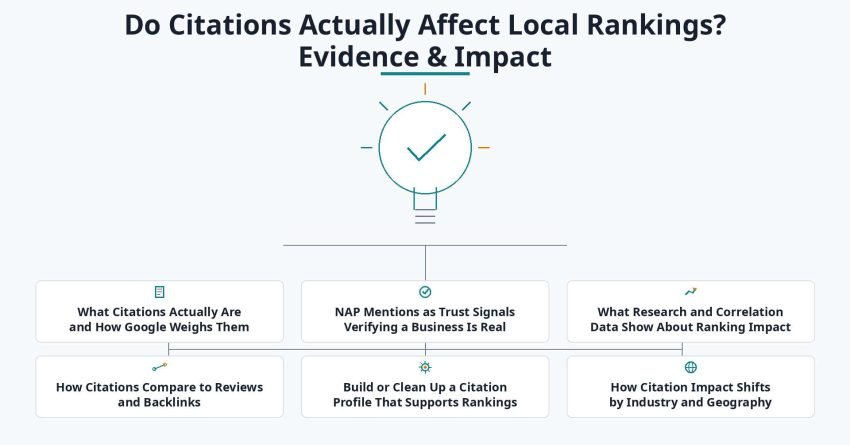
Citations are one of the most debated ranking factors in local SEO, and I get asked constantly whether they still matter. A local citation is any online mention of a business’s name, address, and phone number (NAP) on a directory, website, or platform, and it functions as a trust signal search engines use to verify a business is real. I’ve watched this debate shift over the past few years, and the honest answer is more nuanced than a simple yes or no.
Getting this wrong wastes budget on citation building that delivers nothing. Getting it right means understanding exactly where citations sit in the ranking equation.
This guide covers what citations actually are and how Google weighs them, what the research and correlation data show about their ranking impact, how they compare to reviews and backlinks, and how to build or clean up a citation profile that actually supports rankings. We’ll also look at how citation impact shifts by industry and geography.
What Local Citations Are and Why They Exist
A local citation is a web-based mention of a business’s name, address, and phone number, and it exists to help search engines verify that a business operates at a specific location. These mentions appear on directories, review sites, social platforms, and industry-specific listings, and each one acts as a small data point confirming the business is legitimate.
NAP Consistency as the Foundation
NAP consistency means a business’s name, address, and phone number appear identically across every citation source. Search engines cross-reference these mentions, and mismatched formatting across directories can create confusion about which version of the business information is accurate.
Structured vs. Unstructured Citations
Structured citations appear in a clear format on dedicated directory listing pages, while unstructured citations show up inside articles, blog posts, or news mentions without a formal listing structure. Both types contribute to the overall trust signal, though structured citations are easier for search engines to parse automatically.
Do Citations Actually Affect Local Rankings? The Direct Evidence
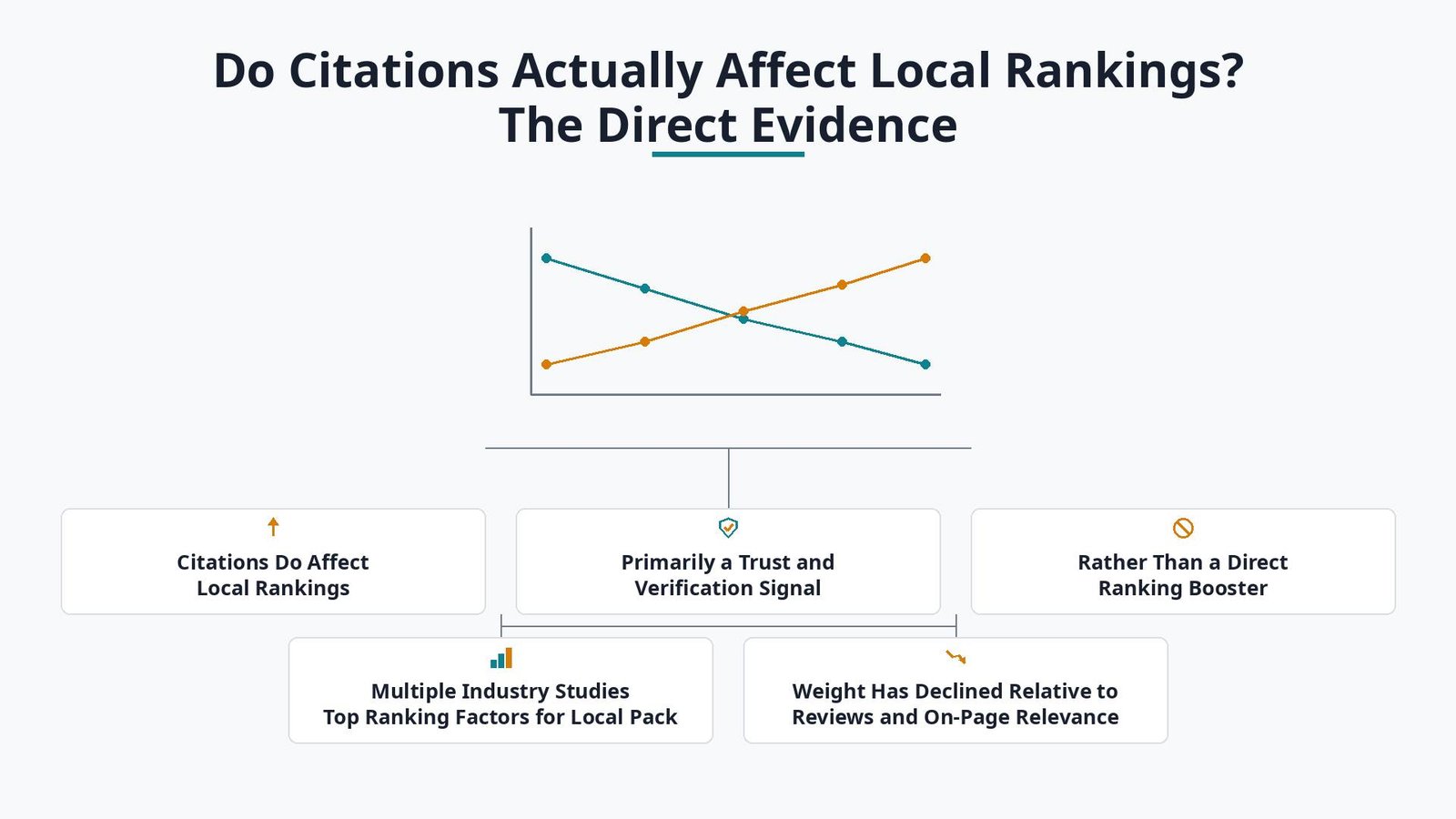
Citations do affect local rankings, but primarily as a trust and verification signal rather than a direct ranking booster. Multiple industry studies place citation signals in the top ranking factor categories for local pack visibility, though their weight has declined relative to reviews and on-page relevance signals over the past several years.
What Local SEO Ranking Studies Show
The Local Search Ranking Factors study from Whitespark has consistently placed citation signals among the top categories influencing map pack rankings, alongside Google Business Profile signals and on-page factors. Citation consistency specifically correlates with higher local pack appearance rates in businesses with otherwise comparable profiles.
Google’s Own Statements on Citations
Google has never explicitly confirmed citation count as a standalone ranking factor, and company representatives have repeatedly emphasized relevance, distance, and prominence as the three pillars of local ranking. Prominence, however, draws partly from information found across the web, which is where citations contribute indirectly rather than as a named algorithmic input.
How Citations Fit Into Google’s Local Ranking Algorithm
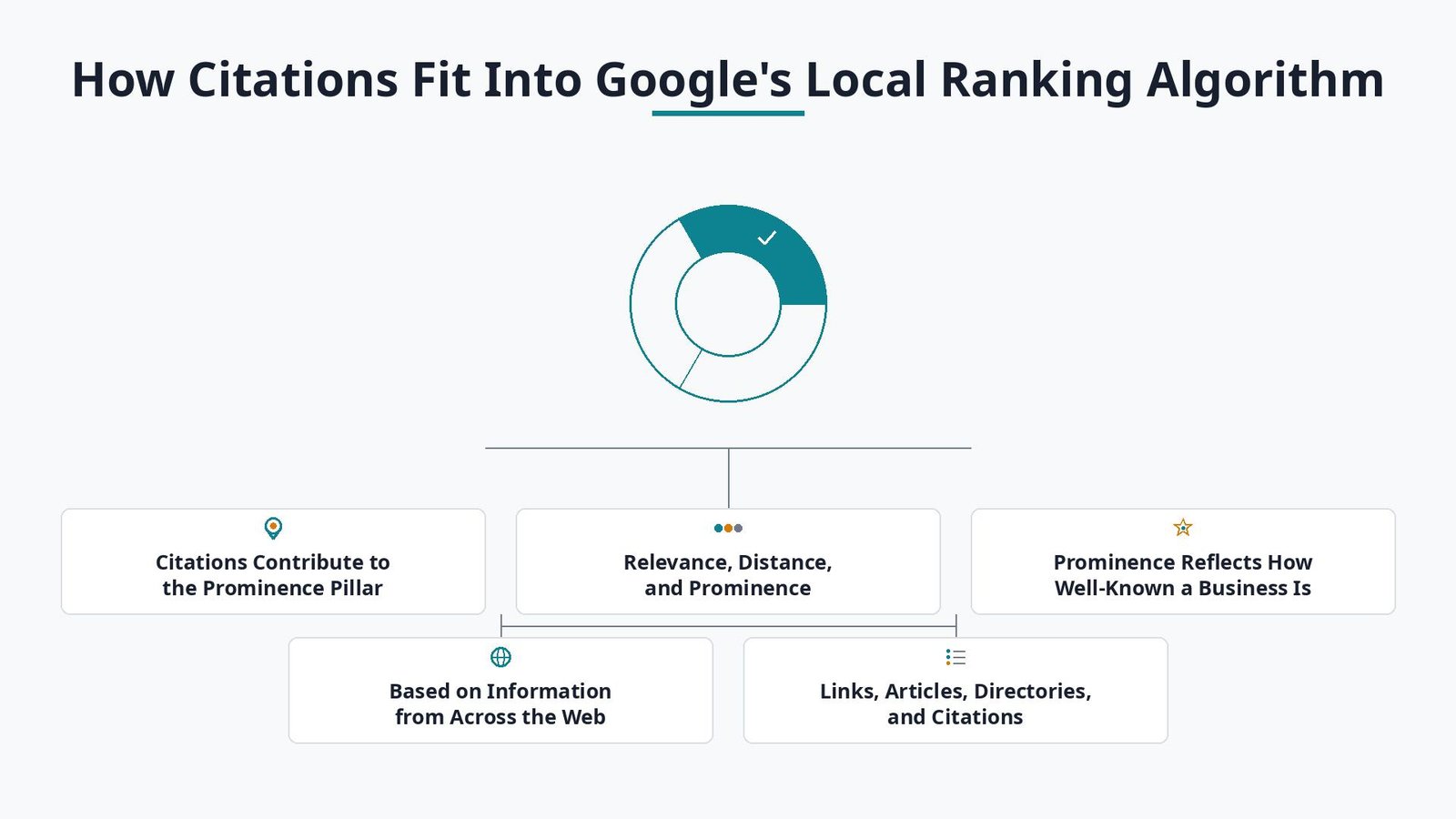
Citations contribute to the prominence pillar of Google’s three-factor local ranking system: relevance, distance, and prominence. Prominence reflects how well-known a business is based on information from across the web, including links, articles, directories, and citations.
Relevance, Distance, and Prominence
Relevance measures how well a business profile matches a search query, distance measures proximity between the searcher and the business location, and prominence measures overall business reputation signals. Citations feed almost exclusively into prominence, which means they matter more when relevance and distance are already well optimized.
Where Citation Signals Sit in Prominence
Prominence draws from review volume, review quality, backlink profile strength, and citation consistency, and no single input dominates this pillar on its own. A business with strong citation consistency but weak reviews will still struggle against a competitor with fewer citations but stronger overall prominence signals.
NAP Consistency and Its Measurable Impact on Trust Signals
Inconsistent NAP information across citation sources creates measurable confusion for search engines trying to verify a business’s identity. When a business name appears as “Smith Plumbing LLC” on one directory and “Smith Plumbing Inc.” on another, search engines have to work harder to confirm these refer to the same entity, which weakens the overall trust signal that citations are meant to provide.
Citation Volume vs. Citation Quality: Which Matters More
Citation quality matters more than raw citation volume for local ranking impact. A handful of citations on high-authority, industry-relevant directories outweighs dozens of listings on low-quality, spammy directories that carry little trust with search engines.
Why Volume Alone Doesn’t Move Rankings
Businesses that chase citation count across hundreds of low-value directories often see no ranking movement at all, because search engines weight citation sources based on the directory’s own authority and relevance. A data aggregator listing like those feeding Google, Bing, and Apple Maps carries more weight than a generic, low-traffic directory with no editorial standards.
Why Quality Compounds Over Time
High-quality citations on established, niche-relevant platforms tend to stay accurate longer and get crawled more frequently, which keeps the trust signal fresh. This compounding effect is why a smaller number of well-chosen citations consistently outperforms a large volume of low-value ones in prominence contribution.
The Most Influential Citation Sources for US Businesses
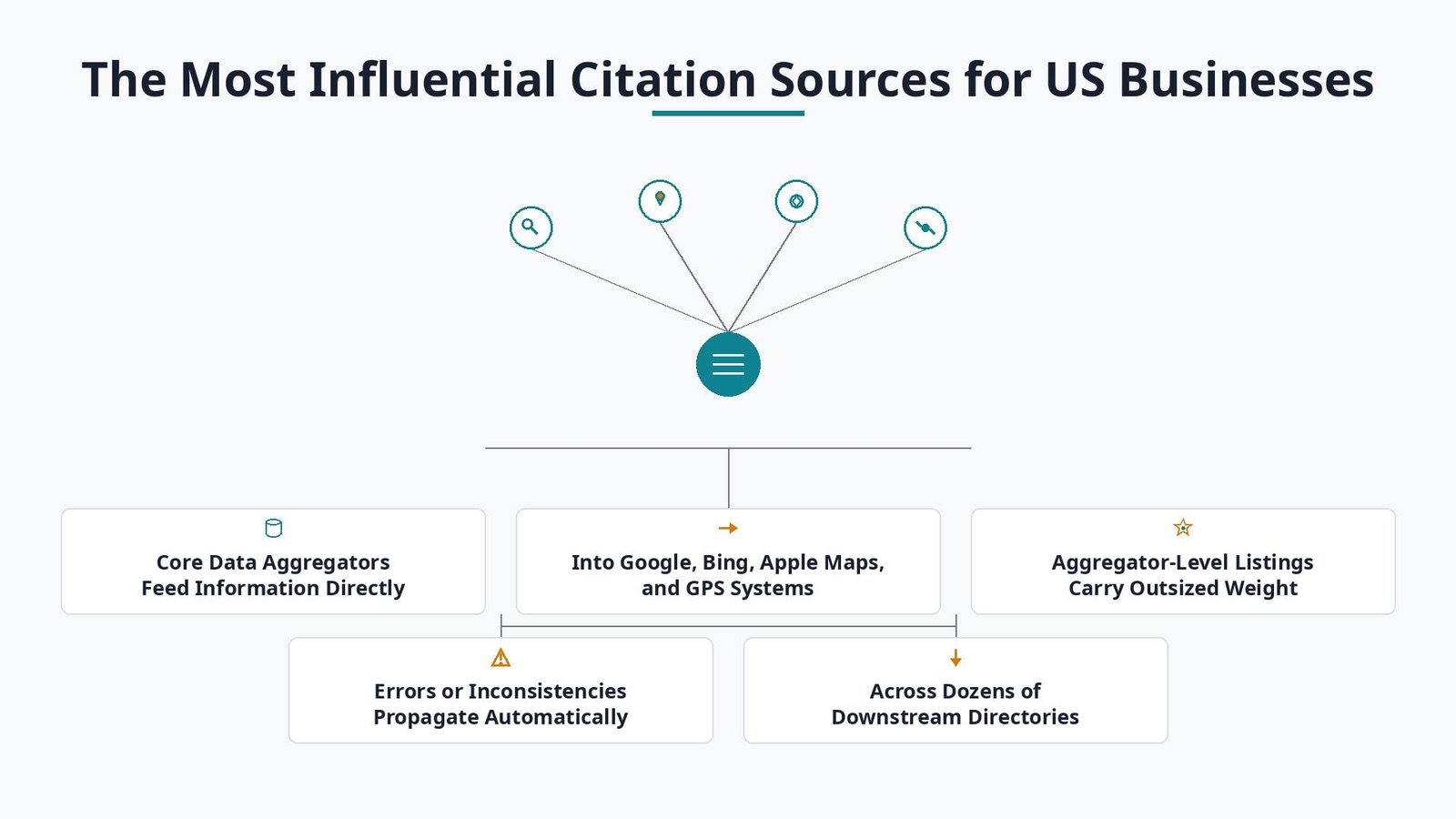
The most influential citation sources for US businesses are the core data aggregators that feed information directly into Google, Bing, Apple Maps, and GPS systems. These aggregator-level listings carry outsized weight because errors or inconsistencies here propagate across dozens of downstream directories automatically.
Core Data Aggregators
Data aggregators like Data Axle, Foursquare, and Neustar Localeze collect and redistribute business information to hundreds of smaller directories and apps. Fixing NAP errors at the aggregator level resolves inconsistencies across the entire downstream citation network simultaneously.
Industry-Specific Directories
Industry-specific directories such as Avvo for legal services or Healthgrades for medical providers carry extra prominence weight within their niche because search engines treat them as topically authoritative sources. A niche-specific citation often outweighs a dozen generic directory listings for businesses in regulated or specialized industries.
How Citations Interact With Google Business Profile Signals
Citation data and Google Business Profile information work together because Google cross-references the NAP details on a business’s profile against mentions found across the web. A Google Business Profile with accurate categories and complete information, backed by consistent citations confirming the same NAP data, strengthens the overall prominence signal more than either element alone.
Citations and the Local Pack: What the Correlation Data Shows
Businesses appearing in the local pack consistently show higher citation consistency scores than businesses ranking lower in organic local results. This correlation doesn’t prove causation on its own, but it does confirm that citation accuracy tracks closely with the businesses search engines trust enough to surface prominently.
Correlation Studies and Their Limitations
Correlation studies compare citation metrics across ranking positions but can’t isolate citations as the sole driver of local pack placement, since review volume, proximity, and on-page relevance move together with citation quality in most real-world datasets. Businesses that rank well tend to have strong signals across every category, which makes isolating citation impact alone statistically difficult.
What the Data Does Confirm
The data consistently confirms that citation inconsistency correlates with lower local pack visibility, even when other ranking factors are held relatively constant. This supports treating citation cleanup as a prerequisite for ranking improvement rather than a standalone growth tactic.
Do Citations Still Matter in 2026? The Declining-Impact Debate
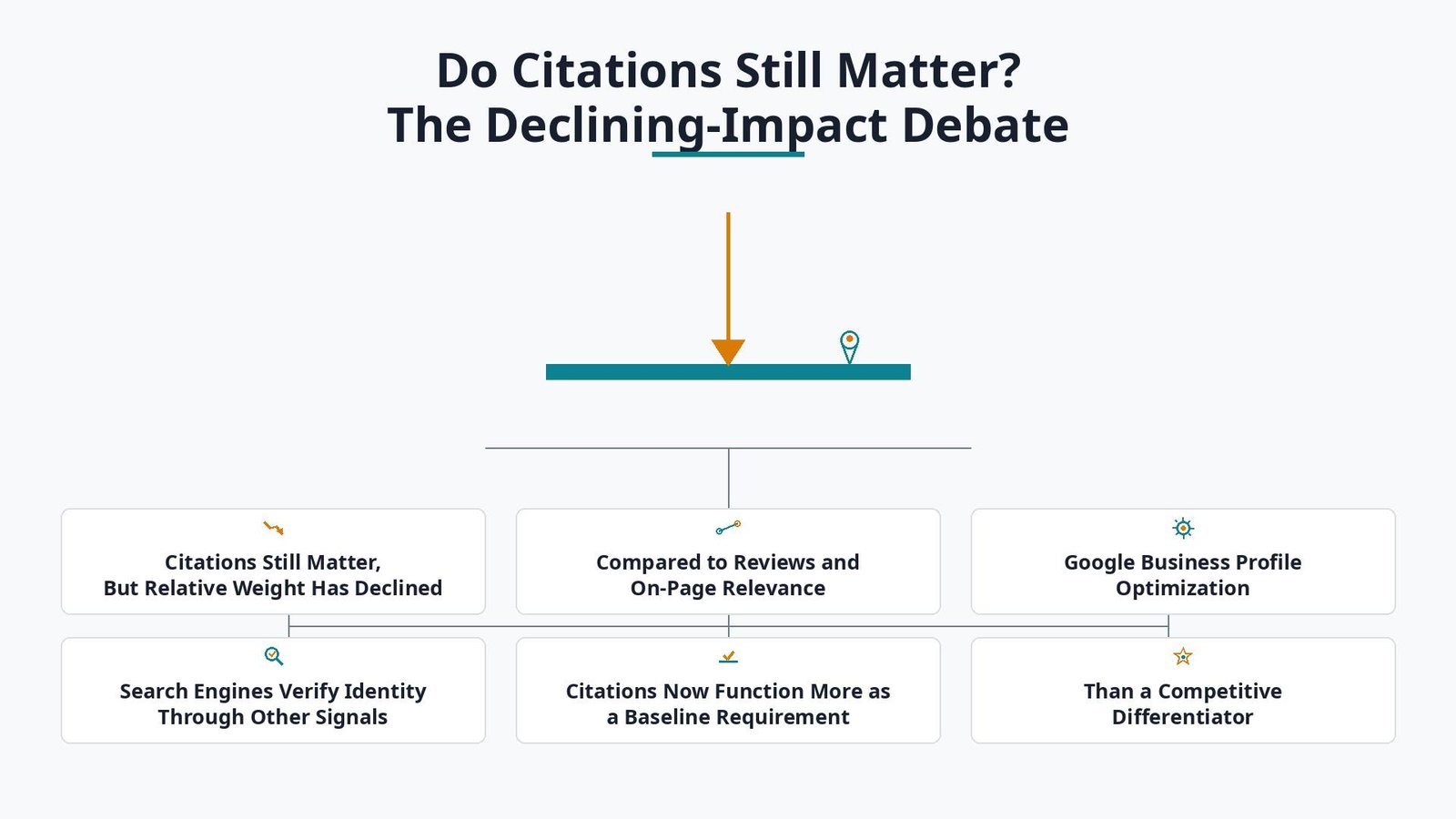
Citations still matter in 2026, but their relative ranking weight has declined compared to reviews, on-page relevance, and Google Business Profile optimization. Search engines have gotten better at verifying business identity through other signals, which means citations now function more as a baseline requirement than a competitive differentiator.
Citation Errors and Their Negative Ranking Impact
Citation errors, including outdated addresses, duplicate listings, and inconsistent phone numbers, can actively suppress local ranking performance. A business with multiple conflicting addresses across directories risks confusing both search engines and potential customers, which can split prominence signals across what search engines perceive as separate entities.
Citations vs. Reviews vs. Backlinks: Comparing Ranking Weight
| Ranking Factor | Primary Algorithm Pillar | Relative 2026 Weight | Fix Difficulty |
| Citations | Prominence | Moderate, declining | Low-Medium |
| Reviews | Prominence | High, increasing | Medium |
| Backlinks | Prominence/Relevance | High, stable | High |
| GBP Optimization | Relevance/Prominence | High | Low |
This table compares the three most commonly debated prominence-related ranking factors by their algorithmic role and current relative weight. Reviews now carry more ranking weight than citations in most industry studies, largely because review volume and recency are harder to manipulate and more directly reflect real customer interaction.
How Many Citations Does a Local Business Actually Need
Most local businesses need somewhere between 20 and 50 high-quality citations to establish a solid prominence baseline, rather than hundreds of low-value listings. Beyond the core aggregators and a handful of industry-relevant directories, additional citation volume produces diminishing returns on ranking impact.
Industry and Geographic Variables That Change Citation Impact
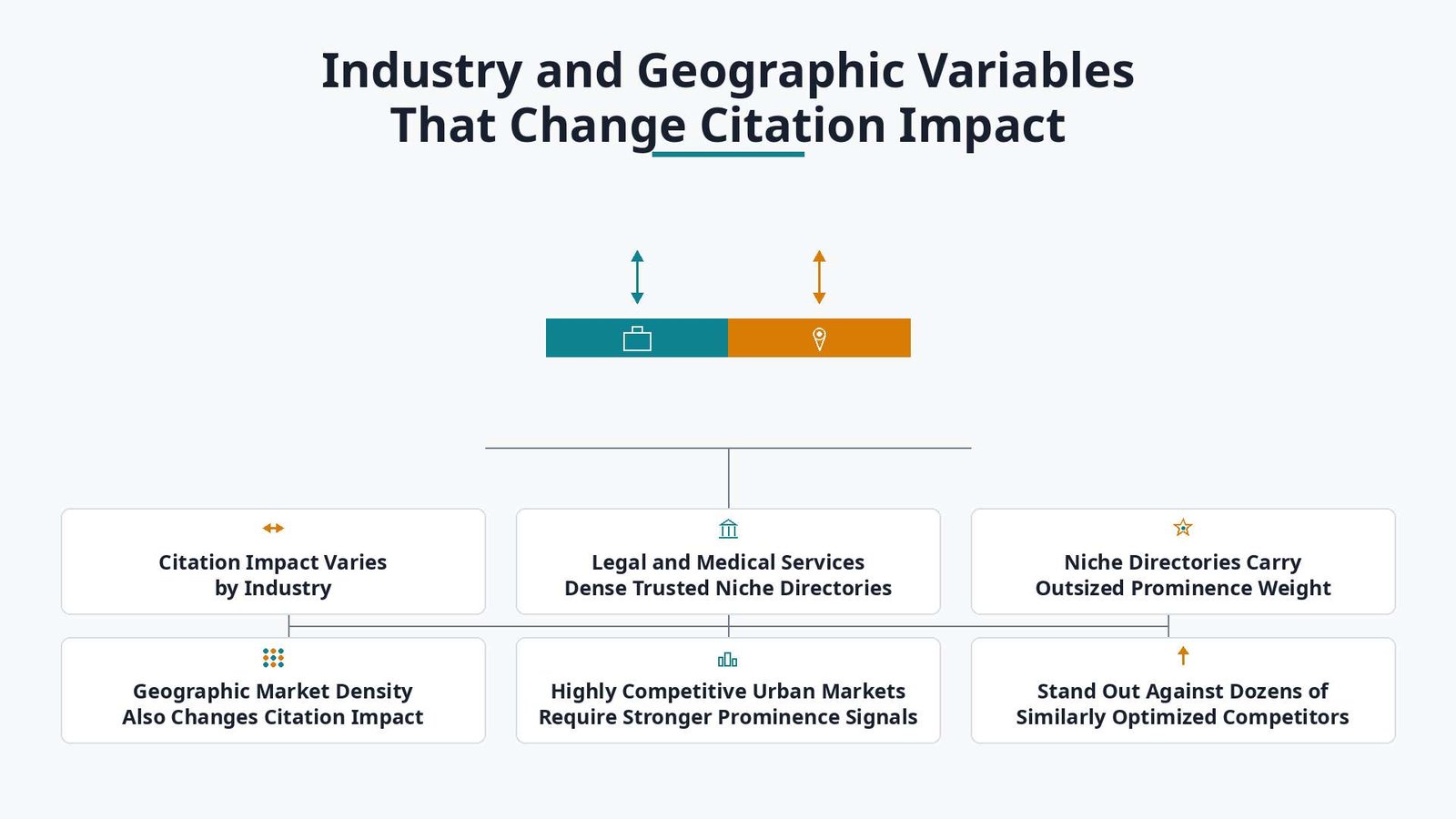
Citation impact varies by industry because some sectors, like legal and medical services, have dense networks of trusted niche directories that carry outsized prominence weight. Geographic market density also changes citation impact, since highly competitive urban markets require stronger overall prominence signals, including citations, to stand out against dozens of similarly optimized competitors.
How to Audit and Fix Inconsistent Citations
Auditing citations starts with identifying every existing mention of a business’s NAP information across the web, then comparing each listing against the current, accurate business details. Tools built for citation tracking can surface inconsistencies automatically, which speeds up the correction process across dozens or hundreds of individual listings.
The following steps outline a standard citation audit process:
- Pull a complete list of existing citations using a citation tracking tool
- Compare each listing’s NAP data against the current, official business information
- Prioritize fixing aggregator-level listings first, since they feed downstream directories
- Correct or remove duplicate listings that create conflicting location data
- Claim and verify any unclaimed directory listings found during the audit
- Re-check listings periodically, since directories can revert or lose data during updates
Building a Citation Strategy That Supports Long-Term Rankings
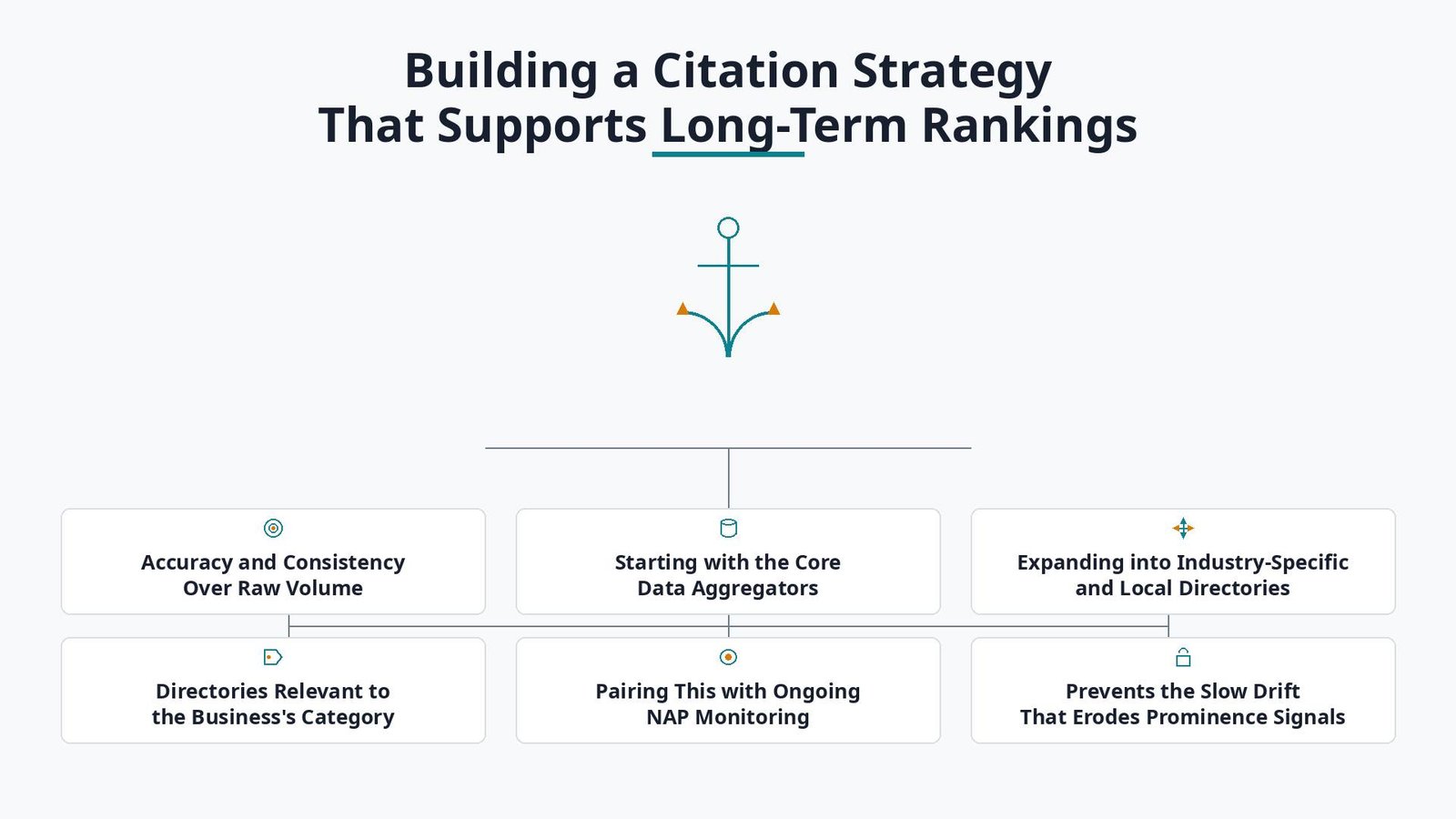
A sustainable citation strategy prioritizes accuracy and consistency over raw volume, starting with the core data aggregators and expanding into industry-specific and local directories relevant to the business’s category. Pairing this with ongoing NAP monitoring prevents the slow drift toward inconsistency that erodes prominence signals over time.
Conclusion
Citations still shape local prominence, working alongside reviews, backlinks, and Google Business Profile signals rather than independently. Their relative weight keeps declining, but consistency remains a baseline requirement for ranking credibility.
We treat citation accuracy as foundational, not optional, when building sustainable local visibility for clients. If your rankings feel stuck despite a decent profile, White Label SEO Service can audit what’s actually holding you back.
Frequently Asked Questions
Do citations still help local SEO in 2026?
Citations still help local SEO in 2026, though their impact has declined relative to reviews and Google Business Profile signals. They function best as a trust baseline rather than a primary ranking driver.
How long does it take for citations to affect rankings?
Citation changes typically take four to eight weeks to show measurable ranking impact. This timeline depends on how quickly search engines recrawl the affected directories.
What happens if my NAP is inconsistent across citations?
Inconsistent NAP data confuses search engines trying to verify a business’s identity across sources. This can suppress prominence signals and reduce local pack visibility.
Are paid citation services worth it?
Paid citation services are worth it when they target high-authority aggregators and industry-relevant directories. They’re not worth it when they prioritize volume over listing quality.
Can too many citations hurt rankings?
Too many low-quality citations don’t directly hurt rankings but waste resources without adding meaningful prominence value. Duplicate or conflicting listings from over-submission can actively cause harm.
Do citations matter more for new businesses?
Citations matter more for new businesses because they lack the review volume and backlink history that established competitors have built. They help establish initial trust and verification faster.
What’s more important: citations or Google reviews?
Google reviews currently carry more ranking weight than citations in most local SEO studies. Citations still matter as a consistency and trust baseline, but reviews drive more measurable prominence impact.


