

I’ve audited hundreds of local citation profiles, and the pattern is always the same: businesses with strong local rankings have citations that share the same core traits: accurate NAP data, relevant sources, and real domain authority. A weak citation profile does the opposite, and it quietly caps how far a business can rank in the map pack.
Getting this wrong wastes budget on directories that add no trust signal at all. I’ve watched campaigns stall for months because nobody checked citation quality before submitting.
This guide covers what a citation actually is and why it matters, the core quality markers like NAP consistency and source authority, the structural differences between citation types, and how to spot and avoid low-quality sources before they hurt a profile.
What Is a Local Citation in SEO?
A local citation is any online mention of a business’s name, address, and phone number (NAP), whether or not it links back to the business’s website. I think of citations as digital breadcrumbs. They tell search engines a business exists at a specific location and operates consistently across the web.
Citations show up on directories, data aggregators, industry associations, chambers of commerce, and local news sites. Some include a clickable link to the business website, and some just mention the business as plain text.
Structured vs. Unstructured Citations
Structured citations live in a predictable format: name, address, phone, category, and hours in defined fields, like on Yelp or Yellow Pages. Unstructured citations are more casual mentions buried in articles, blog posts, or press releases, without a standardized layout.
Both formats contribute to citation quality, but structured citations are easier for search engines to parse and verify at scale.
Citations vs. Backlinks — Key Differences
A backlink’s primary value comes from the linking domain’s authority and the anchor text used, while a citation’s value comes from the accuracy and consistency of the business data it contains. I treat citations and backlinks as separate strategies with overlapping benefits, not interchangeable tactics.
A citation can exist with zero link equity passed and still carry significant local ranking weight.
Why Local Citations Matter for Local SEO Rankings
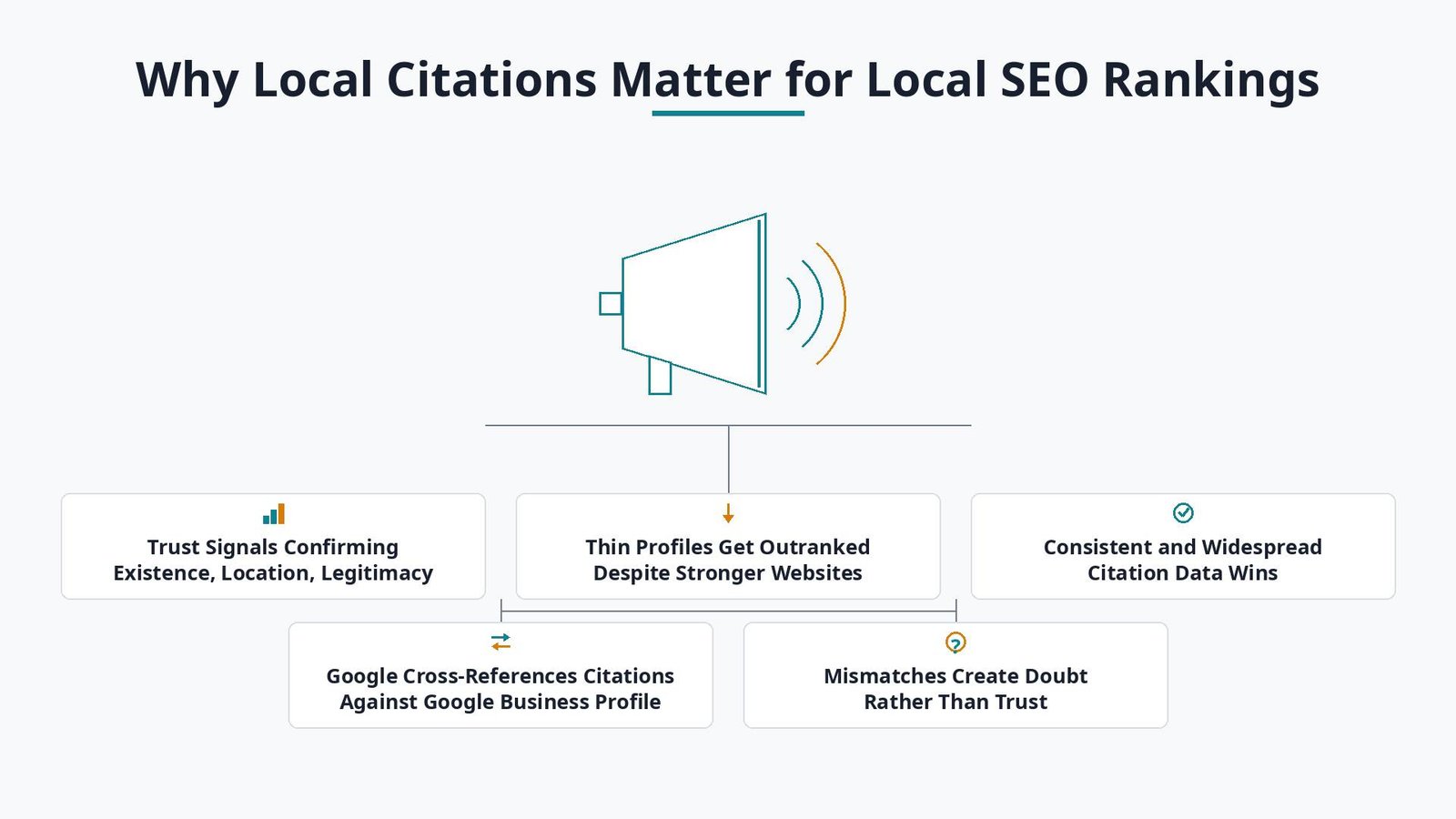
Local citations matter because they act as trust signals that confirm a business’s existence, location, and legitimacy to search engines evaluating local relevance. I’ve seen businesses with thin citation profiles get outranked by competitors with weaker websites simply because their citation data was more consistent and widespread.
Google cross-references citation data against what’s listed on a Google Business Profile, and mismatches create doubt rather than trust.
Citations and the Local Pack / Map Pack Connection
Citation volume and consistency are one of the stronger ranking factors behind local pack visibility, according to Moz’s Local Search Ranking Factors survey, which places citation signals among the top categories influencing map pack placement. I always check a client’s citation footprint early, because it often explains why a well-optimized website still isn’t showing up locally.
NAP Consistency — The Foundation of Citation Quality
NAP consistency means a business’s name, address, and phone number appear identically across every citation source, without variation in formatting, abbreviation, or spelling. consider this the single most important trait of a high-quality citation, because inconsistency creates confusion that search engines interpret as a trust problem rather than a formatting quirk.
A business might operate under “123 Main St.” on one directory and “123 Main Street” on another, and that small difference is enough to fragment the trust signal search engines are trying to build. I always standardize NAP format before submitting a single citation, because fixing it afterward across dozens of directories takes far longer than doing it right the first time.
Search engines use NAP matching as a verification layer, cross-referencing citation data against the Google Business Profile and the website’s own contact information. When the data lines up everywhere, it reinforces confidence in the listing. When it doesn’t, the business starts looking less legitimate by comparison to competitors with cleaner data.
What Counts as a NAP Inconsistency
Inconsistencies include suite number omissions, phone number formatting differences (with or without dashes), old business names after a rebrand, and outdated addresses from a past location. I treat even minor punctuation differences as inconsistencies worth fixing, because automated crawlers don’t interpret intent the way a human reader does.
How Search Engines Use NAP Data for Trust Signals
Search engines compile NAP data from multiple sources and compare it for agreement, similar to how a background check cross-references records from different databases. BrightLocal’s Local Citation Trust study found that businesses with highly consistent NAP data across top directories correlated with stronger local pack visibility compared to businesses with scattered or conflicting listings.
Domain Authority and Trust of the Citation Source
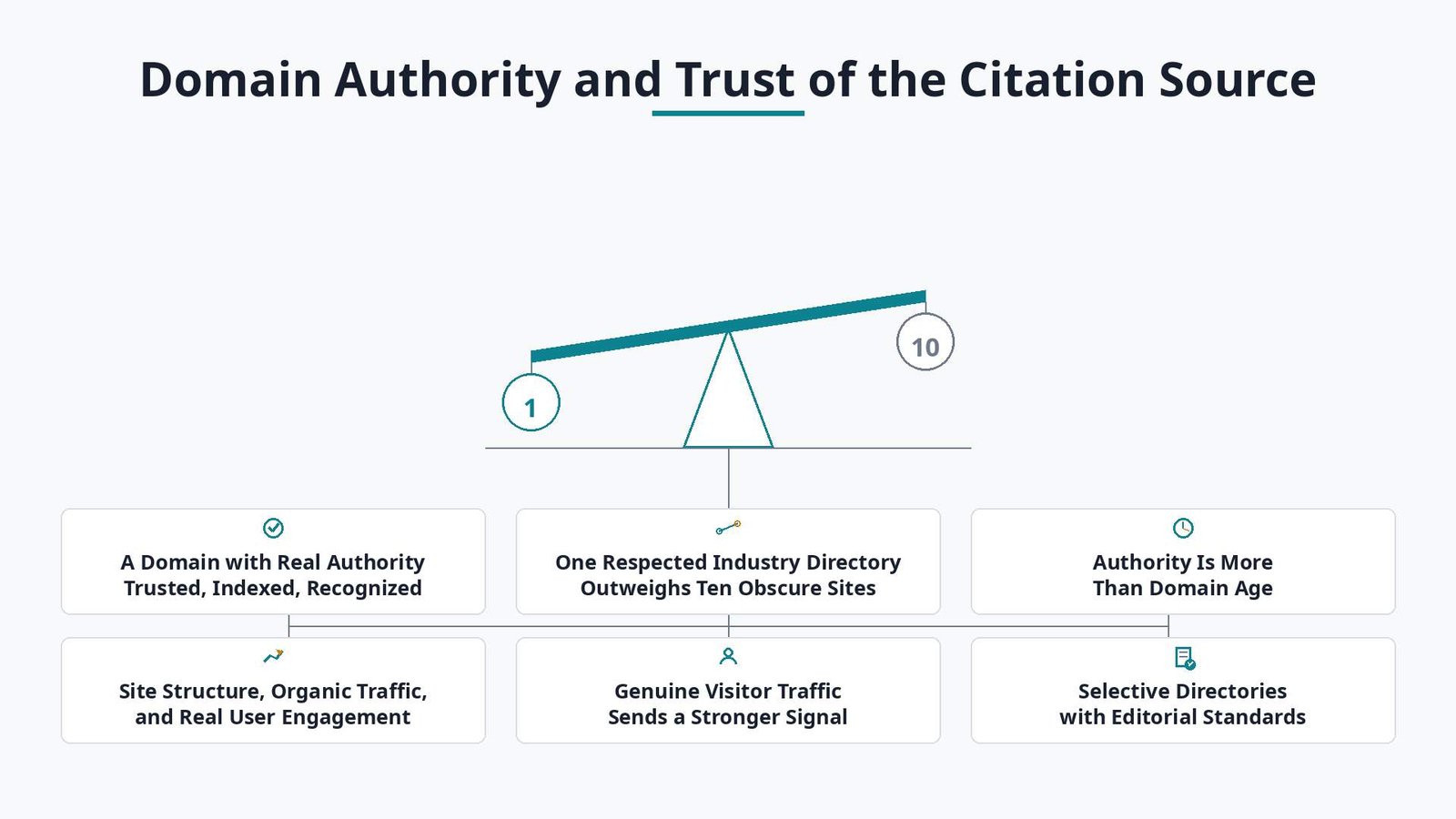
A high-quality citation comes from a domain with real authority, meaning the site itself is trusted, indexed, and recognized as a legitimate reference point by search engines. I rank citation sources by authority first, because a citation on a respected industry directory carries more weight than ten citations on obscure, low-traffic sites nobody actually visits.
Authority isn’t just about domain age. It factors in how the site is structured, how much organic traffic it earns, and whether real users engage with its listings rather than just crawlers indexing empty pages. A citation source with genuine visitor traffic sends a stronger signal than one that exists purely as a database for search engines to scrape.
I also look at how selective the directory is about who gets listed. Directories that accept every submission without review tend to carry less trust than ones with actual editorial standards or verification steps before a listing goes live.
High-Authority vs. Low-Authority Citation Sites
High-authority sites include major data aggregators, well-known review platforms, and established industry associations with real domain history. Low-authority sites are often newly created directories built purely to sell citation packages, with little original content or real user base behind them.
Spam Score and Toxic Citation Sources
A toxic citation source typically shows signs like excessive outbound links, thin or duplicated content across listings, and a pattern of hosting spammy businesses alongside legitimate ones. Moz’s Spam Score metric flags domains carrying risk factors that correlate with manual penalties, and I avoid submitting to any directory that trips multiple spam flags.
Relevance — Industry and Niche Alignment
A relevant citation comes from a directory or platform that caters specifically to a business’s industry, rather than a generic catchall site with no topical focus. I prioritize niche directories for specialized businesses because search engines weigh topical alignment as part of how they judge a citation’s contextual value.
A roofing contractor listed on a dedicated home services directory sends a clearer relevance signal than the same listing buried in a directory covering every industry imaginable.
General Directories vs. Industry-Specific Directories
General directories like broad business listing sites serve as a baseline citation layer that most businesses need regardless of industry. Industry-specific directories add a relevance layer on top of that baseline, reinforcing what type of business this actually is within its specific market.
Geographic Relevance of the Citation Source
A geographically relevant citation comes from a directory that either operates specifically within a business’s service area or clearly tags the listing with accurate local data. I treat geographic alignment as equally important as industry alignment, since local search is fundamentally about proving presence within a specific place.
A plumber based in Austin benefits far more from an Austin-specific business directory than from a national directory with no local filtering at all.
National vs. Local/Regional Directories
National directories establish broad, foundational citation coverage across the entire web. Local and regional directories reinforce geographic specificity, often carrying more local trust weight despite having far less domain authority than national sites.
Citation Completeness — Beyond NAP

A complete citation includes far more than name, address, and phone number. It covers business hours, category selection, a written description, and visual content like photos. I treat completeness as a quality marker because thin, half-filled listings signal low effort and give search engines less data to work with when verifying legitimacy.
Category selection in particular carries more weight than most business owners realize. Picking the right primary and secondary categories tells search engines exactly what the business does and helps match it to relevant local searches. A mismatched or overly broad category choice dilutes that signal.
Photos and descriptions add a layer of authenticity that plain data fields can’t. A directory listing with real photos, accurate hours, and a thoughtfully written description reads as a maintained, active business rather than an abandoned placeholder entry.
Business Hours, Categories, Descriptions, and Photos
Each of these fields acts as an additional trust and relevance signal beyond the core NAP data. I fill out every available field on a directory submission, because partial listings rank less favorably than fully completed ones on most major platforms.
Do-Follow vs. No-Follow Citations — Does It Matter?
A do-follow citation passes link equity to the business website, while a no-follow citation does not pass that equity but still contributes to NAP consistency and citation volume. I don’t dismiss no-follow citations, because their value for local SEO comes from data consistency and trust signals rather than traditional link authority.
Most major citation sources, including large data aggregators, use no-follow links by default, yet they remain some of the most valuable citations a business can build.
Structured Citations (Directories & Data Aggregators)
Structured citations are listings formatted into defined data fields across directories and aggregator platforms that distribute business information to other sites. I consider these the backbone of any citation strategy, since they’re built specifically to be read and verified by search engines and secondary data networks.
Core Data Aggregators Explained
Data aggregators collect and redistribute business information to dozens of smaller directories and apps, meaning one accurate submission to an aggregator can ripple outward into many consistent listings. Data Axle and Foursquare are examples of aggregators that feed data to a wide network of secondary platforms.
Unstructured Citations (Mentions, Blogs, News)

Unstructured citations appear as business mentions within blog posts, news articles, press releases, or forum discussions, without a standardized data format. I value these differently than structured citations, since their strength comes from context and editorial credibility rather than data field completion.
A mention in a respected local news article often carries more trust weight than a dozen low-tier directory listings combined.
Citation Indexing and Crawlability
A high-quality citation needs to actually be indexed by search engines to contribute any ranking value at all. I check indexing status after submitting to new directories, because a listing sitting on an unindexed or deprioritized site provides essentially zero SEO benefit regardless of how accurate the data is.
Crawlability issues on the directory’s side, like heavy JavaScript rendering or blocked crawler access, can prevent a perfectly accurate citation from ever being counted.
Duplicate Listings and How They Hurt Citation Quality
Duplicate listings happen when the same business appears more than once on a single platform, often due to old addresses, rebrands, or multiple past submissions. I treat duplicate cleanup as a priority task, because duplicates split trust signals and confuse the exact verification process search engines rely on.
A business with three overlapping Yelp listings under slightly different names looks fragmented rather than established, even if each individual listing is accurate.
How Citation Quality Differs by Industry
Citation quality standards shift depending on industry, since service-area businesses, retail locations, and professional practices each rely on different directory ecosystems. A medical practice benefits most from healthcare-specific directories and licensing board listings, while a restaurant gains more from food and review platforms.
I adjust citation strategy by industry rather than applying a single generic directory list to every client, because relevance signals compound when sources match the business type.
Signs of a Low-Quality or Spammy Citation
A low-quality citation typically shows thin content, inconsistent formatting, excessive ads, or a pattern of listing every business type without any real curation. I flag a directory as risky the moment I notice outdated design, broken submission forms, or a history of being associated with penalized sites.
Other red flags include directories that charge high fees for basic listings with no added value, sites with almost no organic search traffic of their own, and platforms that allow duplicate or fake business submissions without verification.
The clearest warning sign is a citation source that exists purely to sell links or listings rather than to genuinely serve searchers looking for local businesses.
How to Evaluate a Citation Source Before Submitting
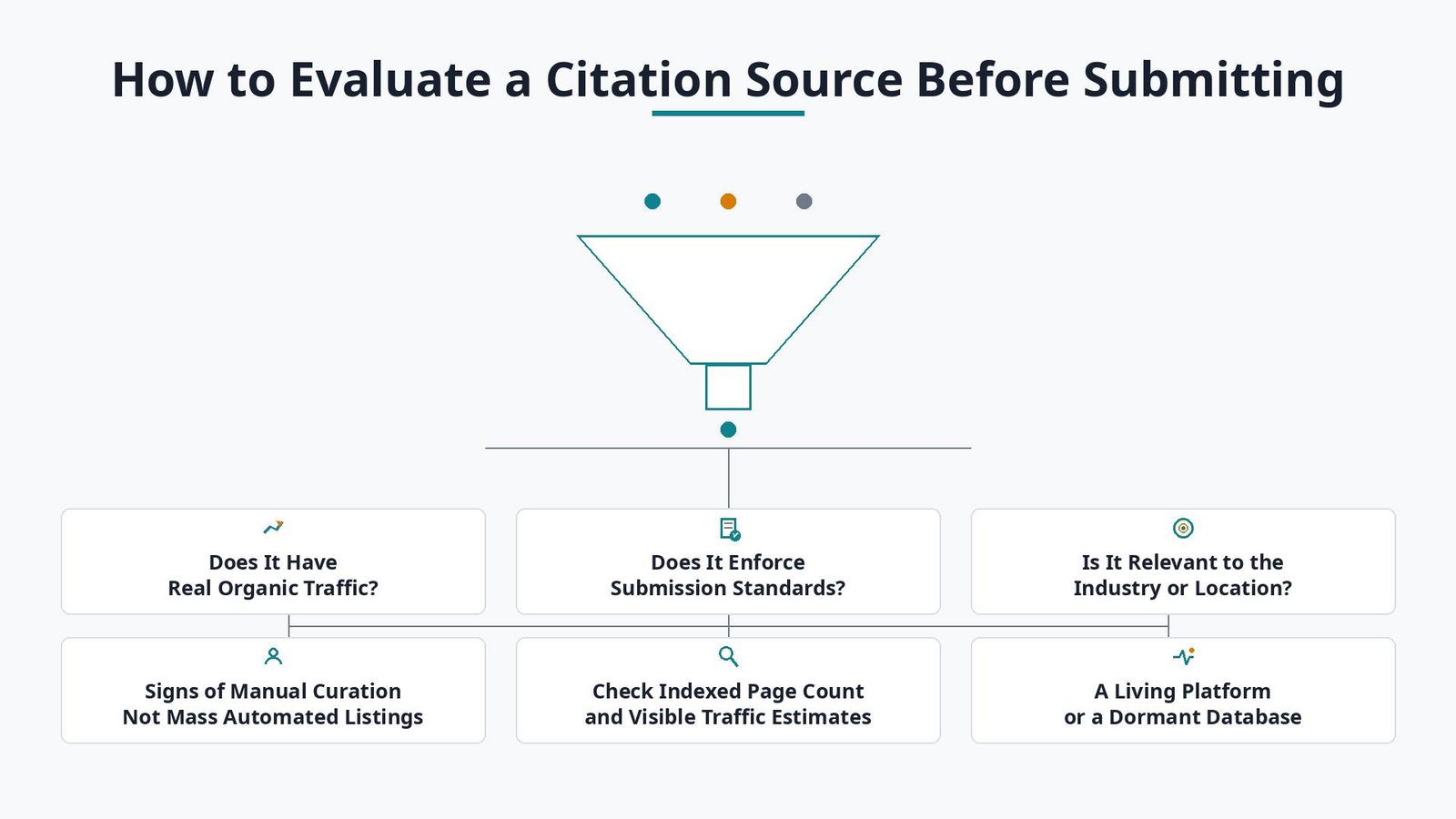
I run every potential citation source through a quick mental checklist before submitting: does it have real organic traffic, does it enforce any submission standards, is it relevant to the industry or location, and does it show signs of manual curation rather than mass automated listings.
Checking a site’s indexed page count and visible traffic estimates gives a fast read on whether it’s a living platform or a dormant database. A directory with almost no indexed pages of its own is unlikely to pass meaningful trust to anything listed on it.
Citation Quality vs. Citation Quantity
Citation quality outweighs citation quantity because a handful of accurate, relevant, high-authority citations builds more trust than hundreds of low-value, inconsistent listings. I’ve reversed declining rankings for clients simply by cleaning up and removing bad citations rather than adding new ones.
Volume still matters at a baseline level, since a business needs enough citations to establish broad presence, but chasing quantity past that point without quality control usually does more harm than good.
Conclusion
Citation quality comes down to consistency, authority, relevance, and completeness working together across every listing. These traits compound, and together they tell search engines exactly how trustworthy and established a business really is.
The citation landscape keeps shifting as directories rise and fall in authority, so an audited, well-maintained profile stays far more valuable than a one-time submission push.
We build and audit citation profiles that actually move local rankings, and White Label SEO Service can show you exactly where your current profile stands.
Frequently Asked Questions
What is considered a high-quality local citation?
A high-quality local citation has consistent NAP data, comes from an authoritative and relevant source, and includes complete business details. It appears on indexed, trusted platforms rather than spammy or abandoned directories.
Does NAP consistency really affect local rankings?
Yes, NAP consistency directly affects local rankings because search engines use it to verify legitimacy. Inconsistent data across listings creates trust gaps that can suppress visibility in local search results.
Are no-follow citations still worth building?
Yes, no-follow citations still carry significant value for local SEO. Their benefit comes from NAP consistency and trust signals, not link equity, making them worth pursuing regardless of follow status.
How many local citations does a business need?
There’s no fixed number, since quality matters more than volume. A smaller set of accurate, authoritative, relevant citations outperforms hundreds of low-quality, inconsistent listings.
What is the difference between structured and unstructured citations?
Structured citations use standardized data fields on directories and aggregators. Unstructured citations are informal mentions in articles, blogs, or news without a fixed format.
Can bad citations hurt local SEO rankings?
Yes, bad citations can hurt rankings by creating NAP inconsistencies or associating a business with spammy, low-trust domains. Cleaning up duplicate or inaccurate listings often improves rankings more than adding new ones.
How do I check if a citation source is trustworthy?
Check for real organic traffic, submission standards, industry or location relevance, and signs of manual curation. Low indexed page counts and no visible traffic are warning signs of a low-value source.


