

Citation monitoring is the ongoing process of tracking a business’s name, address, and phone number across directories, data aggregators, and map platforms to catch and correct inconsistencies before they damage local search visibility. I’ve watched this single discipline separate businesses that dominate the local pack from ones that quietly lose ground to competitors with cleaner data.
Search engines use citation consistency as a trust signal, and a wrong phone number sitting on a forgotten directory can undercut months of other SEO work. Ignoring it costs rankings slowly, then all at once.
This guide covers what citation monitoring actually means and why NAP consistency matters, the core sources and tools worth watching, how errors happen and what they cost, the manual and automated workflows for catching and fixing them, and how citation health fits into a broader local SEO strategy with measurable ROI.
What Citation Monitoring Actually Means
Citation monitoring is the practice of continuously checking where a business’s name, address, and phone number appear online and flagging any version that doesn’t match the official record. I treat it as quality control for data that search engines quietly cross-reference every time they decide which business to trust in local results.
A citation differs fundamentally from a backlink. Citations rarely carry anchor text or require a clickable link. They’re structured data entries, and their value comes from consistency across many sources rather than authority passed through a single link.
Citations vs. Backlinks — Why They’re Tracked Differently
Backlink monitoring focuses on authority and relevance. Citation monitoring focuses on accuracy and uniformity. I run these as separate tracking systems because mixing them hides the specific problem each one is meant to catch.
Why NAP Consistency Determines Local Rankings

NAP consistency is the degree to which a business’s name, address, and phone number match exactly across every online directory, platform, and citation source. Search engines cross-check these entries as a trust signal, and mismatches introduce doubt about which version of the business information is accurate.
I’ve seen local pack rankings shift noticeably once a business cleans up even a handful of conflicting listings. The pattern holds because inconsistent NAP data forces a search engine to guess, and guessing rarely favors the business in question.
What “NAP” Covers Beyond Name, Address, Phone
Modern NAP tracking extends to suite numbers, business hour formatting, and even category tags tied to the listing. A business operating from Suite 200 that shows up as “Suite 2,” “#200,” and “Ste 200” across three directories is still creating the inconsistency search engines penalize.
The Core Citation Sources Worth Watching
The citation ecosystem splits into primary data aggregators that feed hundreds of smaller directories and major consumer-facing platforms that searchers interact with directly. I prioritize monitoring both layers because an error at the aggregator level propagates outward within weeks.
The table below shows where citation data originates and spreads.
| Source Type | Examples | Why It Matters |
| Primary data aggregators | Data Axle, Foursquare, Neustar Localeze | Feed data to hundreds of downstream directories |
| Major consumer directories | Google Business Profile, Bing Places, Apple Maps, Yelp | Directly influence local pack and map visibility |
| Industry-specific directories | Healthgrades, Avvo, Houzz | Carry disproportionate weight within their niche |
| Social and review platforms | Facebook, TripAdvisor | Influence trust signals and review-driven rankings |
Primary Data Aggregators
Data aggregators like Data Axle distribute business information to a wide network of smaller sites automatically. Correcting an error at this level fixes the root source instead of chasing the same mistake across dozens of individual directories.
Major Directories
Google Business Profile carries the most ranking weight of any single citation source I track. Bing Places, Apple Maps, and Yelp follow closely behind for most local business categories.
How Citation Errors Happen in the First Place

Citation errors most often originate from a business change that never gets communicated to every platform carrying the old information. I’ve traced the majority of client citation problems back to one of a small number of recurring triggers.
- A business relocates and updates its website but not its directory listings
- A phone number changes after a provider switch or area code merger
- A rebrand changes the business name without updating existing citations
- A franchise or multi-location business expands and creates duplicate entries
- A third-party data entry error gets picked up and replicated by aggregators
Business Moves, Rebrands, and Phone Number Changes
A physical relocation is the single most disruptive trigger I see, because it invalidates the address across every existing citation simultaneously. Phone number changes run a close second, particularly for businesses that switch VoIP providers without auditing their citation footprint first.
The Real Cost of Inconsistent Citations
Inconsistent citations cost businesses both rankings and customers, and the damage compounds the longer the errors sit uncorrected. A 2024 BrightLocal study found that 68% of consumers lose trust in a business after encountering inconsistent contact information online, which directly affects conversion before a customer ever calls.
The ranking impact runs parallel to the trust impact. Local pack algorithms weight consistency as a proxy for legitimacy, and a business with scattered, conflicting data sends a weaker trust signal than a competitor with clean records.
Local Pack Visibility Impact
Local pack placement depends partly on proximity and relevance, but consistency acts as a tiebreaker when two businesses otherwise compete closely. I’ve watched clients move up two or three local pack positions purely from citation cleanup, with no other ranking factor changed.
Lost Calls and Misdirected Customers
A wrong phone number doesn’t just hurt rankings, it actively sends paying customers to a disconnected line or a competitor. Every outdated citation is a small, ongoing leak in a business’s own marketing funnel.
Manual Citation Monitoring: What It Involves
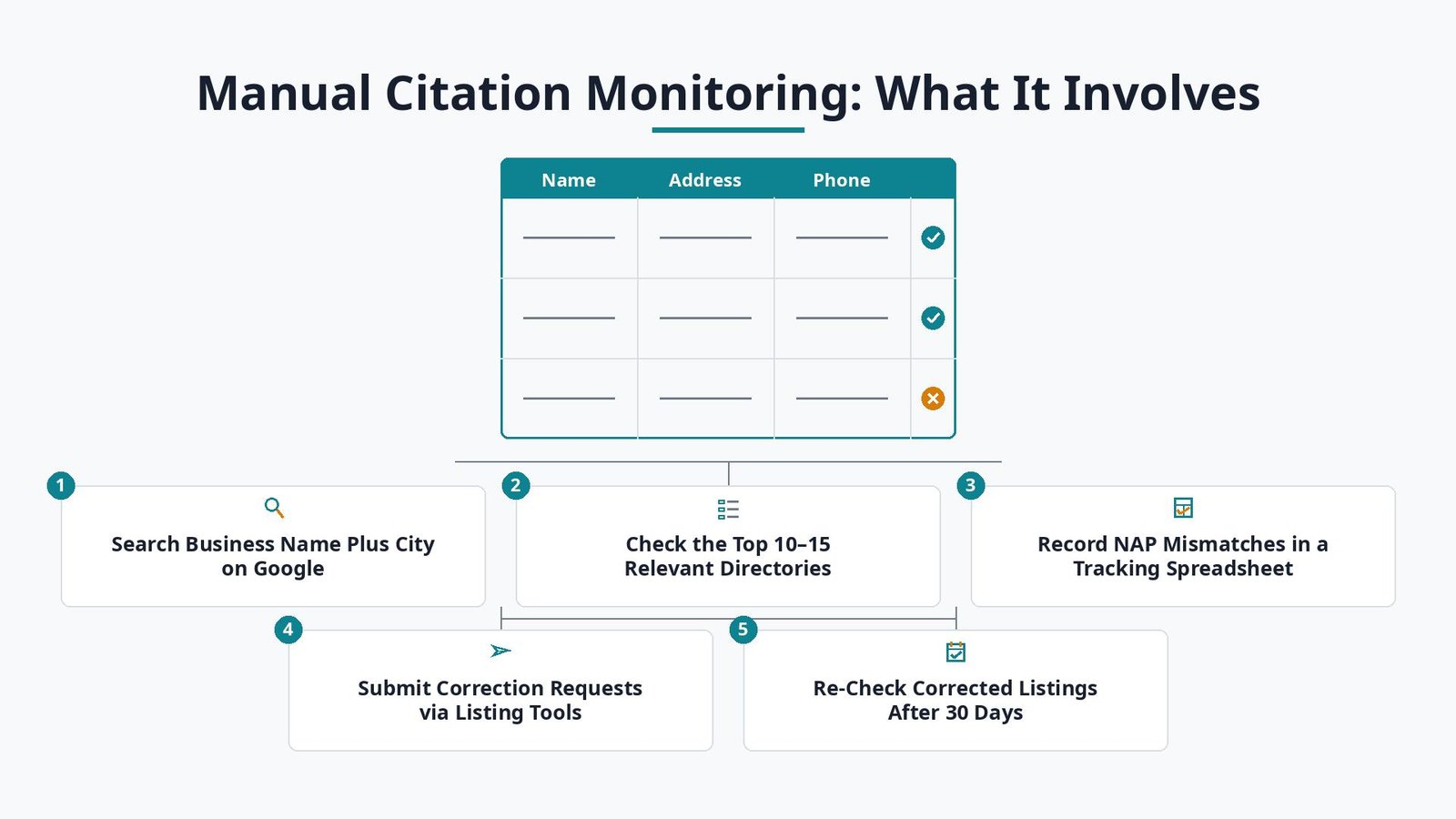
Manual citation monitoring means periodically searching for a business’s name across major directories and comparing the listed information against the official record by hand. It works for single-location businesses with modest citation footprints but becomes unsustainable past a handful of locations.
- Search the business name plus city on Google to surface existing citations
- Check the top 10–15 directories relevant to the business category
- Record any name, address, or phone mismatch in a tracking spreadsheet
- Submit correction requests directly through each platform’s listing management tool
- Re-check corrected listings after 30 days to confirm the update processed
Quarterly Audit Checklist Basics
A quarterly cadence catches most drift before it compounds into a larger problem. I recommend treating the audit as a fixed calendar event rather than something that happens only after a ranking drop prompts it.
Automated Citation Monitoring Tools and Platforms
Automated citation monitoring tools continuously scan hundreds of directories and data aggregators, flagging inconsistencies the moment they appear rather than waiting for a scheduled manual check. I rely on these platforms for any business with more than two or three locations, where manual tracking stops being realistic.
The table below compares what these platforms typically track.
| Tool Category | What It Monitors | Best Fit |
| Aggregator-sync platforms | Pushes corrected data directly to primary aggregators | Businesses needing fast, bulk correction |
| Alert-based monitors | Scans directories and emails flagged discrepancies | Teams managing citations in-house |
| Enterprise listing suites | Combines monitoring, correction, and reporting dashboards | Multi-location brands and franchises |
What Monitoring Software Actually Tracks
These platforms compare live directory data against a stored “source of truth” record for the business, flagging any field that drifts out of alignment. Some tools extend this tracking to review counts and category tags as well as the core NAP fields.
Alert Systems and Change Notifications
Real-time alerts catch a citation error within days instead of months, which matters because the ranking damage from an uncorrected listing accumulates the longer it goes unnoticed. I treat alert responsiveness as a key differentiator between monitoring platforms.
Citation Correction Workflows: Step by Step
Fixing a citation error requires locating the discrepancy, verifying ownership of the listing, and submitting a correction through the platform’s official channel rather than requesting a third party make the change informally. The process varies slightly by platform but follows a consistent overall structure.
- Identify every instance of the incorrect data across directories and aggregators
- Claim or verify ownership of each listing requiring correction
- Submit the corrected NAP data through the platform’s official update tool
- Correct the data at the primary aggregator level first when possible
- Monitor for confirmation that the change has propagated
- Re-audit after 30–60 days to confirm the fix held across dependent directories

Claiming and Verifying Listings
Verification usually requires a postcard, phone call, or email confirmation tied to the business address, and skipping this step is the most common reason correction requests stall. I always verify ownership before attempting any data change.
Submitting Correction Requests to Aggregators
Correcting the primary aggregator first saves significant time because the fix propagates to the directories pulling from that source automatically. Fixing individual directories one by one without touching the aggregator means the same error reappears every time that directory refreshes its data feed.
Duplicate Listings and How to Resolve Them
A duplicate listing occurs when the same business appears twice under slightly different information on the same platform, usually from a move, rebrand, or accidental re-creation of an existing profile. Search engines struggle to determine which version is authoritative, which splits review counts and dilutes ranking signal between the two entries.
- Search the business name and former addresses to surface hidden duplicates
- Determine which listing has more reviews, history, or verification status
- Flag the duplicate for merging through the platform’s official reporting tool
- Request merge or removal rather than simply deleting the newer listing
- Confirm the surviving listing carries the correct, current NAP data
Why Duplicates Appear After Moves or Mergers
A business that relocates without closing its old listing often ends up with two active profiles competing against each other in search results. I see this most often after a merger, where two previously separate businesses combine but their original citations remain live independently.
How Often Citations Should Be Reviewed

Most businesses should review their citation footprint every 90 days, with multi-location or franchise operations benefiting from monthly spot-checks instead. I set this cadence because citation drift tends to surface gradually rather than all at once, and a quarterly rhythm catches most issues before they affect rankings meaningfully.
Businesses going through an active change, a move, rebrand, or ownership transfer, warrant an immediate audit rather than waiting for the next scheduled review.
Industry-Specific Citation Platforms
Certain industries carry directories that influence local rankings more heavily than general-purpose platforms do. I always layer in these niche sources on top of the standard citation checklist because they’re often the first place a searcher validates a business’s credibility.
- Healthcare: Healthgrades, Vitals, WebMD Provider Directory
- Legal: Avvo, FindLaw, Justia
- Home services: Houzz, Angi, HomeAdvisor
Healthcare, Legal, and Home Services Directories
A healthcare provider with an inconsistent listing on Healthgrades faces a steeper trust penalty than the same error on a general directory, because patients specifically cross-reference these specialized sources before booking.
Multi-Location Businesses and Citation Scale Challenges
Citation management for multi-location businesses is the practice of maintaining consistent NAP data across dozens or hundreds of individual location listings simultaneously, rather than a single storefront’s data. The complexity multiplies with every additional location, since each one carries its own unique address and phone number requiring independent verification.
Franchise brands face an additional layer where corporate-level branding needs to stay consistent while each location’s specific contact details remain accurate and distinct.
Citation Monitoring’s Role in the Broader Local SEO Strategy

Citation consistency functions as one of several core local SEO ranking factors, sitting alongside proximity, review signals, and on-page optimization in how search engines evaluate local trust. I never treat citation work as a standalone task. It reinforces the credibility that other local SEO efforts depend on.
A business investing heavily in local content and review generation while ignoring citation drift is building authority on an inconsistent foundation.
Measuring the ROI of Citation Maintenance
Citation cleanup alone has been shown to improve local pack visibility within 30 to 60 days for businesses with significant prior inconsistency. I measure this through local rank tracking tools comparing position before and after a citation audit, isolating the variable as much as the data allows.
The clearest ROI signal is often call volume and direction-request data pulled from Google Business Profile insights, since those numbers respond quickly once accurate contact information propagates across major platforms.
Conclusion
Citation monitoring protects the trust signals search engines and customers both rely on, turning scattered NAP data into a consistent, verifiable record. Manual checks work at small scale, while automated tools and scheduled audits carry multi-location businesses through the same process reliably.
Local search keeps rewarding businesses that maintain clean, consistent data across every directory and aggregator in their footprint, not just the major ones. We’ve built our approach around this exact discipline, pairing monitoring with full-service execution.
Our team at White Label SEO Service tracks, corrects, and maintains citation accuracy as part of a complete local SEO strategy. Reach out and we’ll audit your current citation footprint together.
Frequently Asked Questions
What is citation monitoring in SEO?
Citation monitoring is the ongoing process of tracking a business’s name, address, and phone number across directories and platforms. It catches inconsistencies before they damage local search trust and rankings.
How often should business citations be updated?
Most businesses should review citations every 90 days, with monthly checks for multi-location operations. Any major business change warrants an immediate audit instead of waiting.
What happens if my NAP information is inconsistent?
Inconsistent NAP data confuses search engines about which business details are accurate. This weakens local pack rankings and can send customers to wrong addresses or disconnected numbers.
Can I monitor citations manually without software?
Yes, manual monitoring works well for single-location businesses with a modest citation footprint. It becomes impractical once a business expands past a few locations.
What’s the difference between a citation and a backlink?
A citation is structured NAP data appearing across directories, valued for consistency rather than authority. A backlink passes ranking authority through a clickable link and anchor text.
How long does it take to fix an incorrect citation?
Corrections typically take 30 to 60 days to fully propagate across dependent directories. Fixing the primary aggregator first speeds up this timeline significantly.
Do duplicate listings hurt local search rankings?
Yes, duplicate listings split review counts and confuse search engines about which profile is authoritative. Merging duplicates consolidates ranking signal into a single, stronger listing.


