
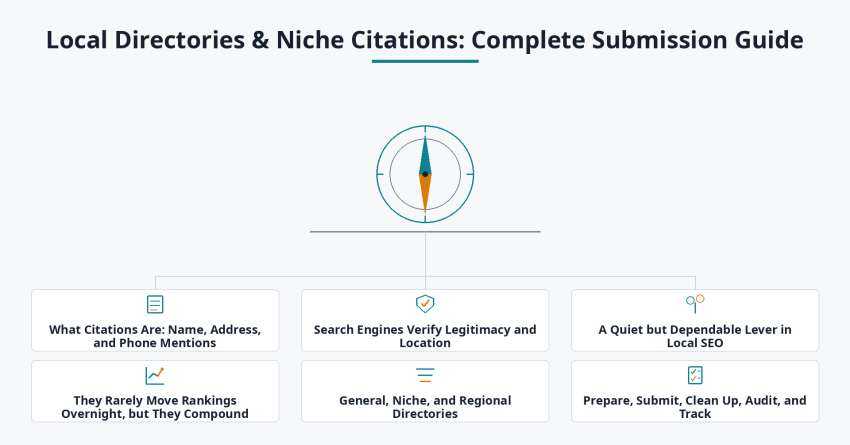
Local citations are online mentions of a business’s name, address, and phone number that help search engines verify its legitimacy and location. I treat them as one of the quieter but more dependable levers in local SEO. They rarely move rankings overnight, but they compound. Any business without a clean citation footprint is working against itself before a single blog post goes live.
Search engines cross-reference citation data across the web to confirm trust. Gaps or mismatches here quietly cap how far local rankings can climb.
This guide covers what citations are and how they influence rankings, where to find the right directories (general, niche, and regional), how to prepare and submit accurate data, how to clean up and audit existing listings, and how to track whether any of it is working.
What Local Citations Are and Why They Matter for SEO
A local citation is any online mention of a business’s name, address, and phone number, whether or not it links back to the business’s website. I’ve seen businesses with strong websites stall in the local pack simply because their citation data was scattered across a dozen slightly different formats.
NAP Consistency Explained
NAP consistency means a business’s name, address, and phone number appear identically across every directory and platform where it’s listed. Search engines use mismatches as a weak trust signal, even when the differences seem trivial, like “St.” versus “Street.”
I keep one master version of NAP data and copy it exactly everywhere, never retyping it per site. Small formatting drift across dozens of directories adds up into a trust problem no one notices until rankings stall.
Structured vs. Unstructured Citations
Structured citations live on dedicated business listing platforms like directories and data aggregators, formatted in consistent fields. Unstructured citations appear in blog posts, news articles, or social mentions where NAP data shows up in regular text.
Both count toward trust signals, but structured citations are easier to audit and correct. Unstructured mentions matter more for authority than for consistency control.
How Citations Influence Local Search Rankings
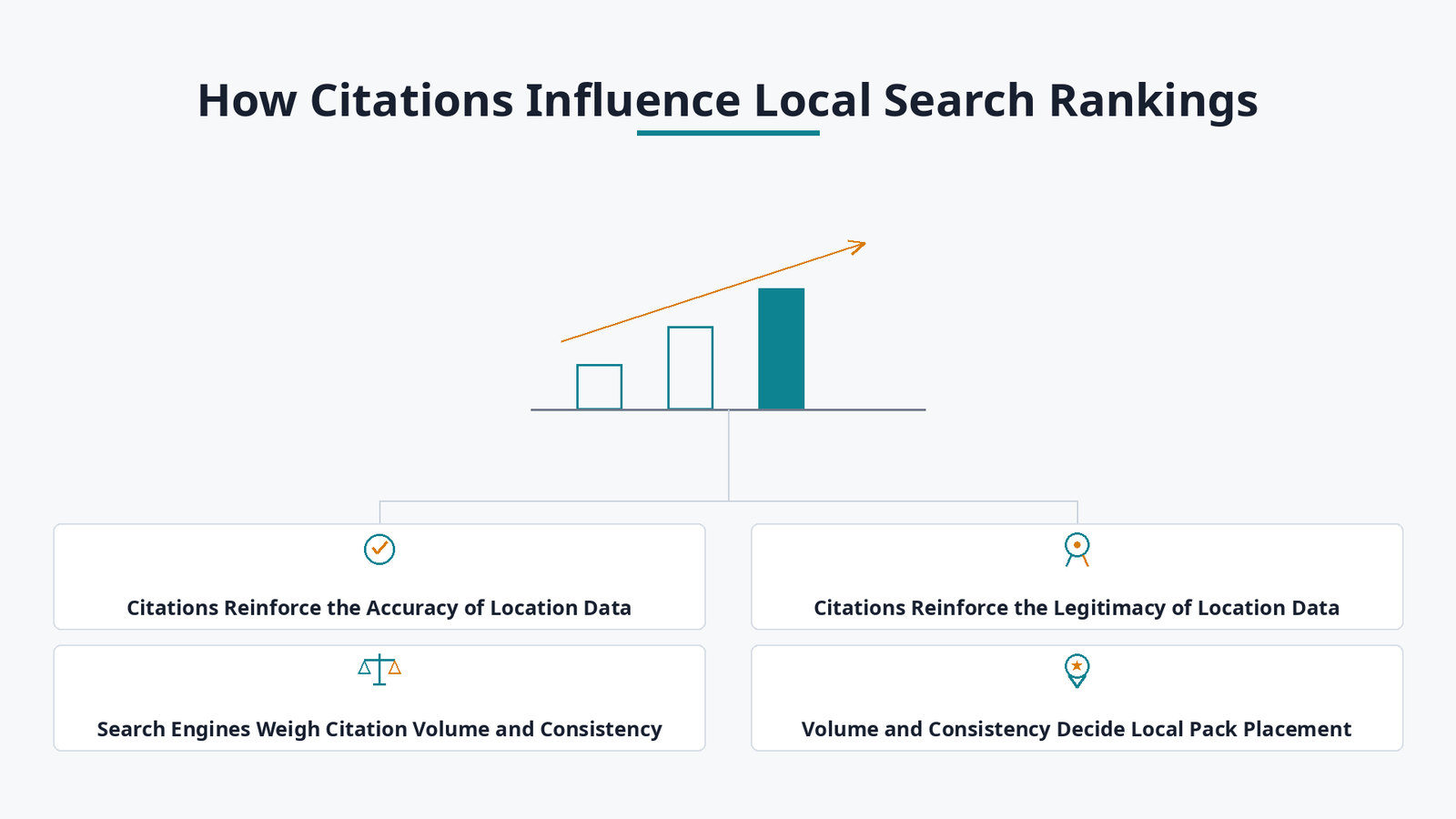
Citations influence local search rankings by reinforcing the accuracy and legitimacy of a business’s location data across the web. Search engines weigh citation volume and consistency as part of how they evaluate which businesses deserve local pack placement for a given query.
Citations and the Local Pack Algorithm
The local pack algorithm draws on proximity, relevance, and prominence, and citations feed directly into prominence. A business cited consistently across dozens of relevant directories signals to search engines that it’s an established, verifiable entity rather than a thin or new listing.
I don’t treat citation volume as a numbers game on its own. A handful of accurate, relevant citations outperforms fifty inconsistent ones every time.
Core Data Aggregators You Need to Know
Data aggregators are companies that collect and redistribute business information to hundreds of directories, apps, and GPS systems simultaneously. Getting listed correctly with the major aggregators often fixes citation problems faster than manually submitting to each downstream directory.
How Data Aggregators Distribute Business Information
Aggregators pull business data from a central submission and push it outward to the directories, apps, and data partners in their network. An error submitted at the aggregator level propagates to every connected directory, which is why accurate NAP data entry at the source matters more than fixing each directory individually.
I always start citation work at the aggregator level before touching individual directories one by one. It saves weeks of redundant manual corrections later.
General Business Directories for Nationwide Visibility

General business directories are broad, industry-agnostic platforms that list businesses across every category and location. They form the baseline citation layer every business needs regardless of industry, and they’re usually the first stop in any citation building effort.
Google Business Profile as the Foundation
Google Business Profile is the free listing service that controls how a business appears in Google Maps, the local pack, and local search results. I consider it the single most important citation a business will ever create, since it directly feeds the ranking surfaces most local searchers actually see.
An incomplete or unverified profile here undercuts every other citation effort, no matter how clean the rest of the footprint looks. Categories, hours, and service areas inside the profile all function as ranking signals, not just contact details.
Bing Places, Apple Maps, and Secondary Search Engines
Bing Places and Apple Maps operate as smaller-scale equivalents to Google Business Profile, each feeding their own search and navigation ecosystems. Secondary search engine directories matter less for raw traffic volume but still contribute to the broader consistency signal search engines evaluate.
I submit to these even on lower-traffic projects, since the incremental trust benefit outweighs the ten minutes it takes to claim each listing.
Niche-Specific Directories by Industry
Niche-specific directories are listing platforms built around a single industry, trade, or professional category rather than general business listings. A roofing contractor and a dental practice both need citations, but the directories that move the needle for each look nothing alike.
Home Services and Contractor Directories
Home services directories like HomeAdvisor, Angi, and Houzz cater specifically to contractors, remodelers, and trade businesses. These platforms often carry more local ranking weight for trade businesses than general directories, because search engines recognize them as category-relevant sources.
I prioritize these ahead of general directories for any contractor client, since the topical relevance signal tends to outweigh raw domain authority.
Healthcare and Medical Directories
Healthcare directories such as Healthgrades, Zocdoc, and WebMD’s provider listings serve as the primary citation sources for medical and dental practices. Medical practice citation building carries additional weight here because these platforms also function as trust signals for patients researching providers directly.
Accuracy matters even more in this category, since incorrect hours or outdated insurance information creates a worse experience than a missing listing altogether.
Legal and Professional Services Directories
Legal directories like Avvo, FindLaw, and Justia operate the same way healthcare directories do, but for attorneys and legal practices. These listings often include credentialing and practice area data that general directories don’t capture at all.
I treat them as mandatory for any legal client, not optional extras, given how much local search volume in this space routes through category-specific platforms.
Local Chamber of Commerce and Regional Business Listings

Chamber of Commerce memberships and regional business associations generate citations tied specifically to a business’s geographic community. These listings carry a trust signal that generic directories can’t replicate, since membership typically requires some form of verification or fee.
I’ve found regional listings especially useful for businesses competing in tightly localized markets, where every relevant local signal helps separate a business from national competitors without a physical presence nearby.
Review Platforms That Double as Citation Sources
Review platforms serve a dual purpose: they collect customer feedback while also functioning as structured citation sources with NAP data attached. A business ignoring review platforms as citation opportunities is leaving an entire category of local SEO value on the table.
Yelp, BBB, and Industry Review Hubs
Yelp and the Better Business Bureau both maintain detailed, structured business profiles that search engines treat as credible citation sources. Industry-specific review hubs add a layer of topical relevance on top of the citation value, similar to niche directories.
I claim and complete these profiles fully rather than leaving them half-finished, since an abandoned-looking profile can undercut the trust signal it’s supposed to build.
How to Prepare Your NAP Data Before Submission
Preparing NAP data before submission means finalizing one exact, consistent version of a business’s name, address, and phone number before it touches a single directory. Skipping this step is the single most common cause of citation inconsistency I see across client accounts.
Building a Master NAP Reference Sheet
A master NAP reference sheet is a single document containing the finalized name, address, phone number, website URL, hours, and categories for a business. I keep this as the source of truth and copy from it directly, rather than relying on memory or old listings that may already contain errors.
Any business with multiple locations needs a separate, clearly labeled reference sheet per location to avoid cross-contamination during submission.
Step-by-Step Directory Submission Process

The directory submission process starts with the master NAP sheet, moves through aggregator submission, then general directories, then niche and regional listings in that order. Following this sequence prevents the common mistake of submitting to dozens of directories before an aggregator-level error gets caught and multiplied downstream.
I submit in batches and verify each listing within a few days rather than submitting everywhere at once and losing track of what’s pending confirmation.
Avoiding Duplicate Listings and Citation Conflicts
Duplicate listings occur when a business gets listed more than once on the same directory, often due to past submissions, mergers, or rebrands. Search engines interpret duplicates as a trust problem, since they can’t tell which listing represents the current, accurate business information.
I search for a business’s name and phone number across major directories before submitting anything new, since old duplicate listings are far more common than most owners realize.
How to Audit Existing Citations for Accuracy
A citation audit means systematically checking every existing directory listing against the master NAP sheet to find inconsistencies, outdated information, or duplicates. I run this before any new citation building begins, since building new citations on top of a messy existing footprint just compounds the inconsistency.
Manual spot-checks across the top twenty directories usually surface most of the problems worth fixing first.
Citation Building vs. Citation Cleanup: What to Prioritize

Citation cleanup fixes existing inaccurate or duplicate listings, while citation building creates new listings on directories where a business doesn’t yet appear. I prioritize cleanup first for any business with an established but messy footprint, since new citations built on top of unresolved errors inherit the same trust problems.
Businesses with few or no existing citations skip straight to building, since there’s nothing to clean up yet.
Manual Submission vs. Automated Citation Tools
Manual submission means an individual completes each directory listing by hand, while automated citation tools like Yext or BrightLocal push data to multiple directories through a single dashboard. Automated citation management tools trade some control and customization for significant time savings across large directory lists.
When Automated Tools Make Sense
Automated tools make the most sense for multi-location businesses managing dozens or hundreds of listings at once. A single-location business with a short directory list often gets more accurate results from manual submission, since automated tools sometimes format data in ways that don’t match a directory’s specific fields.
I use a hybrid approach on most accounts: automation for scale, manual correction for the handful of listings that need precise formatting.
Tracking Citation Performance and Local Ranking Impact
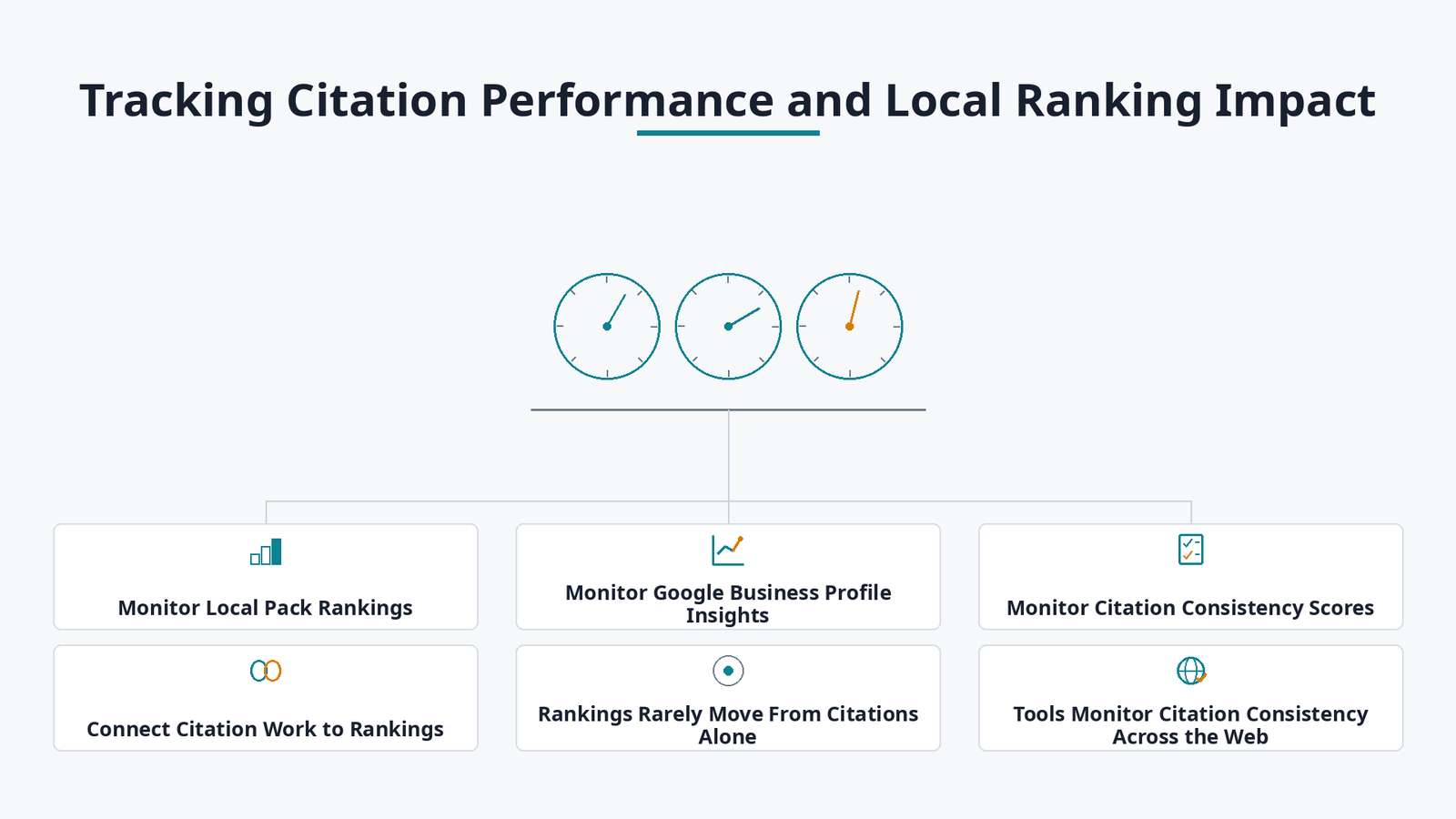
Tracking citation performance means monitoring local pack rankings, Google Business Profile insights, and citation consistency scores over time to connect citation work to ranking movement. Citations rarely move rankings in isolation, so I track them alongside other local SEO signals rather than expecting a direct cause-and-effect line.
Tools that monitor citation consistency across the web flag new inconsistencies as they appear, which matters since directories occasionally alter listing data without notice.
Common Citation Mistakes That Hurt Local SEO

The most frequent citation mistakes are inconsistent NAP formatting, duplicate listings, outdated business information, and submitting to low-quality or irrelevant directories. Each of these erodes the trust signal citations are supposed to build rather than strengthening it.
I also see businesses choose the wrong business category on directories far too often, which misaligns the listing with the search queries it should actually be matching.
Building a Long-Term Local Citation Strategy
A long-term citation strategy treats citations as an ongoing maintenance task rather than a one-time project completed and forgotten. Business details change, directories update their platforms, and new niche directories emerge, which means citation accuracy decays slowly without regular attention.
I schedule a citation audit on a recurring basis, treating it the same way I’d treat any other maintenance task tied to organic visibility. Local search rewards consistency sustained over time, not a single clean-up sprint.
Conclusion
Citations build the trust layer beneath every other local SEO effort, connecting NAP accuracy, directory relevance, and ongoing maintenance into one system.
As AI-driven search grows, consistent business data across the web matters even more for how assistants surface local answers.
We help businesses build and maintain accurate citation profiles that support lasting local visibility. Reach out to White Label SEO Service to get started.
Frequently Asked Questions
How many local citations does a business actually need?
There’s no fixed number that applies to every business, though most benefit from 30-50 accurate, relevant citations. Quality and consistency across directories matter far more than raw citation count.
How long does it take for citations to affect rankings?
Citation impact typically becomes noticeable within 4-8 weeks after submission and indexing. Aggregator-level citations often show impact faster since they distribute to multiple directories simultaneously.
Do paid directories perform better than free ones?
Paid directories don’t inherently outperform free ones; relevance and domain trust matter more than cost. Some high-authority niche directories charge fees, but plenty of free directories carry equal or greater ranking value.
Can incorrect citations hurt my local SEO?
Yes, incorrect citations can hurt local SEO by confusing search engines about which business information is accurate. Inconsistent NAP data weakens the trust signal citations are meant to build in the first place.
Should every business submit to niche directories?
Most businesses benefit from at least a few relevant niche directories tied to their specific industry. Skipping them means missing category-specific trust signals that general directories don’t provide.
How often should citations be audited?
Citations should be audited roughly every 6-12 months, or immediately after any business detail changes. Address changes, rebrands, and phone number updates all require a fresh audit cycle.
Is citation building still worth it with AI search growing?
Yes, citation building remains worth it because AI search assistants pull from the same structured business data that citations help standardize. Consistent NAP data across the web supports accurate representation in both traditional and AI-driven search results.


