

A citation knowledge graph is a structured network that maps the relationships between research papers, authors, institutions, and ideas based on how they cite one another. I think of it as the connective tissue of human knowledge. Every citation is a vote of relevance, and the graph turns millions of those votes into a map you can actually query and analyze.
Researchers, SEOs, and AI developers all rely on these structures now, and ignoring them means missing how modern discovery actually works. We built this guide because the concept shows up constantly in conversations about search and content authority.
This guide covers how citation graphs are built and structured, the semantic relationships that connect research to research, how search engines borrow the same logic for ranking, where these graphs show up in academic and AI research, and how to evaluate one for quality.
What Is a Citation Knowledge Graph?
A citation knowledge graph is a network of connected entities, papers, authors, institutions, and concepts, linked by citation relationships rather than simple lists. Traditional bibliographies just stack references in order. A graph instead stores every connection as data, which means I can query it, visualize it, and run analysis across thousands of connections at once.
Nodes, Edges, and Entities in a Citation Graph
Every citation graph is built from nodes and edges. A node represents an entity, a paper, author, journal, or institution, and an edge represents the relationship between two nodes, like “cites” or “co-authored with.” Nodes and edges form the mathematical backbone borrowed from graph theory, and weighting those edges by citation frequency or recency is what turns a static reference list into something genuinely analyzable.
How Citation Graphs Differ From Traditional Reference Lists
A reference list tells you what a single paper cites. A citation graph tells you how an entire field connects, which papers sit at the center of a conversation, and which ones sit on the fringe. That structural view is something no flat bibliography can offer on its own.
How Citation Knowledge Graphs Work
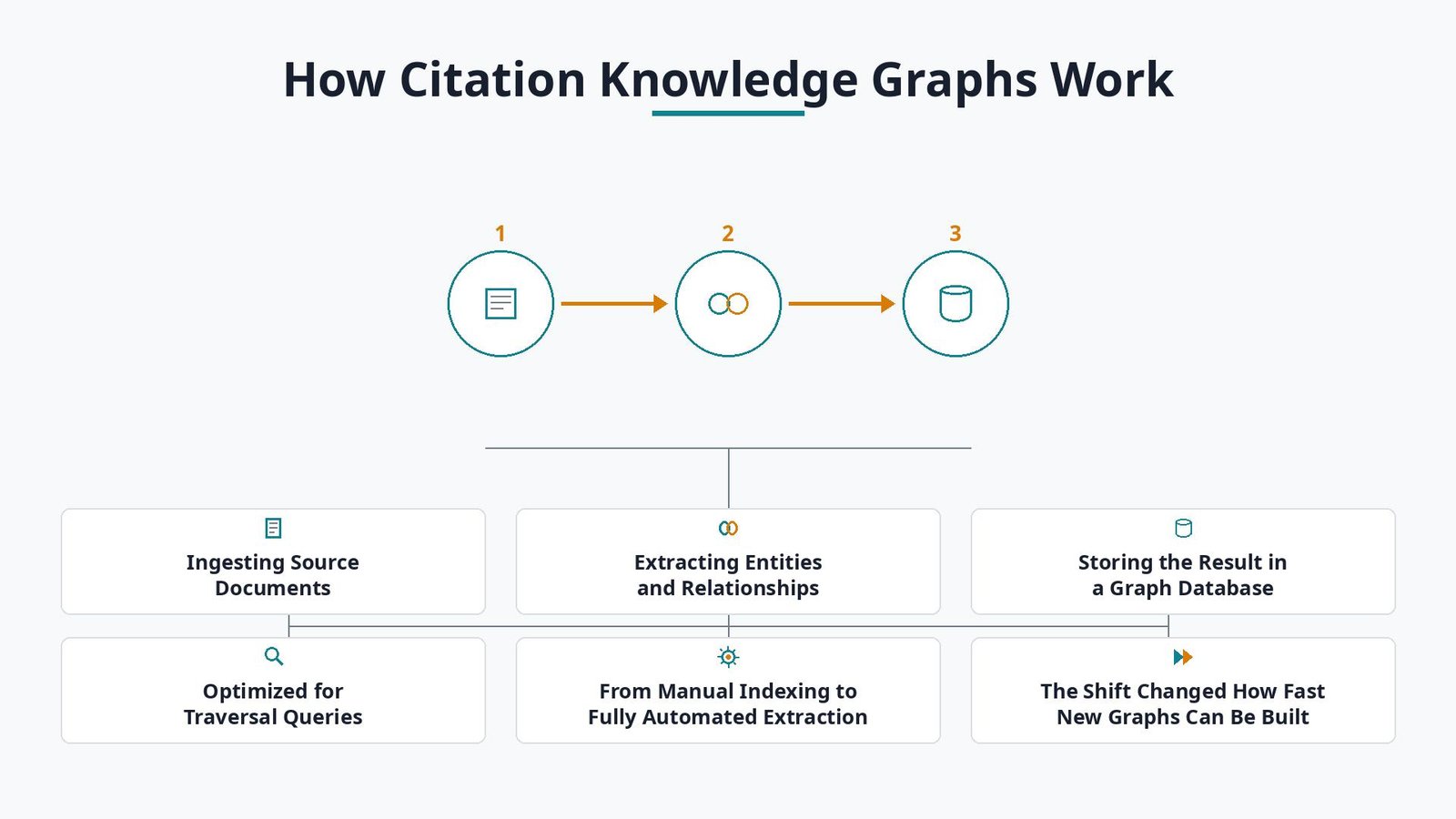
A citation knowledge graph is built in three stages: ingesting source documents, extracting entities and relationships, and storing the result in a graph database optimized for traversal queries. I’ve watched this pipeline evolve from manual indexing to fully automated extraction, and the shift changed how fast new graphs can be built.
Data Ingestion and Entity Extraction
Ingestion starts with parsing documents, papers, patents, articles, and pulling out entities using natural language processing. Named entity recognition identifies authors, institutions, and key terms, while reference parsing extracts the citation list itself. An entity extraction pipeline is the software layer that converts unstructured text into structured, linkable data points.
Modern extraction tools reach high accuracy on well-formatted academic text, though messier sources like preprints or non-English papers still introduce noise. We see this constantly when evaluating data sources for our own content research.
Relationship Mapping Between Citing and Cited Works
Once entities exist, the system maps relationships between them. This step assigns edge types, direct citation, co-citation, bibliographic coupling, and often weights each one by context, like whether a citation was supportive, critical, or just a passing mention. Semantic Scholar’s citation classification research found that distinguishing citation intent meaningfully improves downstream relevance scoring.
Graph Databases and Storage Architecture
Citation graphs typically live in specialized graph databases rather than standard relational tables, because traversing relationships, “find every paper two hops from this one”, is dramatically faster in a native graph structure. Neo4j and similar platforms store nodes and edges directly, which keeps large-scale traversal queries fast even across millions of records.
The Role of Semantic Relationships in Citation Graphs
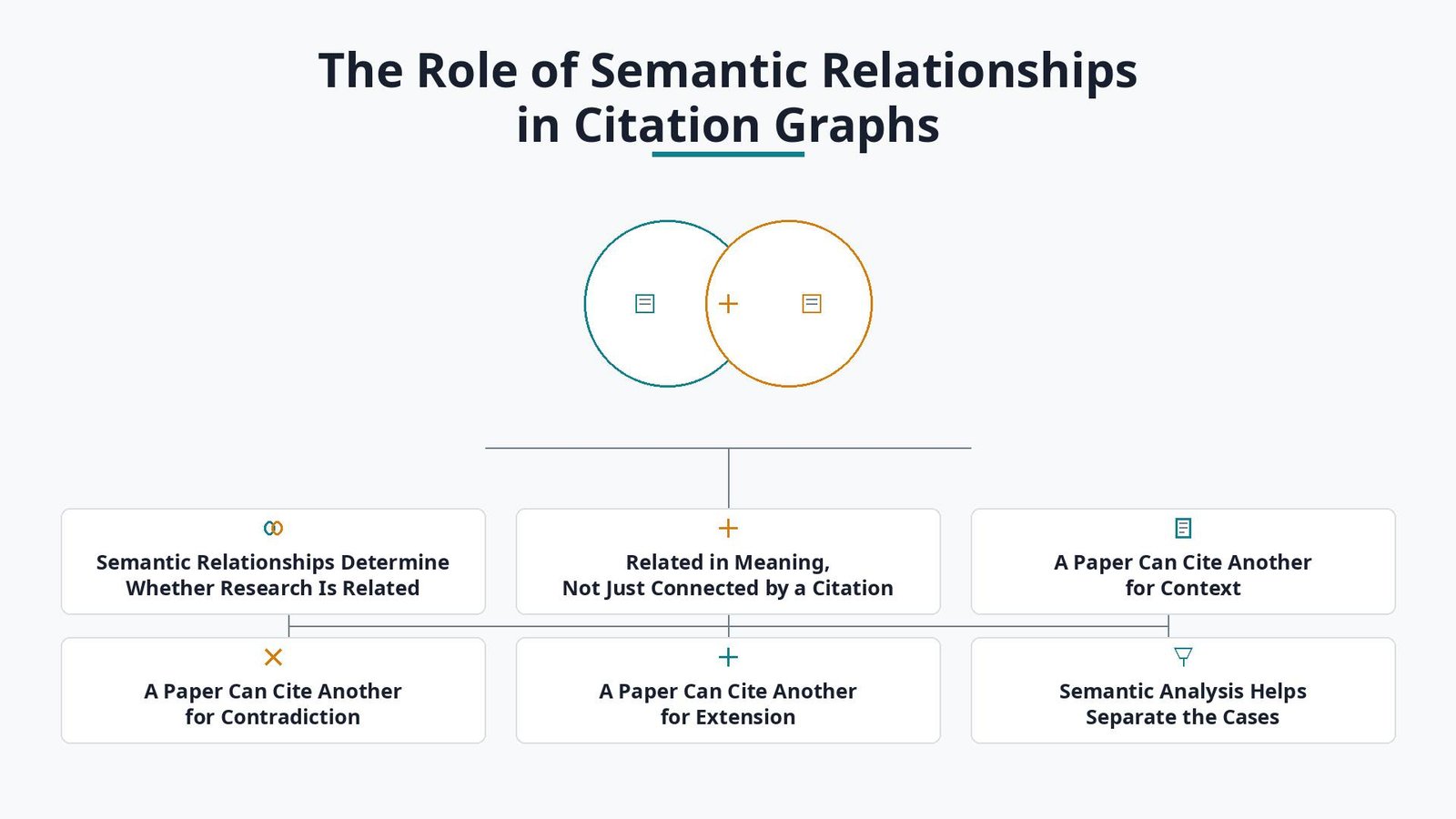
Semantic relationships determine whether two pieces of research are actually related in meaning, not just connected by a citation. A paper can cite another for context, contradiction, or extension, and semantic analysis helps separate those cases from each other.
Co-Citation and Bibliographic Coupling
Co-citation happens when two papers are both cited together by a third paper, suggesting they’re topically related even without citing each other directly. Bibliographic coupling works the opposite way. Two papers that cite the same sources tend to share subject matter. Both techniques let researchers find related work that a keyword search alone would miss.
Semantic Similarity vs. Direct Citation Links
Direct citation links show explicit acknowledgment between works. Semantic similarity, by contrast, measures how close two pieces of content are in meaning, even with zero citation connection between them. Combining both signals produces a far richer map than either one alone.
Key Components of a Citation Knowledge Graph
Every citation knowledge graph is built from a consistent set of components: typed entity nodes, weighted relationship edges, and metadata that adds context to both. Missing any one of these pieces limits how useful the resulting graph becomes.
Entity Nodes (Authors, Papers, Journals, Institutions)
Entity nodes represent the actual objects in the graph, individual papers, named authors, journals, and the institutions behind the research. An entity node is a single addressable unit of data representing one real-world object inside the graph. Disambiguating entities, like distinguishing two authors with the same name, remains one of the hardest parts of building an accurate graph.
Edge Types and Weighted Relationships
Edges capture how nodes relate: citing, co-authoring, or being published in the same venue. Weighting those edges by recency, citation count, or venue prestige lets algorithms prioritize stronger connections over weaker, incidental ones.
How Search Engines Use Citation Graphs for Authority Signals

Search engines borrow the exact logic of academic citation graphs to evaluate authority on the web, treating links and references between pages the same way academia treats citations between papers. This shared logic is why SEO professionals study citation analysis research at all.
Citation Graphs vs. Backlink Graphs
A backlink graph works almost identically to an academic citation graph: pages are nodes, links are edges, and authority flows through the network based on who links to whom. Google’s original PageRank research was directly inspired by academic citation analysis, borrowing its core math from how scholarly influence gets measured.
Why This Matters for SEO and Content Authority
Content that earns citations, whether academic references or web backlinks, signals trust to the systems evaluating it. Building genuinely citation-worthy content means producing original data, clear definitions, and research that other sources want to reference.
Citation Knowledge Graphs vs. Traditional Knowledge Graphs
A citation knowledge graph is a knowledge graph is a structured network that specifically models citation relationships, while a traditional knowledge graph models general facts and entity relationships regardless of citation behavior. A knowledge graph might connect “Paris” to “France” through an “is capital of” relationship, where a citation graph instead connects two papers through a “references” relationship. The citation variant is narrower in scope but denser in the specific relationship type it tracks.
Applications in Academic Research
Citation knowledge graphs speed up nearly every stage of academic research, from finding relevant prior work to spotting where a field hasn’t been explored yet. Researchers increasingly treat these graphs as a primary discovery tool rather than a secondary reference check.
Literature Review Acceleration
A literature review that once took weeks of manual citation chasing can now be mapped visually in a graph tool, surfacing the most-cited and most-connected papers in a field almost instantly. This acceleration is one of the most cited practical benefits among research teams adopting graph-based tools.
Identifying Research Gaps and Emerging Fields
Sparse areas in a citation graph, clusters with few connections to the rest of the network, often point to underexplored research gaps or genuinely emerging fields. A research gap is an area within a knowledge graph that is a topic with unusually low citation density relative to its surrounding cluster. Spotting these gaps visually is far faster than inferring them from reading papers one at a time.
Applications in Scientific Discovery and Citation Analysis
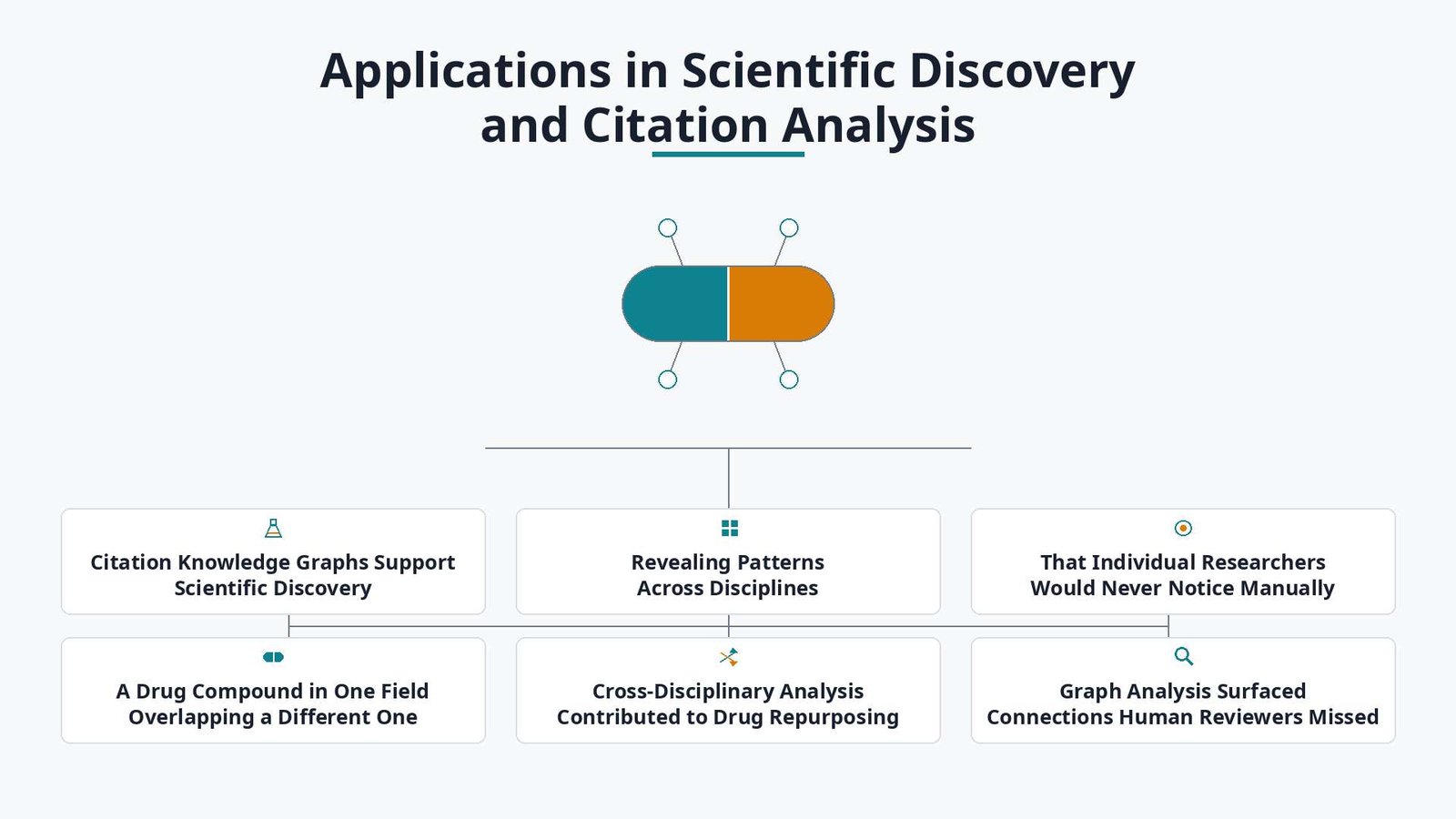
Citation knowledge graphs support scientific discovery by revealing patterns across disciplines that individual researchers would never notice manually, such as a drug compound studied in one field showing unexpected citation overlap with a completely different one. Cross-disciplinary citation analysis has already contributed to several documented cases of drug repurposing discoveries, where graph analysis surfaced connections human reviewers missed.
Citation Graphs in AI Training and Large Language Models
Large language models increasingly rely on citation graphs during training and retrieval to ground generated answers in verifiable, connected sources rather than isolated text fragments. Retrieval-augmented generation systems often query a citation graph structure to find the most authoritative source before generating a response, which reduces the kind of unsupported claims that plague ungrounded models.
Citation Graphs in Search Engine Optimization and AI Overviews
Citation knowledge graphs now directly influence how AI-generated search results choose which sources to cite, making the underlying graph structure a genuine ranking factor for modern search visibility. This shift is reshaping how SEO teams think about earning references rather than just earning links.
Entity-Based SEO and Citation Signals
Entity-based SEO treats a brand, author, or piece of content as a node that needs genuine connections to other trusted nodes, not just keyword matches. Building those connections means getting cited, referenced, and linked by sources that already carry established authority in the graph.
How AI Search Tools Evaluate Source Credibility
AI search tools evaluate source credibility using signals similar to citation graph weighting: frequency of reference, recency, and the authority of the citing source all factor into whether a page gets surfaced or quoted. A page cited by multiple independent, authoritative sources carries far more weight than one cited once by a low-authority site.
Common Tools and Platforms That Build Citation Graphs
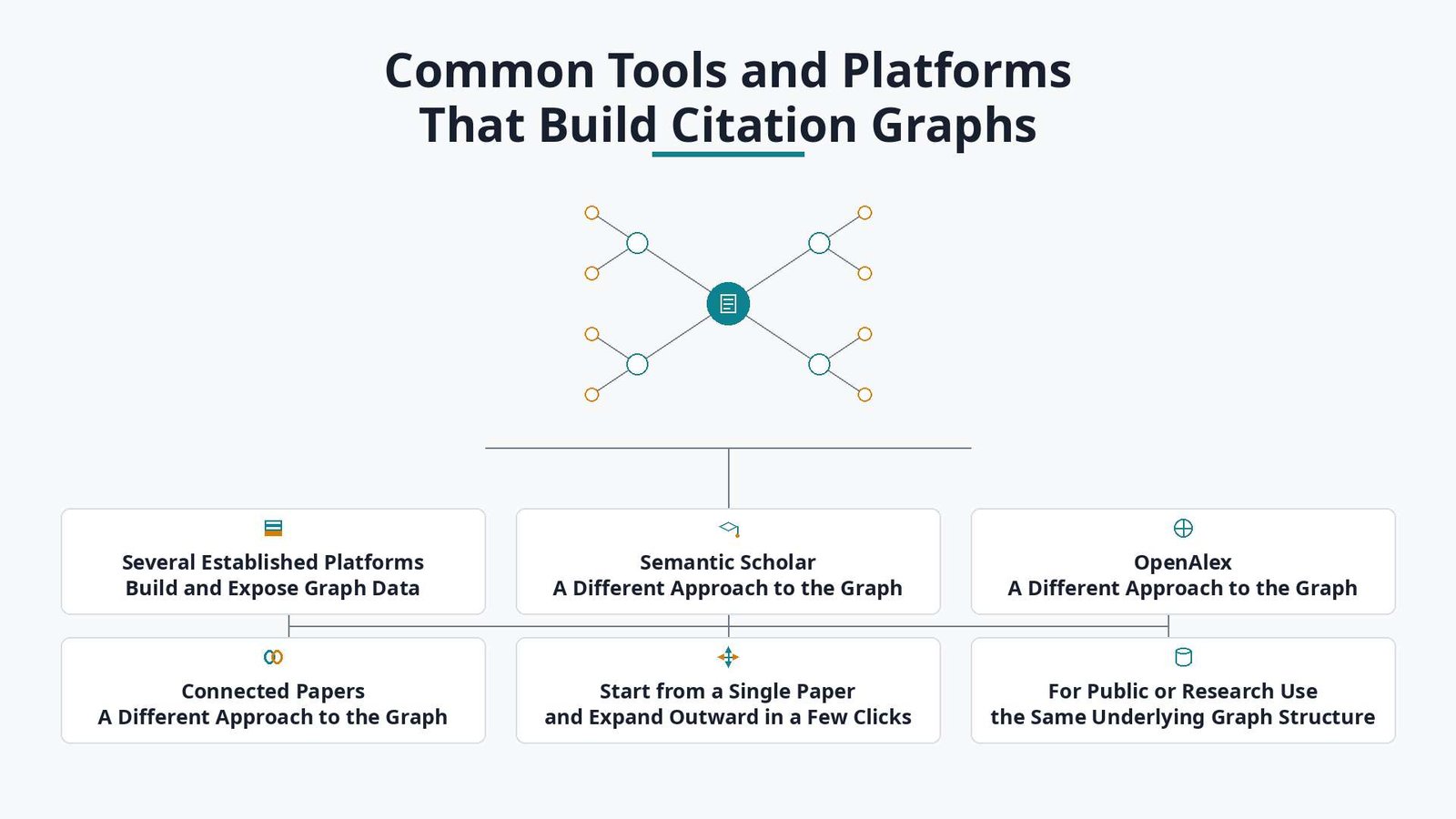
Several established platforms already build and expose citation graph data for public or research use, including Semantic Scholar, OpenAlex, and Connected Papers, each offering a different visualization or query approach to the same underlying graph structure. Most of these tools let you start from a single paper and expand outward through its citation network in just a few clicks.
Challenges and Limitations of Citation Knowledge Graphs
Citation knowledge graphs face real limitations around data quality, entity disambiguation, and citation bias that any user of these systems needs to understand before trusting the output blindly. Papers behind paywalls, non-English research, and older pre-digital publications are frequently underrepresented, which skews the resulting graph toward recent, open-access, English-language work.
How to Evaluate the Quality of a Citation Graph
Evaluating a citation graph’s quality means checking its coverage, update frequency, entity disambiguation accuracy, and the transparency of its source data before relying on its conclusions. A graph that only indexes a narrow set of journals will misrepresent a field’s true structure no matter how sophisticated its underlying algorithm is.
The Future of Citation Knowledge Graphs in Research and Search

Citation knowledge graphs are moving toward real-time updates, cross-domain integration, and deeper involvement in how AI systems select and verify sources before generating answers. As generative search tools mature, the graphs underpinning source credibility will likely become as influential to visibility as backlink profiles have been for the last two decades.
Conclusion
Citation knowledge graphs connect papers, authors, and ideas into networks that reveal authority, influence, and gaps across entire fields. These same structures now shape how search engines and AI tools evaluate credibility. We help brands earn the kind of citations and connections that build lasting authority. Reach out to White Label SEO Service to build yours.
Frequently Asked Questions
What is a citation knowledge graph in simple terms?
A citation knowledge graph is a map connecting papers, authors, and institutions through their citation relationships. It shows how research connects, not just what each paper references individually.
How is a citation graph different from a citation index?
A citation index is a searchable list counting citations per paper. A citation graph adds relationship structure, letting you traverse and analyze connections between entities, not just count them.
Do search engines actually use citation graphs for ranking?
Yes, search engines use citation-graph logic through backlink analysis, treating links between pages the way academic citation graphs treat references between papers. Authority flows through the network similarly in both systems.
What industries or fields use citation knowledge graphs besides academia?
SEO, pharmaceutical research, patent analysis, and AI development all use citation knowledge graphs. Each field applies the same core structure to track authority, discovery, or relevance within its own data.
Can citation knowledge graphs predict future research trends?
Yes, sparse or rapidly growing clusters within a citation graph often signal emerging research trends before they become mainstream. Analysts monitor these clusters to spot shifts earlier than traditional literature reviews would reveal.
What role do citation graphs play in AI Overviews and generative search?
AI Overviews use citation-graph-style signals to select which sources to cite in generated answers. Source authority, citation frequency, and recency all influence which pages get quoted.
What tools can I use to explore a citation knowledge graph?
Semantic Scholar, OpenAlex, and Connected Papers all let users explore citation graphs interactively. Each tool starts from a single paper and expands outward through its citation network.


