
National SEO typically takes 6 to 12 months to deliver meaningful organic results, with competitive industries often requiring 12 to 24 months to achieve top rankings, sustained traffic growth, and measurable ROI from search visibility.
Setting realistic timeline expectations protects your SEO budget from misleading promises, helps you allocate resources correctly, and aligns marketing strategy with sustainable, long-term organic growth.
This guide breaks down each SEO phase, the factors that influence ranking speed, realistic milestones to track, and proven ways to accelerate national search results.
What Is National SEO and Why Timeline Expectations Matter
National SEO is the practice of optimizing a website to rank in organic search results across an entire country rather than a single city or region. It targets broad, high-volume keywords without geographic modifiers, competes against well-established domains, and demands deeper investment in content, technical infrastructure, and authority signals.
Building organic visibility across an entire country requires a different strategic depth than local search, and our national SEO services overview walks through the full scope of what nationwide optimization actually involves.
Unrealistic timeline expectations are the single biggest reason businesses abandon SEO before it pays off. Google itself has stated in its Search Central documentation that meaningful SEO results generally take four months to a year to materialize, and that timeline assumes consistent execution. National campaigns sit at the longer end of that range because they compete against domains that have been earning trust signals for years.

Realistic National SEO Timeline: Month-by-Month Breakdown
National SEO progress unfolds in predictable phases. Each stage builds on the previous one, and skipping foundational work delays every later milestone.
Months 1–3: Foundation and Technical SEO
The first quarter focuses on technical groundwork rather than visible rankings. Work includes site architecture cleanup, crawl error resolution, page speed optimization, schema markup, internal linking structure, and a complete on-page audit. Keyword research and topical mapping are finalized during this period to guide content development.
Expect minimal ranking movement in months one through three. Indexation improvements and initial impressions in Google Search Console are the early signals that work is paying off. The first 90 days focus heavily on crawlability and indexation fixes, which is exactly what a structured technical SEO audit uncovers before any content or link building begins.
Months 4–6: Content Expansion and Authority Signals
Months four through six are the publishing phase. Cluster pages, supporting articles, and pillar content begin filling out topical authority. New pages start ranking on positions 30 to 80 for target keywords, then gradually climb as Google evaluates relevance and engagement signals.
Once foundations are stable, growth shifts toward publishing depth and topical coverage, which is where a documented SEO content strategy becomes the engine of ranking momentum.
Months 7–12: Ranking Acceleration and Traffic Growth
This is when national SEO starts producing measurable business outcomes. Mid-tail and long-tail keywords climb into the top 20, organic traffic increases noticeably month over month, and the earliest leads or sales attributable to SEO begin appearing in analytics.
Ranking acceleration during this phase depends heavily on earning quality backlinks, and a disciplined link building strategy is the lever that pushes pages from page two into top-five visibility.
Months 12+: Compounding Results and Market Leadership
Beyond month twelve, SEO enters its compounding phase. Authority accumulates, internal linking strengthens topical signals, and head terms with high commercial intent begin ranking on page one. ROI per dollar invested typically peaks in years two and three, when content created in earlier phases continues earning traffic without additional spend.

Key Factors That Influence National SEO Timeline
No two campaigns move at the same pace. The variables below determine where a business lands inside the 6-to-24-month range.
- Domain age and history. A brand-new domain spends 3 to 6 months in the so-called sandbox effect before Google begins trusting it. Established domains with clean histories move faster.
- Competition level. Industries like finance, legal, health, and SaaS face dense competition from authoritative incumbents, extending timelines by 6 to 12 months.
- Content production volume. Sites publishing 8 to 20 high-quality pieces monthly see faster topical authority gains than those producing one or two.
- Backlink profile. Quality referring domains accelerate rankings; thin link profiles slow them.
- Technical health. Crawl issues, slow load times, and indexation problems can stall an otherwise strong campaign indefinitely.
- Search intent alignment. Pages built around real user queries outperform keyword-stuffed content on every timeline.
Timeline outcomes are shaped by competition, site authority, and content depth, variables explored in detail across the core SEO ranking factors that determine how fast pages move up the SERPs.
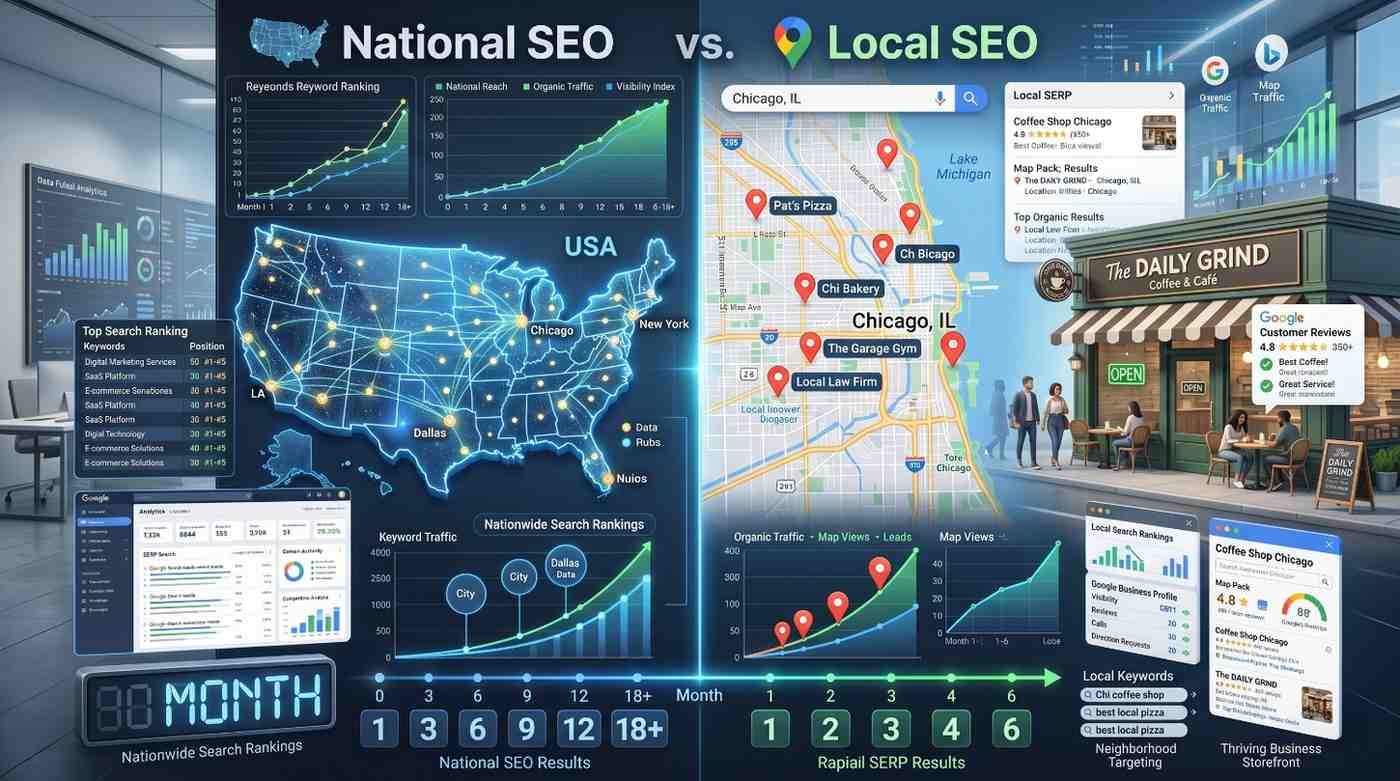
National SEO vs Local SEO: Timeline Differences
Local SEO operates in a smaller competitive pool. A well-optimized Google Business Profile combined with citation building and on-page geographic signals can produce map-pack visibility within 2 to 4 months. National SEO has no equivalent shortcut because it competes against every domain ranking for non-geographic terms.
Geographic scope changes everything about how quickly results appear, and our breakdown of local vs national SEO explains why local campaigns rank faster than nationwide efforts.
Local campaigns also benefit from proximity signals, review velocity, and category relevance — none of which apply nationally. National campaigns must instead earn authority through editorial backlinks, comprehensive topical coverage, brand search demand, and consistent publishing over a longer horizon.
How to Accelerate Your National SEO Results
Speed in SEO comes from execution discipline, not shortcuts. The strategies below consistently compress timelines without violating Google’s guidelines.
- Publish content with topical depth, not just volume. Cover every relevant subtopic inside a content cluster instead of fragmenting effort across unrelated themes.
- Prioritize technical fixes early. Crawl efficiency and Core Web Vitals improvements yield compounding benefits the moment they’re deployed.
- Build links from contextually relevant domains. A handful of editorial backlinks from topically aligned publishers outperforms dozens of generic placements.
- Refresh existing content quarterly. Updating published pages with new data and improved internal links often produces faster ranking lifts than new content.
- Match search intent precisely. Audit top-ranking pages for each target query and match format, depth, and structure rather than guessing.
- Maintain consistent publishing cadence. Stop-start patterns reset momentum.
Pairing technical, content, and link work under one roadmap shortens the path to results, which is why working with a full-service SEO partner typically accelerates timelines compared with fragmented in-house execution.
Measuring Progress: KPIs and Milestones
Tracking the right metrics keeps stakeholders confident during the months before traffic visibly accelerates.
- Months 1–3: Indexation rate, crawl errors resolved, Core Web Vitals scores, impression growth in Search Console.
- Months 4–6: Average ranking position improvements, increase in ranked keywords, branded vs non-branded impression ratio.
- Months 7–12: Organic clicks, top-10 keyword count, conversions from organic traffic, assisted conversions.
- Months 12+: Revenue attributed to organic, share of voice against competitors, organic CAC compared to paid channels.
Tracking progress accurately keeps teams aligned with realistic expectations, which is the role of a structured SEO reporting dashboard covering rankings, traffic, and conversion attribution.
Avoid measuring success by raw traffic in the first six months. Quality indicators — ranked keyword growth, indexation improvements, and rising impressions — predict future revenue far more reliably than early click volume.
Conclusion
National SEO timelines reflect the structural realities of search competition, domain authority, and topical depth, with most campaigns reaching meaningful traction between months six and twelve and full ROI compounding well beyond year one.
Treating SEO as a long-term asset rather than a short-term campaign is what separates sustainable organic growth from short-lived ranking spikes and wasted marketing spend across crowded national search landscapes.
We help businesses build measurable, lasting organic growth through disciplined strategy and execution, and our team at White Label SEO Service is ready to map your national SEO timeline with realistic milestones and accountable performance tracking.
Frequently Asked Questions
How long does national SEO take to show results?
National SEO usually takes 6 to 12 months to produce meaningful ranking and traffic results. Highly competitive industries may require 12 to 24 months before head terms reach top-of-page-one visibility.
Can national SEO results appear faster than 6 months?
Faster results are possible for established domains with strong authority, existing content libraries, and minimal technical issues. New domains or competitive niches rarely see meaningful national rankings before month six.
Why is national SEO slower than local SEO?
National SEO competes against every domain ranking for non-geographic keywords, while local SEO benefits from proximity signals and a smaller competitive pool. National rankings require deeper authority and content investment to overcome.
What happens if I stop SEO after 6 months?
Stopping SEO before 12 months typically means abandoning the investment just before compounding returns begin. Rankings can stall, competitors regain lost ground, and earlier work loses momentum quickly without ongoing optimization.
How much content is needed for national SEO?
Most national campaigns require 50 to 200 well-optimized pages across pillar, cluster, and supporting content to build durable topical authority. Volume alone is insufficient without depth, intent alignment, and internal linking.
Does paid advertising speed up SEO results?
Paid ads do not directly improve organic rankings, but they generate brand search demand, audience data, and conversion insights that strengthen SEO strategy. Combined campaigns often accelerate overall marketing ROI.