
Backlinks remain one of Google’s most influential ranking factors. Whether you actively pursue links through outreach or attract them naturally through exceptional content determines your SEO trajectory, risk exposure, and long-term results.
Understanding when to build versus earn links separates successful SEO campaigns from wasted budgets. Most businesses need both approaches working together.
This guide breaks down each strategy’s mechanics, costs, timelines, and risks. You’ll learn exactly which approach fits your situation and how to execute both effectively.
What Is Link Building?
Link building is the deliberate, proactive process of acquiring backlinks from external websites to your own. It involves identifying target sites, creating outreach campaigns, and securing placements through direct effort. You control the pace, target selection, and messaging.
This approach treats link acquisition as a structured marketing activity. Teams set monthly targets, track response rates, and measure cost-per-link. The process requires consistent effort but delivers predictable results when executed properly.
Link building works because you’re not waiting for links to happen. You’re making them happen through systematic outreach and relationship development.
Traditional Link Building Tactics and Methods
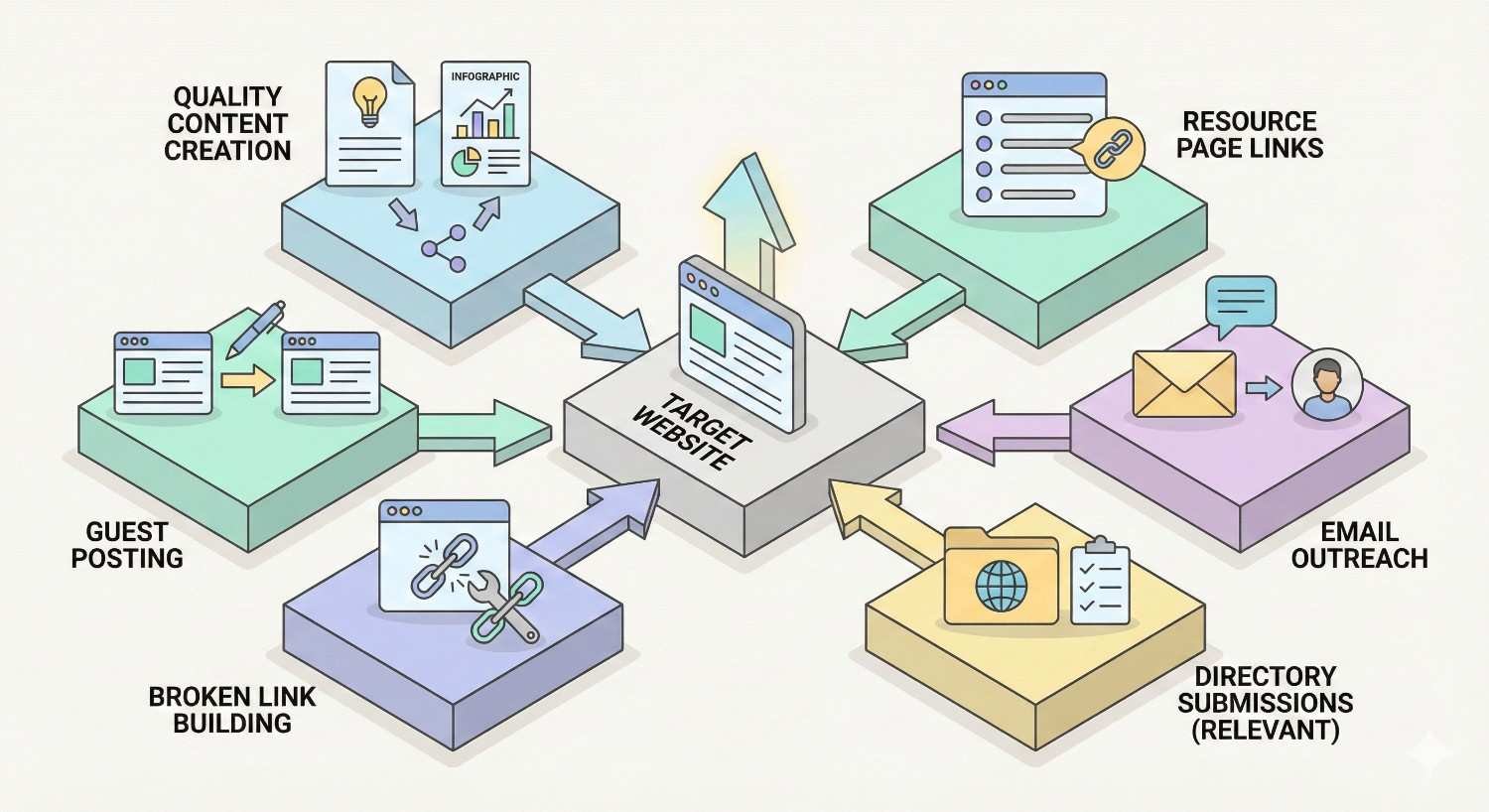
Several proven tactics form the foundation of most link building campaigns.
Guest posting remains effective when targeting relevant, quality publications. You contribute valuable content to another site in exchange for a contextual backlink. The key is providing genuine value rather than thin content designed solely for link placement.
Resource page link building targets curated lists of helpful tools, guides, or references. If your content genuinely belongs on these pages, webmasters often add it willingly.
Broken link building identifies dead links on relevant sites and offers your content as a replacement. This provides value to the site owner while earning you a link.
Skyscraper technique involves finding popular content in your niche, creating something substantially better, and reaching out to sites linking to the original. The improved resource gives webmasters a reason to update their links.
HARO and journalist requests connect you with reporters seeking expert sources. Providing helpful quotes earns mentions and links from news publications.
Each tactic requires different skill sets and resources. Guest posting demands strong writing. Broken link building needs technical research tools. HARO requires quick response times and genuine expertise.
The Role of Outreach in Link Building Campaigns
Outreach is the engine driving link building success. Without effective communication, even the best content sits unlinked.
Personalization matters more than volume. Generic templates get ignored. Emails referencing specific articles, acknowledging the recipient’s work, and explaining clear value propositions earn responses.
Successful outreach follows a relationship-first approach. Before asking for anything, engage with the target’s content. Share their articles. Leave thoughtful comments. Build familiarity before making requests.
Follow-up sequences increase success rates significantly. Most positive responses come from second or third emails, not the initial contact. Persistence without annoyance requires careful timing and varied messaging.
Building genuine relationships with editors, bloggers, and webmasters creates ongoing opportunities. One strong connection can yield multiple links over time as trust develops.
What Is Link Earning?
Link earning is the passive acquisition of backlinks through creating content so valuable that others link to it without being asked. Instead of outreach, you invest in assets designed to attract natural citations.
This approach relies on content quality, brand visibility, and industry positioning. When your research, tools, or insights become reference points in your niche, links accumulate organically.
Link earning requires patience. You’re building assets that compound over time rather than executing campaigns with immediate results.
How Quality Content Drives Natural Link Acquisition
Certain content types naturally attract links because they serve specific needs other creators have.
Original data and research get cited because writers need sources. If you publish the definitive study on a topic, everyone covering that subject links to your findings.
Comprehensive guides become reference materials. When your guide covers a topic more thoroughly than anything else available, it becomes the default recommendation.
Free tools and calculators earn links through utility. Bloggers and journalists link to helpful resources their audiences can use.
Visual assets like infographics, charts, and diagrams get embedded and credited. Complex information presented visually spreads across the web.
The common thread is providing something others can’t easily replicate. Unique value creates linking incentives that persist long after publication.
The Relationship Between Brand Authority and Earned Links
Brand recognition accelerates link earning dramatically. Established brands attract links that newer competitors must actively pursue.
When journalists write about your industry, they cite brands they recognize. When bloggers recommend tools, they mention names their audience trusts. Authority creates a gravitational pull for links.
Building brand authority requires consistent visibility. Speaking at conferences, publishing thought leadership, appearing on podcasts, and engaging in industry conversations all contribute. Each touchpoint reinforces your position as a credible source.
Strong brands also benefit from unlinked mentions converting to links. When someone references your company without linking, a simple request often succeeds because they already view you as authoritative.
Link Building vs Link Earning: Key Differences Explained
Understanding the fundamental differences between these approaches helps you allocate resources effectively and set realistic expectations.
Control and Scalability: Active vs Passive Approaches
Link building offers direct control over outcomes. You choose target sites, set outreach volume, and adjust tactics based on results. Scaling means hiring more outreach specialists or increasing campaign budgets.
Predictability is link building’s advantage. With established processes, you can forecast monthly link acquisition within reasonable ranges. This makes planning and budgeting straightforward.
Link earning provides less control but potentially greater scale. A single viral piece can generate hundreds of links without additional effort. However, you can’t force content to succeed.
The passive nature means results vary significantly. Some assets attract links immediately. Others take months to gain traction. Some never perform despite quality.
Combining both approaches balances control with upside potential. Active building provides baseline results while earned links deliver occasional windfalls.
Resource Investment: Time, Cost, and Effort Comparison
Link building costs are predictable and ongoing. You pay for outreach tools, content creation, and team time. Costs scale linearly with output. More links require proportionally more investment.
Typical link building expenses include prospecting software, email tools, content writers for guest posts, and outreach specialists. Agencies charge per link or monthly retainers based on volume targets.
Link earning requires heavy upfront investment with uncertain returns. Creating linkable assets demands significant resources. Original research might cost thousands before generating a single link.
However, successful link earning assets continue producing returns indefinitely. A comprehensive guide published today might earn links for years. The cost-per-link decreases over time as the asset accumulates citations.
The investment profiles differ fundamentally. Building requires consistent spending for consistent results. Earning requires concentrated investment for potentially compounding returns.
Risk Profiles: Compliance with Google Guidelines
Link building carries inherent risk when executed poorly. Google’s guidelines explicitly prohibit manipulative link schemes. Tactics crossing ethical lines can trigger penalties.
Risky practices include buying links, participating in link exchanges, using private blog networks, and over-optimizing anchor text. These shortcuts might work temporarily but create long-term vulnerability.
Ethical link building remains safe. Guest posting on relevant sites, earning editorial links through genuine outreach, and building relationships with industry peers align with Google’s intent.
Link earning carries minimal algorithmic risk. Natural links from quality content represent exactly what Google wants to reward. There’s no manipulation to penalize.
The risk difference influences strategy selection. Businesses in sensitive industries or those prioritizing long-term stability often favor earning over building.
Link Quality and Authority Signals
Built links vary widely in quality. Outreach campaigns can target high-authority publications or settle for easier placements on lower-quality sites. The approach determines outcomes.
Disciplined link building focuses on relevance and authority. Links from topically related, respected sites carry more weight than random placements.
Earned links typically come from higher-quality sources. Sites linking without being asked usually have editorial standards. They’re citing your content because it genuinely adds value to their audience.
Natural link profiles also show diversity that’s difficult to replicate through building alone. Earned links come from varied sources with different anchor texts and contexts.
When to Use Link Building vs Link Earning
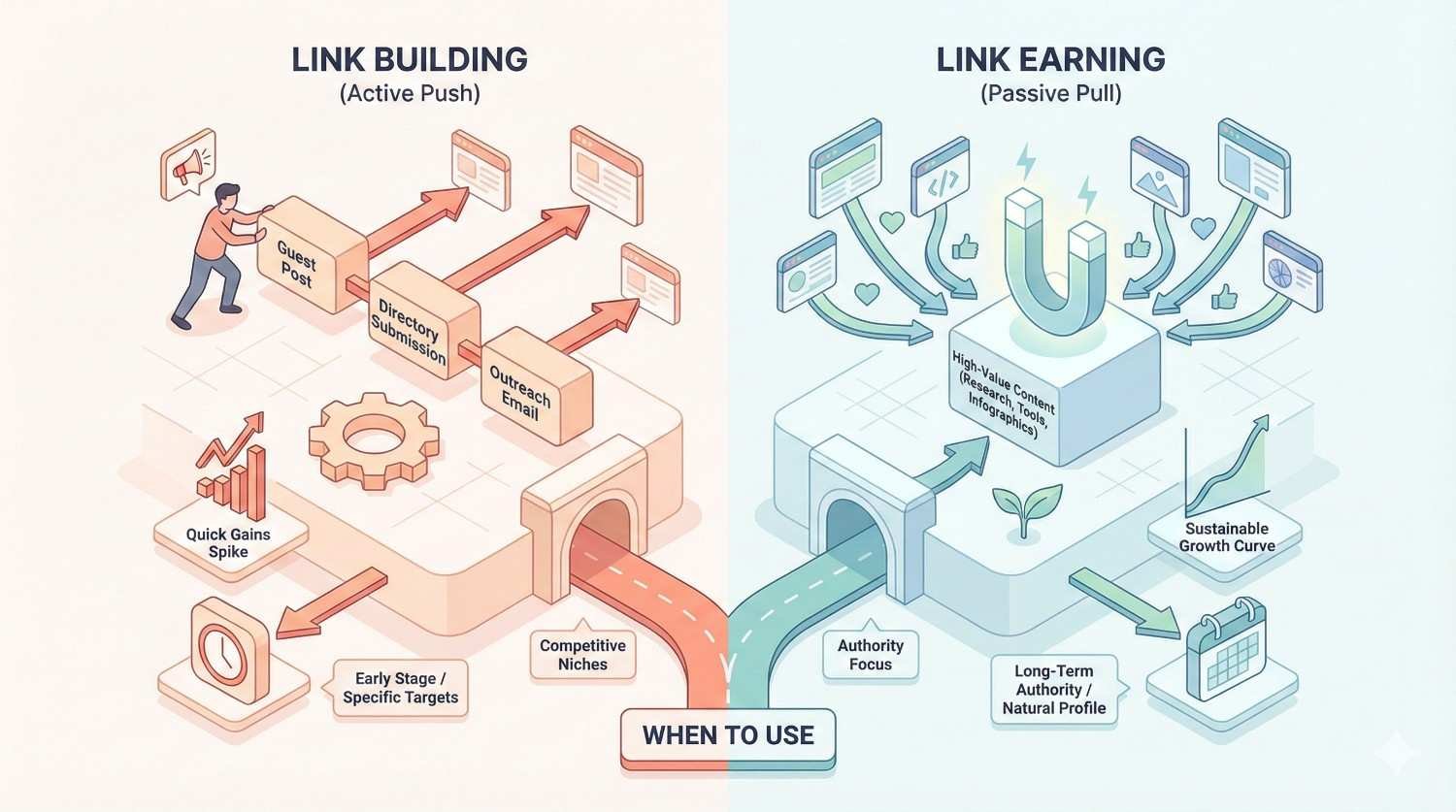
Neither approach works universally. Your situation determines the optimal mix.
Link Building Scenarios: New Sites and Competitive Niches
New websites need active link building. Without existing authority or brand recognition, waiting for natural links means waiting indefinitely. Proactive outreach jumpstarts visibility.
Fresh domains lack the trust signals that attract organic links. Building establishes initial authority that makes future earning possible.
Competitive niches require aggressive building. When rivals actively pursue links, passive strategies fall behind. Matching competitor link velocity often demands outreach campaigns.
Industries like finance, legal, and health feature intense competition for rankings. Earning alone rarely generates sufficient links to compete.
Time-sensitive opportunities favor building. Product launches, seasonal campaigns, and trending topics require immediate link acquisition. Earning can’t match the speed of targeted outreach.
Link Earning Scenarios: Established Brands and Content-Rich Sites
Established brands should prioritize earning. Existing authority means natural links flow more easily. Investing in linkable assets leverages brand recognition efficiently.
Companies with strong reputations attract links through normal business activities. Press coverage, industry mentions, and organic citations accumulate without dedicated outreach.
Content-rich sites benefit from earning strategies. Publishers, media companies, and educational institutions already create substantial content. Optimizing for linkability multiplies existing efforts.
Thought leadership positions favor earning. Industry experts, researchers, and innovators attract citations naturally. Their insights become reference points others link to.
Hybrid Approaches: Combining Both Strategies for Maximum Impact
Most businesses benefit from combining approaches. Building provides predictable baseline results. Earning delivers occasional high-value wins.
A balanced strategy might allocate 60% of resources to building for consistent progress and 40% to earning for long-term asset development.
Amplification bridges both approaches. Create linkable assets, then actively promote them through outreach. This combines earning’s quality with building’s control.
The hybrid model reduces dependency on either approach. If outreach campaigns underperform, earned links provide backup. If content doesn’t attract natural links, building maintains momentum.
How Link Building Works: Process and Implementation
Effective link building follows systematic processes that maximize efficiency and results.
Identifying Link Opportunities and Prospect Research
Prospect research determines campaign success. Targeting irrelevant or low-quality sites wastes resources. Careful selection focuses effort on valuable opportunities.
Start by analyzing competitor backlinks. Tools like Ahrefs, Moz, and Semrush reveal where rivals earn links. These sites have demonstrated willingness to link within your niche.
Evaluate prospects on multiple criteria:
- Domain authority and traffic
- Topical relevance to your content
- Editorial standards and content quality
- Likelihood of response based on site type
- Link placement opportunities available
Build segmented prospect lists organized by tactic. Guest post targets differ from resource page opportunities. Separate lists enable tailored outreach.
Prioritize quality over quantity. One link from a respected industry publication outweighs dozens from obscure blogs. Focus resources on high-value targets.
Outreach Strategies and Relationship Building
Effective outreach feels like genuine communication, not marketing. Recipients receive countless link requests. Standing out requires authentic engagement.
Research each prospect before reaching out. Read their recent articles. Understand their audience. Reference specific content in your email.
Craft value-first pitches. Lead with what you’re offering, not what you want. Explain how your content helps their audience before mentioning links.
Keep emails concise. Busy editors don’t read lengthy pitches. Get to the point quickly while maintaining warmth.
Build relationships beyond single transactions. Connect on social media. Share their content. Engage with their community. Long-term relationships yield ongoing opportunities.
Track all interactions in a CRM or spreadsheet. Note response patterns, preferences, and relationship history. This information improves future outreach.
Guest Posting and Content Contribution Methods
Guest posting remains viable when executed ethically. The key is contributing genuine value rather than thin content designed solely for links.
Target publications your audience actually reads. Links from relevant, respected sites carry more weight and drive referral traffic.
Pitch topics that serve the host site’s audience. Study their existing content. Identify gaps you can fill. Propose angles that complement their editorial calendar.
Write guest posts to the same standard as your own content. Quality reflects on your brand regardless of where it’s published.
Follow editorial guidelines precisely. Publications have specific requirements for formatting, length, and style. Ignoring guidelines signals carelessness.
Diversify guest posting targets. Concentrating links from few sources looks unnatural. Spread contributions across multiple relevant publications.
Measuring Link Building Campaign Performance
Track metrics that matter for your goals. Raw link counts tell part of the story. Quality indicators reveal true impact.
Key performance indicators include:
- Links acquired per month
- Average domain authority of linking sites
- Topical relevance scores
- Referral traffic from new links
- Ranking improvements for target keywords
- Cost per link acquired
- Outreach response and conversion rates
Monitor link velocity for natural patterns. Sudden spikes or perfectly consistent acquisition look artificial. Aim for organic-looking growth curves.
Analyze which tactics perform best. Some approaches yield better results for your niche. Double down on what works. Abandon underperforming tactics.
Regular reporting keeps campaigns accountable. Monthly reviews identify issues early and enable course corrections.
How Link Earning Works: Creating Linkable Assets
Link earning requires strategic content investment designed to attract natural citations.
Types of Content That Naturally Attract Links
Certain content formats consistently earn links across industries.
Ultimate guides covering topics comprehensively become reference materials. When your guide is the most thorough resource available, others link to it rather than recreating the information.
Original research and data get cited because writers need sources. Publishing unique findings makes you the primary source others must reference.
Free tools and calculators earn links through utility. Interactive resources that solve problems attract ongoing citations.
Expert roundups and interviews leverage others’ audiences. Contributors share and link to content featuring their insights.
Controversial or contrarian takes generate discussion and links. Strong positions invite responses, both supportive and critical.
Visual content like infographics, charts, and diagrams gets embedded across the web. Complex information presented visually spreads naturally.
Original Research, Data Studies, and Industry Reports
Original research represents the highest-value linkable asset. Unique data can’t be found elsewhere, making your content the mandatory citation.
Identify questions your industry lacks answers to. Survey your audience. Analyze your internal data. Partner with research firms for larger studies.
Present findings accessibly. Raw data doesn’t earn links. Clear visualizations, key takeaways, and quotable statistics do.
Publish research annually to establish ongoing authority. The “2025 State of [Industry] Report” becomes an anticipated reference point.
Promote research actively upon release. Even linkable assets benefit from initial amplification. Reach out to journalists and bloggers who cover your topic.
Make data embeddable. Provide charts and graphics others can use with attribution. Easy embedding increases link acquisition.
Building Brand Visibility and Thought Leadership
Brand visibility accelerates link earning. Recognized names attract citations that unknown competitors must pursue actively.
Develop thought leadership through consistent content publication. Regular insights establish expertise over time.
Pursue speaking opportunities. Conference presentations, podcast appearances, and webinars build recognition. Each appearance introduces your brand to new audiences.
Engage in industry conversations. Comment on trending topics. Share perspectives on LinkedIn and Twitter. Visibility compounds through consistent presence.
Build relationships with journalists and influencers. When they need expert sources, recognized names come to mind first.
Tracking and Analyzing Earned Link Performance
Monitor new backlinks continuously. Tools like Ahrefs, Moz, and Google Search Console alert you to new links.
Analyze which content earns links. Identify patterns in successful assets. Create more content matching those characteristics.
Track link sources and contexts. Understanding why sites link helps replicate success. Are they citing data? Recommending tools? Referencing guides?
Measure time-to-link for different content types. Some assets earn links immediately. Others build momentum over months. Set realistic expectations based on historical patterns.
Calculate ROI for linkable assets. Compare creation costs against links earned over time. Successful assets justify continued investment in similar content.
The Risks of Link Building: What to Avoid
Link building carries risks when executed improperly. Understanding dangers helps you avoid costly mistakes.
Google Penalties and Algorithmic Devaluation
Google actively combats manipulative link schemes. Violations can trigger manual penalties or algorithmic devaluation.
Manual penalties result from human reviewers identifying violations. Recovery requires removing problematic links and submitting reconsideration requests. The process takes months.
Algorithmic devaluation happens automatically. Google’s systems identify unnatural patterns and discount affected links. You might not even know it’s happening.
Warning signs include:
- Sudden ranking drops without obvious cause
- Manual action notifications in Search Console
- Unnatural link warnings from Google
Prevention beats recovery. Stick to ethical tactics that align with Google’s guidelines.
Low-Quality Link Schemes and Black Hat Tactics
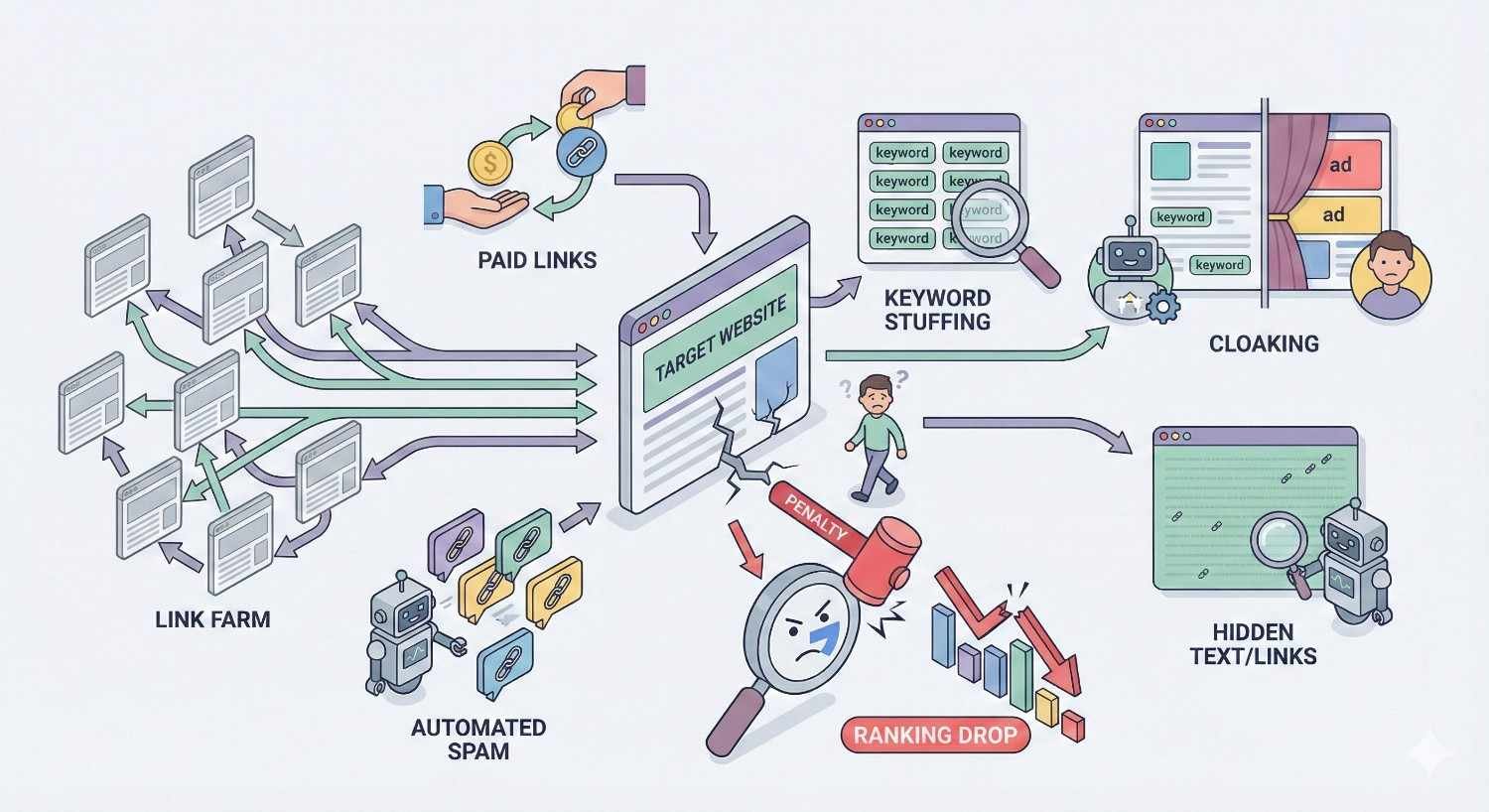
Several tactics cross ethical lines and create risk.
Link exchanges where sites agree to link to each other violate guidelines. Reciprocal linking at scale looks manipulative.
Comment spam placing links in blog comments provides no value and triggers penalties.
Forum and profile links from low-quality sites add no authority and can harm your profile.
Article directories and link farms exist solely for link manipulation. Google identifies and discounts these sources.
Automated link building using software to create links at scale produces obvious patterns that algorithms detect.
These shortcuts might show temporary results but create long-term vulnerability. The risk-reward ratio never favors black hat tactics.
Link Buying and PBN Risks
Buying links directly violates Google’s guidelines. Paid placements without proper disclosure constitute manipulation.
Link sellers often provide low-quality placements on compromised or irrelevant sites. The links carry minimal value while creating penalty risk.
Private blog networks (PBNs) are collections of sites created solely for link building. Google actively identifies and penalizes PBN links.
PBN footprints include shared hosting, similar site designs, thin content, and obvious interlinking patterns. Detection has become increasingly sophisticated.
Sponsored content requires disclosure. Legitimate paid placements use nofollow or sponsored attributes. Undisclosed paid links violate guidelines.
The safest approach avoids any link acquisition involving payment for placement. Focus resources on earning editorial links through value creation.
The Challenges of Link Earning: Why It’s Not Always Enough
Link earning has limitations that prevent it from serving as a complete strategy for most businesses.
Time Investment and Delayed Results
Linkable assets require significant creation time. Original research might take months to complete. Comprehensive guides demand extensive writing and editing.
After publication, earning links takes additional time. Content must be discovered, evaluated, and cited by other creators. This process can’t be rushed.
New sites face a chicken-and-egg problem. Without existing authority, content struggles to gain visibility. Without visibility, links don’t accumulate. Without links, authority doesn’t build.
Businesses needing quick results can’t rely solely on earning. The timeline simply doesn’t match urgent growth requirements.
Content Saturation and Competition for Attention
Every niche has content saturation. Creating something truly link-worthy requires exceeding existing resources. That bar rises constantly.
Competitors also invest in linkable assets. Standing out demands exceptional quality or unique angles. Good enough doesn’t earn links.
Distribution challenges compound creation difficulties. Even excellent content can go unnoticed without promotion. Passive earning assumes discovery that doesn’t always happen.
The attention economy works against passive strategies. Content competes with endless alternatives for limited audience attention.
When Passive Strategies Fail to Generate Momentum
Some industries resist link earning. B2B niches with small audiences generate fewer natural links. Technical topics attract limited coverage.
Certain content types don’t earn links regardless of quality. Product pages, service descriptions, and commercial content rarely attract organic citations.
Timing affects earning potential. Evergreen content earns links over time. Timely content must capture attention immediately or miss the window.
Relying exclusively on earning leaves gaps that active building must fill. Most successful strategies combine both approaches.
Link Building vs Link Earning: Which Strategy Is Right for Your Business?
Choosing the right approach depends on your specific situation, resources, and goals.
Assessing Your Current Domain Authority and Link Profile
Your starting position influences strategy selection. Established sites with strong profiles can emphasize earning. New sites need building to establish baseline authority.
Analyze your current backlink profile using tools like Ahrefs or Moz. Evaluate total referring domains, average domain authority of linking sites, and link velocity trends.
Compare your profile against competitors. If rivals have significantly more links, catching up requires active building. If you’re competitive, earning might maintain position.
Identify profile weaknesses. Lack of diversity, low-quality links, or thin anchor text distribution suggest areas for improvement.
Budget and Resource Considerations
Link building requires ongoing operational budgets. Outreach specialists, tools, and content creation demand consistent investment. Costs scale with volume targets.
Link earning requires concentrated content investment. Creating linkable assets costs more upfront but potentially delivers ongoing returns.
Evaluate your team’s capabilities. Do you have writers who can create exceptional content? Outreach specialists who can build relationships? The skills available influence viable approaches.
Consider opportunity costs. Resources spent on building can’t fund earning, and vice versa. Allocate based on expected returns for your situation.
Industry and Competitive Landscape Factors
Competitive intensity affects strategy requirements. Highly competitive niches demand aggressive link acquisition. Less competitive spaces allow more passive approaches.
Analyze competitor link building activities. Are they actively pursuing links? What tactics do they use? Match or exceed their efforts to compete.
Industry norms influence link earning potential. Some sectors naturally generate more content and citations. Others require active outreach for any link acquisition.
Consider your audience’s content consumption habits. Do they share and link to resources? Or do they consume content without amplification?
How to Build a Balanced Link Acquisition Strategy
Effective strategies combine building and earning in proportions matching your situation.
Setting Realistic Link Growth Goals and KPIs
Base goals on competitive requirements. Analyze how many links top-ranking competitors acquire monthly. Set targets that close or maintain gaps.
Establish quality thresholds alongside volume targets. Minimum domain authority requirements prevent chasing easy but worthless links.
Track leading and lagging indicators:
- Leading: Outreach volume, content production, prospect list size
- Lagging: Links acquired, ranking improvements, organic traffic growth
Set monthly and quarterly targets. Monthly goals maintain momentum. Quarterly reviews assess strategic progress.
Adjust goals based on results. If targets prove unrealistic, recalibrate. If you’re exceeding goals, raise the bar.
Allocating Resources Between Active and Passive Tactics
Start with a baseline allocation, then adjust based on results.
For new sites: 70% building, 30% earning. Prioritize active acquisition while developing linkable assets.
For established sites: 40% building, 60% earning. Leverage existing authority while maintaining outreach.
For competitive niches: 60% building, 40% earning. Match competitor activity while investing in differentiation.
Review allocation quarterly. Shift resources toward approaches delivering better results. Abandon tactics that underperform.
Creating a Content Calendar That Supports Both Approaches
Plan content serving both strategies. Some pieces support outreach campaigns. Others target organic link acquisition.
Outreach-supporting content includes:
- Guest post topics for target publications
- Resources that complement broken link opportunities
- Content addressing journalist and blogger needs
Link-earning content includes:
- Original research and data studies
- Comprehensive guides and resources
- Tools and interactive content
Balance the calendar between both types. Consistent production in each category maintains strategic balance.
Coordinate timing strategically. Launch linkable assets when you have capacity to amplify them. Schedule outreach campaigns around content availability.
Monitoring Link Velocity and Profile Health
Track link acquisition rate over time. Sudden changes in velocity can indicate problems or opportunities.
Unnatural velocity patterns trigger algorithmic scrutiny. Aim for steady, organic-looking growth rather than dramatic spikes.
Monitor profile health indicators:
- Referring domain diversity
- Anchor text distribution
- Link quality trends
- Lost link rate
Set up alerts for significant changes. New high-authority links deserve celebration. Lost important links require investigation.
Regular audits identify issues before they compound. Quarterly profile reviews catch problems early.
Common Mistakes in Link Building and Link Earning
Avoiding common errors improves results and reduces risk.
Over-Optimization and Exact Match Anchor Text Abuse
Exact match anchor text at scale looks manipulative. Natural link profiles show diverse anchor text including brand names, URLs, and generic phrases.
Google’s Penguin algorithm specifically targets anchor text manipulation. Over-optimized profiles trigger devaluation.
Aim for natural anchor text distribution:
- Brand anchors: 30-40%
- URL anchors: 20-25%
- Generic anchors: 15-20%
- Exact match: 5-10%
- Partial match: 10-15%
When building links, vary anchor text deliberately. When earning links, accept whatever anchors others choose naturally.
Neglecting Content Quality in Pursuit of Links
Links from low-quality content provide minimal value. Thin guest posts on irrelevant sites don’t move rankings meaningfully.
Quality standards should apply to all content, regardless of where it’s published. Your brand reputation travels with every piece.
Linkable assets require exceptional quality. Average content doesn’t earn links. Only truly valuable resources attract organic citations.
Invest in quality over quantity. Fewer excellent pieces outperform many mediocre ones.
Ignoring Link Relevance and Topical Authority
Relevance matters as much as authority. A link from a highly relevant site with moderate authority often outperforms an irrelevant link from a high-authority site.
Google evaluates topical relationships between linking and linked sites. Contextual relevance signals genuine endorsement.
Build topical authority through concentrated link acquisition. Links from sites covering your topic reinforce your expertise in that area.
Avoid chasing links solely based on domain authority metrics. Relevance should be the primary filter.
Failing to Diversify Link Sources and Types
Concentrated link profiles look unnatural. Links from varied sources signal genuine popularity rather than manipulation.
Diversify across multiple dimensions:
- Source types: Blogs, news sites, directories, forums
- Link types: Editorial, resource, mention, citation
- Page types: Homepage, inner pages, blog posts
- Geographic sources: Local, national, international
Monitor diversity metrics in your backlink analysis. Address imbalances through targeted acquisition.
Tools and Resources for Link Building and Link Earning
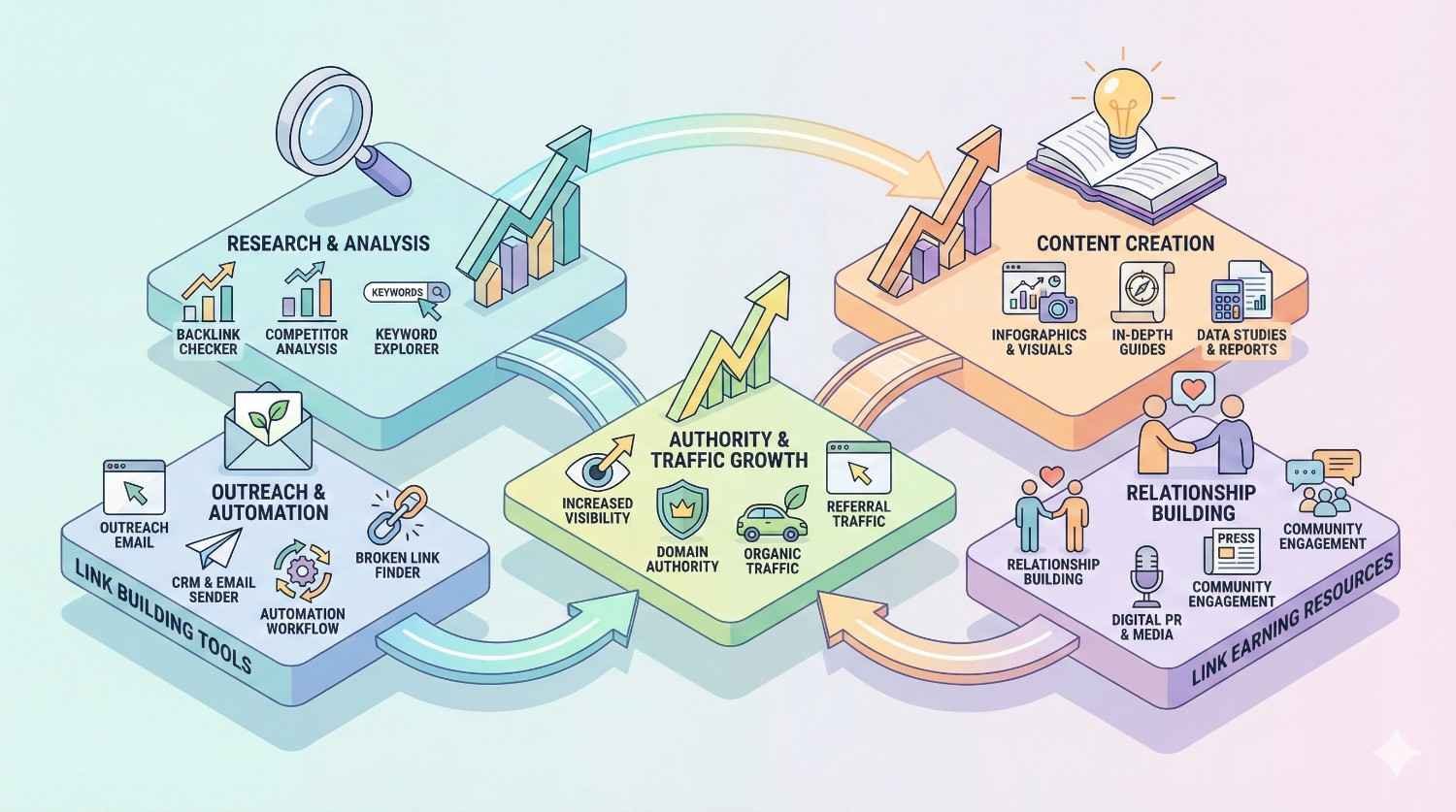
The right tools increase efficiency and effectiveness for both strategies.
Link Prospecting and Outreach Tools
Prospecting tools identify link opportunities at scale.
Ahrefs and Semrush reveal competitor backlinks and identify prospect sites. Their databases cover billions of links across the web.
Hunter.io and Snov.io find contact information for outreach targets. Email verification reduces bounce rates.
Outreach tools manage campaigns efficiently.
Pitchbox and BuzzStream organize prospects, track communications, and automate follow-ups. They’re purpose-built for link building workflows.
Mailshake and Lemlist handle email sequences with personalization at scale. They integrate with prospecting tools for seamless workflows.
Content Research and Ideation Platforms
Research tools identify linkable content opportunities.
BuzzSumo reveals what content earns links and shares in your niche. Analyze top performers to inform your content strategy.
Ahrefs Content Explorer finds content by topic with link and traffic data. Identify gaps and opportunities in existing coverage.
Ideation tools spark content concepts.
AnswerThePublic visualizes questions people ask about topics. These questions often indicate content needs.
Google Trends shows topic interest over time. Identify rising topics before competition intensifies.
Backlink Analysis and Monitoring Software
Analysis tools evaluate link profiles comprehensively.
Ahrefs, Moz, and Semrush provide detailed backlink data including authority metrics, anchor text, and historical trends.
Majestic offers unique metrics like Trust Flow and Citation Flow for quality assessment.
Monitoring tools track changes over time.
Set up alerts for new and lost links. Respond quickly to opportunities and problems.
Regular exports enable trend analysis and reporting. Track progress against goals with historical data.
Relationship Management and CRM Systems
CRM systems organize outreach relationships.
Dedicated tools like BuzzStream track all interactions with prospects. Notes, emails, and outcomes stay organized.
General CRMs like HubSpot or Pipedrive can adapt for link building with custom fields and pipelines.
Spreadsheets work for smaller operations. Google Sheets with proper organization handles modest outreach volumes effectively.
Choose tools matching your scale. Over-investing in software wastes resources. Under-investing creates inefficiency.
How Long Does It Take to See Results from Link Building vs Link Earning?
Timeline expectations differ significantly between approaches.
Link Building Timeline: From Outreach to Indexation
Active link building produces results within weeks to months.
Initial outreach campaigns typically yield first links within 2-4 weeks. Response rates vary, but consistent effort produces consistent results.
Typical timeline breakdown:
- Week 1-2: Prospect research and list building
- Week 2-4: Initial outreach and follow-ups
- Week 4-8: First links secured and published
- Week 8-12: Links indexed and beginning to impact rankings
Ranking improvements from new links typically appear within 2-3 months. Google needs time to crawl, index, and evaluate new links.
Scaling accelerates results. Larger teams running more campaigns compress timelines through parallel effort.
Link Earning Timeline: Content Creation to Natural Acquisition
Link earning requires patience measured in months to years.
Content creation alone takes weeks to months depending on complexity. Original research might require 3-6 months of data collection and analysis.
After publication, earning timelines vary dramatically:
- Viral content: Days to weeks
- Evergreen guides: 3-12 months to gain traction
- Research and data: 6-18 months for full citation accumulation
Some content never earns significant links despite quality. The passive nature means outcomes aren’t guaranteed.
Compounding effects reward patience. Assets that gain initial traction often accelerate over time as visibility increases.
Factors That Accelerate or Delay Link Impact
Several factors influence how quickly links affect rankings.
Accelerating factors:
- Higher authority of linking sites
- Topical relevance of links
- Existing site authority
- Lower competition for target keywords
- Proper internal linking to linked pages
Delaying factors:
- Lower authority links
- Competitive keywords
- New or low-authority sites
- Poor technical SEO preventing crawling
- Links to pages with thin content
Patience remains essential. SEO operates on longer timescales than paid advertising. Expect months, not days, for meaningful impact.
The Future of Link Acquisition: Trends and Best Practices
Link acquisition continues evolving as search engines and content landscapes change.
Google’s Evolving Approach to Link Evaluation
Google increasingly evaluates link quality over quantity. Raw link counts matter less than contextual relevance and authority signals.
Machine learning enables more sophisticated pattern detection. Manipulative tactics that once worked now trigger penalties.
Entity-based understanding changes link evaluation. Google recognizes brands and evaluates links within that context. Brand mentions without links may carry weight.
The direction favors natural, editorial links over manufactured placements. Strategies aligned with this direction remain sustainable.
The Growing Importance of E-E-A-T and Topical Authority
E-E-A-T signals influence how Google evaluates content and links. Experience, Expertise, Authoritativeness, and Trustworthiness matter for rankings.
Links from E-E-A-T-strong sources carry more weight. A citation from a recognized expert outweighs links from anonymous blogs.
Topical authority concentrates link value. Sites with deep coverage of specific topics gain authority in those areas. Links reinforce and benefit from topical positioning.
Building topical authority requires comprehensive content coverage alongside link acquisition. The strategies work together.
Digital PR and Brand-Building as Link Earning Strategies
Digital PR bridges building and earning. Proactive media outreach earns editorial coverage and natural links.
Creating newsworthy content, data, and stories attracts journalist attention. The resulting coverage includes links without explicit requests.
Brand building accelerates all link acquisition. Recognized brands earn links more easily and attract better building opportunities.
Investment in brand visibility pays dividends across link strategies. It’s foundational rather than optional.
AI, Automation, and the Changing Link Building Landscape
AI tools are transforming link building workflows. Prospecting, personalization, and analysis benefit from automation.
Content creation tools assist with linkable asset development. AI can draft, research, and optimize content faster than manual processes.
However, relationship-building remains human. Genuine connections with editors and webmasters can’t be automated. The personal element persists.
Google’s AI capabilities also advance. Detection of manipulative patterns improves continuously. Tactics that fool algorithms today may fail tomorrow.
Sustainable strategies focus on genuine value creation rather than exploiting temporary algorithmic gaps.
Getting Started: Next Steps for Your Link Acquisition Strategy
Implementing effective link acquisition requires systematic planning and execution.
Conducting a Link Profile Audit
Start by understanding your current position. A comprehensive audit reveals strengths, weaknesses, and opportunities.
Audit components include:
- Total referring domains and links
- Domain authority distribution of linking sites
- Anchor text analysis
- Link velocity trends
- Toxic or risky links requiring disavowal
- Competitor comparison
Use tools like Ahrefs, Moz, or Semrush for data collection. Export and analyze in spreadsheets for detailed review.
Identify priority actions from audit findings. Address toxic links immediately. Note gaps competitors have filled. Recognize successful content to replicate.
Defining Your Link Acquisition Goals
Set specific, measurable objectives aligned with business goals.
Connect link targets to ranking and traffic objectives. How many links do you need to compete for target keywords?
Establish quality standards alongside volume goals. Minimum domain authority thresholds prevent chasing worthless links.
Create timeline expectations. When do you need results? Urgent timelines favor building. Longer horizons allow earning emphasis.
Document goals clearly. Share with team members and stakeholders. Review and adjust quarterly based on results.
Working with an SEO Agency vs Building In-House Capabilities
Both approaches have advantages depending on your situation.
Agency advantages:
- Immediate access to expertise and tools
- Established processes and relationships
- Scalable without hiring
- Accountability for results
In-house advantages:
- Deeper brand and industry knowledge
- Long-term relationship building
- Direct control over tactics
- Potential cost savings at scale
Hybrid models combine benefits. Use agencies for specialized tactics while building internal capabilities for ongoing efforts.
Evaluate based on your resources, timeline, and strategic priorities. Neither approach is universally superior.
Conclusion
Link building and link earning represent complementary approaches to acquiring the backlinks that drive organic visibility. Building offers control and predictability. Earning delivers quality and sustainability. Most businesses benefit from combining both strategies in proportions matching their specific situation.
Understanding when each approach fits, executing tactics properly, and avoiding common mistakes separates successful link acquisition from wasted effort. The strategies outlined here provide a framework for sustainable growth.
We help businesses develop and execute comprehensive link acquisition strategies that balance active building with passive earning. Contact White Label SEO Service to discuss how we can accelerate your organic growth through strategic link acquisition.
Frequently Asked Questions
What is the main difference between link building and link earning?
Link building involves actively pursuing backlinks through outreach and direct effort. Link earning means creating content so valuable that others link to it naturally without being asked. Building gives you control over pace and targets. Earning relies on content quality and brand visibility.
Is link building still effective in 2025?
Yes, ethical link building remains effective when focused on quality over quantity. Google penalizes manipulative tactics but rewards genuine editorial links earned through outreach. The key is targeting relevant, authoritative sites and providing real value rather than chasing easy placements.
How long does it take to see results from link building?
Most link building campaigns produce initial links within 2-4 weeks of starting outreach. Ranking improvements typically appear 2-3 months after links are indexed. Consistent effort over 6-12 months delivers meaningful organic traffic growth.
Can small businesses compete with larger competitors through link earning?
Small businesses can compete by creating unique, valuable content that larger competitors haven’t produced. Original research, niche expertise, and specialized tools can earn links regardless of company size. However, combining earning with targeted building often produces faster results.
What types of content earn the most natural backlinks?
Original research and data studies consistently earn the most links because writers need sources to cite. Comprehensive guides, free tools, and visual content like infographics also perform well. The common factor is providing unique value others can’t easily replicate.
How do I know if my link building tactics are safe?
Safe tactics focus on earning editorial links through genuine value creation. If you’re paying for links without disclosure, using private blog networks, or participating in link schemes, you’re at risk. When in doubt, ask whether a tactic would survive Google scrutiny if reviewed manually.
Should I focus on link building or link earning for a new website?
New websites typically need active link building to establish initial authority. Without existing visibility or brand recognition, waiting for natural links means waiting indefinitely. Start with building to gain traction, then shift toward earning as authority grows.