
Your backlink profile can either accelerate your rankings or destroy them—and most website owners can’t tell the difference. The distinction between good links and bad links determines whether your SEO investment generates sustainable organic traffic or triggers penalties that take months to recover from.
Understanding link quality has never been more critical. Google’s algorithms have evolved to evaluate backlinks with unprecedented sophistication, rewarding sites with natural, authoritative link profiles while penalizing those with manipulative or low-quality links. For business owners and marketing teams investing in SEO, this knowledge directly impacts ROI.
This guide breaks down exactly what separates high-quality backlinks from harmful ones, how to audit your existing link profile, and the strategies that build lasting search visibility without risking your domain’s reputation.
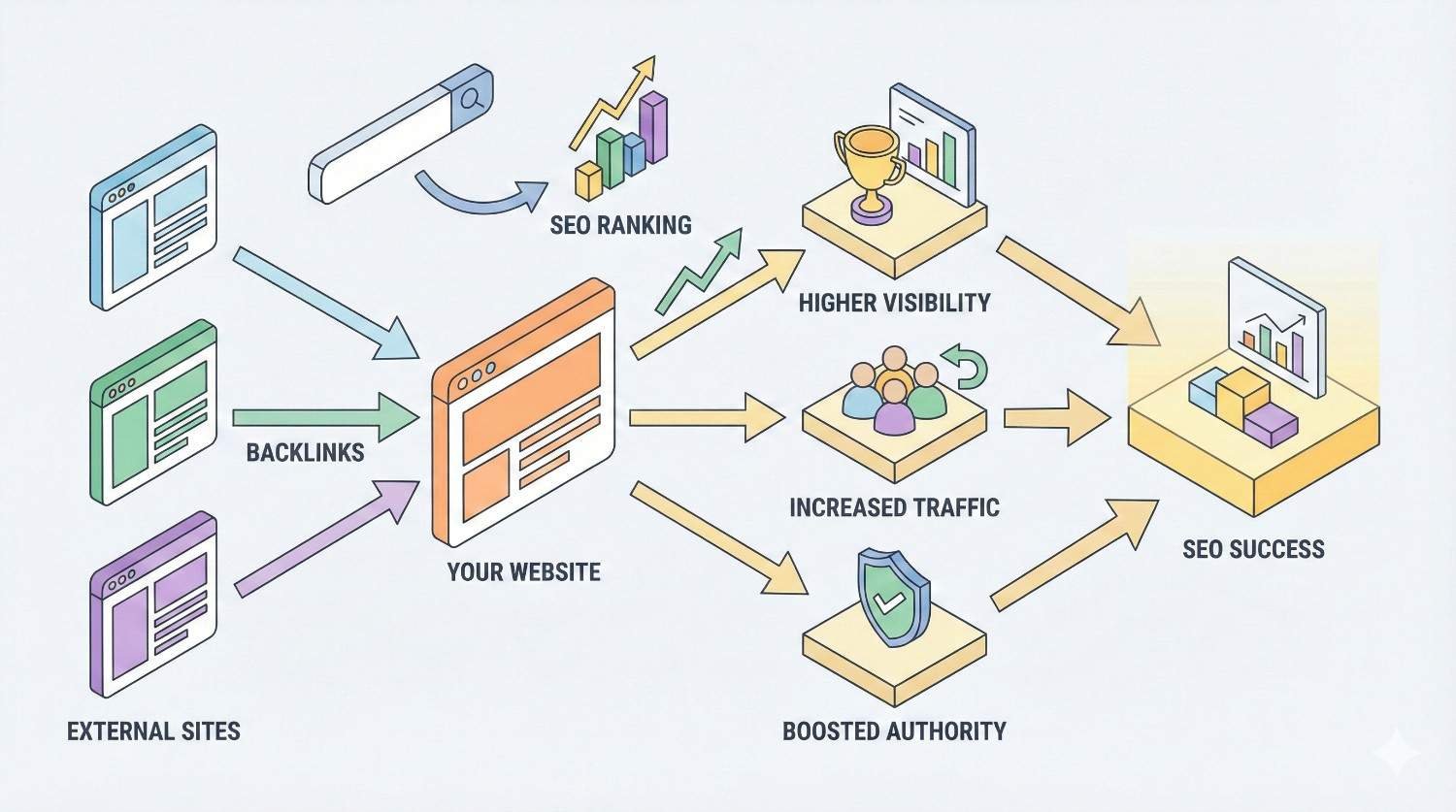
What Are Backlinks and Why Do They Matter for SEO?
Backlinks are hyperlinks from external websites that point to your domain. Each backlink functions as a vote of confidence, signaling to search engines that another site considers your content valuable enough to reference. This fundamental concept has shaped search engine optimization since Google’s founding.
The quantity and quality of your backlinks directly influence your ability to rank for competitive keywords. Sites with strong backlink profiles consistently outperform those without, assuming other ranking factors remain equal. However, not all links carry the same weight—and some can actively harm your rankings.
How Search Engines Evaluate Links
Search engines analyze backlinks through multiple dimensions to determine their value. The linking domain’s authority, the relevance of the linking page to your content, the anchor text used, and the context surrounding the link all factor into the evaluation.
Google’s crawlers examine whether links appear naturally within editorial content or seem artificially placed. They assess the linking site’s own backlink profile, its topical focus, and its history of spam or manipulation. Links from sites that Google trusts transfer more value than those from unknown or suspicious domains.
The placement of a link matters significantly. A contextual link within the main body content of a relevant article carries more weight than a link buried in a footer, sidebar, or comment section. Search engines recognize that editorial links—those placed by content creators because they genuinely add value—represent authentic endorsements.
The Role of Links in Google’s Ranking Algorithm
Links remain one of Google’s top three ranking factors, alongside content quality and RankBrain. Google’s own documentation confirms that links help their systems understand which pages are most relevant and authoritative for specific queries.
The PageRank algorithm, while evolved significantly since its introduction, still forms the conceptual foundation for how Google evaluates link equity. Pages accumulate authority through incoming links, and that authority flows outward through their outgoing links. This creates a web of interconnected trust signals.
Google’s algorithm updates—including Penguin, which specifically targets link spam—have refined how links are evaluated. The search engine now distinguishes between links that represent genuine editorial endorsements and those created primarily to manipulate rankings. This distinction forms the core difference between good links and bad links.
What Are Good Links? (Characteristics of High-Quality Backlinks)
Good links share specific characteristics that signal authenticity and value to search engines. These backlinks come from reputable sources, appear in relevant contexts, and exist because they genuinely serve the reader. Understanding these qualities helps you evaluate your current backlink profile and guide future link acquisition efforts.
High-quality backlinks don’t just avoid penalties—they actively boost your rankings, drive referral traffic, and strengthen your domain’s authority over time. Each good link compounds the value of your existing content and makes future ranking improvements easier to achieve.
Relevance and Topical Authority
The most valuable backlinks come from websites that operate within your industry or cover topics closely related to your content. A link from a respected marketing publication to your SEO guide carries more weight than a link from an unrelated cooking blog, even if both sites have similar domain authority scores.
Topical relevance signals to Google that your content genuinely serves the audience of the linking site. When industry-specific publications link to your resources, it demonstrates that experts in your field consider your content authoritative. This topical clustering strengthens your site’s perceived expertise in specific subject areas.
Search engines have become increasingly sophisticated at understanding topical relationships. They evaluate not just the linking domain’s overall focus but the specific page’s content, the surrounding text, and how the link fits within the broader context of the article.
Domain Authority and Trust Signals
Links from established, authoritative domains transfer more ranking power than those from new or low-authority sites. Domain authority—measured by tools like Moz, Ahrefs, and Semrush—provides a useful proxy for how much trust a linking site has accumulated.
Trust signals extend beyond raw authority metrics. Sites with clean backlink profiles, consistent publishing histories, and recognition from other authoritative sources carry more weight. Government domains (.gov), educational institutions (.edu), and established news publications typically represent high-trust link sources.
However, authority alone doesn’t guarantee link quality. A high-authority site linking to your content from an irrelevant page or through a paid placement may provide less value—or even cause harm—compared to a moderately authoritative site linking naturally from highly relevant content.
Editorial Placement and Natural Context
Good links appear within the main content of a page, placed by the author because they add value for readers. These editorial links exist because the content creator genuinely wanted to reference your resource, not because they were paid or incentivized to include it.
The surrounding context matters significantly. A link introduced with phrases like “according to research from” or “this comprehensive guide explains” signals genuine endorsement. Links that appear randomly or without clear contextual justification may be evaluated as less valuable or potentially manipulative.
Natural link profiles show diversity in anchor text, linking pages, and acquisition timing. When all your backlinks use exact-match anchor text or appear suddenly in large quantities, search engines recognize these patterns as potential manipulation signals.
Traffic-Driving Potential
High-quality backlinks don’t just improve rankings—they send actual visitors to your site. Links from pages that receive genuine traffic expose your content to new audiences and generate referral visits that can convert into leads or customers.
This traffic-driving potential serves as a quality indicator. If a link exists on a page that nobody visits, its value to readers is questionable. Search engines can evaluate user behavior signals to understand which links actually get clicked and which exist purely for SEO purposes.
Links from high-traffic pages also provide immediate business value beyond SEO. Referral traffic from authoritative industry publications often converts at higher rates than organic search traffic because visitors arrive with pre-established trust based on the referring site’s endorsement.
Examples of Good Links
A technology startup publishing original research on industry trends might earn links from major tech publications covering the findings. These links come from relevant, authoritative sources and exist because the research provides genuine value to readers.
A local law firm creating comprehensive guides on specific legal topics might receive links from legal directories, bar association resources, and journalists covering related stories. Each link serves readers by connecting them with useful information.
An e-commerce brand developing detailed product comparison guides might earn links from review sites, industry blogs, and consumer publications. These editorial links acknowledge the brand’s expertise and help readers make informed purchasing decisions.
Guest posts on respected industry publications, where the author provides genuine expertise and the link appears naturally within valuable content, represent another category of good links. The key distinction is that the content would be valuable with or without the link.
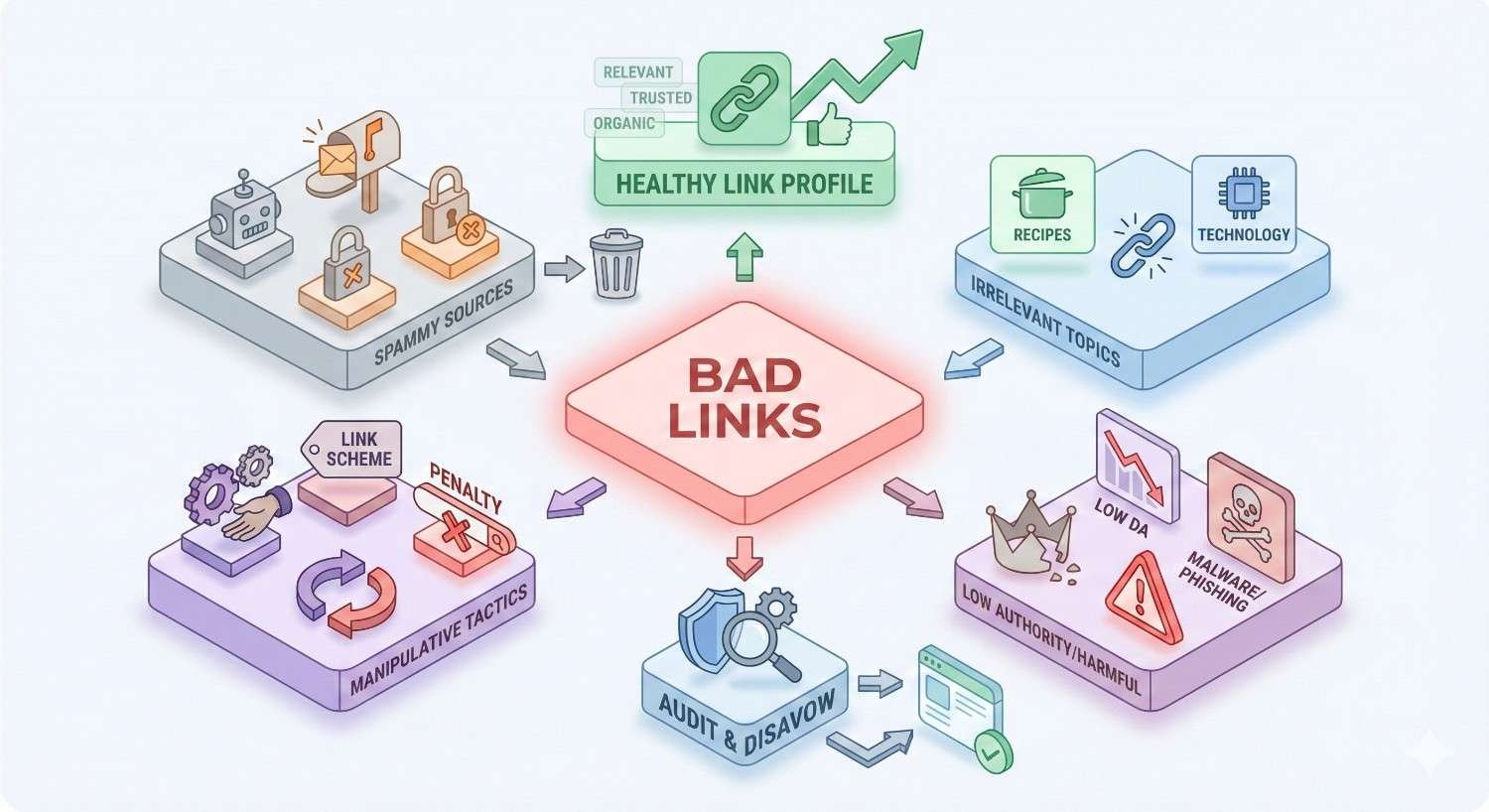
What Are Bad Links? (Characteristics of Low-Quality or Harmful Backlinks)
Bad links share characteristics that signal manipulation, low quality, or spam to search engines. These backlinks can actively harm your rankings, trigger manual penalties, or cause algorithmic devaluations that suppress your visibility. Identifying and addressing bad links protects your SEO investment.
The consequences of bad links range from wasted link equity to severe ranking penalties. Understanding what makes a link harmful helps you avoid risky link building tactics and identify problems in your existing backlink profile before they cause damage.
Spammy and Manipulative Link Schemes
Link schemes encompass any attempt to manipulate rankings through artificial link creation. Google’s Webmaster Guidelines explicitly identify link schemes as violations that can result in manual actions against your site.
Common link schemes include excessive link exchanges (“link to me and I’ll link to you”), automated link building programs, and large-scale article marketing with keyword-rich anchor text. These tactics create unnatural link patterns that algorithms can detect and penalize.
Private Blog Networks (PBNs) represent a particularly risky link scheme. These networks of sites exist solely to create backlinks, with no genuine audience or editorial purpose. Google actively identifies and devalues PBN links, often penalizing both the network sites and the domains they link to.
Irrelevant or Off-Topic Links
Links from sites with no topical connection to your content provide minimal value and can signal manipulation. When a plumbing company has backlinks from gambling sites, pharmaceutical blogs, and foreign-language directories, the lack of relevance raises red flags.
Irrelevant links often result from low-quality link building services that prioritize quantity over quality. These services place links wherever possible, regardless of whether the linking site’s audience would have any interest in the linked content.
While a few irrelevant links won’t typically cause penalties, patterns of irrelevant link acquisition suggest manipulation. Search engines expect natural backlink profiles to show topical coherence, with most links coming from related industries or content areas.
Links from Penalized or Toxic Domains
Links from domains that Google has penalized can transfer negative signals to your site. These toxic domains include sites previously caught participating in link schemes, hosting malware, or publishing spam content.
Identifying toxic domains requires examining their backlink profiles, content quality, and history. Sites with thousands of outgoing links, thin or duplicated content, and obvious monetization through link sales typically represent toxic link sources.
The concept of “link neighborhoods” applies here. If your site receives links from domains that also link to known spam sites, the association can harm your perceived trustworthiness. Search engines evaluate the company your site keeps through its backlink profile.
Paid Links Without Proper Disclosure
Purchasing links to manipulate rankings violates Google’s guidelines. While paid placements can be legitimate for advertising purposes, they must include proper disclosure (typically through rel=”sponsored” or rel=”nofollow” attributes) to avoid passing PageRank.
Links from sites that openly sell followed links represent high-risk sources. These sites often appear in link broker databases and may already be flagged by Google’s spam detection systems. Any link equity they might pass is outweighed by the penalty risk.
The distinction matters: paying for advertising that includes a properly attributed link is acceptable. Paying specifically for a followed link intended to manipulate rankings is not. The intent and disclosure determine whether a paid link is legitimate or harmful.
Examples of Bad Links
A website suddenly acquiring hundreds of links from foreign-language blog comments, all using exact-match anchor text, represents a clear bad link pattern. These links provide no value to readers and exist solely to manipulate rankings.
Links from “link farms”—sites that exist only to host outgoing links with no genuine content or audience—exemplify toxic backlinks. These sites often have thousands of outgoing links, minimal content, and no organic traffic.
Directory submissions to low-quality, general directories that accept any site without editorial review create bad links. While niche-specific, curated directories can provide value, mass directory submissions to sites with no quality standards generate harmful links.
Forum and blog comment spam, where links appear in irrelevant discussions with no genuine contribution to the conversation, represents another bad link category. These links are easily identified by search engines and provide no ranking benefit while potentially triggering spam filters.
Good Links vs Bad Links: Key Differences Comparison
| Factor | Good Links | Bad Links |
| Source Relevance | Topically related to your content and industry | Random, unrelated, or suspicious domains |
| Domain Authority | Established, trusted domains with clean histories | Low-quality, penalized, or newly created spam sites |
| Editorial Intent | Placed because content adds value for readers | Placed solely to manipulate rankings |
| Anchor Text | Natural variation, branded, and contextual | Over-optimized, exact-match keyword stuffing |
| Link Placement | Within main content, contextually appropriate | Footers, sidebars, comment sections, or hidden |
| Acquisition Pattern | Gradual, organic growth over time | Sudden spikes or unnatural patterns |
| Traffic Potential | From pages with genuine readership | From pages with no real audience |
| Disclosure | Transparent, properly attributed if paid | Hidden paid placements without disclosure |
| Surrounding Content | High-quality, relevant editorial content | Thin, spun, or duplicated content |
| Long-term Impact | Compounds authority and rankings over time | Risks penalties and ranking suppression |
How to Identify Good Links and Bad Links in Your Backlink Profile
Regular backlink audits protect your site from accumulated toxic links and help you understand which link building efforts generate results. Most sites accumulate some bad links naturally—competitors may engage in negative SEO, or low-quality sites may link without your knowledge. Proactive monitoring prevents these issues from escalating.
Effective backlink analysis combines automated tools with manual review. Tools identify potential problems at scale, while human judgment evaluates context and intent that algorithms might miss.
Using Backlink Audit Tools
Several professional tools provide comprehensive backlink analysis. Ahrefs, Semrush, Moz Link Explorer, and Majestic each offer backlink databases and quality metrics that help identify problematic links.
Google Search Console provides free access to a sample of your backlinks directly from Google’s index. While not comprehensive, this data shows which links Google has discovered and can reveal obvious spam patterns.
These tools flag potentially toxic links based on various signals, but their assessments require human verification. A link flagged as “toxic” by automated analysis might be perfectly legitimate upon manual review, while some harmful links might not trigger automated warnings.
Metrics to Evaluate Link Quality
Domain authority or domain rating provides a starting point for evaluation, but shouldn’t be the only factor. A high-authority domain linking from an irrelevant page may provide less value than a moderate-authority domain linking from highly relevant content.
Examine the linking page’s organic traffic using tools like Ahrefs or Semrush. Pages with zero organic traffic often indicate low quality or potential spam, while pages ranking for relevant keywords suggest genuine authority.
Review the linking domain’s own backlink profile. Sites with spammy inbound links often represent risky link sources. Check for patterns like excessive outgoing links, thin content, or obvious link selling behavior.
Anchor text distribution across your entire backlink profile reveals potential problems. Natural profiles show diversity—branded anchors, naked URLs, generic phrases, and some keyword variations. Profiles dominated by exact-match keyword anchors suggest manipulation.
Red Flags That Indicate Toxic Links
Sudden spikes in backlink acquisition without corresponding content publication or PR activity suggest artificial link building. Natural link growth correlates with content creation, media coverage, or seasonal trends.
Links from sites in unrelated languages or geographic regions, unless your business operates internationally, often indicate spam. A US-based local business shouldn’t have hundreds of links from foreign-language sites.
Patterns of links from sites with similar templates, hosting, or ownership structures may indicate PBN links. These networks often share technical footprints that tools and manual review can identify.
Links with hidden or manipulated anchor text, links from pages with excessive outgoing links (100+), and links from sites with no indexed pages in Google all represent red flags requiring investigation.
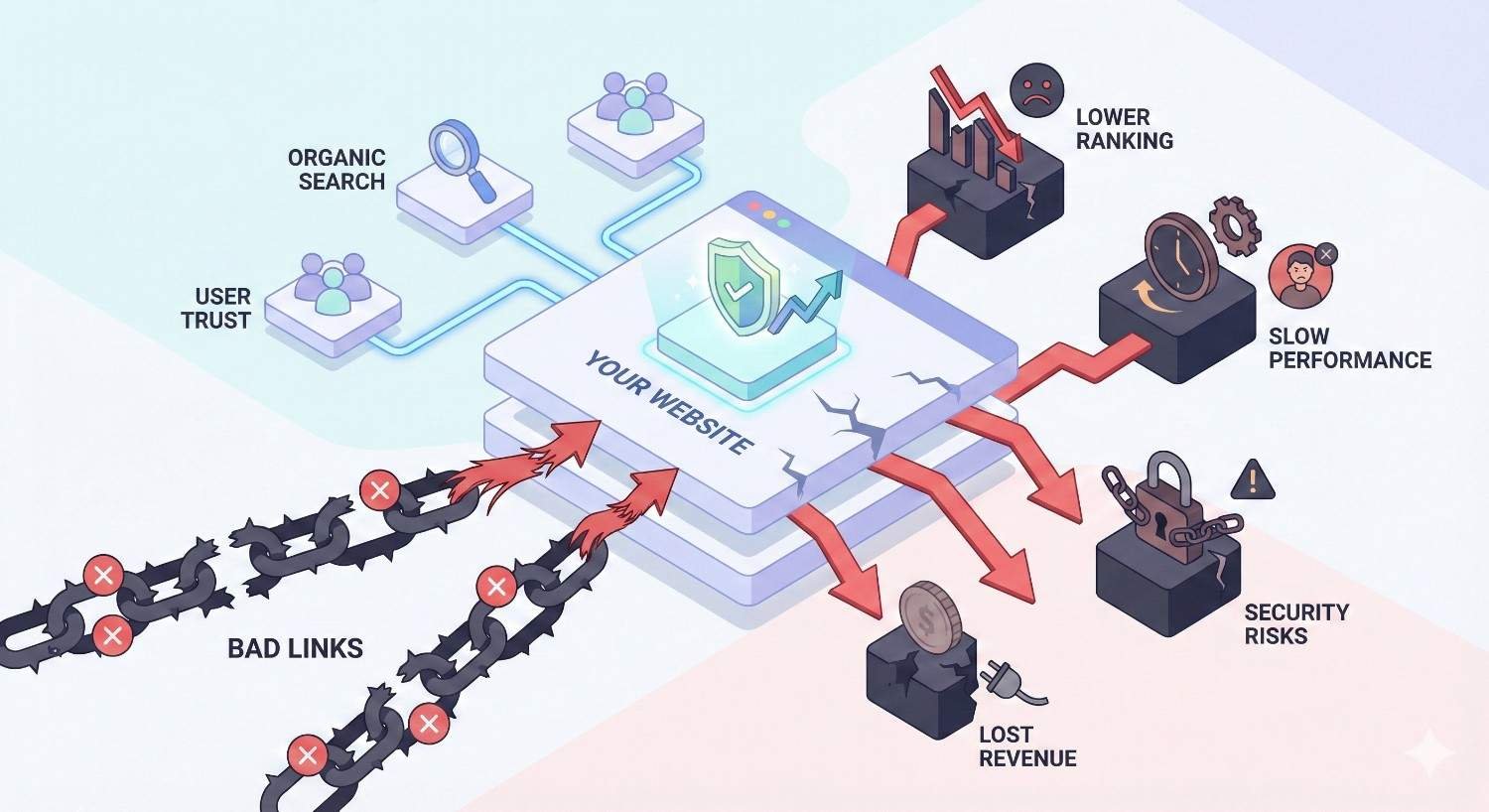
Bad links create consequences ranging from wasted resources to severe ranking penalties. Understanding these impacts helps prioritize link cleanup efforts and informs risk assessment for link building strategies.
The severity of impact depends on the quantity and toxicity of bad links relative to your overall backlink profile. A few low-quality links among hundreds of good ones rarely cause problems. A profile dominated by toxic links almost certainly will.
Google Penalties and Ranking Drops
Google can take manual action against sites with unnatural link profiles, resulting in significant ranking drops or complete removal from search results. Manual actions appear in Google Search Console with specific descriptions of the violation.
Recovering from manual actions requires identifying and removing or disavowing the problematic links, then submitting a reconsideration request. This process typically takes weeks to months, during which organic traffic remains suppressed.
Even without manual action, bad links can suppress rankings through algorithmic evaluation. Google’s systems may simply choose not to count low-quality links, or may apply negative signals that reduce your site’s overall authority.
Manual Actions vs Algorithmic Devaluations
Manual actions result from human reviewers at Google identifying guideline violations. These penalties are explicit—you’ll receive notification in Search Console—and require formal reconsideration requests to lift.
Algorithmic devaluations happen automatically as Google’s systems evaluate your backlink profile. You won’t receive notification, and recovery happens automatically once the problematic signals are addressed. However, identifying algorithmic issues is more difficult since there’s no explicit notification.
The Penguin algorithm, now part of Google’s core algorithm, evaluates link quality in real-time. Sites with spammy link profiles may see rankings suppressed without any manual action, making diagnosis challenging.
Long-Term SEO Damage
Beyond immediate ranking impacts, bad links can create lasting damage to your domain’s reputation. Sites with histories of link spam may face increased scrutiny from Google’s systems, making future ranking improvements more difficult.
The resources required to recover from link-related penalties—auditing, outreach, disavow file creation, reconsideration requests—represent significant opportunity costs. Time spent on recovery is time not spent on growth-focused activities.
Reputation damage extends beyond search engines. If your site becomes associated with spam or manipulation, potential link partners, journalists, and industry publications may be less willing to reference your content, limiting future link acquisition opportunities.
How to Remove or Disavow Bad Links
Addressing bad links requires a systematic approach combining direct removal efforts with Google’s disavow tool. The goal is eliminating or neutralizing toxic links while preserving valuable ones.
Not every low-quality link requires action. Focus efforts on links that pose genuine penalty risk—those from obviously spammy sources, link schemes, or penalized domains. A few random low-quality links in an otherwise healthy profile rarely cause problems.
Manual Link Removal Outreach
Direct outreach to webmasters requesting link removal represents the preferred first step. Google values genuine removal over disavowing because it eliminates the link entirely rather than just asking Google to ignore it.
Create a spreadsheet tracking each toxic link, the contact information for the linking site, outreach attempts, and responses. Document your efforts thoroughly—this documentation supports reconsideration requests if needed.
Outreach emails should be professional and specific. Identify the exact page and link, explain why you’re requesting removal, and make the process easy by providing direct URLs. Follow up on non-responses, but don’t harass webmasters.
Expect low response rates. Many toxic links come from abandoned sites, spam operations, or webmasters who won’t cooperate. Document your outreach attempts regardless of outcomes.
Using Google’s Disavow Tool
Google’s Disavow Tool allows you to tell Google to ignore specific links when evaluating your site. This tool exists specifically for situations where you cannot remove harmful links directly.
The disavow file uses a specific format—one URL or domain per line, with “domain:” prefix for domain-level disavows. Disavowing at the domain level is appropriate for sites that are entirely spammy; use URL-level disavows for specific problematic pages on otherwise legitimate sites.
Submit your disavow file through Search Console. Google processes disavow files during regular crawling, so effects aren’t immediate. Allow several weeks to months for disavowed links to be processed.
Be conservative with disavows. Disavowing legitimate links can harm your rankings. Only disavow links you’re confident are harmful or that you’ve unsuccessfully attempted to remove.
When to Disavow vs When to Ignore
Disavow links that clearly violate Google’s guidelines: obvious link schemes, PBN links, paid links without disclosure, and links from penalized domains. These links pose genuine penalty risk.
Ignore low-quality links that don’t indicate manipulation. Random links from low-authority sites, links from scraper sites that copied your content, and occasional irrelevant links are normal parts of any backlink profile. Google’s algorithms are sophisticated enough to discount these without your intervention.
If you’ve received a manual action for unnatural links, disavow aggressively. In penalty recovery situations, err on the side of disavowing questionable links rather than risking continued penalty.
For sites without manual actions, focus disavow efforts on the most obviously toxic links. Spending excessive time disavowing marginally low-quality links provides diminishing returns.
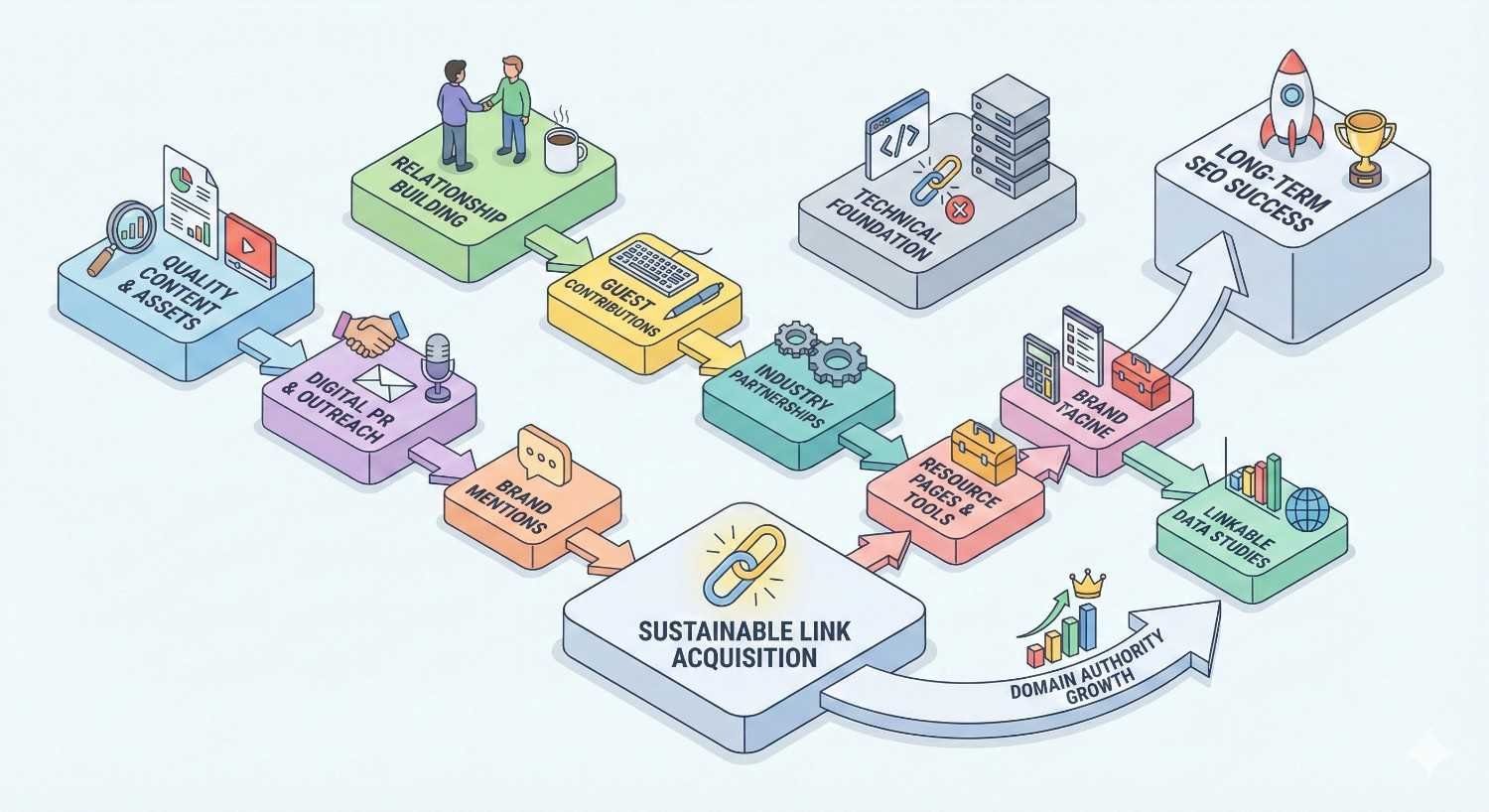
How to Build Good Links: Sustainable Link Acquisition Strategies
Building good links requires creating genuine value that earns editorial endorsements. Sustainable link acquisition focuses on strategies that generate links naturally over time, rather than tactics that manipulate or purchase links.
The most effective link building doesn’t feel like link building. It feels like marketing, public relations, and content creation—activities that happen to generate links as a byproduct of providing value.
Content-Driven Link Building
Original research, comprehensive guides, and unique data assets attract links naturally. Content that provides information unavailable elsewhere gives other creators reasons to reference your work.
Identify content gaps in your industry—topics that lack comprehensive coverage or questions that existing content doesn’t answer well. Creating the definitive resource on a topic positions your content as the natural link target when others write about related subjects.
Visual assets like infographics, original charts, and interactive tools earn links because they’re easy to reference and add value to other content. Creators linking to your visual assets often provide attribution links.
Update and maintain your best content. Resources that stay current continue earning links over time, while outdated content loses link-earning potential. Regular updates also provide opportunities to promote refreshed content.
Digital PR and Outreach
Digital PR applies traditional public relations tactics to earn online coverage and links. This includes press releases for genuinely newsworthy announcements, expert commentary for journalists, and relationship building with industry publications.
HARO (Help A Reporter Out) and similar services connect experts with journalists seeking sources. Providing valuable quotes and insights can earn links from major publications covering your industry.
Newsjacking—providing expert commentary on trending topics—creates timely link opportunities. When industry news breaks, journalists seek expert perspectives. Being available and responsive can earn coverage and links from news sites.
Build relationships with journalists, bloggers, and editors in your industry before you need coverage. Genuine relationships based on providing value lead to organic link opportunities over time.
Relationship-Based Link Earning
Industry relationships generate link opportunities naturally. Partners, vendors, clients, and professional connections often link to businesses they work with and trust.
Participate genuinely in industry communities—conferences, associations, online forums, and social media groups. Visibility and reputation within your industry lead to organic mentions and links.
Collaborative content with industry peers—co-authored research, expert roundups, joint webinars—creates mutual link opportunities. Each participant naturally promotes and links to collaborative projects.
Testimonials and case studies for products and services you genuinely use often include links back to your site. These represent legitimate, relevant links from businesses in your network.
Avoiding Link Building Tactics That Create Bad Links
Avoid any tactic that prioritizes link quantity over quality. Services promising hundreds of links for low prices invariably deliver low-quality or harmful links.
Guest posting at scale on low-quality sites, even with original content, creates patterns that search engines recognize as manipulation. Focus guest posting efforts on respected publications where the content provides genuine value.
Link exchanges, even with relevant sites, should be limited and natural. Excessive reciprocal linking suggests manipulation rather than genuine editorial endorsement.
Any tactic that wouldn’t make sense without the SEO benefit probably creates bad links. Ask whether you’d pursue the opportunity if links didn’t exist—if not, the tactic likely violates guidelines.
Good Links vs Bad Links: Common Mistakes to Avoid
Prioritizing quantity over quality. One link from a respected industry publication provides more value than hundreds of links from low-quality directories. Focus resources on earning fewer, better links.
Ignoring relevance in pursuit of authority. A link from a high-authority site in an unrelated industry provides less value than a link from a moderate-authority site in your niche. Topical relevance matters as much as raw authority metrics.
Using exact-match anchor text excessively. Natural backlink profiles show anchor text diversity. Over-optimizing anchor text with target keywords signals manipulation and can trigger penalties.
Neglecting existing link opportunities. Unlinked brand mentions, broken links to your content, and outdated references represent easy link opportunities. Reclaiming and updating existing mentions often proves more efficient than pursuing new links.
Failing to audit regularly. Backlink profiles change constantly. Regular audits catch problems before they escalate and identify new opportunities from recent link acquisitions.
Disavowing too aggressively. Disavowing legitimate links harms your rankings. Reserve disavows for clearly toxic links, not merely low-quality ones.
Expecting immediate results. Link building compounds over time. New links may take weeks or months to impact rankings. Sustainable strategies require patience and consistent effort.
Copying competitor tactics without evaluation. Competitors may have links from tactics that worked historically but now create risk. Evaluate link sources independently rather than assuming competitor links are safe to replicate.
Conclusion
The distinction between good links and bad links fundamentally shapes your SEO outcomes. Good links—relevant, authoritative, editorially placed, and naturally acquired—compound your domain’s authority and drive sustainable ranking improvements. Bad links—spammy, manipulative, irrelevant, or artificially created—risk penalties that can take months to recover from and waste resources better spent on legitimate strategies.
Building a healthy link profile requires ongoing attention: regular audits to identify problems, strategic content creation to earn editorial links, and relationship building that generates organic opportunities. The investment in quality over quantity pays dividends through stable rankings, referral traffic, and long-term organic growth.
At White Label SEO Service, we help businesses build sustainable link profiles through strategic content development, digital PR, and authority building that aligns with search engine guidelines. Contact our team to discuss how we can strengthen your backlink profile and accelerate your organic growth.
Frequently Asked Questions About Good Links and Bad Links
How many backlinks do I need to rank?
There’s no universal number—backlink requirements depend on your keyword competition, industry, and existing domain authority. Focus on earning quality links consistently rather than hitting arbitrary targets. Some pages rank with few links due to low competition, while competitive terms may require hundreds of authoritative backlinks.
Can bad links hurt my website even if I didn’t build them?
Yes, though Google has become better at ignoring obviously spammy links. Competitors can engage in negative SEO by pointing toxic links at your site. Regular backlink monitoring helps identify suspicious link spikes, and the disavow tool provides protection against links you didn’t create.
Are nofollow links good or bad?
Nofollow links aren’t inherently good or bad—they simply don’t pass PageRank directly. However, nofollow links from authoritative sources still provide value through referral traffic, brand visibility, and natural link profile diversity. A healthy backlink profile includes a mix of followed and nofollow links.
How long does it take to recover from bad links?
Recovery timelines vary based on penalty severity and cleanup thoroughness. Manual action recoveries typically take 4-8 weeks after submitting a successful reconsideration request. Algorithmic recoveries may take longer as Google recrawls and reevaluates your backlink profile over several months.
Should I buy links to improve rankings?
Buying links to manipulate rankings violates Google’s guidelines and risks penalties. Paid placements for advertising purposes are acceptable with proper disclosure (rel=”sponsored” attribute). The risk-reward calculation rarely favors purchased links—penalties can devastate organic traffic that took years to build.
What’s the fastest way to identify toxic links in my backlink profile?
Use backlink audit tools like Ahrefs, Semrush, or Moz to flag potentially toxic links, then manually review flagged links for context. Look for patterns: foreign-language spam, exact-match anchor text clusters, links from obvious link farms, and sudden acquisition spikes. Google Search Console also shows links Google has discovered.
How often should I audit my backlink profile?
Conduct comprehensive backlink audits quarterly for most sites, with monthly monitoring for high-risk industries or sites with previous penalty history. Set up alerts in your backlink tool to notify you of significant changes—sudden spikes in new links often indicate spam attacks or problematic link building by previous agencies.