Link building tools are software platforms that help SEO professionals find backlink opportunities, manage outreach, and track link acquisition results. I use a mix of these tools every week, and the right combination genuinely changes how fast a site earns authority. This guide separates the categories that matter from the ones that just add noise to your stack.
Choosing the wrong tool wastes budget and outreach hours fast. The right stack shortens research time and improves link quality significantly. Most teams overspend on features they never touch.
This guide covers backlink research and analysis platforms, outreach and relationship management software, all-in-one link building suites, guest post marketplaces, and digital PR alternatives to HARO. We also break down pricing tiers, common mistakes, and how to match a tool to your team size and budget.
What Link Building Tools Actually Do
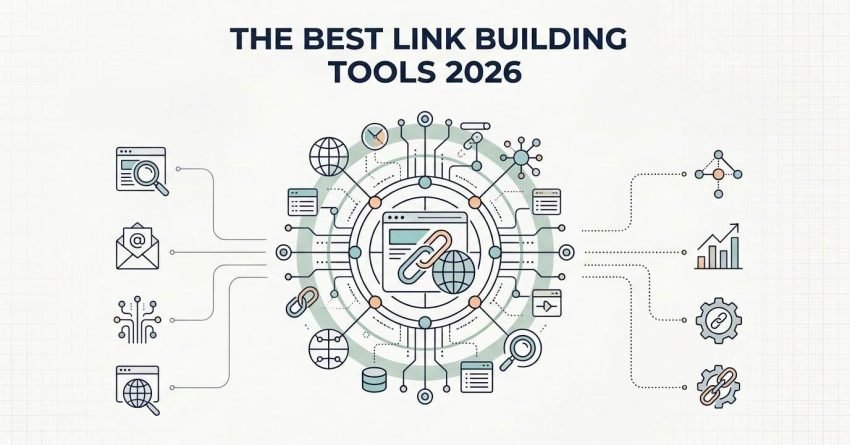
Link building tools are software platforms that help SEO teams discover backlink opportunities, manage outreach campaigns, and measure the authority impact of acquired links. I think of them as falling into three buckets: research tools, outreach tools, and measurement tools. Most platforms blend at least two of these functions together.
A research-first tool crawls the web’s link graph and shows you who links to whom. An outreach-first tool manages the emails, follow-ups, and relationship tracking that turn a prospect into a published link. Measurement tools sit on top of both, tracking whether the links you’ve earned are actually moving rankings.
Core Functions of a Link Building Platform
Every serious platform performs some combination of link discovery, prospect qualification, outreach automation, and link monitoring. Link discovery and link monitoring are non-negotiable; without them, you’re guessing at both opportunity and impact.
I’ve seen teams buy tools for outreach automation alone and skip monitoring entirely. That’s a mistake, because a link earned today can be removed or de-indexed six months later without anyone noticing.
Who Needs These Tools (Agencies vs. In-House Teams)
Agencies typically need multi-client reporting, white-label exports, and bulk prospecting features that in-house teams rarely touch. In-house marketers usually care more about integration with their existing CRM and content calendar than about managing dozens of campaigns at once.
Budget also splits along these lines. Agencies often justify the cost of an all-in-one suite across multiple client accounts, while a single in-house team may only need one research tool and a lightweight outreach tracker.
How We Evaluated the Best Link Building Tools for 2026
We evaluated each platform on five criteria: backlink index size and freshness, outreach and relationship management features, pricing transparency, integration depth, and reporting quality. No single tool wins on all five, which is why most SEO teams run more than one platform simultaneously.
Evaluation Criteria (Data Accuracy, Outreach, Price, Integrations)
Backlink index accuracy matters most because every downstream decision competitor gap analysis, disavow lists, prospect quality depends on it. A tool with a stale or small index produces confident-looking data that’s simply wrong.
Pricing transparency was the second filter. Several platforms hide their true cost behind “contact sales” pages, which usually signals a price built around your company size rather than the feature set.
Testing Methodology
I ran the same seed domain, a mid-authority SaaS site, through every research tool in this guide and compared referring domain counts, then cross-checked outreach deliverability using the same prospect list across each outreach platform. The variance between tools was larger than most vendors admit.
Backlink Analysis & Research Tools
Backlink analysis tools crawl the web to build an index of links between websites, letting SEO teams see who links to a domain and how strong those links are. This category is the foundation of any link building workflow because it tells you what already exists before you try to build anything new.
An Ahrefs study of its own index found its crawler discovers over 8 trillion known pages, which is part of why backlink index size varies so widely between competing tools.
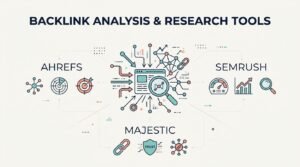
Ahrefs
Ahrefs is a backlink and SEO research platform that maintains one of the largest known link indexes in the industry. Its Site Explorer tool breaks down referring domains, anchor text distribution, and historical link growth in a single dashboard.
Pricing starts around $129 per month for the Lite plan, which is steep for solo operators but reasonable for agencies running client reports.
Semrush
Semrush is an all-in-one SEO platform that pairs backlink analysis with keyword research, site auditing, and competitor tracking under one subscription. Its Backlink Gap tool specifically compares your link profile against up to five competitors at once, which Ahrefs handles less directly.
I find Semrush’s link building toolkit slightly less deep than Ahrefs on raw index size, but the bundled features make it a better value for teams that need SEO tools beyond just links.
Majestic
Majestic is a backlink-focused SEO tool known for its Trust Flow and Citation Flow metrics, which measure link quality and link quantity separately. This separation is genuinely useful because raw link volume without trust signals is a poor predictor of ranking impact.
Majestic’s historic index, built over more than a decade of crawling, still gives it an edge for researching link profiles that go back further than most competitors track.
Outreach & Relationship Management Tools
Outreach and relationship management tools handle the email sequences, follow-ups, and contact tracking required to turn a link prospect into a published backlink. These platforms exist because manual outreach in a spreadsheet breaks down fast once a campaign passes a few dozen prospects.
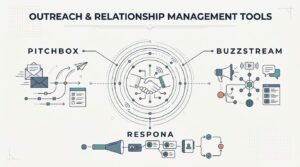
Pitchbox
Pitchbox is an outreach automation platform built specifically for link building and digital PR campaigns. It combines prospect discovery with automated email sequences and reply detection, cutting the manual tracking work significantly.
Agencies managing multiple client campaigns tend to favor Pitchbox because of its team collaboration and white-label reporting features.
BuzzStream
BuzzStream is a relationship management tool that tracks outreach history, contact details, and campaign status across large prospect lists. Its browser extension pulls contact information directly from a webpage, which speeds up manual prospecting considerably.
I’ve found BuzzStream’s CRM-style contact database particularly useful for teams running ongoing digital PR rather than one-off campaigns.
Respona
Respona is an outreach platform that combines content-based prospecting with personalized email sequencing, aiming to match link requests to genuinely relevant sites. It pulls prospects directly from search engine results, which keeps the discovery process closer to how a human researcher would work.
Smaller teams often pick Respona over Pitchbox because its per-seat pricing is friendlier for a one- or two-person link building operation.
All-in-One Link Building Platforms
All-in-one link building platforms combine backlink research, outreach management, and link monitoring into a single subscription, reducing the number of tools a team needs to juggle. This bundling comes with trade-offs, since a platform that does everything rarely leads in any single category.
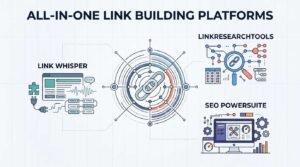
Link Whisper
Link Whisper is a WordPress plugin focused primarily on internal linking, though its newer versions include basic external link opportunity suggestions. It’s a lightweight option for teams whose main pain point is internal link structure rather than external outreach.
LinkResearchTools
LinkResearchTools is a backlink analysis suite that emphasizes link risk detection and disavow file management alongside standard link discovery features. Its Link Detox tool specifically flags potentially toxic backlinks, which matters for sites recovering from a past penalty.
SEO PowerSuite
SEO PowerSuite is a desktop-based SEO toolkit that bundles link research, rank tracking, and site auditing into one installed application rather than a cloud dashboard. The one-time licensing option appeals to teams wary of recurring SaaS subscriptions, though the desktop model means less real-time data than cloud competitors.
Guest Post & Content Placement Marketplaces
Guest post marketplaces are platforms that connect website owners willing to publish sponsored or contributed content with brands looking to acquire backlinks through that content. This category sits in a gray area of SEO because Google’s guidelines technically discourage paid link placements, even though the practice remains widespread.
Types of Placement Marketplaces
Marketplaces generally fall into three types: direct publisher marketplaces where you buy placements on specific sites, agency-managed marketplaces that vet sites before offering them, and open bidding platforms where price is the primary filter.
Open bidding platforms tend to produce the lowest quality links because sites competing purely on price rarely maintain strong editorial standards.
Quality Verification Signals to Check
Traffic authenticity, editorial relevance to your niche, and a site’s existing organic traffic trend are the three signals worth checking before buying any placement. A site with a large but declining traffic graph is often shedding the authority that made it attractive in the first place.
HARO & Digital PR Alternative Tools
Digital PR tools connect journalists seeking expert sources with brands willing to provide commentary, in exchange for a citation and often a backlink. This category shifted significantly after HARO’s acquisition and relaunch changed its pricing and query volume.
Connectively (Formerly HARO)
Connectively is the rebranded successor to HARO, connecting journalists with expert sources through daily query digests across multiple industries. The rebrand introduced tiered pricing where the free version existed under the old HARO model, narrowing access for smaller teams.
Qwoted
Qwoted is a source-matching platform that pairs journalists and media outlets with expert commentators, functioning similarly to Connectively but with a stronger emphasis on verified expert profiles. Its verification step tends to produce higher journalist response rates than open-query platforms.
Broken Link Building & Link Reclamation Tools
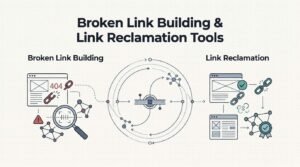
Broken link building is a technique that identifies dead links on other websites and pitches your own content as a replacement resource. This method has slowed in effectiveness as the web has consolidated, but it still works well in niches with a high density of older, less-maintained sites.
Link reclamation tools scan your own backlink profile for links pointing to pages that now 404, then help you either redirect the destination or reach out to have the link updated. Recovering a handful of lost links from your own historical profile is often faster than earning new ones from scratch.
Competitor Backlink Gap Analysis Tools
Backlink gap analysis tools compare your link profile against one or more competitors to identify domains that link to them but not to you. This is one of the fastest ways to generate a qualified prospect list, since a site already linking to a direct competitor has demonstrated willingness to link within your niche.
Most major research platforms include a gap analysis feature, but the output quality depends heavily on how current and complete their underlying index is.
Domain Authority & Link Metric Checkers
Domain authority checkers are tools that assign a numeric score estimating how likely a website’s backlinks are to help it rank in search results. These scores are proprietary estimates, not something Google publishes or endorses, which means the same site can carry very different scores across different tools.
Moz Link Explorer
Moz Link Explorer is a backlink research tool built around Domain Authority, the metric Moz created and popularized across the SEO industry. Domain Authority remains widely referenced in outreach pitches, even though Moz itself cautions against treating it as a direct Google ranking factor.
Understanding DA, DR, and Trust Flow Differences
Domain Authority, Domain Rating, and Trust Flow are three separate proprietary scoring systems built by Moz, Ahrefs, and Majestic, respectively, and none of them are interchangeable. A domain scoring 40 on one system might score 55 on another simply because each tool weighs link quantity and quality differently.
Free vs. Paid Link Building Tools: What Changes
Free link building tools typically offer limited search volume, capped result counts, and delayed index updates compared to their paid counterparts. The core tradeoff is depth and freshness of data rather than the absence of features entirely.
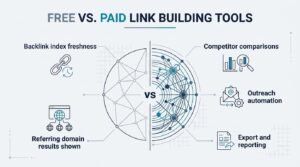
The table below shows what typically changes between a free and paid tier across the major tool categories.
| Feature | Free Tier | Paid Tier |
| Backlink index freshness | Weekly or monthly | Daily |
| Referring domain results shown | 5–50 | Unlimited or 10,000+ |
| Competitor comparisons | Rarely included | Standard |
| Outreach automation | Not included | Included |
| Export and reporting | Limited or none | Full CSV/API access |
How Much Link Building Tools Cost in 2026
Link building tool pricing in 2026 typically ranges from $0 for limited free tiers to over $500 per month for enterprise-level suites with multi-user access. Most small teams land in the $99–$200 per month range for a single research or outreach platform.
| Tier | Monthly Price Range | Typical Buyer |
| Free | $0 | Solo bloggers, testing phase |
| Starter | $50–$150 | Small businesses, single-site teams |
| Professional | $150–$400 | Growing SMEs, small agencies |
| Enterprise | $400+ | Multi-client agencies, large in-house teams |
How to Choose the Right Link Building Tool for Your Team
The right link building tool depends primarily on team size, budget, and whether outreach or research is the bigger bottleneck. A solo operator rarely needs the same stack as an agency running fifteen client campaigns at once.
By Business Size
Solo operators and small businesses generally do fine with one research tool and a spreadsheet for outreach tracking. Agencies managing multiple clients tend to need a dedicated outreach platform on top of research software just to keep campaigns from colliding.
By Budget and Goals
Teams focused purely on measuring existing link health can often get by with a single research subscription under $150 a month. Teams actively running outreach campaigns should budget for both a research tool and an outreach platform, since trying to do both in one underpowered tool usually produces mediocre results at both jobs.
Common Link Building Tool Mistakes to Avoid
The most common mistake is buying an all-in-one suite before confirming which specific function research, outreach, or monitoring is actually the bottleneck. Teams frequently pay for outreach automation they never use because their real gap was link prospecting.
Ignoring link monitoring after a campaign ends is another frequent error. Links get removed, pages get deleted, and a backlink profile that looked strong three months ago can quietly shrink without anyone noticing.
How Link Building Tools Fit Into a Broader SEO Strategy
Link building tools support one piece of a larger SEO strategy that also includes technical site health, content quality, and on-page optimization. A strong backlink profile on a technically broken site rarely produces the ranking gains a team expects.
I’ve watched campaigns pour budget into outreach while the site’s core content wasn’t strong enough to earn links naturally once acquired. Tools solve the mechanics of link acquisition, not the underlying content quality that makes a link worth earning in the first place.
Link Building Tool Alternatives Worth Watching in 2026
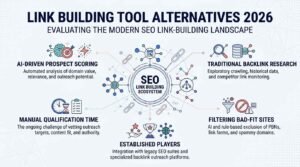
A handful of newer platforms are combining AI-driven prospect scoring with traditional backlink research, aiming to cut the manual qualification time that outreach teams currently spend filtering bad-fit sites. These tools are early enough that most haven’t displaced the established players in this guide, but they’re worth tracking as the category matures through 2026.
Conclusion
Link building tools split into research, outreach, and monitoring categories, each solving a different part of the acquisition process. The right combination depends on team size, budget, and where your current bottleneck actually sits.
We help businesses build backlink strategies that combine the right tools with strategic execution. Talk to White Label SEO Service about building a link acquisition plan that fits your goals.
Frequently Asked Questions
What is the best free link building tool?
Google Search Console is the strongest free option because it shows your actual existing backlinks and search performance directly from Google’s own data. It lacks competitor comparison features, so pairing it with a limited free tier elsewhere fills that gap.
How much do link building tools cost per month?
Most link building tools cost between $50 and $400 per month, depending on whether you need research, outreach, or both. Enterprise suites with multi-client reporting can exceed $500 monthly.
Do I need more than one link building tool?
Most active link building campaigns need at least two tools: one for backlink research and one for outreach management. Relying on a single platform for both usually means compromising on one function.
What’s the difference between Ahrefs and Semrush for link building?
Ahrefs generally offers a larger, more specialized backlink index, while Semrush bundles link data with broader SEO features like keyword research. The choice often comes down to whether link data alone or an all-in-one SEO suite better fits your workflow.
Can link building tools replace manual outreach?
Link building tools automate the mechanical parts of outreach, like sending sequences and tracking replies, but they cannot replace genuine relationship building. The best results still come from a human reviewing fit before an email goes out.
How do link building tools measure domain authority?
Domain authority scores are calculated using proprietary algorithms that weigh referring domain count, link quality, and trust signals differently across each tool. These scores are estimates, not metrics Google itself publishes or uses directly.
Are link building tools worth it for small businesses?
Link building tools are worth it once manual prospecting and tracking start eating more time than the campaigns are worth. Many small businesses start with free tools and upgrade only after outreach volume justifies the cost.