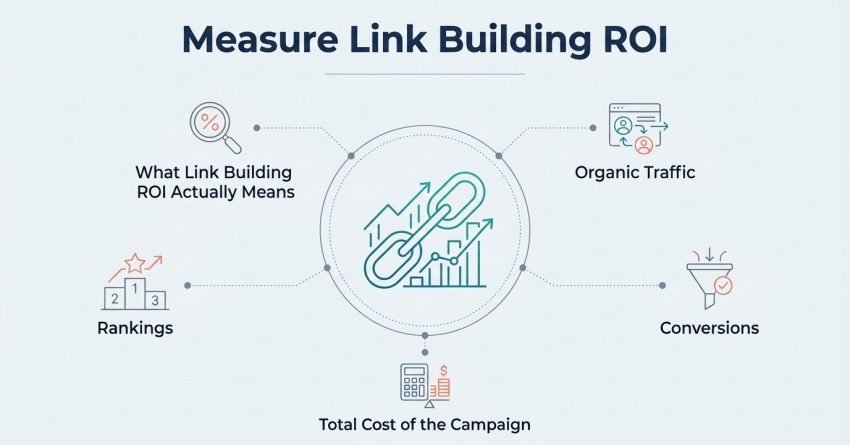
I’ve sat across the table from enough business owners to know the question that always comes up: link building ROI is the measurable return a business gets from acquiring backlinks, calculated by comparing the value of increased organic traffic, rankings, and conversions against the total cost of the campaign. It sounds simple until you try to isolate it from everything else happening on a site at the same time.
Link building rarely works in isolation, and that’s exactly why measuring it feels messy. We built this guide to give you a clear, repeatable way to track it.
This guide covers what link building ROI really means and why it’s hard to isolate, the core metrics and formulas that prove links are working, the tools you’ll actually use to track performance, realistic timelines and attribution models, and how to report all of it to stakeholders who want a straight answer.
What Link Building ROI Actually Means
Link building ROI measures the financial and organic growth return generated by a set of acquired backlinks relative to what was spent acquiring them. It’s not just “did rankings go up”; it’s whether that ranking movement translated into traffic, leads, or revenue that justified the spend.
I think the confusion starts because links rarely act alone. A single backlink can influence rankings for dozens of keywords, and those keywords can influence traffic to pages that convert at wildly different rates.
Why Link Building ROI Is Hard to Isolate
Search engines weigh hundreds of ranking factors together, so isolating the exact contribution of new backlinks against content updates, technical fixes, or algorithm shifts happening in the same window is genuinely difficult. Most sites are changing several variables at once.
I usually tell clients to expect a range, not a single clean number. Correlation over a defined window is the realistic standard, not laboratory-level causation.
Direct vs. Assisted Value in Link-Driven Growth
Direct value comes from a backlink pushing one specific page up in rankings for one tracked keyword. Assisted value is broader; it’s the referring domain authority lift that helps the entire domain rank better across many pages over time.
We track both because assisted value often dwarfs direct value on older campaigns. A single high-authority link can lift domain-wide trust that shows up months later on pages that were never directly linked to.
The Core Metrics That Prove Link Building Is Working
The core metrics for proving link building ROI are referring domain growth, organic traffic lift to linked pages, keyword ranking movement, and conversion attribution tied to that traffic. Together, these four numbers tell you whether links are actually moving the business forward.
I never look at just one metric alone. A ranking jump with no traffic lift usually means the keyword has low search volume, and traffic with no conversion lift usually means the wrong pages got the links.
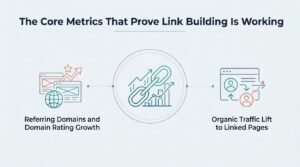
Referring Domains and Domain Rating Growth
The number of unique referring domains pointing to a site is one of the clearest leading indicators of link building progress, since search engines weight link diversity heavily. Ahrefs’ study of ranking correlations found that the number of referring domains correlates more strongly with top rankings than total backlink count.
Domain rating and domain authority scores rise slowly as referring domain count and quality increase. I watch this metric monthly, not weekly, because it moves gradually and daily checks just create noise.
Organic Traffic Lift to Linked Pages
Organic traffic lift is measured by comparing sessions to the specific linked page in the weeks before and after a link goes live, isolated as much as possible from site-wide traffic changes. This page-level comparison is more honest than looking at whole-site traffic, which mixes in dozens of unrelated factors.
I usually wait four to six weeks post-link before drawing conclusions. Search engines need time to crawl, index, and fully weigh a new link into their ranking calculations.
Keyword Ranking Movement Tied to New Links
Keyword ranking movement tracks position changes for the specific terms a linked page targets, checked against a pre-link baseline recorded before outreach began. Rank tracking tools log daily position, but weekly averages smooth out the volatility that search engines create through routine testing.
A page moving from position 15 to position 7 after a batch of links is a strong signal. A page stuck on page two despite new links usually points to content or technical issues, not a links problem.
Conversion and Revenue Attribution
Conversion attribution connects the traffic increase on a linked page to actual leads, sales, or revenue events tracked through analytics goals or ecommerce tracking. This is the step most businesses skip, and it’s the step that actually answers the “was it worth it” question.
I assign a dollar value to organic leads using average close rates and deal size. That dollar figure is what eventually gets compared against total campaign spend.
How to Calculate Link Building ROI (The Formula)
Link building ROI is calculated using the formula: (Value Generated minus Total Cost) divided by Total Cost, multiplied by 100 to get a percentage. Value generated includes the estimated revenue from increased organic traffic and conversions attributable to the links.
I build this out in a simple spreadsheet for every client. The formula itself is basic; the hard part is getting an honest number for “value generated.”
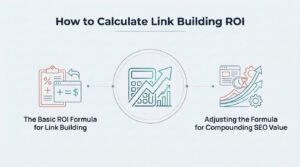
The Basic ROI Formula for Link Building
The basic formula looks like this: ROI% = ((Organic Value Generated − Link Building Cost) ÷ Link Building Cost) × 100. Organic value generated is typically calculated by multiplying new organic conversions by average conversion value.
A campaign costing $5,000 that generates $15,000 in attributable organic revenue produces a 200% ROI using this formula. That’s the number I put in front of stakeholders because it’s the one they actually understand.
Adjusting the Formula for Compounding SEO Value
Link building value compounds over time because backlinks continue driving rankings and traffic long after the initial cost was paid, unlike a paid ad that stops the moment spend stops. A more accurate long-term formula spreads the value generated over a 12- to 24-month window instead of a single month.
I always show clients both the month-one number and the twelve-month projection side by side. The month-one number is usually underwhelming, and the twelve-month number is usually where the real ROI story shows up.
Link Quality Metrics That Predict Future ROI
Link quality metrics domain authority, topical relevance, and referring domain traffic predict how much ranking and traffic value a backlink will eventually generate. High-quality links produce compounding ROI, while low-quality links often produce none at all.
I’ve seen ten mediocre links do less for a site than one genuinely relevant, high-authority placement. Quality metrics exist because not all links are worth the same investment.
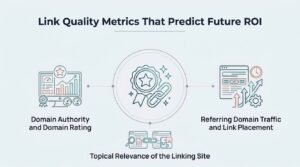
Domain Authority and Domain Rating
Domain authority and domain rating are third-party scores, built by Moz and Ahrefs respectively, that estimate how likely a domain’s backlinks are to help rankings based on the site’s own backlink profile strength. Neither metric is used directly by search engines, but both correlate reasonably well with ranking potential.
I use these as a filtering tool during outreach, not as the final word on link value. A domain rating of 40 with strong topical relevance can outperform a domain rating of 70 with none.
Topical Relevance of the Linking Site
Topical relevance measures how closely the subject matter of the linking site matches the subject matter of the page receiving the link, and it’s one of the strongest predictors of link value. A gardening blog linking to a gardening tool review carries far more contextual weight than a random directory listing ever will.
We prioritize relevance over raw authority scores in almost every campaign now. It’s a better predictor of long-term ranking movement.
Referring Domain Traffic and Link Placement
Referring domain traffic is the actual visitor volume the linking site receives matters because it signals the site is real, active, and likely to pass meaningful authority. Link placement within the content, versus buried in a footer or sidebar, also significantly affects how much ranking value a link passes.
A link placed in the main body of a well-trafficked article does more work than the same link tucked into a resource page nobody visits.
Setting Up Tracking Before You Build Links
Tracking must be set up before outreach begins, because without a recorded baseline for rankings, traffic, and conversions, there’s no accurate way to measure the change links caused afterward. Skipping this step is the single most common reason ROI reporting ends up unreliable.
I require a baseline snapshot on every campaign before the first link goes live. It takes twenty minutes and saves weeks of guesswork later.
Baseline Metrics to Record First
The baseline metrics to record are current keyword rankings for target terms, current organic sessions to target pages, current referring domain count, and current conversion rate on those pages. These four numbers become the “before” side of every comparison made later.
I export these into a dated spreadsheet the same week outreach starts. Without a timestamp, a baseline is just a guess after the fact.
UTM Tagging and Campaign Tracking for Outreach
UTM tagging applied to any trackable outreach links (guest post author bios, resource page submissions with click potential) allows referral traffic from those specific placements to show up distinctly in analytics. Most backlinks won’t get direct clicks, but the ones that do are worth isolating.
I tag every guest post bio link with a unique UTM parameter. It’s a small habit that occasionally surfaces surprising referral traffic nobody expected.
Tools for Measuring Link Building Performance
The core tools for measuring link building ROI are Google Search Console for ranking and click data, Google Analytics 4 for traffic and conversion tracking, third-party backlink tools for link quality data, and rank tracking software for keyword position monitoring. No single tool covers the full picture on its own.
I run all four in parallel for every active campaign. Each one answers a different piece of the ROI question.
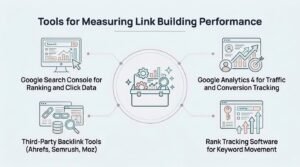
Google Search Console for Ranking and Click Data
Google Search Console shows average position, impressions, and clicks for every query a page ranks for, pulled directly from actual Google search data rather than a third-party estimate. This makes it the most accurate free source for tracking real ranking movement tied to link campaigns.
I check the Performance report weekly during active campaigns, filtering by the specific target pages receiving new links.
Google Analytics 4 for Traffic and Conversion Tracking
Google Analytics 4 tracks organic sessions, user behavior, and conversion events on linked pages, making it the primary tool for connecting traffic changes to actual business outcomes. GA4’s exploration reports let you segment traffic by landing page and date range to isolate the exact window a link campaign ran.
I build a saved exploration for every campaign that filters to the specific target URLs and compares pre- and post-campaign date ranges.
Third-Party Backlink Tools (Ahrefs, Semrush, Moz)
Third-party backlink tools like Ahrefs, Semrush, and Moz track referring domain growth, domain rating changes, and the quality metrics of every acquired link over time. These platforms crawl the web independently, so they catch links Google Search Console doesn’t always surface quickly.
I export a monthly backlink profile snapshot from one of these tools to track referring domain growth against the campaign timeline.
Rank Tracking Software for Keyword Movement
Rank tracking software monitors daily or weekly position changes for a defined list of target keywords, giving a cleaner view of ranking trends than manually checking search results. Tools in this category log historical position data, which is essential for correlating rank changes to specific link acquisition dates.
I set up a dedicated keyword group for each link campaign so movement is easy to isolate from the site’s broader keyword portfolio.
How Long It Takes to See Link Building ROI
Link building typically takes three to six months to show measurable ROI on newer or lower-authority sites, and one to three months on established, high-authority domains. The exact timeline depends on how quickly search engines crawl and weigh the new links relative to the site’s existing trust level.
I set this expectation with every client before a single link goes live. Anyone promising rankings in weeks is setting up a conversation that ends badly.
Timeline Expectations by Website Authority Level
Newer domains with limited existing authority often need six or more months of consistent link acquisition before ROI becomes clearly measurable, while established domains with strong existing trust can see movement in as little as four to eight weeks. Domain age and existing backlink profile strength are the biggest variables in how fast a new link translates into visible ranking change.
I always frame timelines as a range tied to the site’s current authority level, never as a fixed number of weeks.
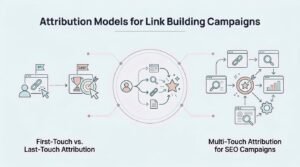
Attribution Models for Link Building Campaigns
Attribution models determine how credit for a conversion gets assigned across the multiple touchpoints, including organic search sessions influenced by link building that led a user to convert. Choosing the wrong model can make link building ROI look far better or far worse than it actually is.
I default to a data-driven or multi-touch model whenever the analytics platform supports enough conversion volume to make it statistically meaningful.
First-Touch vs. Last-Touch Attribution
First-touch attribution credits the very first interaction a user had with a brand, while last-touch attribution credits whichever interaction happened immediately before conversion. Link building tends to look stronger under first-touch models, since backlinks often introduce new visitors at the very top of the funnel.
I run both models side by side on reports specifically to show how differently link building’s contribution can appear depending on which lens you use.
Multi-Touch Attribution for SEO Campaigns
Multi-touch attribution distributes conversion credit across every touchpoint in a user’s journey, giving organic search and link-driven traffic partial credit alongside paid, email, and direct visits. This model tends to give the most balanced picture of what link building actually contributed, especially for longer sales cycles.
I recommend multi-touch attribution for any B2B client with a sales cycle longer than a few days.
Cost Per Link and Budget Efficiency Metrics
Cost per link is calculated by dividing total link building campaign spend by the total number of links successfully acquired, giving a simple efficiency benchmark for comparing campaigns or vendors. Industry benchmark data from Backlinko shows average costs varying widely by niche competitiveness and link quality tier.
I use cost per link as a budgeting tool, never as a standalone quality measure. A cheap link that does nothing for rankings isn’t actually cheap.
Calculating Cost Per Acquired Link
Cost per acquired link equals total outreach and content spend divided by the number of live, indexed links resulting from that spend. This calculation should only count links that actually went live and remained live after follow-up checks, since a meaningful percentage of promised placements get removed or never published.
I recheck link status at thirty and ninety days, because a link counted at launch that disappears by month two shouldn’t count toward the final cost-per-link figure.
Common Mistakes That Distort Link Building ROI Data
The most common mistakes that distort link building ROI data are measuring too soon, ignoring baseline data, attributing all traffic gains to links alone, and counting links that were never actually indexed or later removed. Any one of these can make a campaign look far more or less successful than it really was.
- Measuring results within the first two to four weeks, before search engines fully process new links
- Skipping baseline recording, making before-and-after comparisons impossible
- Ignoring other simultaneous changes like content updates or technical fixes
- Counting nofollow or unindexed links in ROI calculations
- Failing to recheck whether links remain live months later
- Using vanity metrics like domain rating alone instead of traffic and conversion data
I see the “measured too soon” mistake most often. Clients want an answer at week three, and week three almost never has one.
How to Report Link Building ROI to Stakeholders
Reporting link building ROI to stakeholders works best as a simple before-and-after comparison across four numbers: referring domains, organic traffic to target pages, keyword rankings, and estimated revenue attributable to that traffic. Stakeholders rarely want raw data; they want the story those four numbers tell together.
I keep every stakeholder report to a single page. Anything longer gets skimmed instead of read.
Building a Link Building ROI Dashboard
A link building ROI dashboard pulls together data from Google Search Console, Google Analytics 4, and a backlink tracking tool into one recurring view, usually refreshed monthly. Tools like Looker Studio can connect directly to Search Console and GA4 to automate most of this reporting.
I build a template dashboard once per client and then just let the data refresh monthly with minimal manual work after that.
Link Building ROI Benchmarks by Industry
Link building ROI benchmarks vary meaningfully by industry, with competitive niches like finance and legal often requiring larger investments to see the same ranking movement that ecommerce or local service niches achieve at lower cost. Search competitiveness directly affects both the cost per link and the time needed to see measurable ROI.
I adjust every client’s expectations based on how saturated their specific niche already is with existing backlink activity.
When Link Building ROI Justifies Increased Investment
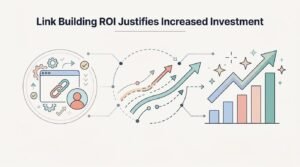
Increased link building investment is usually justified when existing campaigns show consistent ranking movement, referring domain growth, and positive attributable revenue over a sustained three- to six-month window. A pattern of compounding results, rather than a single good month, is the signal worth scaling around.
We look for that repeatable pattern before recommending any client increase their monthly link building budget.
Conclusion
Link building ROI comes down to tracking referring domains, rankings, traffic, and revenue against real cost, using consistent baselines and the right attribution model. It compounds over months, not weeks, and rewards patience over shortcuts.
We build these tracking systems into every campaign from day one. If you want a clear, data-backed read on your own link building performance, White Label SEO Service is ready to help you measure it properly.
Frequently Asked Questions
What is a good ROI for link building?
A good ROI for link building is generally considered 100% or higher over a 12-month window, meaning the campaign generated at least double its cost in attributable organic value. Competitive industries may see lower initial returns that improve significantly after the first year.
How do you measure the success of a backlink?
A backlink’s success is measured by tracking ranking movement, organic traffic change, and referring domain growth for the specific page it points to, compared against a pre-link baseline. A successful link shows measurable movement in at least two of these three areas within three months.
How many links does it take to move rankings?
There’s no fixed number, since ranking movement depends on the target keyword’s competitiveness and the linking sites’ quality rather than link count alone. Some pages move with three to five high-quality links while others need dozens.
Can you track link building ROI in Google Analytics?
Google Analytics 4 can track traffic and conversion data for linked pages but cannot directly attribute ranking changes to specific backlinks. It must be paired with Search Console and a backlink tracking tool for complete ROI measurement.
What is the average cost per link in the US?
Average cost per link in the US typically ranges from $150 to over $1,500 depending on the linking site’s authority, niche competitiveness, and content requirements. Higher-authority, highly relevant placements sit at the top of that range.
How long before link building shows ROI?
Link building typically shows measurable ROI within three to six months for most sites, though established high-authority domains can see movement in as little as four to eight weeks. Newer sites generally need the longer end of that range.
Does link building ROI decline over time?
Link building ROI generally compounds rather than declines, since acquired links continue passing authority and driving rankings long after the initial investment. ROI can decline only if the linking sites lose authority or the links get removed.