
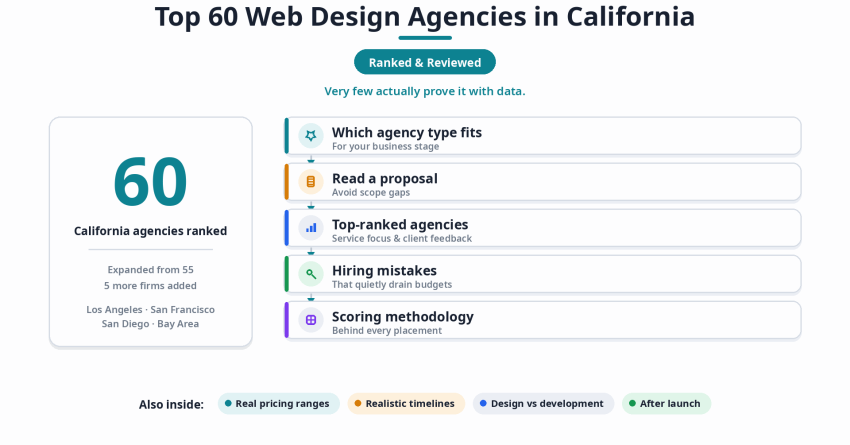
California holds one of the densest, most competitive web design markets anywhere. Hundreds of agencies across Los Angeles, San Francisco, San Diego, and the Bay Area promise the same things: modern design, stronger conversions, better visibility. Very few actually prove it with data.
This guide breaks that pattern. I expanded the original field of 55 agencies to 60, added five more established California firms to the comparison table, and layered in the practical questions most roundups skip entirely — real pricing ranges, realistic timelines, the actual difference between design and development, and what happens once your site goes live.
I cover how to figure out which agency type fits your business stage, how to read a proposal without getting fooled by scope gaps, a full breakdown of the top-ranked agencies with their actual service focus and client feedback patterns, the most common hiring mistakes that quietly drain budgets, and the exact scoring methodology behind every placement on this list.
Top Web Design Agencies in California in 2026 (At a Glance)
Comparing agencies by portfolio alone tells you almost nothing about how they’ll perform under your specific conditions — your budget, your industry, your growth stage. This section gives you a fast, honest snapshot before the full breakdown.
Each agency below is summarized by its strongest, most defensible specialty, so you can match it against your own priorities in seconds rather than scrolling through fifteen case studies.
Coalition Technologies — best for SEO-integrated design built around measurable traffic and revenue growth.
Zoek Marketing — best for small businesses that want an affordable launch paired with ongoing local visibility support.
SmartSites — best for brands running paid media who need design and PPC working as one system.
Digital Silk — best for premium, brand-first builds centered on storytelling and conversion architecture.
eSEOspace — best for SEO-ready sites that stay usable, accessible, and fast to launch. Lounge Lizard — best for branding-heavy experiences backed by decades of creative direction.
Suffescom Solutions Inc — best for technically demanding builds that need engineering depth, not just visuals.
Magneto IT Solutions — best for ecommerce brands running complex product catalogs and multi-channel sales.
Probey Services — best for conversion-first sites built for fast lead generation.
Gapsy Studio — best for SaaS and product teams that need structured, interface-driven UX.
This snapshot exists so you’re not stuck guessing. Instead of wading through every agency’s marketing language, you can immediately shortlist two or three names that match your business model, your budget range, and your growth stage — then dig into the full profiles below for the details that actually matter.
How to Choose the Right Web Design Agency in California
Picking a web design partner in California isn’t a creative decision — it’s a business decision with measurable consequences. The agency you choose will directly shape how prospects perceive your credibility, how easily they navigate toward a purchase, and how well your site performs against competitors spending heavily on the same keywords and ad placements.
A well-matched agency builds you a system that compounds — better rankings, steadier leads, cleaner data. A poorly matched one leaves you rebuilding in eighteen months after discovering the “beautiful” site never actually converted.
The sections below walk through exactly how to make that decision with evidence instead of guesswork.
1. Identify Your Business Type First
Your business model should drive your agency shortlist — not the other way around. A pre-revenue startup, a multi-location franchise, and an enterprise manufacturer each need fundamentally different things from a website, and an agency strong in one area can be genuinely weak in another.
Startups typically need clarity above everything else. Investors and early customers alike need to understand the offer in seconds, so positioning, load speed, and a tight conversion path matter more than visual experimentation.
Multi-location service businesses need information architecture — city-specific landing pages, consistent local SEO structure, and service breakdowns that scale cleanly as locations are added. This is a structural problem, not a styling one.
Ecommerce brands live or die on performance metrics: checkout friction, mobile speed, product hierarchy, and cart abandonment rates. An agency that talks mostly about visual trends and rarely about average order value is the wrong fit here.
B2B manufacturers and enterprise firms need authority signals — case studies, certifications, technical documentation, and CTAs built around longer sales cycles and lead qualification, not single-session conversions.
Web Design vs. Web Development: Why the Difference Matters When Hiring
These two terms get used interchangeably in sales calls, and that confusion costs buyers money. Design covers layout, visual identity, user experience, and how a page communicates. Development covers the actual build — the code, the CMS setup, integrations, hosting architecture, and technical performance.
An agency can be excellent at one and mediocre at the other. A firm with a stunning portfolio of static mockups may struggle with complex integrations, page speed optimization, or scalable CMS architecture. Conversely, a technically strong development shop may produce functional but visually forgettable sites.
Before you request a proposal, ask directly whether the team handles both disciplines in-house or subcontracts one of them. Subcontracting isn’t automatically a red flag, but it does add a coordination layer that affects timelines, accountability, and revision cycles. Knowing this upfront changes how you read every subsequent conversation with that agency.
2. Match Metro Strength to Your Needs
California isn’t a single market. Los Angeles agencies tend to lean into branding and storytelling, shaped by the entertainment and consumer-brand economy around them. San Francisco and Silicon Valley firms specialize in tech-driven, product-style experiences built for SaaS companies and investor-facing clarity. San Diego blends lifestyle positioning with performance marketing, often serving healthcare, hospitality, and biotech clients.
Geography doesn’t determine competence, but it does shape an agency’s instincts. A consumer brand chasing emotional resonance may click faster with an LA-based creative team. A SaaS founder optimizing onboarding flow may find more natural alignment with a Bay Area product-design studio. Matching that context saves you translation time during the discovery phase.
3. Questions You Should Always Ask
Before signing anything, push past the pitch deck. Ask how they run discovery — do they conduct real interviews, competitor audits, and user journey mapping, or skip straight to wireframes?
Ask how they define success. If the answer centers on traffic alone rather than conversions, leads, or revenue, that’s a meaningful gap. Ask what happens after launch — is there a performance review cadence, or does the relationship end at handoff? Ask who owns copywriting, SEO structure, and analytics setup, since vague answers here often turn into unexpected invoices later.
4. Red Flags You Shouldn’t Ignore
Some warning signs show up before you’ve even signed a contract. Be skeptical of agencies promising fast, guaranteed results — no credible firm can promise rankings or conversion lifts with certainty. Pay attention to whether conversations center on awards and aesthetics rather than business outcomes.
Suspiciously low pricing usually means corners get cut somewhere — often in strategy, QA, or post-launch support. Early communication habits are also a reliable predictor: if responses are slow or vague during the sales process, that pattern rarely improves once a contract is signed.
5. How to Compare Proposals Strategically
When you’re staring at two or three proposals side by side, compare structure rather than gut feeling. Look at whether UX research is actually scoped as a line item, or simply implied. Check for clear timeline milestones rather than a single delivery date months away.
Clarify who owns copywriting, SEO implementation, and analytics setup — these are frequently assumed rather than stated. Look closely at what post-launch support includes, and what triggers an additional invoice. The goal isn’t finding the cheapest number; it’s finding the proposal where scope, timeline, and ownership are all explicit.
Understanding Web Design Pricing in California
Pricing conversations get vague fast, which makes it hard to know if a quote is reasonable. Here’s a more concrete picture based on typical project complexity.
A basic brochure-style website for a small service business generally lands in the 3,000–10,000 range, covering a handful of pages, a content management system, and baseline mobile optimization. Mid-complexity sites — multi-location service businesses, lead-generation sites with custom forms, or small ecommerce stores — typically run 10,000–30,000, reflecting added integrations, custom design work, and more structured SEO foundations.
Enterprise or highly custom builds — platforms with complex integrations, headless architecture, or large product catalogs — often start at $30,000 and can extend well past $100,000 depending on scope. Agencies working in AI, blockchain, or advanced software development frequently set minimums at $25,000 or higher simply because of the engineering hours involved.
The number itself matters less than what’s included in it. A $5,000 quote with no SEO structure, no copywriting, and two rounds of revisions can end up costing more in rework than a $12,000 quote that includes all three from the start.
List of The Top 55 Web Design Companies in California (2026)
Note: this list has been expanded to 60 entries for 2026, adding five additional established California web design firms to the comparison table below. The original heading has been preserved as published for consistency with the underlying ranking data; see the “5 Additional California Web Design Agencies Worth Knowing” section for details on the newly added names and how they were evaluated differently from the scored 55.
Swipe to see more
| 1 | Coalition Technologies | Worldwide | 10 | 4.60 | 664,400 | 305 | 17 | 4.56 | 420 | 4.60 | 124 | 50 | 1,000 | 70 | |
| 2 | Zoek Marketing | Worldwide | 20 | 4.20 | 628 | 109 | 14 | 4.30 | 5,146 | 3.35 | 96 | 100 | 1,000 | 52 | |
| 3 | SmartSites | Worldwide | 10 | 4.80 | 16,100 | 307 | 15 | 4.74 | 1,671 | 4.40 | 95 | 100 | 1,000 | 50 | |
| 4 | Digital Silk | Worldwide | 50 | 4.80 | 126,700 | 299 | 11 | 4.16 | 96 | 3.45 | 98 | 100 | 10,000 | 49 | |
| 5 | eSEOspace | Worldwide | 60 | 5.00 | 3,400 | 12 | 20 | 4.76 | 138 | 5.00 | 1 | 50 | 1,000 | 48 | |
| 6 | Lounge Lizard | Worldwide | 60 | 4.80 | 5,500 | 57 | 28 | 4.77 | 79 | 4.20 | 32 | 100 | 10,000 | 47 | |
| 7 | Suffescom Solutions Inc | Worldwide | 10 | 4.90 | 12,700 | 292 | 13 | 4.98 | 192 | 4.50 | 91 | 25 | 25,000 | 47 | |
| 8 | Magneto IT Solutions | Worldwide | 10 | 4.70 | 7,200 | 168 | 17 | 4.50 | 140 | 4.20 | 129 | 25 | 10,000 | 46 | |
| 9 | Probey Services | Worldwide | 40 | 5.00 | 1,800 | 64 | 10 | 5.00 | 226 | 4.50 | 14 | 25 | 1,000 | 44 | |
| 10 | Gapsy Studio | Worldwide | 70 | 5.00 | 1,200 | 16 | 8 | 4.90 | 59 | 4.00 | 1 | 25 | 5,000 | 44 | |
| 11 | SmartBug Media | Worldwide | 10 | 4.80 | 14,900 | 187 | 19 | 4.87 | 248 | 3.25 | 159 | 150 | 1,000 | 44 | |
| 12 | Ignite Visibility | Worldwide | 10 | 4.70 | 56,400 | 305 | 13 | 4.46 | 289 | 3.65 | 89 | 100 | 10,000 | 43 | |
| 13 | EIGHT25MEDIA | Worldwide | 50 | 4.90 | 376 | 140 | 15 | 4.30 | 39 | 4.00 | 71 | 100 | 25,000 | 42 | |
| 14 | ForeFront Web | Worldwide | 35 | 5.00 | 8,000 | 13 | 20 | 4.93 | 73 | 5.00 | 3 | 100 | 5,000 | 42 | |
| 15 | INSIDEA | Worldwide | 10 | 5.00 | 22,900 | 185 | 4 | 4.57 | 93 | 4.30 | 86 | 50 | 1,000 | 41 | |
| 16 | Bop Design | Worldwide | 60 | 4.90 | 4,000 | 59 | 18 | 4.90 | 132 | 5.00 | 4 | 150 | 25,000 | 41 | |
| 17 | Designli | Worldwide | 20 | 4.80 | 6,300 | 74 | 13 | 4.98 | 271 | 5.00 | 1 | 50 | 10,000 | 41 | |
| 18 | SapientPro | Worldwide | 20 | 4.80 | 670 | 67 | 10 | 4.95 | 58 | 4.80 | 5 | 25 | 5,000 | 40 | |
| 19 | New Target, Inc. – The Digital Agency | Worldwide | 20 | 4.80 | 2,900 | 42 | 28 | 4.85 | 63 | 4.15 | 7 | 100 | 10,000 | 40 | |
| 20 | UPQODE | Worldwide | 40 | 4.80 | 5,400 | 47 | 11 | 4.93 | 147 | 4.80 | 4 | 100 | 5,000 | 40 | |
| 21 | Jacob Tyler | Worldwide | 40 | 4.60 | 980 | 20 | 26 | 4.48 | 78 | 4.40 | 22 | 150 | 5,000 | 40 | |
| 22 | GoldenComm | Worldwide | 20 | 4.70 | 159 | 49 | 30 | 4.95 | 81 | 4.65 | 33 | 150 | 25,000 | 39 | |
| 23 | Funnel Boost Media | Worldwide | 10 | 4.80 | 2,200 | 46 | 14 | 4.66 | 441 | 4.60 | 11 | 50 | 1,000 | 39 | |
| 24 | 500 Designs | Worldwide | 50 | 4.90 | 154 | 87 | 9 | 4.87 | 60 | 3.10 | 81 | 100 | 25,000 | 39 | |
| 25 | Jives Media | Worldwide | 10 | 5.00 | 4,000 | 53 | 14 | 4.93 | 565 | 5.00 | 4 | 100 | 1,000 | 39 | |
| 26 | Sachs Marketing Group | Worldwide | 10 | 4.80 | 351 | 25 | 16 | 4.90 | 73 | 5.00 | 42 | 100 | 1,000 | 39 | |
| 27 | Diffco | Worldwide | 10 | 4.90 | 200 | 23 | 18 | 4.75 | 92 | 4.75 | 23 | 50 | 25,000 | 38 | |
| 28 | LAD Solutions | Worldwide | 20 | 4.70 | 867 | 34 | 17 | 4.80 | 45 | 3.40 | 6 | 50 | 1,000 | 38 | |
| 29 | Titan Growth | Worldwide | 10 | 4.90 | 1,700 | 38 | 22 | 4.17 | 36 | 4.85 | 7 | 100 | 1,000 | 37 | |
| 30 | Bilberrry | Worldwide | 10 | 4.90 | 125 | 32 | 15 | 4.95 | 61 | 4.55 | 13 | 50 | 25,000 | 37 | |
| 31 | Bliss Drive | Worldwide | 10 | 4.80 | 2,200 | 29 | 19 | 4.57 | 51 | 3.20 | 15 | 50 | 1,000 | 36 | |
| 32 | HigherVisibility | Worldwide | 10 | 4.40 | 40,600 | 79 | 9 | 4.26 | 214 | 4.30 | 61 | 100 | 1,000 | 36 | |
| 33 | Vardot | Worldwide | 20 | 4.90 | 1,600 | 59 | 15 | 4.85 | 64 | 4.15 | 26 | 100 | 25,000 | 36 | |
| 34 | ParkerWhite Brand Interactive | Worldwide | 10 | 4.40 | 470 | 12 | 29 | 4.95 | 28 | 4.00 | 1 | 100 | 25,000 | 36 | |
| 35 | Flying V Group | Worldwide | 20 | 4.90 | 20,100 | 61 | 10 | 4.90 | 120 | 5.00 | 5 | 150 | 5,000 | 35 | |
| 36 | Baunfire | Worldwide | 55 | 4.70 | 639 | 33 | 25 | 4.90 | 93 | 4.40 | 2 | 150 | 75,000 | 35 | |
| 37 | Three29 | Worldwide | 25 | 4.90 | 318 | 15 | 16 | 4.27 | 60 | 4.40 | 3 | 100 | 10,000 | 35 | |
| 38 | Burst Digital | Worldwide | 15 | 4.90 | 234 | 25 | 8 | 4.93 | 111 | 4.75 | 14 | 100 | 5,000 | 35 | |
| 39 | Kobe Digital | Worldwide | 15 | 4.60 | 2,000 | 29 | 10 | 4.58 | 105 | 4.65 | 16 | 100 | 1,000 | 34 | |
| 40 | Urban Insight | Worldwide | 20 | 4.90 | 746 | 28 | 26 | 4.83 | 42 | 4.80 | 14 | 150 | 50,000 | 34 | |
| 41 | The Bureau Of Small Projects | Worldwide | 25 | 4.90 | 198 | 17 | 13 | 4.87 | 127 | 4.30 | 5 | 150 | 1,000 | 34 | |
| 42 | Growwwise | Worldwide | 15 | 4.90 | 9,100 | 3 | 8 | 4.10 | 47 | 4.00 | 3 | 25 | 1,000 | 34 | |
| 43 | Watson Creative | Worldwide | 15 | 5.00 | 1,200 | 35 | 18 | 4.90 | 74 | 4.40 | 32 | 150 | 25,000 | 34 | |
| 44 | Mojo Media | Worldwide | 70 | 5.00 | 539 | 4 | 8 | 5.00 | 103 | 0.00 | 0 | 100 | 1,000 | 33 | |
| 45 | Idea Maker | Worldwide | 20 | 4.90 | 630 | 12 | 10 | 4.58 | 49 | 4.70 | 12 | 100 | 25,000 | 33 | |
| 46 | Moburst | Worldwide | 10 | 4.80 | 7,800 | 99 | 13 | 4.60 | 75 | 3.80 | 67 | 150 | 25,000 | 33 | |
| 47 | Ramotion | Worldwide | 20 | 4.60 | 43,800 | 29 | 17 | 4.95 | 55 | 5.00 | 1 | 150 | 50,000 | 32 | |
| 48 | Tiny Frog Technologies | Worldwide | 65 | 4.90 | 4,400 | 19 | 23 | 4.10 | 183 | 0.00 | 0 | 150 | 10,000 | 32 | |
| 49 | Clay | Worldwide | 30 | 4.50 | 32,700 | 83 | 10 | 4.88 | 92 | 4.35 | 12 | 150 | 50,000 | 31 | |
| 50 | DreamX | Worldwide | 40 | 5.00 | 1,200 | 9 | 4 | 4.90 | 83 | 0.00 | 0 | 25 | 1,000 | 31 | |
| 51 | ENDERTECH | Worldwide | 25 | 4.80 | 696 | 27 | 26 | 4.75 | 53 | 0.00 | 0 | 100 | 10,000 | 31 | |
| 52 | Storm Brain | Worldwide | 40 | 4.90 | 1,500 | 49 | 19 | 4.97 | 266 | 0.00 | 0 | 150 | 10,000 | 30 | |
| 53 | Visceral | Worldwide | 30 | 4.90 | 284 | 23 | 20 | 5.00 | 26 | 4.00 | 2 | 200 | 50,000 | 29 | |
| 54 | metajive | Worldwide | 40 | 4.70 | 224 | 24 | 21 | 4.90 | 39 | 4.10 | 7 | 150 | 100,000 | 28 | |
| 55 | ThrillX | Worldwide | 50 | 4.80 | 1,300 |
Deep Dive: 14 Top Web Design Agencies in California (2026)
A quick snapshot only tells part of the story. California’s web design market is wide enough to support boutique UX studios, enterprise engineering teams, ecommerce specialists, and branding-first creative shops — often within the same ten-mile radius.
This section profiles 14 of the top-ranked agencies in depth, covering their specialization, pricing tier, and the patterns that show up repeatedly in client feedback. Rather than ranking them again, this gives you the detail needed to match a specific agency against your specific situation — because the right partner usually isn’t the biggest name. It’s the one aligned with what you actually need built.
⭐Top Pick: WhiteLabelSeoService (Best for SEO-integrated web design to scale in competitive California markets)
WhiteLabelSeoService positions itself around a straightforward idea: a website is a growth asset, not a decorative one. Rather than opening projects with mood boards, the agency starts with research — search intent mapping, keyword clustering, and competitor analysis — before any layout decisions get made.
That sequencing shows up across their published case material. Projects reportedly begin with an audit of user behavior and friction points, and structural decisions follow from that analysis rather than preceding it. For businesses evaluating this agency, the relevant question isn’t whether the approach sounds credible — it’s whether your own project genuinely needs that depth of upfront research, or whether a lighter, faster build would serve you just as well.
A Web Design Process That Starts With Strategy
The agency’s published process emphasizes competitor audits and keyword cluster mapping ahead of wireframing. This sequencing — research before visuals — is a pattern worth evaluating in any agency’s proposal, not just this one. If a prospective partner jumps straight to mockups without asking about your competitive landscape or your customers’ search behavior, that’s a meaningful gap compared to agencies that build structure first.
UX and Psychology
Published material from WhiteLabelSeoService describes placing trust signals where hesitation tends to occur and positioning calls-to-action at points where buying intent peaks. This reflects a broader principle in conversion-focused design: user attention is finite, and friction removal matters more than visual flourish. Any agency claiming UX expertise should be able to explain specifically where and why they place proof elements, not just that they do.
We Build for Competitive Markets
The agency positions itself toward harder, more saturated categories — enterprise SaaS, FinTech, and B2B software — where competitors already invest heavily in content and search visibility. In categories like these, a surface-level redesign rarely moves the needle; winning requires link-worthy content structure and internal architecture built to support topical authority over time.
Data Sharpened Creativity
Their published approach ties design choices to measurable inputs — readability data informing typography, heatmap behavior shaping layout decisions. This is a useful litmus test for any agency: ask whether design decisions trace back to data, or whether they’re primarily aesthetic preferences dressed up as strategy.
Integration With SEO From Day One
One of the more defensible points in WhiteLabelSeoService‘s positioning is treating SEO as a planning-stage consideration rather than a post-launch add-on. URL structure, page speed budgets, and content placement decided early tend to prevent expensive rebuilds later. Businesses relying heavily on organic traffic should specifically ask any prospective agency whether SEO planning happens during design, or only after the site is already built.
Who WhiteLabelSeoService Is Best For
Based on their published positioning, this model fits companies that treat their website as an ongoing growth channel rather than a static brochure — particularly those competing on organic visibility in crowded categories. Businesses simply looking for a visual refresh without deeper structural needs may find this level of integration more than what the project calls for.
Why We Positioned WhiteLabelSeoService Separately
WhiteLabelSeoService‘s published emphasis on search-aligned architecture, conversion structure, and technical SEO integration places it in a different category from agencies focused primarily on visual presentation. That distinction is worth noting for any reader comparing agencies by process depth rather than portfolio alone.
1. Coalition Technologies

- Website: coalitiontechnologies.com
- Final Score: 70
- Minimum Project Cost: $1,000+
- Client Rating: 4.56 (based on 420 reviews)
- Team Size: 305 (LinkedIn)
- Years in Business: 17
- Monthly Website Visits: 664,400
- Employee Review Score: 4.60 (based on 124 reviews)
Los Angeles businesses tend to move fast, and Coalition Technologies is structured around that expectation. Rather than treating web design as a standalone deliverable, the agency positions it as one component inside a larger performance system that includes SEO, paid media, and conversion optimization working together.
That integration matters most in cost-sensitive paid-traffic markets like LA and Orange County, where a slow or confusing page can erase ad spend efficiency almost immediately. With a team exceeding 300 people, projects run through specialists across multiple disciplines rather than a single generalist handling everything — a structural advantage that smaller studios can’t easily replicate.
The visual style leans practical over experimental. Pages are typically built around clear user flow and conversion points rather than artistic risk-taking, which tends to perform well in high-competition categories like ecommerce, legal services, and healthcare where clarity outperforms novelty.
Core Services:
- SEO campaigns spanning technical optimization, ecommerce SEO, local SEO, and AI-driven search strategies
- Web design and development across Shopify, WordPress, Magento, and custom builds focused on conversion
- PPC management including Google Ads and paid social campaigns
- Conversion rate optimization (CRO), including UX restructuring and testing
- Email, SMS, and lifecycle marketing tied to revenue growth
- Content marketing, link building, and digital PR support
Why They Rank #1
- 420 verified client reviews, one of the highest review volumes in this evaluation
- 305 team members, reflecting enterprise-level operational capacity
- $1,000+ starting budget, keeping the entry point accessible for SMBs
- 17 years in business, demonstrating sustained performance through multiple market shifts
- Consistent feedback around responsiveness and conversion-focused execution
A Snapshot of Client Reviews:
Reviewers frequently describe the team as organized and easy to communicate with, noting that delivered sites feel clean and straightforward to navigate. Feedback on SEO work tends to emphasize measurable traffic and revenue growth rather than vague visibility claims.
Our Take
Coalition Technologies fits SMBs and midmarket brands that want dependable, performance-driven execution without unnecessary creative risk. The combination of scale, longevity, and review volume reduces the uncertainty that comes with smaller or newer agencies. Brands chasing highly experimental, design-led storytelling may find a boutique creative studio a better match.
2. Zoek Marketing

- Website: gozoek.com
- Final Score: 52
- Minimum Project Cost: $1,000+
- Client Rating: 4.30 (based on 5,146 reviews)
- Team Size: 109 (LinkedIn)
- Years in Business: 14
- Monthly Website Visits: 628
- Employee Review Score: 3.35 (based on 96 reviews)
Not every California business is a funded startup chasing enterprise scale. Most are small, local, and trying to grow without burning through budget on complex digital systems. Zoek Marketing, based in Irvine, is built for exactly that segment.
Rather than running long discovery phases, the agency prioritizes speed and simplicity — getting a functional website live quickly and layering visibility on top. That model aligns naturally with how smaller operators actually buy: they typically want something reliable and manageable, not a fully bespoke build.
The review volume here is notable. Supporting a client base this large suggests Zoek has built repeatable systems that work across industries, from local retail to home services. The tradeoff is that the experience can feel more standardized than customized, which becomes more noticeable in highly competitive urban markets where differentiation carries more weight.
Core Services:
- Website design focused on small business usability and quick deployment
- Search engine optimization (on-page, local SEO, directory listings)
- Pay-per-click (PPC) campaigns for lead generation
- Social media marketing and account management
- Graphic design and branding support
- Subscription-based digital marketing bundles for ongoing growth
Why They Rank #2:
- 5,146 verified client reviews, one of the largest review footprints evaluated
- 109 team members, providing mid-size structured delivery
- $1,000+ starting budget, accessible for small and local operators
- Strong specialization in small-business SEO and fast website launches
- High-volume, repeatable delivery model suited to SMB-dense regions
A Snapshot of Client Reviews:
Feedback tends to focus on practicality rather than strategic language — clients frequently mention how easy the process felt and how approachable the team was, particularly for owners without technical backgrounds.
Our Take
Zoek Marketing suits small businesses that need a fast, affordable path to an online presence with ongoing visibility support. For companies that need deep strategic differentiation or complex technical builds, the standardized model may feel limiting.
3. SmartSites

- Website: smartsites.com
- Final Score: 50
- Minimum Project Cost: $1,000+
- Client Rating: 4.74 (based on 1,671 reviews)
- Team Size: 307 (LinkedIn)
- Years in Business: 15
- Monthly Website Visits: 16,100
- Employee Review Score: 4.40 (based on 95 reviews)
Businesses already running ad campaigns with inconsistent results tend to land here. SmartSites isn’t positioned as a creative-first agency — the focus is on stabilizing and scaling what’s already generating some traction, which matters most in paid-traffic-heavy categories like ecommerce and local services.
Campaigns are structured around clear metrics and ongoing optimization rather than a single large redesign. In cost-sensitive markets like Los Angeles, where paid traffic is expensive and mistakes compound quickly, that iterative approach helps protect ad spend efficiency rather than risking it on a one-time overhaul.
Core Services:
- Search engine optimization (technical SEO, local SEO, national campaigns)
- Pay-per-click (PPC) management across Google Ads and paid social
- Conversion-focused web design and website redesigns
- Social media marketing and audience engagement strategies
- Email and SMS marketing for lifecycle and retention
- Digital strategy aligned with lead generation and ecommerce growth
Why They Rank #3:
- 1,671 client reviews, demonstrating repeatable delivery at volume
- 307 team members, supporting large-scale structured execution
- $1,000+ starting budget, accessible while still supporting bigger builds
- Strong marketing-led design approach combining SEO, PPC, and landing pages
- Consistent operational signals around timeliness and communication
A Snapshot of Client Reviews:
Clients frequently describe the team as fast and organized, with active communication and timelines that hold up. Redesign work is often tied directly to measurable outcomes like stronger lead flow or improved return on ad spend.
Our Take
SmartSites fits businesses that want structured, metric-driven growth without unnecessary experimentation. Brands seeking bold creative differentiation may find the approach more execution-focused than visionary.
4. Digital Silk
- Website: digitalsilk.com
- Final Score: 49
- Minimum Project Cost: $10,000+
- Client Rating: 4.16 (based on 96 reviews)
- Team Size: 299 (LinkedIn)
- Years in Business: 11
- Monthly Website Visits: 126,700
- Employee Review Score: 3.45 (based on 98 reviews)
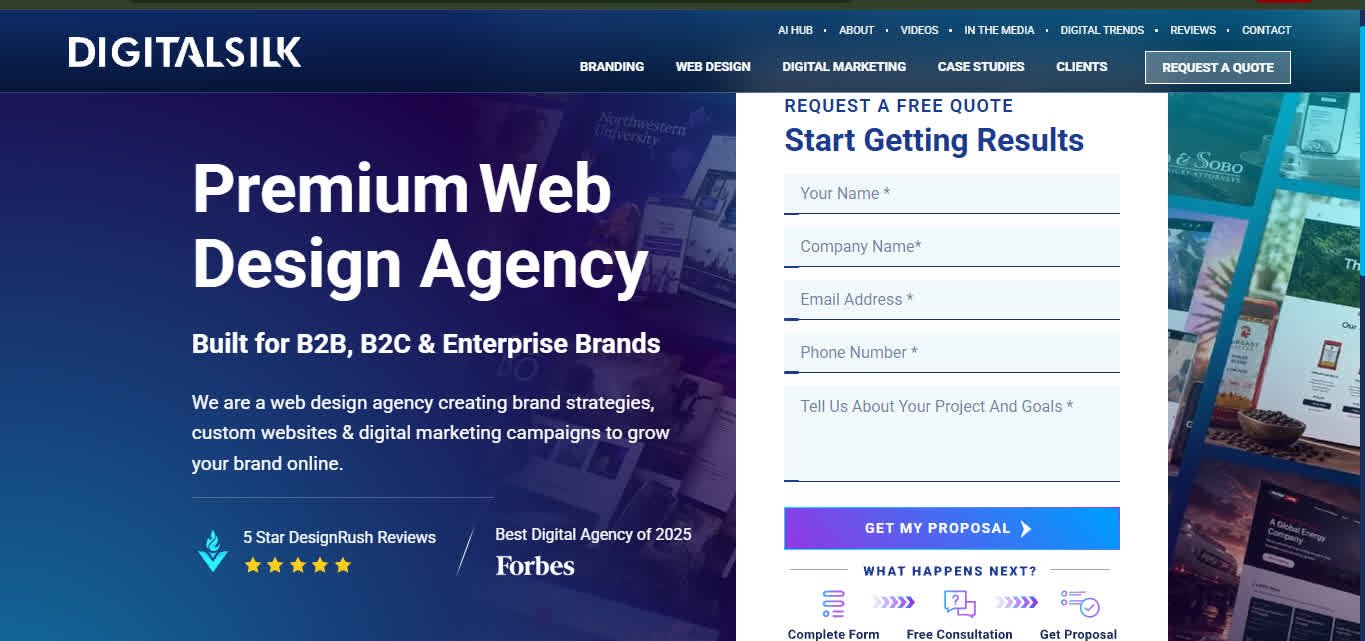
Some projects aren’t about simply launching a website — they’re about repositioning an entire brand. Digital Silk operates in that space, starting projects with positioning and messaging work before any layout decisions happen.
That distinction matters most in perception-sensitive markets like Los Angeles and San Francisco, where first impressions directly affect conversion. The agency’s project structure — dedicated teams and layered execution — reflects an enterprise-style process built for complexity rather than speed.
Core Services:
- Custom website design focused on UX, branding, and conversion
- eCommerce design and development (Shopify, WooCommerce, Magento)
- Branding and brand identity development (logos, messaging, visual systems)
- SEO and digital marketing campaigns integrated from the start
- Website redesign and optimization for performance and scalability
- Full-service digital strategy covering research, UX, development, and growth
Why They Rank #4:
- Strong custom design focus built for premium brand presentation
- $10,000+ minimum project cost, aligning with serious redesign budgets
- Solid review performance around organization and professionalism
- Conversion-led layouts designed to move visitors toward action
- Best fit for competitive, first-impression-driven markets
A Snapshot of Client Reviews:
Clients describe the team as responsive and detail-focused, with an iterative process that refines the site step-by-step rather than rushing delivery. Complex builds with heavy revisions can extend timelines, though clear scope tends to keep delivery smoother.
Our Take
Digital Silk suits brands that treat their website as a strategic asset rather than a simple marketing tool. Smaller businesses or those needing fast turnaround may find the process heavier than necessary.
5. eSEOspace

- Website: eseospace.com
- Final Score: 48
- Minimum Project Cost: $1,000
- Client Rating: 4.76 (based on 138 reviews)
- Team Size: 12 (LinkedIn)
- Years in Business: 20
- Monthly Website Visits: 3,400
- Employee Review Score: 5.00 (based on 1 review)
Smaller California businesses — local clinics, service providers, small ecommerce shops — rarely need layered funnels or complex marketing systems. They need a website that works and starts generating leads quickly. eSEOspace is built around that simplicity.
Projects move fast, decisions stay direct, and communication remains close throughout. That speed shows up most clearly in trust-driven local categories like healthcare, real estate, and home services, where responsiveness often matters more than design sophistication.
Core Services:
- Custom website design focused on engagement and conversion
- Web development including CRMs, automation systems, and backend integrations
- Search engine optimization (on-page, technical, local, and AI SEO)
- App and software design & development
- Branding and graphic design support
- Marketing strategy and lead generation optimization
Why They Rank #5:
- 60% of service focus concentrated on web design
- 4.76 client rating across 138 reviews, showing consistent delivery
- $1,000 minimum project cost, an accessible entry point
- 12-person team enabling direct, boutique-style communication
- San Diego-based positioning aligned with local, trust-driven markets
A Snapshot of Client Reviews:
Feedback often reads as personal rather than transactional, with clients describing the team as patient and accommodating, particularly those needing more guidance throughout the process.
Our Take
eSEOspace fits businesses that value speed, close collaboration, and direct team access. Larger, multi-layered projects may find the smaller team structure limiting.
6. Lounge Lizard

- Website: loungelizard.com
- Final Score: 47
- Minimum Project Cost: $10,000
- Client Rating: 4.77 (based on 79 reviews)
- Team Size: 57 (LinkedIn)
- Years in Business: 28
- Monthly Website Visits: 5,500
- Employee Review Score: 4.20 (based on 32 reviews)
Operating since 1998, Lounge Lizard has worked through nearly every major shift in digital design and search. That longevity tends to produce a more grounded, tested approach rather than a reactive one.
The agency balances creativity with performance in a way that serves both Los Angeles brand-storytelling clients and San Francisco SaaS companies prioritizing usability. Its client mix spans startups to enterprise brands, united by a desire to stand out rather than simply exist online.
Core Services:
- Custom website design with strong branding and storytelling focus
- UI/UX design and responsive web development
- eCommerce development (Shopify, Magento, custom builds)
- SEO and AI-driven search optimization
- Digital marketing including PPC, social media, and email campaigns
- Conversion rate optimization (CRO) and analytics-driven improvements
Why They Rank #6:
- Founded in 1998, among the most experienced agencies in this evaluation
- Roughly 55% of service focus concentrated on web design
- $10,000 minimum project cost, built for serious redesign budgets
- 4.77 client rating reflecting strong satisfaction across projects
- Los Angeles presence relevant for California-based buyers
A Snapshot of Client Reviews:
Client feedback often highlights the team’s upfront involvement in understanding goals before execution begins, which tends to produce stronger outcomes on branding-heavy projects.
Our Take
Lounge Lizard suits established brands that value experience and brand authority over quick turnaround. Early-stage startups or budget-driven projects may find the approach more robust than necessary.
7. Suffescom Solutions Inc
- Website: suffescom.com
- Final Score: 47
- Minimum Project Cost: $25,000+
- Client Rating: 4.98 (based on 192 reviews)
- Team Size: 292 (LinkedIn)
- Years in Business: 13
- Monthly Website Visits: 12,700
- Employee Review Score: 4.50 (based on 91 reviews)
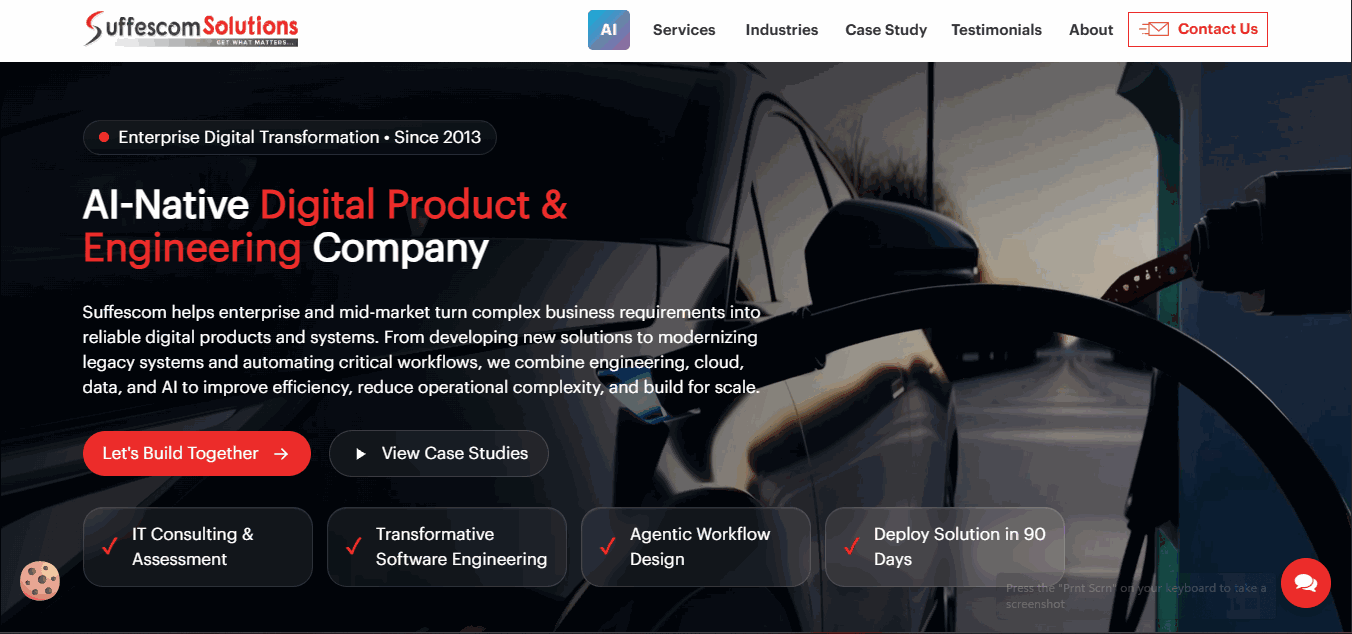
Suffescom operates closer to a technology partner than a traditional design studio, with work starting at the product and infrastructure level rather than the page level. That distinction matters for businesses building platforms, apps, or scalable systems rather than simple marketing sites.
Capabilities spanning AI, blockchain, and full-stack development attract startups launching MVPs and fintech or healthcare companies managing complex, compliance-sensitive systems. A distributed global team allows the agency to handle larger, multi-layered projects without slowing execution.
Core Services:
- Mobile app development (iOS, Android, cross-platform)
- AI development including generative AI, adaptive AI, and automation systems
- Blockchain and Web3 development solutions
- Custom software development and enterprise systems
- Web development and scalable platform engineering
- Cloud-native architecture and API-based infrastructure
Why They Rank #7:
- 292-person team, reflecting enterprise-level delivery capacity
- 4.98 client rating across 192 reviews, an unusually strong satisfaction score
- $25,000+ minimum project cost, positioned for mid-to-large builds
- Strong engineering identity centered on product-driven development
- Web design functions as part of a broader technical engine rather than a standalone focus
A Snapshot of Client Reviews:
Clients describe the team as structured and technically strong, citing clear roadmaps and consistent communication. Some feedback notes that visual creativity can vary depending on scope, with better outcomes when UX direction is defined upfront.
Our Take
Suffescom fits companies building infrastructure rather than simple marketing interfaces. Brands prioritizing visual storytelling over technical depth may find stronger alignment elsewhere.
8. Magneto IT Solutions
- Website: magnetoitsolutions.com
- Final Score: 46
- Minimum Project Cost: $10,000+
- Client Rating: 4.50 (based on 140 reviews)
- Team Size: 168 (LinkedIn)
- Years in Business: 17
- Monthly Website Visits: 7,200
- Employee Review Score: 4.20 (based on 129 reviews)
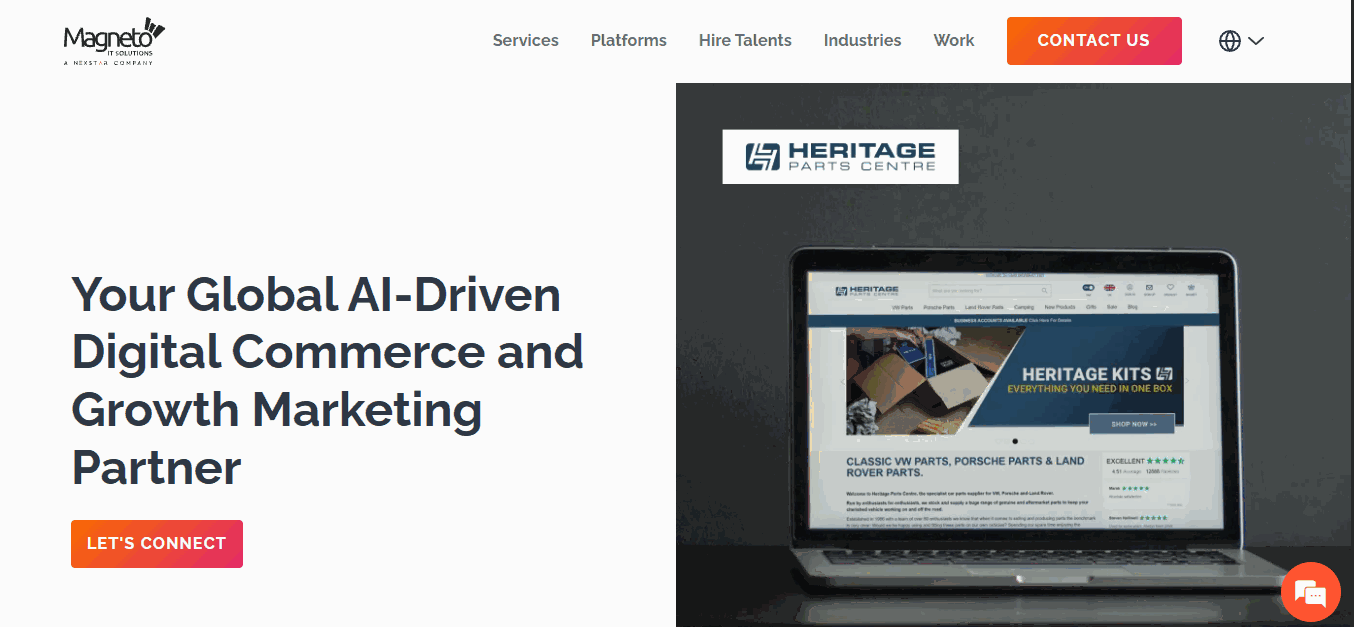
Magneto IT Solutions centers its entire model around digital commerce rather than general web design. That focus changes how projects are structured, typically starting with product architecture, integrations, and scalability planning rather than visual direction.
Mid-to-large ecommerce businesses benefit most, particularly those managing multiple platforms, inventory systems, and customer touchpoints. Flexibility across Magento, Shopify Plus, and composable commerce setups suits businesses planning long-term growth rather than a quick storefront launch.
Core Services:
- End-to-end eCommerce development (B2C, B2B, D2C, marketplaces)
- Headless and composable commerce architecture
- Platform integrations (ERP, CRM, PIM, DAM, OMS systems)
- UX/UI design focused on conversion and shopping experience
- SEO, paid marketing, and retention strategies
- AI-driven commerce solutions (personalization, pricing, analytics)
Why They Rank #8:
- 17 years of ecommerce specialization
- 168-person team supporting structured delivery capacity
- $10,000+ minimum project cost, positioned for mid-sized commerce builds
- Commerce-first identity with a highly specialized focus
- Web design functions in service of revenue systems rather than standing alone
A Snapshot of Client Reviews:
Clients frequently report measurable improvements in traffic, conversion rates, and overall user experience post-launch, particularly on projects involving inventory systems and multi-channel operations.
Our Take
Magneto IT Solutions suits businesses serious about ecommerce growth across platforms. Simpler websites or brand-focused projects may find the depth more than what’s needed.
9. Probey Services

- Website: probeyservices.com
- Final Score: 44
- Minimum Project Cost: $1,000+
- Client Rating: 5.00 (based on 226 reviews)
- Team Size: 64 (LinkedIn)
- Years in Business: 10
- Monthly Website Visits: 1,800
- Employee Review Score: 4.50 (based on 14 reviews)
Probey Services prioritizes efficient execution over elaborate positioning. With core operations rooted in India and a footprint extending into markets including Los Angeles, the agency combines offshore cost efficiency with an understanding of Western client expectations.
Service coverage extends well beyond web design into mobile apps, enterprise systems, and SEO campaigns, making the agency useful for businesses that prefer a single vendor managing multiple digital functions rather than coordinating several specialists.
Core Services:
- Website design and development (WordPress, Shopify, web apps)
- Mobile app development (iOS, Android, Flutter)
- Custom software development (ERP, CRM, SaaS platforms)
- SEO, PPC, and performance marketing campaigns
- Branding, content creation, and graphic design
- Social media marketing and influencer campaigns
Why They Rank #9:
- 5.00 client rating across 226 reviews, a notably consistent satisfaction record
- $1,000+ minimum project cost, a highly accessible entry point
- 64-person team supporting mid-sized structured delivery
- Performance-oriented positioning focused on implementation over luxury design
- Web design work integrated with SEO thinking from the outset
A Snapshot of Client Reviews:
Clients describe the team as responsive and outcome-focused, citing clear timelines and adaptability to changing requirements. Some feedback suggests simplified technical explanations would help non-technical clients early in projects.
Our Take
Probey Services suits startups and service-based businesses needing dependable execution on a limited budget. Buyers seeking high-end brand storytelling or complex enterprise systems may need deeper specialization elsewhere.
10. Gapsy Studio

- Website: gapsystudio.com
- Final Score: 44
- Minimum Project Cost: $5,000+
- Client Rating: 4.90 (based on 59 reviews)
- Team Size: 16 (LinkedIn)
- Years in Business: 8
- Monthly Website Visits: 1,200
- Employee Review Score: 4.00 (based on 1 review)
A website that looks polished and one that actually guides users through a decision are two different things. Gapsy Studio builds for the second outcome, structuring navigation and interaction around reducing friction rather than layering on visuals first.
That approach tends to attract SaaS and tech-driven clients, particularly in San Francisco, where usability directly affects product adoption. A smaller, tightly focused team keeps execution consistent from concept through delivery.
Core Services:
- UI/UX design for web and mobile applications
- Custom website design focused on usability and engagement
- Branding and visual identity development
- Motion design and interactive experiences
- UX research, audits, and product strategy
- Web development and low-code/no-code solutions
Why They Rank #10:
- 4.90 client rating across 59 reviews, strong satisfaction in design delivery
- Specialized 16-person team enabling focused creative execution
- $5,000+ minimum project cost, a mid-tier positioning
- Design-heavy service concentration, around 70% web design focus
- UI/UX depth prioritized over large-scale development infrastructure
A Snapshot of Client Patterns:
Feedback tends to highlight depth over speed, with clients noting the team’s strong grasp of user behavior before design decisions are finalized.
Our Take
Gapsy Studio fits companies where UX directly impacts product success. Businesses needing rapid deployment or broader marketing support may find the focus too narrow.
11. SmartBug Media

- Website: smartbugmedia.com
- Final Score: 44
- Minimum Project Cost: $1,000+
- Client Rating: 4.87 (based on 248 reviews)
- Team Size: 187 (LinkedIn)
- Years in Business: 19
- Monthly Website Visits: 14,900
- Employee Review Score: 3.25 (based on 159 reviews)
Growth often breaks down not from weak design but from disconnected systems — marketing generates leads sales can’t convert, with data lost somewhere in between. SmartBug Media positions itself as a lifecycle partner addressing that specific gap, working across demand generation, CRM integration, and revenue operations rather than isolated web design.
Deep alignment with HubSpot shapes much of their model, connecting marketing, sales, and customer success into a single operational system — particularly valuable for mid-to-enterprise SaaS and healthcare companies in markets like San Francisco and San Diego.
Core Services:
- HubSpot implementation, integration, and CRM optimization
- Website development and conversion optimization
- Demand generation and inbound marketing strategy
- SEO, paid media, and content marketing
- Revenue operations (RevOps) and sales enablement
- AI-driven marketing automation and lifecycle optimization
Why They Rank #11:
- 4.87 client rating across 248 reviews, high satisfaction consistency
- 19 years in business with a 187-person team, reflecting mature delivery
- Web design tied to inbound growth systems rather than standalone creative work
- Strong fit for funnel-based, CRM-driven website builds
- Lower employee score (3.25 across 159 reviews) keeps the agency outside the top tier
A Snapshot of Client Patterns:
Clients frequently describe the team as organized with strong project management, particularly around PPC, SEO support, and lifecycle strategy. Some feedback points to inconsistency in account management on larger engagements.
Our Take
SmartBug Media suits companies needing alignment between marketing, sales, and operations. Smaller businesses seeking quick execution may find the model more complex than necessary.
12. Ignite Visibility
- Website: ignitevisibility.com
- Final Score: 43
- Minimum Project Cost: $10,000+
- Client Rating: 4.46 (based on 289 reviews)
- Team Size: 305 (LinkedIn)
- Years in Business: 13
- Monthly Website Visits: 56,400
- Employee Review Score: 3.65 (based on 89 reviews)
Ignite Visibility is built for businesses that already have working marketing and need it to scale predictably. The client base leans toward enterprise brands, franchises, and multi-location businesses across California, where complexity across locations and audiences requires integrated systems rather than isolated campaigns.
Every channel — SEO, paid media, CRO, analytics — feeds into a larger growth framework rather than operating independently, which suits efficiency-focused markets like Los Angeles and predictability-focused SaaS companies in Silicon Valley alike.
Core Services:
- SEO (including AI SEO, local SEO, and digital PR)
- Paid media (PPC, display, social advertising, retargeting)
- Conversion rate optimization (CRO) and analytics
- Website design and development
- Email, SMS, and lifecycle marketing
- Influencer marketing and affiliate marketing
Why They Rank #12:
- 305-person team with 13 years in business, reflecting large-scale structured delivery
- Web design built around SEO and paid media performance rather than creative-first identity
- Strong fit for companies running aggressive, ROI-tracked marketing campaigns
- High monthly visit volume reflecting strong market presence
- Lower employee score (3.65 across 89 reviews) and some consistency concerns keep the agency outside the top tier
A Snapshot of Client Patterns:
Clients often describe the team as proactive and organized, with strong reporting habits and measurable improvements in traffic and conversions. Some feedback notes occasional communication gaps tied to team turnover, though transitions are generally well managed.
Our Take
Ignite Visibility fits companies already investing heavily in SEO and paid media who need their website aligned with aggressive growth targets. Brands prioritizing brand artistry over performance optimization may prefer a design-focused studio.
13. EIGHT25MEDIA

- Website: eight25media.com
- Final Score: 42
- Minimum Project Cost: $25,000+
- Client Rating: 4.30 (based on 39 reviews)
- Team Size: 140 (LinkedIn)
- Years in Business: 15
- Monthly Website Visits: 376
- Employee Review Score: 4.00 (based on 71 reviews)
Based in San Jose, EIGHT25MEDIA works primarily with technology companies that need more than visual polish — SaaS platforms, AI startups, and enterprise tech firms explaining complex solutions to non-technical audiences.
Projects begin with messaging, user flow, and conversion-path strategy before design execution, which matters in investor-facing environments like Palo Alto and San Francisco where UX decisions can influence funding perception. Client range spans startups to Fortune 500 companies, with development capabilities across modern tech stacks including headless CMS setups.
Core Services:
- Web design and development (WordPress, Drupal, custom builds)
- UX/UI design and conversion-focused interfaces
- Digital strategy and product positioning
- Branding and visual identity systems
- SEO and performance optimization
- CMS implementation and scalable web architecture
Why They Rank #13:
- Premium delivery bracket with a $25,000+ minimum, built for serious strategic projects
- Strong employee satisfaction (4.00 across 71 reviews) suggesting healthy internal culture
- Solid client satisfaction (4.30), though smaller review volume (39 reviews) limits scale-based proof
- Specialized toward tech and B2B/SaaS clients, strong fit but narrower applicability
- Known for disciplined execution, with occasional notes on communication clarity late in projects
A Snapshot of Client Patterns:
Feedback often highlights execution quality, with clients noting improvements in engagement, site performance, and design clarity after launch, particularly around translating complex ideas into intuitive interfaces.
Our Take
EIGHT25MEDIA fits tech-driven companies needing strategic, conversion-focused websites. Smaller businesses or purely creative branding projects may find the tech-first approach more intensive than necessary.
14. ForeFront Web

- Website: forefrontweb.com
- Final Score: 42
- Minimum Project Cost: $5,000+
- Client Rating: 4.93 (based on 73 reviews)
- Team Size: 13 (LinkedIn)
- Years in Business: 20
- Monthly Website Visits: 8,000
- Employee Review Score: 5.00 (based on 3 reviews)
ForeFront Web operates on a simple premise: if a website isn’t generating leads, something is broken, and fixing that matters more than chasing design trends. The focus stays on fundamentals — search intent, user clarity, and conversion structure.
Two decades in the industry show up in a more deliberate, less experimental process. With a smaller team, projects tend to move steadily without unnecessary scope expansion, which suits businesses that want practical performance improvements over elaborate creative direction.
Core Services:
- SEO-first website design and development
- Search engine optimization (technical, on-page, local SEO)
- Paid search and digital advertising (PPC)
- Branding and digital strategy
- Content marketing and social media support
- Conversion optimization and analytics tracking
Why They Rank #14:
- 20 years in business, reflecting rare longevity and process maturity
- 4.93 client rating across 73 reviews, strong satisfaction consistency
- $5,000+ minimum project cost, accessible for serious SMB and mid-market builds
- Smaller team size offering higher accountability but less scale than larger agencies above
- Strong employee score, though based on a limited sample of three reviews
A Snapshot of Client Patterns:
Feedback tends to highlight clear communication and a practical ability to simplify complex work, with projects often involving WordPress builds tied to UX improvements, mobile optimization, and SEO support.
Our Take
ForeFront Web suits businesses wanting better performance from an existing website and SEO effort. Large-scale, multi-channel campaigns may find the smaller team more limiting.
5 Additional California Web Design Agencies Worth Knowing
The comparison table above now includes five additional agencies beyond the original 55, rounding the list out to 60. These five weren’t run through the same five-dimension scoring model used for the ranked agencies above, since independently verified figures for review volume, team size, and employee satisfaction weren’t available at the same depth. They’re included here as directional additions worth researching further, not as scored entries.
Blue Fountain Media has built a long-standing reputation for enterprise-grade custom web design, with particular strength in complex B2B and healthcare builds that require heavy stakeholder coordination.
Clay (formerly Codal) operates as a product design studio known for design systems work and digital product experiences, often serving venture-backed companies that need interface consistency across multiple platforms.
Huemor focuses on strategy-first website redesigns for mid-market and enterprise brands, with a process built around discovery workshops before any visual design begins.
Ramotion specializes in branding and product design for technology companies, frequently working with startups preparing for funding rounds or major product launches.
Thrive Internet Marketing Agency operates as a full-service digital marketing firm with web design as one of several integrated services, serving a broad range of small and mid-sized businesses across multiple industries.
If you’re considering any of these five, request the same documentation you’d ask of a fully scored agency: client references, a clear scope breakdown, and recent case studies relevant to your industry. The absence of a composite score here isn’t a quality signal either way — it simply reflects the data available at the time of this evaluation.
How Long a Website Redesign Actually Takes
Timelines get glossed over in most proposals, which leaves buyers guessing until delays start piling up. A basic small-business website with a handful of pages typically takes 4 to 6 weeks from kickoff to launch, assuming content and feedback arrive on schedule.
Mid-complexity projects — multi-location sites, ecommerce stores with moderate catalogs, or lead-generation sites with custom integrations — generally run 8 to 14 weeks. Enterprise builds involving custom development, complex integrations, or large content migrations commonly stretch 4 to 6 months, sometimes longer when stakeholder approval chains are involved.
The biggest variable isn’t the agency’s speed — it’s client responsiveness. Projects stall most often when content, feedback, or approvals sit unanswered for days or weeks at a time. Asking an agency directly how they handle client-side delays, and what their average turnaround actually looks like on comparable projects, gives you a far more honest timeline than any number in a proposal.
What Are the Common Mistakes People Make When Hiring a Web Design Agency
Hiring an agency feels exciting at the start — a stronger brand, better visibility, more leads all feel within reach. That excitement is exactly where expensive mistakes tend to happen.
Buyers focus on visuals, rush decisions, and evaluate style over strategy. Months later, they’re left with a site that looks impressive but underperforms. In a market as competitive as California, these mistakes carry a real cost.
Mistake #1: Choosing Based on Aesthetics Alone
Clean layouts and smooth animations are easy to fall in love with, but a website is infrastructure, not art. If an agency only discusses design trends and never mentions conversion flow, search visibility, or mobile performance, that’s a stylist, not a growth partner. Ask whether the site will generate leads, rank, and guide users toward action — because rankings depend on real search data and keyword research, not visual appeal alone.
Mistake #2: Skipping Strategy and Discovery
Moving fast often means skipping research, and that shortcut costs more than it saves. Without competitor analysis, audience research, and journey mapping, a website becomes a guess — and guessing in a saturated market like California rarely pays off. A serious agency studies the business model and competitive landscape before touching a mockup.
Mistake #3: Choosing the Cheapest Proposal
Budget matters, but context matters more. Comparing proposals purely on price ignores scope depth — lower-cost agencies often cut UX research, SEO structure, and post-launch refinement. Savings upfront frequently turn into rework costs later, since a well-built site compounds value while a poorly built one drains resources.
Mistake #4: Not Clarifying Scope
Assumptions create friction fast. Buyers often assume SEO, copywriting, and analytics tracking are included, only to find separate invoices later. Clarifying who owns content creation, how many revision rounds exist, and what post-launch support looks like protects against scope creep before it starts.
Mistake #5: Ignoring Technical Performance
A beautifully designed site that loads slowly fails quietly, especially in mobile-heavy, competitive markets like California. If an agency doesn’t address Core Web Vitals, hosting infrastructure, or mobile-first architecture, they aren’t building for longevity. Structured technical audits reveal these issues long before a design preview ever could.
Mistake #6: Overlooking Scalability
Planning only for launch day ignores what happens when new services, locations, or products get added later. Multi-location growth also depends on consistent rank tracking across pages. Asking about CMS flexibility and modular page structures upfront prevents expensive rebuilds down the line.
Mistake #7: Hiring Without Industry Alignment
A SaaS buyer evaluates differently than a dental patient, and a B2B procurement manager behaves differently than an ecommerce shopper. An agency that doesn’t understand a business’s sales cycle or trust triggers will produce messaging that feels shallow. Niche exclusivity isn’t required, but relevance is.
Mistake #8: Ignoring Communication Systems
A strong sales pitch doesn’t guarantee smooth execution. What matters is structure — regular updates, defined project managers, and clear documentation. Disorganized communication before signing rarely improves after the contract is in place.
Mistake #9: Failing to Define Success Metrics
“A better website” isn’t a measurable goal. Without clear KPIs tied to traffic, leads, revenue, or positioning, evaluation becomes emotional rather than data-driven. Aligning on reporting dashboards and measurable outcomes before development begins keeps expectations grounded.
Mistake #10: Treating the Website as a One-Time Project
A website isn’t a brochure — it’s a living system that needs to evolve alongside search algorithms, competitors, and shifting user behavior. If an agency doesn’t discuss testing and post-launch optimization, only half the solution is being built. The strongest websites keep improving long after launch day.
What Happens After Launch: Maintenance, Updates, and Ongoing Support
Launch day often gets treated as the finish line, but a website’s performance curve really begins afterward. Security patches, CMS updates, and plugin maintenance need regular attention to avoid vulnerabilities and downtime — something that becomes more pressing the longer a site has been live.
Beyond maintenance, performance tends to drift without active monitoring. Page speed can degrade as content gets added, broken links accumulate, and search rankings shift as competitors update their own sites. A clear post-launch plan — whether handled in-house or through a maintenance retainer with the original agency — prevents a strong launch from quietly eroding over the following year.
Before signing any contract, it’s worth asking directly what’s included after go-live: Is there a warranty period for bug fixes? Does ongoing SEO monitoring come standard, or is it a separate line item? How are content updates handled once the agency’s involvement ends? Getting clear answers here avoids the common surprise of discovering a “finished” website actually needs a second budget just to stay functional.
Frequently Asked Questions
How much does a website redesign cost in California?
Most small business redesigns run 3,000–10,000, while mid-complexity or ecommerce builds typically cost 10,000–30,000. Enterprise projects often exceed $30,000 depending on scope.
How long does it take to build a new website?
Basic sites typically take 4–6 weeks. Mid-complexity builds run 8–14 weeks, and enterprise projects can take 4–6 months or longer.
Is web design the same as web development?
No. Design covers layout, visuals, and user experience. Development covers the actual code, integrations, and technical build behind that design.
Should I choose an agency based on price alone?
No. The cheapest proposal often cuts corners in strategy, SEO, or post-launch support, which usually costs more in rework later.
Do web design agencies handle SEO too?
Many do, but the depth varies significantly. Ask specifically whether SEO is integrated into the design process or treated as a separate add-on.
What should I expect after my website launches?
Expect ongoing maintenance needs — security updates, performance monitoring, and content changes. Clarify what’s included versus billed separately before signing.
Conclusion
Choosing among California’s top web design agencies ultimately comes down to alignment, not prestige. Some firms specialize in brand elevation, others in ecommerce infrastructure, inbound systems, or enterprise-grade engineering — and the “best” choice depends entirely on which one matches your business reality.
In a state where competition, ad costs, and user expectations run high, a website can’t afford to be directionless. It needs to actively support how the business grows, not just how it looks on day one.
The strongest outcomes happen when capability matches context — a SaaS company in Silicon Valley needs something fundamentally different from a local service provider in Orange County. Budget, technical complexity, and growth stage should always drive the decision more than portfolio appeal alone.
Methodology of Our Study
This ranking reflects a structured evaluation built for one of the most competitive digital markets in the world. California isn’t a small, uniform ecosystem — an agency serving venture-backed SaaS companies in the Bay Area operates in a completely different environment than a firm building multi-location contractor sites in Riverside or hospitality brands along the Central Coast.
Budgets vary. Buyer expectations vary. Project complexity varies. That variability means agencies can’t be ranked fairly using shallow metrics or popularity alone — the evaluation needs balance, measurable signals, and transparency.
Why This Ranking Is Different
Many agency rankings online read as promotional, with placements that go unexplained or sponsored. That’s not the case here. This ranking was built using publicly verifiable data collected independently, with no agency paying for inclusion and no ranking position sponsored. Every placement reflects a measurable scoring outcome.
Where Your Data Comes From
Performance data was pulled from established third-party platforms. Website visibility was estimated through SEMrush to understand organic authority and brand reach. Client satisfaction ratings and review counts came from platforms including Clutch, DesignRush, G2, Google Business Profiles, and Trustpilot.
Employee satisfaction scores were sourced from Glassdoor and Indeed to evaluate internal culture and operational stability. LinkedIn was used to estimate team size, and agency websites verified years in business, service focus, and pricing thresholds.
The Five Dimensions That Shape Your Rankings
Every agency was evaluated across five structured dimensions, each carrying a specific weight in the final composite score. This structure prevents any single metric — like traffic or review count alone — from dominating the ranking unfairly. The goal was balance, not hype.
Service Focus & Value Assessment (20%)
This category evaluates whether web design functions as a genuine core service rather than a side offering, and how clients perceive value relative to cost. Many digital marketing agencies in California treat web design as an add-on, which doesn’t make them design leaders. Agencies are rewarded here when design is clearly central to their business model and client feedback consistently reflects strong value for the investment.
| Metric | Weight | How It Was Calculated |
| Web Design Service Emphasis | 10% | Evaluated whether web design is positioned as a core service line |
| Client Rating for Cost (1–5) | 10% | Average value-for-cost rating across review platforms |
Brand Authority (45%)
This is the most heavily weighted dimension, reflecting how visibility signals strength in a competitive environment. Agencies generating consistent website traffic, maintaining substantial teams, and operating for many years demonstrate resilience and demand. This category protects against hiring an agency that might struggle to scale a project or disappear within a couple of years.
| Metric | Weight | How It Was Calculated |
| Website Traffic (SEMrush) | 20% | Higher estimated traffic reflects stronger online visibility |
| LinkedIn Team Size | 15% | Larger team indicates greater operational capacity |
| Years in Business | 10% | Longevity reflects resilience and experience |
Client Satisfaction (30%)
Results and experience matter most in the end. An agency with impressive branding and traffic numbers but consistently poor client experiences represents a real red flag, which is why client satisfaction carries significant weight. Both rating quality and review volume were measured, since a perfect rating from five reviews doesn’t carry the same weight as a strong rating backed by hundreds.
| Metric | Weight | How It Was Calculated |
| Average Client Satisfaction Rating (1–5) | 15% | Weighted average from review platforms |
| Total Number of Client Reviews | 15% | Higher volume strengthens reliability |
Employee Satisfaction (25%)
Employee reviews often get overlooked when hiring a web design agency, but they shouldn’t be. Agencies with strong internal culture tend to deliver more stable, predictable results — they retain senior talent, communicate better, and execute more smoothly. High turnover tends to produce inconsistency that directly affects timelines and quality.
| Metric | Weight | How It Was Calculated |
| Average Employee Satisfaction Rating (1–5) | 15% | Weighted average from employer review platforms |
| Total Number of Employee Reviews | 10% | Higher volume strengthens reliability |
Cost Accessibility Adjustment (–20%)
California spans both premium and value-driven markets, from enterprise-level pricing tiers to agencies serving growth-stage startups and small businesses. A modest pricing adjustment keeps the ranking balanced — agencies with higher hourly rates and project minimums received a small deduction, not as a penalty against premium firms, but to keep accessibility part of the evaluation.
| Metric | Weight | How It Was Calculated |
| Hourly Rate | –10% | Higher hourly rates received a modest deduction |
| Minimum Project Cost | –10% | Higher entry thresholds received a modest deduction |
How the Final Score Was Calculated
Every metric across these five dimensions was normalized and weighted according to its importance, then combined into a final composite score out of 100. This process allows agencies of vastly different sizes and business models to be compared fairly — a large enterprise agency is evaluated within the same structured framework as a smaller, high-performing boutique firm.
No agency paid to be included or ranked. All placements are based strictly on scoring outcomes.


