

A citation service is a local SEO offering that creates, corrects, and monitors a business’s name, address, and phone number listings across directories and data aggregators to strengthen local search visibility. I’ve watched businesses treat citations as an afterthought, then wonder why a competitor with half their reviews outranks them in the map pack. Citations are one of the quieter ranking signals, but they carry real weight.
Getting this wrong costs visibility for months before anyone notices the pattern. Local rankings suffer quietly while inconsistent listings pile up across directories nobody checks.
This guide covers what citation services actually deliver, the difference between building and cleanup work, one-time versus ongoing engagement models, service tiers from DIY to fully managed, and how pricing and provider selection work in practice. We’ll also look at industry-specific and multi-location considerations along the way.
What Citation Services Actually Do

Citation services manage the creation, correction, and consistency of a business’s NAP data across directories, data aggregators, and industry-specific platforms. I think of them as the plumbing behind local search — invisible when working, disruptive when not.
Core Citation Deliverables
Most providers bundle a handful of consistent deliverables: an initial audit, new listing creation, data aggregator submissions , and ongoing monitoring. We’ve found the audit step is where most value gets created early, since it surfaces problems a business owner never knew existed.
A citation is a mention of a business’s name, address, and phone number on an external website, and it functions as a trust signal rather than a direct link. That distinction matters because it changes how we prioritize the work against other SEO deliverables.
Why Citations Still Matter for Local Rankings
Consistent citations help search engines confirm a business is real, active, and located where it claims to be. An inconsistent NAP profile can quietly suppress map pack visibility even when the website itself is technically sound.
I’ve seen businesses fix a six-month ranking plateau simply by correcting duplicate and outdated listings. It’s rarely the flashiest fix, but it’s often the fastest one.
NAP Consistency Audits and Cleanup

A NAP consistency audit is a process that scans existing directory listings to identify mismatched business name, address, and phone number data across the web. This is usually the first deliverable in any citation engagement, and for good reason.
What a NAP Audit Covers
A thorough audit checks major data aggregators, niche directories, map platforms, and social profiles. We cross-reference every instance against the verified business record to flag discrepancies.
The output is typically a spreadsheet or dashboard listing every inconsistency found, prioritized by directory authority and visibility impact.
Common NAP Inconsistency Sources
Business moves, rebrands, phone number changes, and multiple employees creating listings independently are the usual culprits. Franchise businesses face this constantly, since local managers sometimes create their own unauthorized listings.
Old suite numbers and abandoned phone lines are some of the most common reasons inconsistent data lingers for years.
Citation Building Deliverables
Citation building is the process of creating new, accurate business listings on directories and platforms where none previously existed. This differs from cleanup work, which corrects listings that already exist.
New Citation Creation
Providers typically build listings across a core set of 40-80 directories depending on the package. An Ahrefs study of local ranking factors found citation consistency correlates with improved map pack visibility across most industries studied.
We prioritize directories by domain authority and relevance to the business’s industry rather than chasing raw volume. A hundred low-quality directory submissions rarely outperforms thirty well-chosen ones.
Data Aggregator Submissions
Data aggregators distribute business information to dozens of downstream directories from a single submission point. Submitting correct data to the major aggregators prevents incorrect information from propagating across the broader web.
This step alone often resolves a large share of future inconsistency problems before they start.
Niche and Industry-Specific Directories
Industry-specific directories carry outsized weight for certain business categories, even when their general domain authority is modest. A plumbing contractor benefits more from a trade-specific directory than from a generic business listing site with no industry relevance.
Citation Cleanup and Correction Services

Citation cleanup is a service that identifies and corrects duplicate, outdated, or inaccurate business listings across existing directories. This work usually follows the audit phase and addresses what the audit uncovered.
Duplicate Listing Removal
Duplicate listings confuse both users and search engines about which profile is authoritative. We submit removal requests directly to each platform, which can take anywhere from days to several weeks depending on the directory’s review process.
Outdated Listing Correction
Old addresses, disconnected phone numbers, and former business names need direct correction requests submitted to each platform. This is tedious, manual work, and it’s exactly the kind of task that justifies hiring a dedicated service rather than handling it internally.
One-Time vs. Ongoing Citation Engagement Models
A one-time citation engagement is a single project that builds or cleans up listings without continuing maintenance, while an ongoing engagement provides continuous monitoring and correction. Choosing between them depends mostly on how often a business’s information changes.
One-Time Citation Packages
One-time packages suit stable, single-location businesses with no planned changes to address, phone number, or branding. These projects typically run a few weeks from audit through completion.
We’ve found this model fits newer businesses building their first citation footprint from scratch.
Monthly Retainer Citation Management
Ongoing retainers monitor listings continuously and catch new inconsistencies as they appear, whether from directory errors, data decay, or unauthorized edits. Moz’s local search ranking factors survey found that listing accuracy issues reappear regularly even after a successful initial cleanup, which is the core argument for ongoing management.
Multi-location businesses and franchises benefit most from this model since their data footprint is larger and changes more frequently.
DIY, DIFM, and Fully Managed Service Tiers
Citation service tiers range from do-it-yourself tools that a business manages internally to fully managed services where a provider handles every step. The right tier depends on available time, internal expertise, and how much oversight a business wants.
Do-It-Yourself Citation Tools
DIY platforms give businesses direct access to bulk-submit and manage their own listings across directories. This suits businesses with marketing staff and time to spare, but it demands ongoing attention most teams underestimate.
Done-For-Me vs. Fully Managed Models
A done-for-me model handles the technical submission work while the business supplies the information; a fully managed model handles strategy, submission, monitoring, and correction without ongoing input. We typically recommend fully managed for businesses without dedicated marketing staff.
Local Citation Services vs. National Directory Services
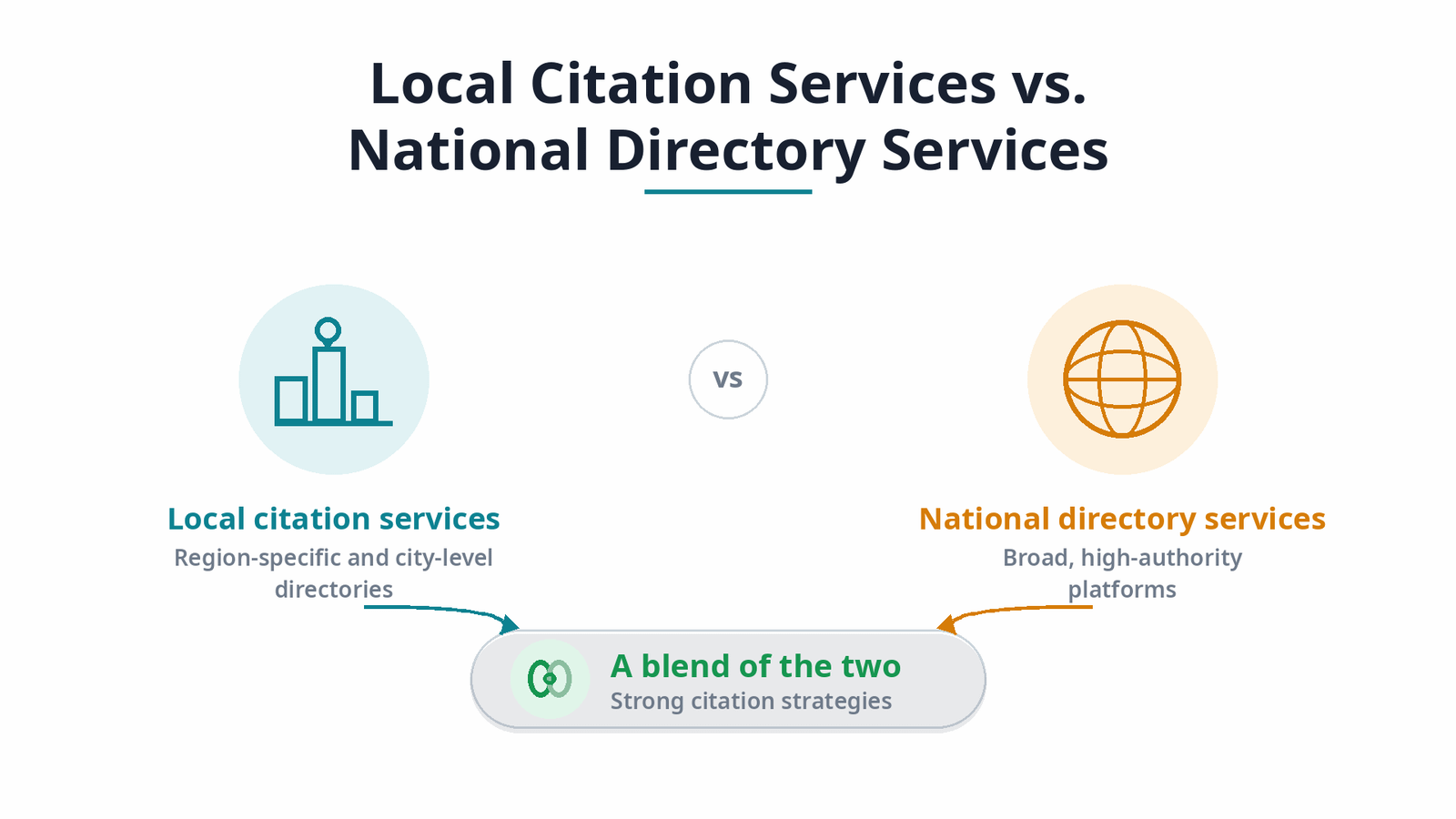
Local citation services focus on region-specific and city-level directories, while national directory services target broad, high-authority platforms used across every market. Both play a role, and most strong citation strategies use a blend of the two.
A business targeting a single metro area gets more value from local chamber-of-commerce-style directories than a national retailer with locations in forty states. National directory coverage still matters as a baseline, but it rarely moves rankings on its own without the local layer underneath it.
Industry-Specific Citation Services
Industry-specific citation services target directories built exclusively for a given trade or professional category rather than general business listings. Healthcare, legal, and home services each have dedicated directory ecosystems with real ranking weight.
Healthcare and Legal Citation Niches
Medical and legal directories often require license verification before listing, which adds both credibility and friction to the submission process. These niches reward accuracy heavily since incorrect credential data can trigger removal.
Home Services and Trades Citation Niches
Trade-specific directories for contractors, electricians, and plumbers carry strong local relevance signals. A home services citation audit <!–NEW PAGE NEEDED–> often reveals gaps general-purpose citation packages miss entirely.
Citation Building for Multi-Location Businesses
Multi-location citation management coordinates consistent listing data across every branch, franchise, or storefront a business operates. Scale introduces problems a single-location business never encounters.
Location Page and Listing Syncing
Each location needs its own accurate citation set rather than one shared listing covering multiple addresses. We sync this data against the business’s location pages to keep web content and directory listings aligned.
Franchise and Enterprise Citation Management
Franchise systems need centralized oversight to prevent individual franchisees from creating conflicting listings. Enterprise-level citation management typically includes approval workflows so local managers can’t publish unverified changes.
White Label Citation Services for Agencies
White label citation services let marketing agencies offer citation management to their clients under the agency’s own brand while a third-party provider does the underlying work. This model has grown as agencies expand service offerings without building in-house teams.
Reseller and Partner Models
Reseller arrangements typically charge a wholesale rate that the agency marks up for its own clients. We’ve found this works well for agencies wanting to add local SEO without hiring specialized staff.
Reporting Under the Agency’s Brand
White label providers deliver reports formatted with the agency’s branding rather than their own, keeping the agency as the client-facing point of contact. This preserves the agency relationship while outsourcing the operational work.
Citation Monitoring and Reporting Deliverables

Citation monitoring is an ongoing service that tracks listing accuracy over time and alerts a business when new inconsistencies appear. Reporting deliverables typically include a dashboard showing listing status across every tracked directory.
Monthly or quarterly reports usually summarize new citations built, errors corrected, and overall consistency score changes. We treat this reporting layer as the proof point that justifies an ongoing retainer rather than a one-time project.
Pricing Models and What Drives Cost
Citation service pricing typically ranges from flat per-project fees for one-time cleanups to monthly retainers for ongoing management. Several factors push pricing up or down within that range.
Per-Citation vs. Package Pricing
Some providers charge per individual citation built or corrected, while others bundle a fixed number of directories into a flat package price. Package pricing tends to suit businesses wanting predictable costs upfront.
Retainer Pricing Factors
Business size, number of locations, industry complexity, and reporting frequency all factor into retainer pricing. A single-location business typically pays far less than a 50-location franchise requiring ongoing synchronized management.
How Citation Services Fit Into Local SEO Strategy
Citation services form one component of a broader local SEO strategy that also includes Google Business Profile optimization , review management, and local content. Citations alone rarely drive rankings, but weak citation data holds back an otherwise strong local strategy.
We treat citation work as foundational rather than the centerpiece, since it supports the other signals rather than replacing them.
Choosing the Right Citation Service Model for Your Business

The right citation service model depends on business size, number of locations, internal resources, and how frequently business information changes. A single-location business with stable data might only need a one-time cleanup, while a multi-location franchise typically needs ongoing management.
We walk new clients through an audit first, since the audit results usually make the right engagement model obvious. Businesses rarely need to guess once they see how inconsistent their current listings actually are.
Conclusion
Citation services span auditing, building, cleanup, and ongoing monitoring, each solving a different stage of listing consistency. Engagement models range from one-time projects to fully managed retainers, suited to different business sizes and growth stages.
Local search keeps rewarding businesses with clean, consistent data across the broader directory ecosystem. Citations work best alongside the rest of a local SEO strategy, not in isolation from it.
We help businesses sort through which citation model fits their situation and build it into a broader growth plan. Reach out to White Label SEO Service to get a clear, data-backed citation strategy built around your business.
Frequently Asked Questions
What is a citation service in SEO?
A citation service manages the creation, correction, and consistency of a business’s name, address, and phone number across online directories. It typically includes an audit, cleanup, and sometimes ongoing monitoring.
How much do citation services typically cost?
Pricing ranges from one-time flat fees for cleanup projects to monthly retainers for ongoing management. Cost depends on business size, number of locations, and reporting frequency.
How long does it take to build citations?
Initial citation building typically takes a few weeks to a couple of months depending on the number of directories targeted. Some directories approve listings within days, while others take several weeks.
What is the difference between a citation and a backlink?
A citation is a mention of business name, address, and phone number, while a backlink is a hyperlink from one website to another. Citations don’t require a clickable link to carry ranking value.
Do I need ongoing citation management or a one-time cleanup?
Stable, single-location businesses often only need a one-time cleanup. Businesses with multiple locations or frequent changes typically benefit more from ongoing management.
Can citation services hurt my rankings if done wrong?
Yes, submitting inconsistent or inaccurate data across directories can create confusion that suppresses local rankings. Choosing a provider with a careful audit process reduces this risk significantly.
What should I look for in a citation service provider?
Look for a provider that starts with a thorough audit, prioritizes directories by relevance and authority, and offers transparent reporting. Avoid providers that only promise raw submission volume without accuracy checks.


