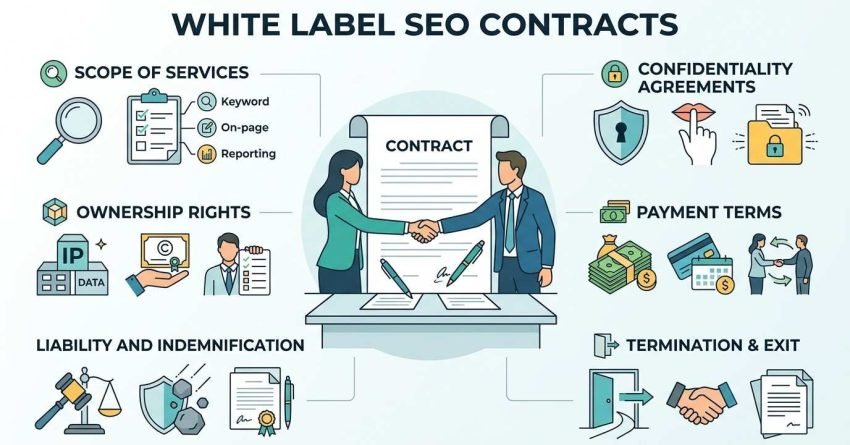
White label SEO contracts are legally binding agreements that define the scope, confidentiality, ownership, and payment terms between an agency and its reseller or client. I’ve seen too many agency partnerships fall apart not because of bad SEO work, but because nobody wrote down who owns the client relationship or what happens when the contract ends.
These agreements protect both sides when disputes, breaches, or unclear expectations threaten to unravel months of collaborative work. Poorly drafted white label SEO contracts create ambiguity around ownership, liability, and confidentiality that surfaces at the worst possible time.
This guide covers what a white label SEO contract actually includes, how NDAs and confidentiality clauses protect reseller relationships, who owns the work product and client data, how liability and indemnification get allocated, and what termination and exit terms should look like before you sign anything.
What Is a White Label SEO Contract?
A white label SEO contract is a legal agreement between an SEO provider and a reseller that defines how services get delivered under the reseller’s own brand. I always tell partners this document is the backbone of the entire relationship, not a formality to rush through.
Reseller agreement is the more precise term some providers use, since the agency’s client never sees the underlying white label SEO provider’s name. Without a written agreement, both the reseller and the underlying provider are exposed to disputes over payment, quality standards, and client ownership.
Key Parties Involved (Agency, Reseller, End Client)
Three parties sit inside most white label arrangements even though only two ever sign the contract. The reseller (often a marketing agency) contracts directly with the white label provider, while the end client only interacts with the reseller’s brand.
This structure means the contract has to account for a party that isn’t even present at signing. Provisions covering client data, confidentiality, and service standards all need to protect an end client who never reviews the agreement itself.
Why Written Agreements Matter in White Label Partnerships
Verbal agreements or informal email chains leave both parties guessing when disagreements happen. I’ve watched agencies lose clients over disputes that a single clause could have prevented.
A signed agreement establishes enforceable expectations around deliverables, timelines, and confidentiality from day one. It also gives each side a reference point when a reseller partnership grows past its original scope.
Core Components Every White Label SEO Agreement Needs
A complete white label SEO agreement needs, at minimum, a defined scope of services, payment terms, term length, termination conditions, confidentiality provisions, and liability allocation. Missing any one of these leaves room for costly disputes later.

I treat scope definition as the single most important clause because it prevents the classic “scope creep” problem agencies complain about most. When deliverables aren’t itemized, one side ends up feeling shortchanged, and the other feels overworked.
Scope of Services & Deliverables
The scope section should spell out exactly which SEO services are included: technical audits, content production, link building, reporting cadence, and any excluded services. Vague phrases like “ongoing SEO support” invite disagreement the moment expectations diverge.
I recommend itemizing deliverables by month or milestone rather than describing SEO work in general terms. Specificity here protects both the provider’s time and the reseller’s client relationships.
Payment Terms & Pricing Structures
Payment terms define billing frequency, accepted payment methods, late payment penalties, and currency if the partnership crosses borders. Most white label SEO contracts use monthly retainer billing tied to a fixed scope of deliverables.
Late payment penalty clauses matter more than most new resellers expect. I’ve seen contracts stall for months because nobody specified what happens when an invoice goes 30, 60, or 90 days unpaid.
Term Length & Termination Clauses
Contract term length is usually 6 to 12 months with automatic renewal unless either party gives written notice. Shorter terms give resellers flexibility, while longer terms give providers stability to plan resource allocation.
Termination clauses need advance notice periods, typically 30 to 60 days, so neither side is caught unprepared. This section connects directly to the exit strategy planning covered further down.
Non-Disclosure Agreements (NDAs) in White Label SEO
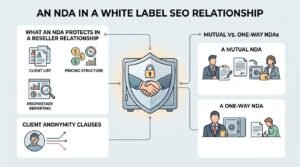
An NDA in a white label SEO relationship is a legal contract that prevents either party from disclosing confidential business information, client identities, or proprietary processes to outside parties. This single document is often what makes or breaks trust in a reseller partnership.
I never start a white label engagement without an NDA signed first, before any client names or strategy details get shared. The entire model depends on the end client never learning who actually performs the SEO work.
What an NDA Protects in a Reseller Relationship
An NDA protects client lists, pricing structures, proprietary reporting methods, and the fact that services are being subcontracted at all. Breach of this confidentiality can destroy a reseller’s credibility with their own client base overnight.
Client anonymity clauses specifically prevent the underlying provider from contacting the end client directly, bypassing the reseller. This protection matters most when reseller margins depend entirely on the client never discovering the arrangement.
Mutual vs. One-Way NDAs
A mutual NDA obligates both the reseller and the provider to keep each other’s information confidential, while a one-way NDA only restricts one party. Most healthy white label partnerships use mutual NDAs since both sides exchange sensitive business information.
One-way NDAs tend to appear when one party has significantly more leverage or when only one side is disclosing proprietary methods. I’d flag a one-way NDA request as worth a closer look before signing.
Confidentiality Clauses Beyond the NDA
Confidentiality clauses inside the main contract extend protection beyond the standalone NDA to cover ongoing operational details discovered during the partnership. These clauses typically survive even after the contract itself terminates.
I always check whether confidentiality obligations have a defined expiration date, since some information (like a client’s proprietary keyword strategy) needs protection indefinitely.
Client Ownership vs. Agency Disclosure Restrictions
This clause defines exactly what the reseller can and cannot tell the end client about how work gets performed behind the scenes. Disclosure restrictions typically prevent the reseller from revealing subcontractor identities even under direct client questioning.
The balance here protects the provider’s business model while still letting the reseller manage their own client relationship honestly within agreed boundaries.
White Labeling & Client Ownership Rights
White label ownership rights determine who legally owns the SEO work product, including content, backlink profiles, and reporting data, once it’s delivered. Most agreements assign full ownership to the end client, with the reseller and provider retaining only their internal processes.
I’ve seen disputes arise specifically when a contract doesn’t address what happens to accumulated backlinks or content assets if the client ends the relationship.
Who Owns the Work Product
Work product ownership should transfer to the paying client upon full payment, covering content, technical implementations, and any custom reporting dashboards built during the engagement. This clause needs to be explicit, not assumed.
Ambiguity here creates real business risk, particularly around whether a former client can take published content and link assets to a new provider without dispute.
Branding & Attribution Rules
Branding rules specify that all deliverables, reports, and communications must carry the reseller’s branding rather than the underlying provider’s name. Attribution restrictions typically forbid the provider from including their own logo, watermarks, or contact details anywhere the client might see them.
This is the mechanical core of “white label” as a concept, and it needs contractual teeth, not just a verbal understanding between account managers.
Service Level Agreements (SLAs) in White Label SEO
A service level agreement defines the measurable performance standards, reporting frequency, and response times a white label provider commits to delivering. Google’s own guidance on SEO notes that sustainable ranking improvements typically take several months to materialize, which makes realistic SLA language essential to avoid overpromising results to end clients.

I push back on any contract that guarantees specific rankings, since search engines don’t operate on guarantees. A well-drafted SLA focuses on deliverable consistency and reporting transparency instead.
Reporting Cadence & Performance Guarantees
Reporting cadence clauses specify how often the provider delivers performance data, typically monthly, and what metrics those reports must include. Response time guarantees for support requests or urgent issues also belong in this section.
I recommend avoiding hard ranking guarantees entirely and instead committing to process-based standards like audit turnaround time or content delivery deadlines.
Liability, Indemnification & Risk Allocation
Liability allocation in a white label SEO contract determines which party bears financial responsibility if search engine penalties, ranking drops, or client disputes cause damages. This clause protects both parties from being blindsided by costs neither anticipated.
I treat this section as non-negotiable homework before signing, since SEO work carries genuine risk when algorithm updates shift rankings unexpectedly.
Limitation of Liability Clauses
A limitation of liability clause caps the maximum financial exposure either party faces, often limiting damages to the fees paid over a set period, such as the prior three or six months. Without this cap, a single dispute could theoretically expose a small agency to damages far beyond what they were ever paid.
I always negotiate this cap explicitly rather than accepting a provider’s standard boilerplate language without review.
Indemnification for Algorithm Penalties or Ranking Drops
Indemnification clauses specify who compensates whom if a search engine algorithm update or manual penalty causes a documented traffic or ranking decline. A Search Engine Journal analysis of major algorithm updates found that core updates can shift rankings for up to 45% of tracked keywords in affected niches, which is exactly the kind of risk this clause needs to address.
Most contracts reasonably exclude penalties caused by algorithm changes outside anyone’s control, while still holding providers accountable for clearly negligent practices like manipulative link schemes.
Non-Compete & Non-Solicitation Clauses
A non-solicitation clause prevents either party from directly contacting or poaching the other’s clients or employees during and after the contract term. These clauses typically run 12 to 24 months past contract termination.
I consider this one of the most contentious sections in any white label negotiation, since both sides have legitimate business interests to protect.
Protecting Client Relationships from Poaching
This provision specifically stops a white label provider from reaching out to the reseller’s end client directly, even after the contract ends. Poaching protection is the reason resellers can safely disclose client identities to a provider in the first place.
Without this clause, a reseller has no real recourse if a provider decides to approach their client base independently once the relationship sours.
Intellectual Property & Data Ownership
Intellectual property clauses in white label SEO contracts define who owns proprietary tools, custom reporting templates, and any software used to deliver services. Data ownership addresses who controls access to analytics accounts, Search Console properties, and keyword research once the engagement ends.
I flag data portability as one of the most overlooked issues until a client relationship actually ends and nobody can access historical performance data.
Access Credentials & Data Portability
Access credential clauses specify who holds admin-level login information for Google Search Console, Analytics, and CMS platforms throughout the engagement. Data portability provisions guarantee the client can retrieve all historical data and reports if they switch providers.
This section prevents a provider from holding data hostage as leverage during a contract dispute or termination.
Pricing Models & Payment Terms in White Label Contracts
White label SEO pricing typically follows a flat monthly fee, per-project rate, or revenue-share structure, each with different risk and incentive implications. A 2024 industry pricing survey found that flat monthly retainers remain the most common structure, used by roughly two-thirds of agencies offering white label services.

I generally recommend flat-fee structures for predictable budgeting, though revenue-share models can align incentives better for performance-focused partnerships.
Common Structures (Flat-Fee, Per-Project, Revenue Share)
Flat-fee pricing charges a consistent monthly rate regardless of hours worked, per-project pricing bills for defined one-time deliverables, and revenue-share ties provider compensation to a percentage of client billing. Each model shifts risk differently between the reseller and provider.
I’ve found flat-fee arrangements work best for ongoing retainer relationships, while per-project pricing suits one-off audits or migrations.
Termination Clauses & Exit Strategies
Termination clauses define the conditions, notice periods, and processes required for either party to legally end a white label SEO contract. A clean exit strategy protects the end client from service disruption during a provider transition.
I never sign a contract missing this section, since the way a partnership ends often matters more than how it began.
Transition Plans for Offboarding Clients
A transition plan clause requires the outgoing provider to hand over all account access, historical reports, and documentation within a specified window, often 15 to 30 days. This prevents client service gaps when a reseller switches providers.
Offboarding requirements should also address whether the outgoing provider can be contacted for clarifying questions during the handover period.
Common Legal Risks & Contract Pitfalls to Avoid
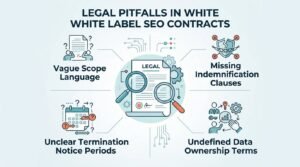
The most common legal pitfalls in white label SEO contracts involve vague scope language, missing indemnification clauses, and undefined data ownership terms. These gaps rarely cause problems until a dispute forces both parties to read the fine print for the first time.
I’d add unclear termination notice periods to this list, since ambiguous timelines create friction exactly when a relationship is already strained.
Vague Scope Language & Unclear Deliverables
Vague scope language, such as promising “ongoing optimization” without itemized deliverables, is the single most common source of white label contract disputes. Both parties end up with different mental models of what’s actually owed each month.
I recommend rejecting any contract draft that describes services in generalities rather than specific, countable deliverables.
How to Vet a White Label SEO Partner’s Contract
Vetting a white label SEO partner’s contract means checking for clear scope definitions, realistic SLAs, explicit ownership clauses, and fair termination terms before signing. A rushed review at this stage tends to surface as a costly dispute later.
I always read the termination and liability sections first, since those reveal how a provider handles conflict before it happens.
Red Flags in Reseller Agreements
Red flags include ranking guarantees, vague scope descriptions, missing data portability language, and unusually long automatic renewal terms with short cancellation windows. Any contract that guarantees specific rankings warrants extra scrutiny given how search algorithms actually function.
I also watch for one-sided liability clauses that protect the provider entirely while leaving the reseller fully exposed to client disputes.
Conclusion
Solid white label SEO contracts tie scope, NDAs, ownership, liability, and termination terms into one coherent framework. Each clause protects a specific point where reseller partnerships tend to break down.
We’ve seen how confidentiality, data ownership, and SLAs connect across the entire reseller relationship lifecycle. Clear contracts turn white label partnerships into sustainable, long-term arrangements rather than sources of ongoing risk.
We help agencies structure these agreements correctly from day one. Partner with White Label SEO Service to build contracts that protect your business and your clients.
Frequently Asked Questions
What should be included in a white label SEO contract?
A white label SEO contract should include scope of services, payment terms, confidentiality provisions, liability allocation, and termination conditions. Missing any of these creates ambiguity that surfaces during disputes.
Do I need an NDA for a white label SEO partnership?
Yes, an NDA is essential before sharing any client information or business details with a white label provider. It legally protects client anonymity and confidential business processes from disclosure.
Who owns the content and links created in white label SEO work?
Ownership typically transfers to the paying end client once full payment is received. This should be explicitly stated in the contract to prevent disputes if the relationship ends.
Can a white label SEO provider guarantee rankings?
No legitimate provider can guarantee specific rankings, since search engines don’t operate on guarantees. Contracts should focus on deliverable and process-based SLAs instead.
How long should a white label SEO contract term be?
Most white label SEO contracts run 6 to 12 months with automatic renewal clauses. Shorter terms offer flexibility, while longer terms give providers planning stability.
What happens if a white label SEO partnership ends abruptly?
A well-drafted contract requires a transition plan, typically 15 to 30 days, for handing over account access and historical data. This protects the end client from service disruption.
What’s the difference between a mutual and one-way NDA?
A mutual NDA obligates both parties to protect each other’s confidential information, while a one-way NDA only restricts one side. Most healthy reseller partnerships use mutual NDAs.