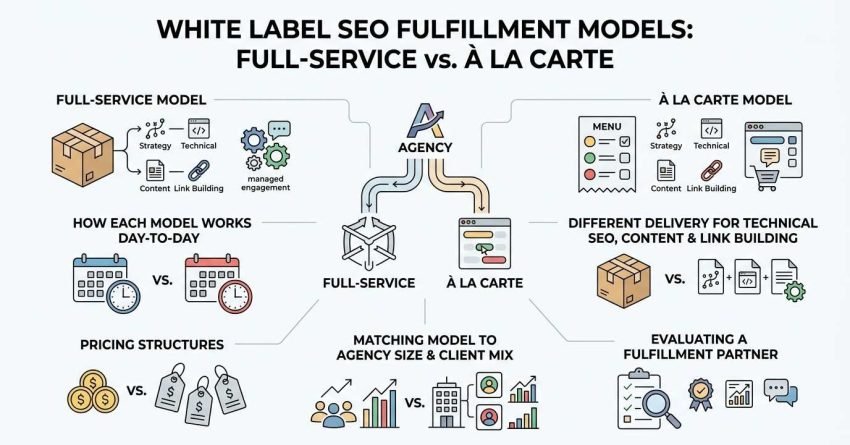
White label SEO fulfillment is the delivery structure an agency uses to outsource client SEO work under its own brand, and it typically takes one of two shapes: full-service or à la carte. Full-service bundles strategy, technical SEO, content, and link building into one managed engagement. A la carte breaks those same disciplines into standalone services an agency buys individually.
I’ve watched agencies pick the wrong model and pay for it in margin and client churn within two quarters. Picking the right one changes your delivery cost, your client retention, and how much you can scale without hiring.
This guide covers how each model actually works day-to-day, what’s bundled versus sold separately, how pricing is structured across both, and how technical SEO, content, and link building get delivered differently depending on which one you choose. It also covers how to evaluate a fulfillment partner and match the right model to your agency’s size and client mix.
What White Label SEO Fulfillment Actually Means
White label SEO fulfillment is the practice of a third-party provider executing SEO work that an agency then resells to its own clients under its own branding. The agency owns the client relationship; the fulfillment partner does the technical and creative labor behind the scenes.
I think of it as a manufacturing relationship. The agency is the storefront, and the fulfillment partner is the factory floor producing the actual technical audits, content, and links that make up the deliverable.
Most agencies land here for one of two reasons: they can’t hire fast enough to match sales, or they don’t want the overhead of an in-house SEO team for a service that’s a smaller slice of their revenue. Either way, the fulfillment relationship decides quality, turnaround, and how defensible the agency’s margins stay over time.
Who Uses White Label SEO Fulfillment (Agencies, Freelancers, Consultants)
Digital marketing agencies use white label fulfillment most often, typically when SEO is a secondary offering alongside paid ads or web design. Freelance consultants use it to take on SEO clients without building execution capacity themselves. Web design and PPC-first shops use it to round out a full-service pitch without diluting their core specialty.
How Full-Service White Label SEO Works
Full-service white label SEO is a bundled fulfillment model where one provider handles strategy, technical SEO, content, and link building as a single ongoing engagement. The agency hands off the client and receives a complete monthly program back, usually with one point of contact managing the whole account.
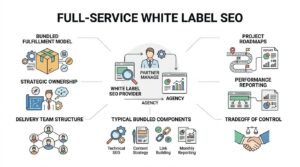
I’ve found this model works best when an agency has zero internal SEO expertise and needs someone else to own the strategic thinking, not just execution. The provider sets the roadmap, prioritizes the work, and reports on results as one cohesive program rather than disconnected tasks.
The tradeoff is control. An agency buying full-service is trusting the provider’s judgment on where budget goes each month, and that requires real vetting upfront.
What’s Typically Bundled in a Full-Service Model
A full-service package usually bundles technical SEO audits and fixes, on-page optimization, content strategy and production, link building, and monthly reporting into one retainer. Keyword research and competitive analysis are typically included at no extra line item.
How Full-Service Providers Structure Delivery Teams
Full-service providers generally assign a strategist or account manager alongside specialist executors for technical, content, and outreach work. This team structure lets the agency deal with one contact while the provider coordinates multiple disciplines internally.
How A La Carte White Label SEO Works
A la carte white label SEO is a fulfillment model where an agency purchases individual services, such as content writing or link building, separately rather than as a bundled program. The agency controls the strategy and only outsources the execution pieces it lacks capacity for.
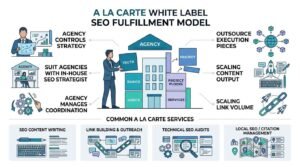
This model suits agencies that already have an SEO strategist in-house but need extra hands for production work. I see it used most by agencies scaling content output or link volume without adding headcount for those specific tasks.
The catch is coordination. Without a single provider managing the whole picture, the agency has to make sure the individually purchased pieces still add up to a coherent strategy.
Common A La Carte Services (Content, Links, Technical, Local)
The most commonly purchased a la carte services are SEO content writing, link building and outreach, technical SEO audits, and local SEO/citation management. Each is typically priced and delivered independently, with its own turnaround time and reporting format.
How A La Carte Pricing Is Typically Structured
A la carte services are usually priced per unit: per article, per link, per audit, or per location for local SEO. This gives agencies granular cost control since spend scales directly with volume ordered rather than a flat monthly retainer.
Full-Service vs. A La Carte Core Differences
The core difference between full-service and a la carte white-label SEO is who controls strategy: full-service providers own the roadmap, while a la carte buyers direct their own strategy and only outsource execution. This single distinction drives most of the practical differences in cost, speed, and oversight.
I’ve noticed agencies underestimate how much strategic ownership actually costs in hidden time. Full-service removes that time cost; à la carte keeps it in-house.
Comparison Table: Scope, Cost, Control, Speed
The table below compares full-service and à la carte models across the four factors agencies weigh most when choosing a fulfillment structure.
| Factor | Full-Service | À la carte |
| Strategic control | Provider-led | Agency-led |
| Cost structure | Flat monthly retainer | Per-unit, variable |
| Onboarding speed | Slower (full audit first) | Faster (order-specific service) |
| Best for | No in-house SEO expertise | Existing SEO strategist on staff |
| Reporting | Consolidated program report | Per-service reporting |
Technical SEO Fulfillment Under Each Model
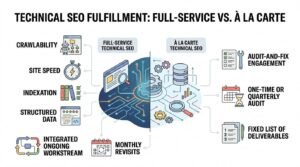
Technical SEO fulfillment covers crawlability, site speed, indexation, and structured data, and it’s delivered as an integrated ongoing workstream in full-service models versus a standalone audit-and-fix engagement in a la carte models. A full-service provider revisits technical health monthly as part of the broader strategy.
An à la carte technical SEO purchase is typically a one-time or quarterly audit with a fixed list of deliverables. A 2024 industry benchmark found that sites addressing core technical issues saw organic traffic gains averaging 30% within six months. That gain depends heavily on whether technical fixes are revisited regularly or treated as a single pass.
Content Fulfillment Under Each Model
Content fulfillment in a full-service model is planned against the overall keyword strategy and produced on a recurring editorial calendar tied to ranking goals. In à la carte models, content is ordered by volume, such as a set number of articles per month, without the provider necessarily setting the topical strategy.
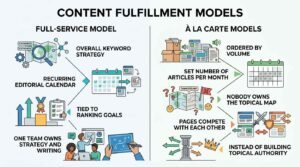
I’ve seen a la carte content go sideways when nobody owns the topical map, so pages compete with each other instead of building topical authority. Full-service avoids this because one team owns both the strategy and the writing.
Link Building Fulfillment Under Each Model
Link building fulfillment is typically tied to a broader authority-building roadmap in full-service models, while a la carte link building is sold as a fixed quantity of links per month based on a set price per link. The a la carte version gives cost predictability but less strategic sequencing.
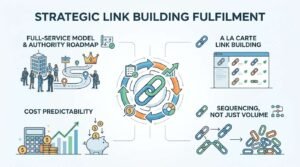
A study of over 11 million search results by Backlinko found that the number one Google result has an average of 3.8 times more backlinks than positions two through ten. That gap makes sequencing, not just volume, matter to how link building actually gets delivered.
Reporting and Performance Tracking Differences
Reporting under full-service fulfillment is consolidated into one performance report covering technical, content, and link metrics together against agreed goals. A la carte reporting is typically fragmented, with each vendor or service line producing its own separate report.
I always tell agencies that fragmented reporting is the hidden cost of a la carte, because someone still has to stitch those reports into one client-facing narrative.
Pricing Structures Across Fulfillment Models
Pricing for full-service white label SEO usually runs as a flat monthly retainer covering all bundled disciplines, while a la carte pricing is unit-based and scales directly with the volume of individual services ordered. Full-service retainers commonly range from $1,500 to $5,000+ per client per month depending on scope and market competitiveness.
A la carte pricing varies by service type, with content typically priced per word or per article and links priced per placement based on the linking site’s authority.
What Drives Cost Differences Between Models
Cost differences come down to bundled strategic overhead versus per-unit production cost. Full-service retainers price in the strategist’s time; a la carte pricing strips that out and charges only for the deliverable itself.
Which Model Fits Which Agency Type
The right fulfillment model depends mainly on whether an agency already has in-house SEO strategy capability: agencies without it fit full-service better, and agencies with an existing strategist fit a la carte better. Agency size and client SEO budget size also factor into which model keeps margins healthy.
I generally point smaller agencies without dedicated SEO staff toward full-service first, since piecing together a la carte services without in-house oversight tends to produce disjointed results.
Signals You Need Full-Service vs. A La Carte
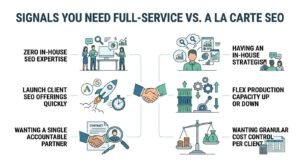
Signals pointing toward full-service include having zero in-house SEO expertise, needing to launch client SEO offerings quickly, and wanting a single accountable partner. Signals pointing toward à la carte include having an in-house strategist, needing to flex production capacity up or down, and wanting granular cost control per client.
How to Evaluate a White Label SEO Partner
Evaluating a white label SEO partner starts with checking their case studies, asking for references from current agency clients, and confirming how they handle reporting transparency and client confidentiality. A partner unwilling to share verifiable results or explain their process in plain terms is a warning sign regardless of fulfillment model.
I always ask potential partners how they’d handle a client asking directly whether SEO work is outsourced, since their answer reveals a lot about how they’ve built white-label agency processes around confidentiality.
Common Risks and Pitfalls by Fulfillment Model
Full-service risks center on losing visibility into exactly how budget gets allocated month to month, since the provider controls the roadmap. A la carte risks center on strategic fragmentation, where individually purchased services don’t add up to a coherent SEO program without someone actively coordinating them.
Both models carry a reputational risk if the fulfillment partner underperforms, since the agency’s name is the one attached to client-facing results.
How Fulfillment Models Affect Client Retention and Scalability
Fulfillment model choice affects retention because clients churn faster when reporting feels disconnected or results plateau without clear explanation, which happens more often in poorly coordinated à la carte setups. Full-service models tend to support smoother scaling since the agency can onboard new SEO clients without sourcing additional individual vendors each time.
I’ve seen agencies scale client count faster under full-service simply because onboarding a new client means plugging into an existing program structure rather than assembling a new vendor stack.
Conclusion
Full-service and a la carte fulfillment differ mainly in who owns strategy and how pricing scales. Technical work, content, links, and reporting all shift shape depending on which model an agency picks.
Choosing correctly protects margins and client retention as an agency’s SEO client base grows past its first few accounts.
We help agencies fulfill both models reliably. Talk to White Label SEO Service about building a fulfillment structure that fits your client mix.
Frequently Asked Questions
What is white label SEO fulfillment?
White label SEO fulfillment is a third-party provider performing SEO work that an agency resells under its own brand. The agency manages the client relationship while the provider executes the work.
Is full-service or a la carte white label SEO cheaper?
A la carte is usually cheaper for agencies with existing SEO strategy staff, since they avoid paying for strategic overhead. Full-service costs more but includes strategy and coordination.
Can an agency switch between fulfillment models?
Yes, agencies commonly switch models as their in-house capabilities change. Many start full-service and shift toward a la carte once they hire internal SEO strategists.
How long does a white label SEO retainer typically last?
Most white label SEO retainers run month-to-month with a minimum three-to-six-month commitment. Providers typically require this minimum to show measurable ranking movement.
Do a la carte SEO services include strategy?
Most a la carte services do not include strategic planning, only execution of the specific service ordered. The purchasing agency is expected to direct where that service fits into the broader plan.
How do agencies maintain client confidentiality with white label SEO?
Agencies maintain confidentiality through white-labeled reporting, NDAs with the fulfillment provider, and direct-to-agency communication channels that never reference the provider by name. Reputable providers build this into their standard process.
What’s the biggest risk with a la carte SEO fulfillment?
The biggest risk is strategic fragmentation, where individually purchased services don’t combine into a coherent SEO program. This typically happens when no one internally owns the overall keyword and content strategy.