White label SEO services let agencies, web designers, and marketing firms offer full SEO programs under their own brand without building an in-house team. A specialized provider handles the technical work, content, and link building behind the scenes while the reseller manages the client relationship. This model has become the backbone of how smaller agencies compete with larger, full-service shops.
Most agencies can’t justify hiring a full SEO department for the volume of client work they have right now. White label partnerships close that gap fast, without the payroll risk.
This guide covers what white label SEO actually is and how it differs from reselling, the different service types and pricing models available, the technical, on-page, content, and link-building deliverables included in most packages, and how to evaluate a provider before signing a contract.
What Is White Label SEO?
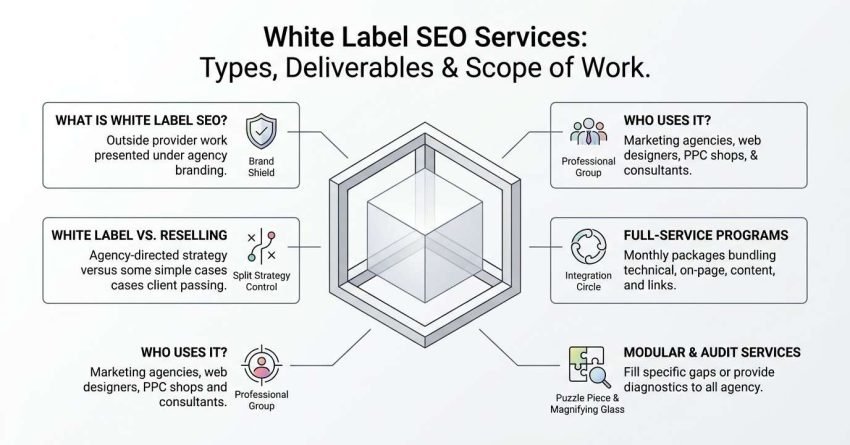
White label SEO is an arrangement in which an outside provider performs SEO work that an agency or reseller then presents to its own clients under its own branding. The provider stays invisible to the end client, and the agency owns the relationship, the invoicing, and the reporting.
This distinction matters because it shapes everything downstream: pricing, reporting format, and communication expectations. An agency that misunderstands the white label model often ends up promising deliverables the provider doesn’t actually offer.
How White Label SEO Differs From Reselling
White label SEO involves an agency directing strategy and packaging deliverables under its own name, while SEO reselling often just means passing a client along with minimal input on strategy. The line blurs in practice, but the difference shows up in how much control the agency retains over deliverables and client communication.
Who Uses White Label SEO (Agencies, Freelancers, Consultants)
Marketing agencies, web design firms, PPC shops, and independent consultants use white label SEO to add organic search services without hiring specialists. A one-person consultancy can offer the same technical SEO deliverables as a 20-person agency by routing the execution through a white label partner.
Types of White Label SEO Services
White label SEO services generally fall into three structural categories: full-service programs, modular à la carte services, and audit-only engagements. Each category suits a different stage of agency growth and client need.
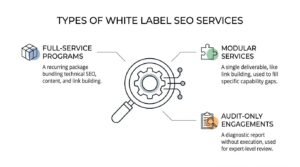
Full-service white label programs bundle technical SEO, content, and link building into one recurring package, usually billed monthly. Modular services let an agency buy only what it needs, say, link building alone, and combine it with in-house work on other fronts. Audit-only engagements provide a diagnostic report and recommendations without ongoing execution, often used by agencies that want to keep execution in-house but need expert-level auditing.
| Service Type | What’s Included | Best For |
| Full-Service | Technical, on-page, content, links, reporting | Agencies with no in-house SEO capacity |
| Modular/À La Carte | Single deliverable (e.g., links only) | Agencies filling specific capability gaps |
| Audit-Only | Diagnostic report, no execution | Agencies with execution staff, needing expert review |
Full-Service White Label Programs
A full-service program covers the entire SEO function from the initial technical SEO audit through ongoing content production and link acquisition reported back to the agency in white-labeled dashboards.
À La Carte/Modular White Label Services
Modular services let an agency mix and match. An agency strong in content but weak in link building outreach might buy only the link acquisition piece and keep everything else in-house.
White Label SEO Audits & Reporting Only
Some providers specialize purely in SEO audits and diagnostic reporting, handing off a prioritized action list that the agency’s own team then executes.
Technical SEO Deliverables
Technical SEO deliverables address the crawlability, indexability, and site health issues that prevent a site from ranking regardless of content quality. This is usually the first workstream a white label provider tackles because content and links can’t perform on a technically broken site.
Site Audits & Crawlability Fixes
A technical audit identifies broken links, redirect chains, duplicate content, and crawl budget waste. Google’s own Search Central documentation notes that crawl budget becomes a real ranking constraint mainly on sites exceeding a few thousand pages, which shapes how aggressively an audit needs to prioritize fixes.
Core Web Vitals & Site Speed
Core Web Vitals measure loading performance, interactivity, and visual stability, and they factor into Google’s page experience signals. A 2024 Portent study found that conversion rates dropped by an average of 4.42% with each additional second of load time, which is the kind of number that makes speed work an easy sell to skeptical clients.
Schema Markup & Indexation
Schema markup is structured data added to a page’s code that helps search engines understand entities, relationships, and content type. Implementing it correctly is a technical deliverable most white label providers include as standard, since it directly supports rich result eligibility.
On-Page SEO Deliverables
On-page SEO deliverables optimize the content and code of individual pages to match search intent and target keywords more precisely. This workstream sits between technical fixes and full content production.
Keyword Mapping & Content Optimization
Keyword mapping assigns target search terms to specific URLs so pages don’t compete against each other for the same query. This mapping exercise usually happens before any content creation and strategy work begins, since it determines what gets written and where.
Meta Data & Internal Linking
Title tags, meta descriptions, header structure, and internal linking patterns all get audited and rewritten as part of on-page deliverables. Internal linking in particular distributes authority across a site’s existing pages rather than concentrating it all on the homepage.
Content Creation & Strategy Deliverables
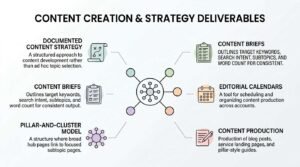
Content deliverables cover everything from keyword-driven blog posts to comprehensive pillar pages, built around a documented content strategy rather than ad hoc topic selection.
Content Briefs & Editorial Calendars
A content brief outlines the target keyword, search intent, required subtopics, and word count before a writer starts, which keeps output consistent across multiple writers on the same account.
Blog, Landing Page & Pillar Content Production
Most white label content packages include a mix of blog posts, service landing pages, and occasional pillar-style guides, scaled to the client’s monthly budget. The pillar-and-cluster model, where broad hub pages link down to focused subtopic pages, has become the dominant structure recommended by Ahrefs’ content strategy research.
Link Building & Off-Page Deliverables
Off-page deliverables build the external authority signals search engines use to gauge trust and relevance beyond the site’s own content and code.
Guest Posting & Outreach
Guest posting places a client’s content on relevant third-party sites in exchange for a contextual backlink, and outreach is the manual process of securing those placements. Quality control matters more here than volume. A Backlinko study of 11.8 million search results found no significant correlation between total backlink volume and rankings once relevance and authority were accounted for separately.
Digital PR & Authority Building
Digital PR campaigns earn backlinks and mentions through newsworthy content, data studies, or expert commentary rather than direct link requests, producing links that tend to carry more editorial weight.
Local SEO Deliverables (If Applicable)
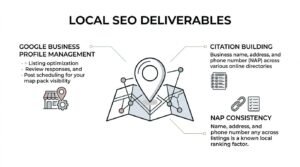
Local SEO deliverables apply specifically to businesses serving a defined geographic area, and they’re often bundled separately since not every client needs them.
Google Business Profile Management
Google Business Profile management covers listing optimization, review responses, and post scheduling to improve visibility in map pack results for local queries.
Citation Building & NAP Consistency
Citations are mentions of a business’s name, address, and phone number across directories, and consistency across these listings is a known local ranking factor.
Reporting & Analytics Deliverables
Reporting deliverables are what make white label partnerships sustainable long-term, since agencies need client-ready proof of progress without exposing who actually did the work.
White Label Dashboards & Client-Ready Reports
White label dashboards pull data from Google Search Console and Google Analytics into a branded report showing rankings, traffic, and conversions under the agency’s own logo.
KPI Tracking (Rankings, Traffic, Conversions)
Rankings, organic traffic, and conversion metrics form the core KPI set most agencies report on monthly, tying SEO activity directly back to business outcomes their clients actually care about.
Scope of Work: What’s Typically Included vs. Excluded
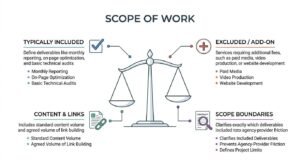
A white label SEO scope of work defines exactly which deliverables are included in a given package and which require an additional fee, and misunderstanding this line is the single most common source of agency-provider friction.
| Typically Included | Often Excluded / Add-On |
| Monthly reporting | Paid media management |
| On-page optimization | Conversion rate optimization |
| Standard content volume | Video or podcast production |
| Basic technical audits | Website redesign/development |
| Link building (agreed volume) | Reputation management |
Standard Inclusions Across Providers
Most providers include monthly reporting, agreed content volume, ongoing on-page optimization, and a set number of backlinks as standard inclusions in any recurring package.
Common Exclusions & Add-On Services
Paid media, full website redesigns, and conversion rate optimization typically sit outside standard SEO scope and get quoted separately.
How White Label SEO Partnerships Work
A white label partnership runs through a defined onboarding process, ongoing communication cadence, and a reporting structure that keeps the end client unaware of the provider’s involvement.
Onboarding & Communication Process
Onboarding typically involves a kickoff call, access handoff to analytics and CMS platforms, and an agreed communication channel usually a shared project management tool or a dedicated account manager.
Branding & Client-Facing Reporting
Everything the end client sees, from proposals to monthly reports, carries the reseller’s branding, with the provider’s name appearing nowhere in client-facing materials.
Who Should Use White Label SEO Services
White label SEO fits agencies that have client demand for SEO but lack the internal headcount or expertise to deliver it consistently at scale.
Agencies Scaling Without Hiring
Agencies scaling revenue without adding full-time SEO specialists use white label partnerships to take on new SEO clients without the six-month hiring and training runway an in-house hire requires.
Web Design & Marketing Firms Adding SEO
Web design and PPC-focused firms often add SEO as a cross-sell service through white label partners rather than building a competing specialty from scratch.
Pricing Models & Cost Structures
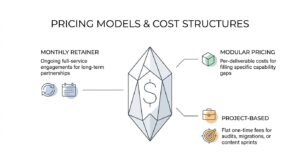
White label SEO pricing generally follows one of two structures: a monthly retainer covering a bundle of deliverables, or project-based and per-deliverable pricing for narrower engagements.
Monthly Retainer vs. Project-Based Pricing
Monthly retainers suit ongoing full-service engagements, while project-based pricing suits one-time technical audits or defined content sprints with a clear end date.
| Pricing Model | Typical Range (Monthly) | Best Fit |
| Retainer (Full-Service) | $1,500–$5,000+ | Ongoing agency partnerships |
| Modular/Per-Deliverable | $300–$1,500 per service | Filling specific gaps |
| Project-Based | Flat fee, one-time | Audits, migrations, one-off content sprints |
Per-Deliverable Pricing
Per-deliverable pricing charges a set fee per audit, per article, or per link acquired, giving agencies granular control over margin on each client engagement.
How to Choose a White Label SEO Provider
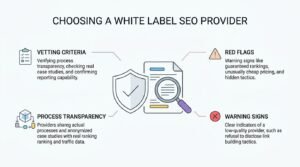
Choosing a white label SEO provider comes down to verifying process transparency, checking real case studies, and confirming reporting capability before signing any contract.
Vetting Criteria (Transparency, Process, Case Studies)
Strong providers share their actual process, provide anonymized case studies with real ranking and traffic data, and answer direct questions about link building outreach methods without vague deflection.
Red Flags to Avoid
Guaranteed rankings, unusually cheap pricing relative to the market, and refusal to disclose link building tactics are the clearest warning signs of a low-quality provider.
Timelines & Realistic Expectations
White label SEO timelines mirror standard SEO timelines: most agencies should expect three to six months before meaningful ranking movement, and six to twelve months for compounding traffic growth.
Short-Term vs. Long-Term Deliverable Cadence
Technical fixes and quick on-page wins tend to show measurable impact fastest, while content creation and strategy work and link building compound more slowly over sustained months of consistent output.
Benefits of White Label SEO for Agencies
White label partnerships let agencies expand service offerings, protect margins, and retain clients who would otherwise churn to a full-service competitor. The scaling benefit compounds as an agency adds clients without adding proportional headcount.
Common Challenges & How to Manage Them
Quality control and communication delays are the two most common friction points in white label relationships. Regular check-ins and clearly documented scope of work agreements resolve most of these issues before they affect the end client.
Conclusion
White label SEO connects technical fixes, content, and link building into one outsourced system agencies can rebrand as their own. Understanding deliverables and scope protects margins and client trust alike.
Providers and pricing models vary widely, but the fundamentals of scope, reporting, and timeline expectations stay consistent across the industry.
We built White Label SEO Service to make that partnership transparent from day one. Reach out and let’s map out your scope together.
Frequently Asked Questions
What does white label SEO include?
White label SEO typically includes technical audits, on-page optimization, content production, link building, and branded reporting. Exact inclusions vary by provider and package tier.
How much does white label SEO cost?
Monthly retainers range from $1,500 to $5,000+, while modular services run $300 to $1,500 per deliverable. Project-based pricing depends on scope and complexity.
Is white label SEO the same as SEO reselling?
Not exactly. White label SEO involves the agency directing strategy and owning client communication, while reselling often means passing work along with minimal strategic input.
How long does white label SEO take to show results?
Most campaigns show initial ranking movement within three to six months. Compounding traffic and lead growth typically appear between six and twelve months in.
Can white label SEO be branded as my own agency’s work?
Yes. Branding is the core feature of the model; reports, proposals, and communications all carry the reseller’s name, not the provider’s.
What’s the difference between full-service and modular white label SEO?
Full-service bundles technical, content, and link work into one package. Modular white label SEO lets agencies buy individual deliverables separately based on specific needs.
Do white label SEO providers work directly with my clients?
No. Providers work exclusively through the reseller agency. Direct client contact would break the white label arrangement entirely.