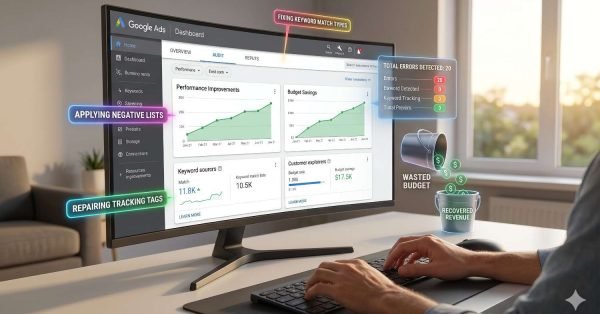
Choosing the right Google Ads campaign type determines whether your budget drives qualified leads or burns through impressions. Each campaign format serves a distinct intent stage, audience reach, and conversion goal.
With nine campaign types now available, marketers face increasing complexity when matching ad formats to business goals, customer journeys, and measurable performance outcomes in 2026.
This guide explains each Google Ads campaign type, when to use it, and how to align your selection with audience intent and clear growth objectives.
Understanding Google Ads Campaign Types
A Google Ads campaign type is a structural container that defines where your ads appear, which auction signals drive bidding, and what creative formats Google will serve to users. Selecting a campaign type is therefore not a tactical choice. It is the architectural decision that governs reach, intent, and ROI before a single ad is written.
Each campaign type serves a different stage of the buyer journey, and our complete Google Ads guide breaks down the platform’s full structure, account hierarchy, and bidding ecosystem so you can place this comparison in context.
How Campaign Types Shape Performance
Different campaign types use different machine learning models, signal inputs, and inventory access. A Search campaign optimizes against keyword auctions and Quality Score, while Performance Max optimizes against conversion value across every Google surface. The same daily budget will produce dramatically different outcomes depending on which model receives the spend.
Intent, Reach, and Bidding Differences
Campaigns split along three axes: intent depth (high-intent keyword search versus low-intent video impressions), reach breadth (single surface versus omnichannel), and bidding control (manual versus fully automated). Matching these axes to your funnel stage prevents the most common misallocation problem in paid search.
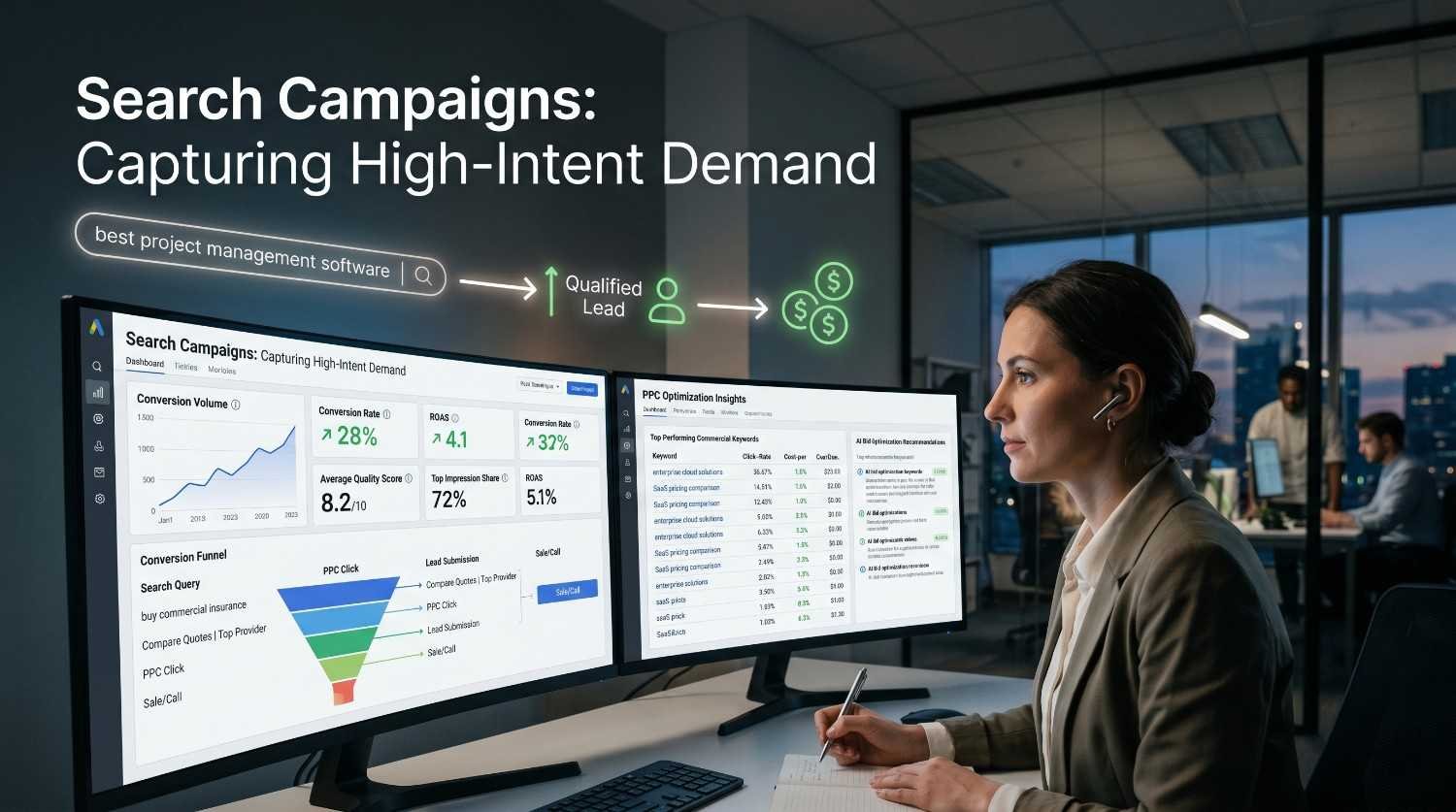
Search Campaigns: Capturing High-Intent Demand
Search campaigns are text-based ads that appear on the Google Search results page when users actively type queries matching your keywords. They remain the highest-intent format in the platform because the user has already declared a need through their query.
Effective Search campaigns start with the right query targeting, and a disciplined keyword research process determines which terms deserve budget, which match types to use, and where competition makes paid acquisition unprofitable.
When to Use Search Campaigns
Use Search when your product or service has existing search demand, your average order value justifies cost-per-click economics, and your landing pages convert traffic predictably. Service businesses, B2B SaaS, and high-consideration purchases consistently perform best in Search.
Strengths and Limitations
Search delivers the strongest direct response performance in the platform but cannot scale beyond available query volume. If your category has limited search demand, no amount of bidding will create new customers. Search also rewards mature landing pages, structured conversion tracking, and disciplined negative keyword management.
Performance Max: AI-Driven Multi-Channel Reach
Performance Max is Google’s fully automated campaign type that serves ads across Search, Display, YouTube, Discover, Gmail, and Maps from a single asset group. The advertiser provides creative assets, audience signals, and conversion goals, and Google’s machine learning handles placement, bidding, and audience matching.
How Performance Max Works
Performance Max uses Smart Bidding with target ROAS or target CPA, drawing on first-party data, audience signals, and real-time auction context to predict conversion likelihood. It is designed to consolidate fragmented campaign structures into one optimization engine.
When Performance Max Wins
Performance Max delivers best results when conversion volume is high, conversion tracking is accurate, and product feeds or service catalogs feed the algorithm clean data. It is the default choice for ecommerce, lead generation at scale, and accounts with strong historical performance data.
Performance Max relies entirely on machine learning, which means a clean conversion tracking setup is the single most important prerequisite for the algorithm to identify valuable customers and allocate spend correctly.
Display, Video, and Demand Gen Campaigns
Upper-funnel campaigns build awareness, recall, and consideration rather than capture immediate intent. They differ from Search in that the user has not declared a need. Your ad must create one or stay top of mind until intent emerges.
Upper-funnel formats depend on signal quality more than creative volume, and a structured audience targeting strategy defines which segments deserve awareness budget and which to exclude from prospecting altogether.
Display Campaigns
Display campaigns serve image and responsive ads across the Google Display Network, which spans more than two million websites and apps. Display is most effective for retargeting warm audiences, reinforcing brand visibility, and supporting longer consideration cycles.
Video Campaigns
Video campaigns run on YouTube and Google video partner sites in skippable, non-skippable, bumper, and in-feed formats. Video drives awareness, completed views, and brand lift but rarely produces direct conversions in isolation. It belongs in the upper and middle funnel.
Demand Gen Campaigns
Demand Gen serves visually rich ads across YouTube Shorts, the YouTube feed, Discover, and Gmail. It is engineered for social-style discovery behaviour and works best for brands with strong creative production and lookalike audience strategies.
Shopping and App Campaigns
Shopping and App campaigns serve specialized commercial intents. Both rely on structured product or app data rather than keywords as the primary targeting signal.
Standard Shopping Campaigns
Standard Shopping campaigns pull product information directly from Google Merchant Center and display product listings on Search and the Shopping tab. They suit retailers who want granular control over bidding by product, brand, or category rather than ceding control to Performance Max.
Product visibility in Google’s results depends on more than feed health, and a complete ecommerce marketing strategy ties Shopping campaign performance to organic listings, category structure, and merchant signals.
App Campaigns
App campaigns promote mobile app installs and in-app actions across Search, Play, YouTube, and Display. Google’s algorithm handles targeting and creative assembly. App campaigns are the only effective scaled acquisition format for mobile applications inside the Google ecosystem.

How to Choose the Right Google Ads Campaign Type
Campaign selection should follow a simple decision sequence: define the goal, identify the user intent stage, evaluate your data readiness, and only then select the campaign type. Most underperforming accounts reverse this order and choose a campaign type first.
Match Campaign to Funnel Stage
Bottom of funnel maps to Search and Performance Max. Middle of funnel maps to Shopping, Demand Gen, and remarketing Display. Top of funnel maps to Video and prospecting Display. Misalignment is the root cause of most wasted spend.
Paid search rarely delivers sustainable ROI in isolation, and our PPC and SEO comparison explains how the two channels reinforce each other, where they overlap, and how to balance investment across them.
Budget, Data, and Creative Readiness
Performance Max requires at least 30 conversions per month for the algorithm to optimize reliably. Search can work at any budget but needs accurate tracking. Video needs production-quality creative. Shopping needs a clean product feed. Choose the campaign type your account is ready to support, not the one you aspire to run.

Avoiding Common Campaign Selection Mistakes
The most common mistake is running overlapping campaign types that cannibalize each other in the auction. Performance Max and Search campaigns will compete for the same branded queries unless brand exclusions are set correctly. Shopping and Performance Max compete on product inventory unless feed segmentation is enforced.
The second mistake is launching automated campaign types without sufficient conversion data. Smart Bidding underperforms on low-volume signals and will misallocate budget toward easy conversions that lack real business value.
Most campaign selection errors compound quietly over months, and a structured Google Ads audit checklist surfaces the misallocations, broken attribution, and conflicting campaign types most accounts miss.
Conclusion
Google Ads campaign types are not interchangeable. Each one optimizes against a specific intent depth, signal model, and inventory surface, and selecting incorrectly compounds inefficiency across every dollar spent.
The right choice depends on funnel stage, conversion data maturity, creative readiness, and how paid acquisition integrates with your broader organic and content strategy across long-term growth horizons.
We help businesses build paid and organic strategies that reinforce each other. Talk to White Label SEO Service to align your campaign architecture with sustainable, data-driven search growth.
Frequently Asked Questions
What is the best Google Ads campaign type for beginners?
Search campaigns are the best starting point because they target users actively searching for your offer, produce measurable results quickly, and require less creative production than Video or Demand Gen formats.
Is Performance Max better than Search campaigns?
Performance Max is not better or worse than Search. It is broader. Search delivers higher control and intent precision, while Performance Max scales across surfaces but requires strong conversion data and accurate tracking to perform.
How many Google Ads campaign types should I run at once?
Most accounts run two to four campaign types simultaneously. Start with Search, add Performance Max once conversion volume justifies automation, and layer in remarketing Display or Video as funnel needs emerge.
Which Google Ads campaign type is best for ecommerce?
Ecommerce brands typically combine Shopping campaigns for product-level control with Performance Max for scaled reach. Standard Shopping suits accounts wanting granular bidding, while Performance Max suits accounts prioritizing automation and inventory breadth.
Do I need separate campaigns for brand and non-brand keywords?
Yes. Separating brand and non-brand campaigns prevents budget cannibalization, gives clearer performance reporting, and lets you bid more aggressively on high-intent branded queries without inflating non-brand acquisition costs.
When should I avoid Performance Max?
Avoid Performance Max when conversion tracking is incomplete, monthly conversions are below thirty, or you need transparent visibility into placement and query data. Limited reporting makes optimization difficult in low-data accounts.
How long before a Google Ads campaign starts performing?
Most campaigns require two to four weeks of learning before bidding stabilizes. Performance Max and Smart Bidding strategies often need a full conversion cycle, typically four to six weeks, before delivering reliable performance benchmarks.