

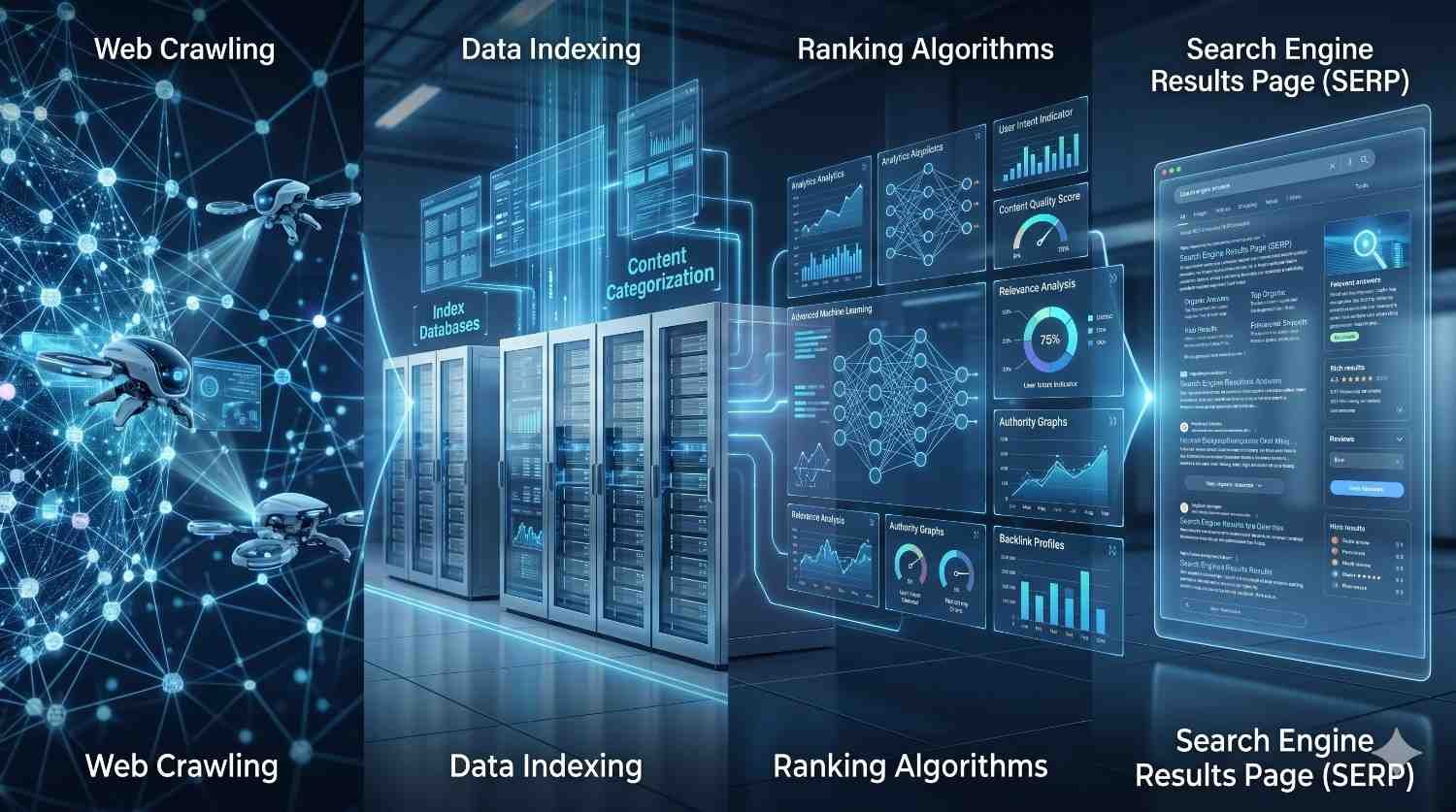
Search engines work by discovering, organizing, evaluating, and serving billions of web pages through four coordinated stages: crawling, indexing, ranking, and serving results. Behind every query you type sits a complex pipeline of automated systems that decide which pages deserve visibility, what order they appear in, and how each result is formatted on the page you see.
For business owners and marketers investing in organic growth, understanding this pipeline matters because every SEO decision, timeline, and ranking outcome traces back to how these mechanics actually operate.
This guide walks through what a search engine is, the four core stages of the process, the ranking factors that shape visibility, how AI reshapes modern results, and what all of it means for your SEO strategy.
What Is a Search Engine?
A search engine is a software system designed to discover, store, evaluate, and retrieve web content in response to user queries. Google, Bing, and other major engines exist to deliver the most relevant, trustworthy, and useful results possible within milliseconds of a search.
At the most basic level, every search engine performs three jobs. It collects information from across the web, organizes that information into a searchable database, and then surfaces the best matches whenever a user asks a question or types a keyword. Each of these jobs requires specialized infrastructure, including automated bots, distributed storage systems, and complex ranking algorithms.
The most important thing to understand is that search engines do not search the live web when you type a query. They search a pre-built index, which is a structured database of pages they have already discovered and analyzed. This distinction explains why some pages take days or weeks to appear in results and why technical SEO matters so much.
Google alone processes 8.5 billion searches every day, and its index contains hundreds of billions of pages. The systems that power modern discovery have evolved far beyond simple keyword matchers into multi-layered information retrieval engines, and our deep-dive into what a search engine really is <!–NEW PAGE NEEDED–> walks through every component, from query parsers to ranking models, so you can see how each piece shapes the results you compete for.
The Four Core Stages of How Search Engines Work
Search engines operate through four sequential stages, and a page must successfully pass through each one to appear in results. Skipping or failing any stage means a page becomes invisible to searchers, regardless of how valuable its content might be.
Crawling
Crawling is the discovery stage. Automated programs called crawlers or spiders follow links across the web, fetching pages and noting what they find. Googlebot is the most well-known example.
Indexing
Indexing is the storage and analysis stage. Once a page is crawled, the search engine processes its content, extracts meaning, and stores it in a massive structured database called the index.
Ranking
Ranking is the evaluation stage. When a user submits a query, the search engine pulls eligible pages from the index and orders them based on hundreds of signals that estimate relevance, authority, and quality.
Serving Results
Serving is the delivery stage. The search engine assembles the final results page, choosing which formats to display, which features to include, and how to present each result.
Each of these stages depends on the one before it, and the search engine process explained <!–NEW PAGE NEEDED–> breaks down every step in full detail, including the technical signals Googlebot evaluates at each handoff between crawling, indexing, and ranking.
Crawling: How Search Engines Discover Content
Crawling is how search engines find new pages and updates to existing ones. Without it, no content can ever appear in results, which makes crawl health one of the most overlooked technical SEO foundations.
Crawlers begin with a list of known URLs, often called a seed list. From those starting points, they follow every internal and external link they encounter, adding new URLs to a queue called the crawl frontier. The crawler revisits known pages on a schedule based on how often they change and how important they appear to be.
Several factors influence whether a crawler reaches your pages:
Internal linking structure signals which pages matter most. Pages buried five or six clicks deep from the homepage are crawled less frequently than pages linked from the main navigation.
Site speed and server response affect how many pages a crawler can fetch in a given session. Slow servers cause crawlers to back off, reducing the volume of pages discovered.
Robots.txt and meta directives tell crawlers which pages to skip. Misconfigured rules are one of the most common reasons important pages never get crawled.
XML sitemaps act as a direct signal to search engines about which pages exist and how often they update. A clean, current sitemap accelerates discovery.
Crawl budget, a concept relevant mostly for large sites, refers to the number of pages a search engine is willing to crawl on your domain within a given window. Wasting crawl budget on low-value pages, like filtered URLs or duplicate content, slows discovery of your most important content.
Google does not crawl every page it discovers. It prioritizes pages it expects to be valuable and skips or deprioritizes pages it considers low quality or duplicative. This is why publishing thousands of thin pages often hurts rather than helps visibility.
Approximately 16% of webpages on indexed sites never get crawled, often because of internal architecture issues that prevent discovery. Crawl efficiency directly determines how quickly new content earns visibility, and our complete crawling and indexing guide <!–NEW PAGE NEEDED–> covers every method to audit crawl budget, fix discovery issues, and ensure search engines reach your most valuable pages first.
Indexing: How Search Engines Store and Organize Content
Indexing is the stage where a search engine analyzes the content of a crawled page and decides whether to add it to its searchable database. Being crawled does not guarantee being indexed, and pages that fail to be indexed cannot rank for any query.
During indexing, the search engine parses the HTML, extracts text, identifies images and videos, processes structured data, and evaluates the overall meaning of the page. It builds a representation of what the page is about, which entities it covers, what queries it could potentially answer, and how it relates to other content already in the index.
The decision to index a page depends on several factors:
Content quality and originality matter enormously. Duplicate content, thin pages with minimal unique value, and auto-generated low-effort pages are often discovered but never indexed.
Canonical signals tell search engines which version of similar pages should be treated as the primary one. When canonicals are missing or conflicting, the search engine picks its own canonical, which may not match your preference.
Technical signals such as noindex tags, blocked resources, or rendering failures can prevent indexation even for high-quality content.
Page experience signals influence which version of a page is considered most useful. Mobile-first indexing means Google primarily uses the mobile version of your site to determine what gets indexed.
The index itself is not a single file but a distributed system spread across thousands of servers. When you search for a phrase, the search engine queries this index using inverted lookups, a technique that maps every meaningful term to every document containing it.
Indexation decisions often determine whether a page ranks at all, and our breakdown of how Google indexing works <!–NEW PAGE NEEDED–> walks through canonicalization, duplicate handling, and the exact signals that move a page from “discovered” to “indexed and eligible to rank.”
Ranking: How Search Engines Decide Order
Ranking is the stage that most people associate with SEO, but it only runs after crawling and indexing have already succeeded. When a query is submitted, the search engine retrieves all eligible indexed pages, then ranks them using hundreds of signals.
Google has publicly confirmed that its ranking system uses hundreds of factors to evaluate each result, with weighting that varies by query type, user context, and intent. There is no single algorithm. There are layers of systems working together, including foundational ranking systems, query understanding systems, machine learning models, and post-ranking adjustments.
The ranking process can be summarized in three steps. First, the engine interprets the query, identifying intent, entities, and the type of answer the user likely wants. Second, it retrieves a candidate set of pages from the index that match the query’s terms and concepts. Third, it scores and orders those candidates based on relevance, quality, authority, and contextual signals such as location and device.
Some of the most heavily weighted signal categories include content relevance, link authority, page experience, freshness, and user intent alignment. Different queries weight these signals differently. A health-related query weights expertise and trust signals heavily, while a “near me” query weights location signals far more.
Search engines also apply real-time adjustments based on user behavior. If users consistently click a lower-ranked result and engage with it, the engine learns that result deserves higher placement for that query.
Algorithm updates further reshape rankings. Google rolls out multiple core updates per year, each capable of significantly shifting visibility across entire industries. Sites that follow durable best practices recover quickly. Sites built on short-term tactics often lose ground permanently.
The weighting of these signals shifts constantly as algorithms update, and our full breakdown of Google ranking factors <!–NEW PAGE NEEDED–> goes deeper into every confirmed and inferred signal, including how they interact across different query types and industries.

Serving Results: How SERPs Are Built
Once ranking is complete, the search engine assembles the search engine results page, commonly called the SERP. This is the final stage, and it determines how each result is displayed to the user.
Modern SERPs are no longer simple lists of blue links. A single results page may include featured snippets, knowledge panels, image carousels, video results, local map packs, shopping listings, People Also Ask boxes, and AI-generated overviews. The format chosen depends entirely on the query’s intent.
A query like “best running shoes” may return product listings, comparison tables, and review carousels. A query like “how to tie a tie” may return a featured video at the top. A query like “weather in Madrid” may return a direct answer with no need to click anything.
This shift from ten blue links to feature-rich SERPs means visibility is not just about ranking position. A page in position three with a featured snippet often outperforms position one without one. Click-through rates vary enormously based on which SERP features appear and where your result sits among them.
Personalization also plays a role at this stage. Location, device, search history, and language all influence the final result. Two users in different cities can search the exact same query and see different SERPs.
Modern result pages contain dozens of feature types competing with traditional blue links, and our guide to SERP features <!–NEW PAGE NEEDED–> covers each one, from featured snippets to AI overviews, with strategies for earning visibility in the formats your audience actually clicks.
Key Ranking Factors That Influence Visibility
While search engines use hundreds of ranking signals, most of them group into four major categories. Understanding these categories helps you prioritize SEO work and set realistic expectations for what drives growth.
Technical Foundations
Technical SEO ensures search engines can crawl, render, and index your site without obstacles. This includes site architecture, internal linking, crawlability, mobile-friendliness, HTTPS, structured data, and indexability controls. Without strong technical foundations, even excellent content cannot rank.
Technical infrastructure determines whether search engines can even evaluate your content, and our walkthrough of technical SEO fundamentals <!–NEW PAGE NEEDED–> covers every audit point, from crawl budget management to schema implementation, with concrete fixes for the issues that most often block rankings.
Content Relevance and Quality
Content signals tell search engines what each page is about and how well it answers a query. This includes topical depth, entity coverage, semantic richness, internal linking, content freshness, and intent alignment. Quality is judged by whether the page satisfies the searcher’s need better than competing results. Content relevance is shaped by how well each page aligns its terms, structure, and intent signals with the queries it targets, and our resource on on-page SEO best practices <!–NEW PAGE NEEDED–> goes deeper into title optimization, semantic content modeling, and internal linking frameworks.
Authority and Backlinks
Authority signals estimate whether a site is trustworthy and respected within its topic. Backlinks remain one of the strongest authority signals, but quality matters far more than quantity. Links from authoritative, topically relevant domains carry weight. Links from low-quality or unrelated sites add little. Backlinks function as votes of trust between domains, and our strategic link building approach <!–NEW PAGE NEEDED–> explains every legitimate acquisition method, from digital PR to resource-based outreach, with frameworks for evaluating link quality and protecting your profile from harmful patterns.
User Experience Signals
Page experience signals measure how users interact with your pages. This includes Core Web Vitals, mobile usability, secure browsing, intrusive interstitials, and engagement metrics inferred from behavior. Page experience metrics now influence rankings for queries where multiple results are equally relevant, and understanding Core Web Vitals <!–NEW PAGE NEEDED–> is essential for any site auditing speed, interactivity, and visual stability against Google’s measurable thresholds.

How AI and Machine Learning Power Modern Search
Modern search engines no longer rely on keyword matching alone. Over the past decade, machine learning systems have become the foundation of how queries are interpreted and how results are ranked.
Google’s evolution illustrates this shift clearly. RankBrain, introduced in 2015, was the first major machine learning ranking signal. BERT, launched in 2019, transformed natural language understanding by analyzing the relationships between words in a query rather than the words themselves. MUM, introduced in 2021, extended these capabilities across languages and content formats. More recently, Search Generative Experience and AI Overviews have begun synthesizing results directly into AI-generated summaries.
These systems shift how visibility is earned. Search engines now reward content that demonstrates real topical expertise, addresses user intent precisely, and covers a subject in semantic depth. Stuffing keywords or producing thin pages has not worked in years, and AI-driven ranking systems penalize these patterns more aggressively each year.
For businesses, this means the foundation of strong SEO is producing content that humans find useful and that machines can evaluate as authoritative. The two are no longer separate goals.
The shift from keyword matching to intent modeling has changed what wins on modern results pages, and our breakdown of how AI is reshaping search <!–NEW PAGE NEEDED–> covers the impact of BERT, MUM, SGE, and AI Overviews on content strategy, with practical adjustments for staying visible.
How User Behavior Shapes Search Results
Search engines use signals from billions of user interactions to refine results over time. When users click a result, engage with the page, return to the SERP, or refine their query, those behaviors feed back into the ranking system.
This loop is part of why some pages climb steadily after publishing while others fade. Pages that satisfy intent earn engagement signals that reinforce their ranking. Pages that fail to satisfy intent lose ground.
Personalization adds another layer. Location, search history, device type, and language all shape the final results. This is why ranking trackers show a position range rather than a fixed number, and why two competitors looking at the same query can see different rankings.
Intent matters more than wording. Two queries with identical keywords can have completely different intents based on context, and search engines now distinguish between them with high accuracy.
Aligning content to the underlying need behind a query matters more than matching its exact wording, and our resource on mapping search intent properly <!–NEW PAGE NEEDED–> walks through every intent type, classification framework, and content alignment method needed to win competitive SERPs.
What This Means for Your SEO Strategy
Understanding how search engines work changes how you should think about SEO. It is not a single tactic, a quick win, or a one-time project. It is a long-term discipline that aligns your website with how search systems actually evaluate content.
Strong SEO starts with technical health. A site that crawlers can access easily, that loads fast, and that indexes cleanly creates the foundation everything else builds on. Without these basics, content and link building deliver diminishing returns.
Content built around real topical authority outperforms content built around individual keywords. Search engines reward sites that cover a subject thoroughly across multiple pages, with clear internal linking, consistent entity usage, and depth that matches user intent.
Authority compounds over time. Backlinks, brand mentions, and topical expertise grow gradually, which is why SEO timelines typically run from six to twelve months for meaningful results, and longer in competitive industries.
The most important shift is mental. Stop chasing algorithm changes and start aligning with the principles those algorithms try to measure: usefulness, expertise, clarity, and trust.
For teams that need to translate this technical understanding into measurable organic growth without staffing every discipline in-house, partnering with full-service SEO support <!–NEW PAGE NEEDED–> compresses months of trial and error into a structured engagement covering strategy, execution, and performance reporting.
Common Misconceptions About How Search Engines Work
Several persistent myths shape how non-specialists think about search, and clearing them up makes SEO investment decisions far easier.
Search engines do not search the live web. They search their own pre-built index. This is why new pages take time to appear.
More content is not always better. Search engines prefer fewer high-quality pages over many thin ones. Publishing volume without quality often suppresses overall visibility.
Backlinks are not dead. They remain a major ranking signal. What has changed is that low-quality links no longer help, and many actively harm.
SEO is not a one-time project. Algorithms update constantly, competitors invest continuously, and content decays without maintenance. Sustainable visibility requires ongoing work.
Ranking position is not a fixed number. Results vary by location, device, history, and personalization. A single ranking position rarely tells the whole story.
Conclusion
Search engines work through four coordinated stages, crawling, indexing, ranking, and serving, each shaped by hundreds of signals and continuously refined by machine learning systems built around user intent.
Understanding these mechanics turns SEO from guesswork into strategy, and every spoke linked throughout this guide goes deeper into the specific systems, signals, and frameworks that shape long-term organic growth.
We help businesses translate this understanding into measurable results, and at White Label SEO Service we build sustainable visibility through technical depth, content authority, and link strategy aligned with real ranking systems.
Frequently Asked Questions
How long does it take for a new page to rank on Google?
Most new pages take three to six months to reach meaningful rankings, depending on competition, site authority, and content quality. Highly competitive queries can take twelve months or longer to win consistent positions.
How often do search engines crawl my website?
Crawl frequency depends on site authority, update cadence, and crawl budget. High-authority sites are crawled multiple times daily, while smaller or low-activity sites may be crawled every few days or weeks.
Why is my page indexed but not ranking?
Indexed pages that do not rank usually lack topical depth, internal linking support, authority signals, or alignment with searcher intent. The page exists in the index but does not yet earn the relevance score needed to compete.
Do all search engines work the same way?
All major search engines follow the same four core stages, but they weight signals differently. Bing weighs social and click-through signals more heavily than Google, while Google relies more on link authority and topical relevance.
How does Google know which page is most relevant?
Google evaluates relevance through hundreds of signals, including content match, semantic coverage, topical authority, internal linking, user engagement, and contextual factors like location and device. No single factor decides ranking alone.
What is the difference between crawling and indexing?
Crawling is the process of discovering pages by following links. Indexing is the process of analyzing those pages and storing them in a searchable database. A page must be crawled before it can be indexed.
Can search engines understand images and videos?
Modern search engines analyze visual content using machine learning, structured data, alt text, captions, and surrounding context. They can identify objects, scenes, and content themes, though textual signals still carry significant interpretive weight.