

Local SEO is the practice of optimizing your online presence so your business appears in search results when people nearby search for the products or services you offer. Unlike broad organic SEO, local search targets geography-specific intent — connecting businesses with customers in their immediate area at the exact moment they are ready to act. For small and medium businesses, local search visibility is often the single most direct path from search engine to paying customer.
Without a structured local SEO strategy, your business risks being invisible in the searches that matter most — the ones happening within miles of your location, from people who are ready to buy, book, or visit today.
This guide covers what local SEO is, how Google’s local algorithm works, the role of Google Business Profile, keyword research, on-page optimization, citations, reviews, link building, technical SEO, performance tracking, common mistakes, and realistic timelines.
What Is Local SEO?
Local SEO is a branch of search engine optimization focused on improving a business’s visibility in geographically relevant search results. When someone searches “coffee shop near me,” “plumber in Austin,” or “best dentist open Saturday,” Google returns results that are filtered by location, relevance, and the searcher’s proximity to the business. Local SEO is the discipline of ensuring your business appears prominently in those results.
At its core, local SEO involves three interconnected layers: your Google Business Profile (the listing that appears in the local pack and on Google Maps), your website’s on-page signals (content, metadata, and structure that communicate your location and services), and your off-page authority signals (citations, reviews, and backlinks that establish trust and prominence in your market).
According to Google’s own research, 76% of people who search for something nearby on their smartphone visit a related business within a day, and 28% of those searches result in a purchase. These numbers illustrate why local search is not a secondary channel for location-based businesses — it is often the primary driver of foot traffic, phone calls, and direct revenue.

How Local SEO Differs from Traditional SEO
Traditional SEO and local SEO share the same foundational principles, relevance, authority, and technical quality, but they diverge significantly in how Google evaluates and ranks results. Traditional SEO focuses on ranking a website for broad, non-geographic queries across a national or global audience. Local SEO focuses on ranking a business for queries tied to a specific location, service area, or geographic intent.
The most visible difference is the search result format. Traditional SEO targets the standard blue-link organic results. Local SEO targets the local pack — the map-based block of three business listings that appears above organic results for location-intent queries. Ranking in the local pack requires a different set of signals than ranking in standard organic results, including a verified Google Business Profile, consistent NAP (name, address, phone number) data, and proximity to the searcher.
Understanding what SEO is and how it works at a foundational level gives you the context to see why local search requires its own distinct strategy, signals, and optimization priorities, the two disciplines reinforce each other but are not interchangeable.
Why Local SEO Matters for Small and Medium Businesses
For businesses that serve customers in a defined geographic area, whether a single city, a service radius, or a regional market, local SEO is the most cost-efficient form of digital marketing available. Unlike paid advertising, which stops generating results the moment you stop spending, local SEO builds compounding visibility that grows over time.
The competitive reality is straightforward: if your business does not appear in the local pack or the top organic results for your core service queries, your competitors who do appear are capturing the customers you are not. BrightLocal’s 2024 Local Consumer Review Survey found that 98% of consumers used the internet to find information about local businesses in the past year, making local search presence a baseline requirement, not a competitive advantage.
How Google’s Local Search Algorithm Works
Google’s local search algorithm determines which businesses appear in the local pack and local organic results for any given query. Unlike the standard organic algorithm, which evaluates hundreds of ranking factors primarily tied to website authority and content relevance, the local algorithm applies a distinct three-factor framework that every local SEO strategy must be built around.
Relevance, Distance, and Prominence Explained
Google evaluates every local search result against three primary signals:
Relevance measures how well a business listing matches what the searcher is looking for. Google assesses relevance through your Google Business Profile category, the services you list, the keywords in your business description, and the content on your website. A plumbing company that has clearly categorized itself, listed its services in detail, and built a website with service-specific pages will rank more relevantly for plumbing queries than a competitor with a sparse, uncategorized listing.
Distance measures how far each potential search result is from the location term used in the query, or from the searcher’s location if no location is specified. Distance is the one factor you cannot directly optimize, your physical location is fixed. What you can control is ensuring Google has accurate, consistent location data across every platform so it can correctly calculate your proximity to searchers.
Prominence measures how well-known and trusted a business is, both online and offline. Google evaluates prominence through the volume and quality of your reviews, the number and consistency of your citations across the web, the authority of websites linking to you, and your overall online reputation. A business with 400 reviews, consistent directory listings, and local press coverage will outrank a competitor with 12 reviews and no off-site presence, even if their websites are comparable.
The Role of the Local Pack in Search Results
The local pack — also called the “map pack” or “three-pack” — is the block of three business listings that appears at or near the top of Google’s search results for location-intent queries. It includes a map, the business name, rating, address, hours, and a link to the full Google Business Profile. For most local businesses, appearing in the local pack generates significantly more clicks and calls than ranking in standard organic results below it.
The local pack and the organic results below it are governed by overlapping but distinct ranking systems. A business can rank in the local pack without having a particularly strong website, and a business with a strong website can fail to appear in the local pack if its GBP is incomplete or its citation profile is inconsistent. A comprehensive local SEO strategy addresses both systems simultaneously.
Understanding how Google’s local algorithm evaluates relevance, distance, and prominence gives you a clear framework for prioritizing your optimization efforts — businesses that want to accelerate this process without building an in-house team often partner with white label local SEO services that apply this exact framework at scale across multiple client locations.

Google Business Profile: The Foundation of Local SEO
Google Business Profile (GBP) — formerly known as Google My Business — is the free business listing platform that powers your presence in the local pack, Google Maps, and the Knowledge Panel that appears when someone searches your business name directly. It is the single most important asset in local SEO, and it is entirely separate from your website.
A complete, optimized, and actively managed GBP listing signals to Google that your business is legitimate, relevant, and trustworthy. An incomplete or neglected listing — regardless of how strong your website is — creates a ceiling on your local pack visibility that no amount of on-page optimization can overcome.
What Information Google Business Profile Uses
Google uses the following GBP fields as direct ranking and display signals:
Business name: Must match your real-world business name exactly. Keyword stuffing in the business name field is a violation of Google’s guidelines and can result in suspension.
Primary and secondary categories: Your primary category is the single most important field in your GBP listing. It tells Google what type of business you are and determines which queries you are eligible to appear for. Secondary categories expand your relevance to related services.
Business description: A 750-character field where you can describe your services, specialties, and value proposition. Google reads this for relevance signals, so natural inclusion of your core service terms is appropriate here.
Services and products: Detailed service listings with descriptions give Google additional relevance signals and give searchers more information before they click.
Photos and videos: Businesses with photos receive 42% more requests for directions and 35% more website clicks than businesses without photos, according to Google’s own data.
Posts, Q&A, and attributes: Regular GBP posts signal an active, engaged business. The Q&A section, if managed proactively, can address common customer questions and add keyword-rich content to your listing.
How GBP Signals Influence Local Rankings
Google uses your GBP data in combination with your website signals and off-site authority to determine local pack placement. The completeness of your profile — how many fields are filled in, how accurate the information is, and how recently it has been updated — directly affects your relevance score. Businesses that treat their GBP as a static listing rather than an active marketing channel consistently underperform against competitors who update their profiles regularly.
Your GBP listing is the single highest-leverage asset in local SEO, and every element from your business category to your photo frequency sends ranking signals to Google — our guide on how to optimize your Google Business Profile walks through every field, feature, and update cadence that drives local pack visibility.
Local Keyword Research: Finding What Your Customers Search For
Local keyword research is the process of identifying the specific search terms your target customers use when looking for businesses, products, or services in your geographic area. It is the strategic foundation that every other local SEO activity — your GBP optimization, your website content, your landing pages — must be built on.
Without accurate local keyword research, you risk optimizing for terms that either have no search volume, face competition you cannot realistically overcome, or do not match the actual intent of your target customers. With it, you can prioritize your efforts around the queries most likely to drive qualified traffic and conversions.
Types of Local Search Queries
Local search queries fall into three primary categories, each requiring a slightly different optimization approach:
Implicit local queries include location intent without a geographic modifier — “emergency plumber,” “pizza delivery,” “urgent care.” Google infers the searcher’s location from their device and returns local results automatically. These queries are often the highest-intent searches in any local market.
Explicit local queries include a geographic modifier — “plumber in Chicago,” “best Italian restaurant downtown Seattle,” “accountant near Canary Wharf.” These queries are more competitive because the intent is unambiguous, but they also convert at higher rates because the searcher has already committed to a location.
Branded and navigational queries include your business name or a competitor’s name. While these are not traditional optimization targets, monitoring them gives you insight into brand awareness and competitive positioning in your market.
Tools and Methods for Local Keyword Discovery
Effective local keyword research combines data from multiple sources. Google Search Console shows you which queries are already driving impressions and clicks to your site — a critical starting point for identifying what is working and what gaps exist. Google’s autocomplete and “People Also Search For” features surface the exact language your customers use. Tools like Semrush, Ahrefs, and BrightLocal provide search volume data, keyword difficulty scores, and competitor keyword gap analysis specifically for local markets.
The most overlooked source of local keyword intelligence is your own customer data — the language your customers use in reviews, support inquiries, and sales conversations often reveals high-intent search terms that keyword tools miss entirely.
Identifying the right geographic and intent-based queries is the strategic foundation that every other local SEO activity builds on, our dedicated guide to local SEO keyword research covers every method, tool, and prioritization framework for finding the terms your customers actually use when searching for businesses like yours.
On-Page SEO for Local Businesses
On-page SEO for local businesses refers to the optimization of your website’s content, structure, and metadata to communicate your location, services, and relevance to both search engines and local searchers. While your Google Business Profile handles your presence in the local pack, your website’s on-page signals determine how well you rank in the local organic results that appear below the map pack — and they reinforce your GBP’s relevance signals simultaneously.
A well-optimized local website does three things clearly: it tells Google what you do, where you do it, and who you serve. Every page, heading, and piece of content should be built around that framework.
NAP Consistency and Why It Matters
NAP stands for Name, Address, and Phone Number — the three pieces of business information that Google uses to verify your business’s identity and location across the web. NAP consistency means that your business name, address, and phone number appear in exactly the same format on your website, your Google Business Profile, and every directory, citation, and platform where your business is listed.
Inconsistent NAP data — different phone numbers on different platforms, abbreviated address formats that do not match your GBP, or a business name that varies between listings — creates conflicting signals that reduce Google’s confidence in your business’s legitimacy and location accuracy. This directly suppresses local pack rankings.
Your NAP information should appear in the footer of every page on your website, on your Contact page, and in your LocalBusiness schema markup. Every instance should be identical to the information in your Google Business Profile.
Local Landing Pages and Location-Specific Content
If your business serves multiple locations or a defined service area, location-specific landing pages are one of the most powerful on-page tools available. A dedicated page for each city, neighborhood, or service area you serve — with unique, locally relevant content rather than duplicated templates — allows you to rank for location-specific queries that a single homepage cannot target effectively.
Effective local landing pages include the target location in the H1, title tag, and meta description; reference local landmarks, neighborhoods, or community context naturally; include location-specific testimonials or case studies where available; and embed a Google Map of the location or service area.
Aligning your website’s content, metadata, and structure with local search intent is what transforms organic traffic into qualified leads from your service area, our complete guide to on-page SEO for local businesses covers every optimization layer from title tags and header structure to location-specific content and internal linking.

Local Citations and Directory Listings
A local citation is any online mention of your business’s name, address, and phone number — whether on a directory, a review platform, a local news site, a chamber of commerce listing, or any other web property. Citations are one of the foundational trust signals in Google’s local algorithm, and they serve two distinct purposes: they help Google verify that your business exists and is located where you say it is, and they provide additional pathways for customers to discover your business outside of Google Search.
What Counts as a Local Citation
Citations exist on a spectrum of authority and relevance. Tier 1 citations come from the major data aggregators — Neustar Localeze, Data Axle, Foursquare, and similar platforms that feed business data to hundreds of downstream directories. Getting your information accurate on these aggregators is the highest-leverage citation activity because errors here propagate across the entire citation ecosystem.
Tier 2 citations come from major general directories — Yelp, Apple Maps, Bing Places, Yellow Pages, and Facebook Business. These platforms have significant traffic and authority in their own right, and they are among the first places Google cross-references your business information.
Tier 3 citations come from industry-specific directories, local business associations, chamber of commerce listings, and niche platforms relevant to your business category. These citations carry less raw authority than Tier 1 and 2 sources but add topical relevance signals that reinforce your category and service area.
How Citation Accuracy Affects Rankings
Citation accuracy — the degree to which your NAP information is consistent and correct across all citation sources — is a direct input into Google’s confidence in your business’s legitimacy. Moz’s Local Search Ranking Factors research consistently identifies citation signals as among the top factors influencing local pack rankings, particularly for competitive markets where multiple businesses have comparable GBP and website quality.
A citation audit — the process of finding, correcting, and building citations systematically — is a foundational step in any local SEO engagement. Building a consistent, accurate citation profile across directories, data aggregators, and industry platforms is one of the most foundational trust signals in local SEO, our guide to local citation building covers every platform tier, audit process, and correction workflow you need to establish citation authority in your market.
Online Reviews and Reputation Management
Online reviews are both a direct local ranking signal and the primary trust mechanism that converts local search visibility into customer action. Google uses the volume, recency, rating, and diversity of your reviews as inputs into the prominence component of its local algorithm. A business with a strong, growing review profile consistently outranks competitors with comparable GBP and website quality but weaker review signals.
Beyond rankings, reviews function as social proof at the exact moment a potential customer is deciding whether to contact your business. BrightLocal’s 2024 research found that 49% of consumers trust online reviews as much as personal recommendations from friends and family, making your review profile one of the most commercially significant assets in your local marketing ecosystem.
How Reviews Influence Local Search Rankings
Google evaluates reviews across several dimensions. Review quantity matters — businesses with more reviews generally outrank those with fewer, all else being equal. Review recency matters — a steady stream of new reviews signals an active, engaged business, while a review profile that stopped growing two years ago signals stagnation. Review quality matters — detailed, keyword-rich reviews that mention your services and location provide relevance signals that generic “great service!” reviews do not.
Review diversity also matters. Google values reviews across multiple platforms — not just Google reviews, but Yelp, Facebook, TripAdvisor, and industry-specific platforms relevant to your category. A business with 200 Google reviews and no presence elsewhere looks less authoritative than a business with 150 Google reviews, 80 Yelp reviews, and 40 Facebook reviews.
Responding to Reviews: Best Practices
Responding to reviews — both positive and negative — is a ranking signal in its own right. Google’s guidelines explicitly state that responding to reviews shows that you value your customers and their feedback. Businesses that respond to reviews consistently signal engagement and legitimacy to both Google and prospective customers.
For positive reviews, a brief, personalized response that thanks the reviewer and references a specific detail from their review is more effective than a generic “thank you for your review.” For negative reviews, a professional, solution-focused response that acknowledges the issue and offers a resolution demonstrates accountability and often converts a negative impression into a positive one for readers who see the exchange.
Reviews are one of the most direct ranking signals in Google’s local algorithm, and a consistent strategy for generating and responding to them compounds your visibility over time, our guide on local SEO reviews and reputation covers every platform, response framework, and generation tactic that builds trust with both customers and search engines.
Local Link Building and Authority Signals
Link building for local SEO follows the same foundational principle as traditional link building — earning links from authoritative, relevant websites signals to Google that your business is trusted and prominent. But local link building has a distinct strategic focus: the geographic and topical relevance of the linking source matters as much as its domain authority.
A link from a local newspaper, a regional business association, a city government resource page, or a well-regarded local blog carries more local ranking weight than a link from a high-authority national website with no geographic connection to your market. Google’s prominence signal is built in part on how well-known your business is within its specific community — and local links are the clearest signal of that community standing.
What Makes a Local Backlink Valuable
Three factors determine the value of a local backlink: geographic relevance (does the linking site serve the same market you do?), topical relevance (does the linking site’s content relate to your industry or services?), and authority (does the linking site have a strong, trusted presence in its own right?).
The highest-value local links typically come from local news coverage, local business directories with editorial standards, sponsorships of local events or organizations, partnerships with complementary local businesses, and mentions in local government or community resources. These links are difficult to acquire at scale, which is precisely why they carry significant ranking weight — they cannot be manufactured easily.
Community and Partnership Link Opportunities
The most sustainable local link building strategy is built around genuine community involvement. Sponsoring a local sports team, partnering with a local charity, hosting a community event, or contributing expert commentary to a local news outlet all create natural link opportunities that also build brand awareness and goodwill in your market.
Business association memberships — local chambers of commerce, industry trade associations, and regional business networks — typically include a directory listing with a link as part of membership. These links are among the easiest high-quality local links to acquire and should be a baseline activity in any local SEO strategy.
Earning links from locally relevant, authoritative sources is one of the most powerful ways to build the prominence signal that Google’s local algorithm rewards, our guide on local SEO link building strategies covers every outreach method, partnership opportunity, and community-based tactic that generates real authority for local businesses.
Technical SEO Considerations for Local Businesses
Technical SEO refers to the infrastructure-level optimizations that allow search engines to crawl, index, and understand your website accurately. For local businesses, technical SEO has a specific set of priorities that go beyond the standard technical audit checklist — because the way your website communicates your business entity, location, and service area to Google directly affects your local ranking eligibility.
A technically sound local website is not just faster and more crawlable — it is more legible to Google’s entity understanding systems, which is what allows your website signals to reinforce your GBP signals effectively.
Mobile Optimization and Core Web Vitals
Local search is overwhelmingly a mobile behavior. Google’s data shows that the majority of “near me” searches happen on mobile devices, often in high-intent moments when the searcher is ready to act immediately. A website that loads slowly, renders poorly on mobile, or creates friction in the conversion path — finding a phone number, getting directions, booking an appointment — loses customers at the exact moment they are most likely to convert.
Core Web Vitals — Google’s framework for measuring real-user page experience across Largest Contentful Paint (LCP), Interaction to Next Paint (INP), and Cumulative Layout Shift (CLS) — are direct ranking signals. Google’s 2023 page experience update confirmed that Core Web Vitals scores influence ranking eligibility across both mobile and desktop results. For local businesses competing in markets where multiple competitors have comparable content quality, Core Web Vitals performance can be a meaningful differentiator.
Schema Markup for Local Businesses
LocalBusiness schema is a structured data format that allows you to communicate your business’s name, address, phone number, hours, service area, and other key attributes directly to Google in a machine-readable format. Implementing LocalBusiness schema on your website removes ambiguity from Google’s entity understanding — instead of inferring your business details from unstructured text, Google can read them directly from your schema markup.
The most important schema properties for local businesses include: @type (your specific business category, such as “Plumber” or “Restaurant”), name, address (using the PostalAddress format), telephone, openingHours, geo (latitude and longitude coordinates), areaServed, and url. For multi-location businesses, each location should have its own schema markup on its dedicated location page.
The infrastructure of your website — how fast it loads, how well it renders on mobile, and how clearly it communicates your business entity to search engines — directly affects your ability to rank in local results, our guide to technical SEO for local businesses covers every audit point from Core Web Vitals and mobile usability to LocalBusiness schema and crawl optimization.
Tracking and Measuring Local SEO Performance
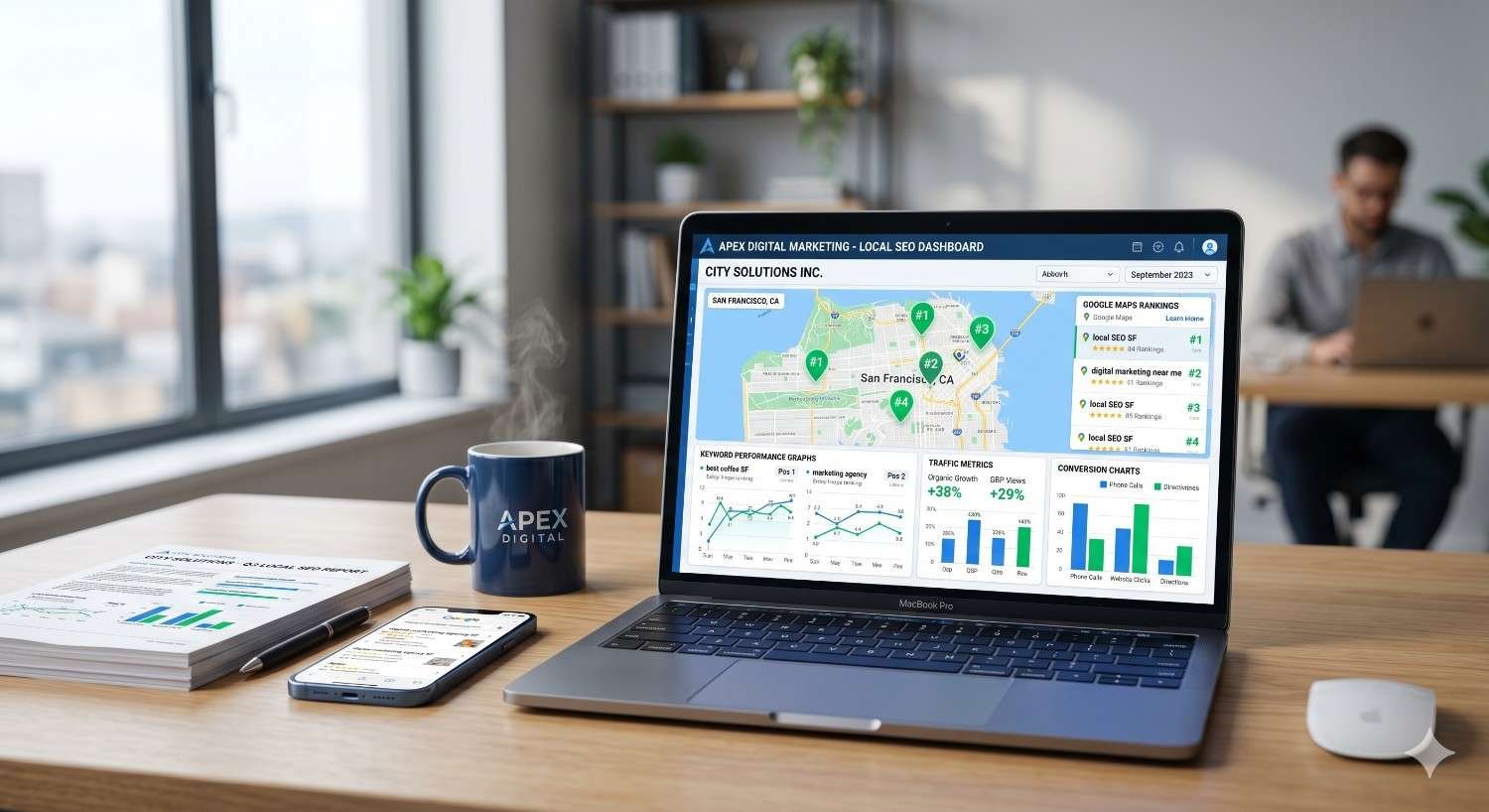
Measuring local SEO performance requires a different set of metrics and tools than standard organic SEO reporting. Because local search visibility spans multiple surfaces — the local pack, Google Maps, local organic results, and your Google Business Profile — a complete performance picture requires data from multiple sources combined into a coherent view of what is working, what is improving, and where gaps remain.
Without consistent measurement, local SEO becomes a set of activities rather than a strategy. With the right metrics in place, you can identify which optimizations are driving results, which channels are generating the most qualified traffic, and where your next highest-leverage opportunity lies.
Key Metrics to Monitor
Local pack rankings: Your position in the local pack for your core service queries, tracked by location. Because local pack results vary by the searcher’s precise location, rank tracking for local SEO requires tools that simulate searches from specific geographic points within your service area — not just a single city-level average.
Google Business Profile insights: GBP provides data on how many people found your listing through direct searches (searching your business name) versus discovery searches (searching a category or service), how many viewed your photos, how many clicked for directions, and how many called your business directly from the listing. These metrics are direct indicators of GBP performance and local pack visibility.
Organic traffic by location: Google Analytics 4 allows you to segment organic traffic by city or region, giving you visibility into which geographic markets are generating the most website visits and conversions from local search.
Conversion metrics: Phone calls, direction requests, appointment bookings, and contact form submissions from local search traffic are the ultimate measure of local SEO ROI. Tracking these conversions back to their source — local pack, local organic, or direct GBP interaction — gives you a complete picture of how local search visibility translates into business outcomes.
Tools for Local SEO Reporting
The core local SEO reporting stack includes Google Search Console (organic impressions, clicks, and average position by query and page), Google Analytics 4 (traffic, engagement, and conversion data by channel and location), and Google Business Profile Insights (GBP-specific performance data). For more granular local rank tracking and citation monitoring, tools like BrightLocal, Whitespark, and Semrush’s Local SEO toolkit provide the location-specific data that Google’s native tools do not.
Measuring the right metrics — from local pack rankings and GBP insights to organic traffic by location and conversion rates — is what separates a strategy that compounds over time from one that drifts without direction, our guide to local SEO reporting and analytics covers every KPI, tool, and dashboard setup that gives you clear visibility into what is working and what needs adjustment.
Common Local SEO Mistakes to Avoid
Even well-intentioned local SEO efforts frequently stall because of a small number of recurring mistakes that undermine the foundational signals Google relies on. Understanding these mistakes before you invest time and resources in optimization is the most efficient way to avoid the setbacks that cost businesses months of ranking progress.
Inconsistent Business Information
The most common and most damaging local SEO mistake is inconsistent NAP data across your website, Google Business Profile, and directory listings. A business that lists its address as “123 Main St” on its website, “123 Main Street, Suite 4” on Yelp, and “123 Main St.” on its GBP is sending conflicting signals to Google about its own identity and location. These inconsistencies reduce Google’s confidence in the business’s legitimacy and suppress local pack rankings.
The fix is systematic: audit every platform where your business is listed, standardize your NAP format to match your GBP exactly, and use a citation management tool to monitor for new inconsistencies as they appear. This is not a one-time task — business information changes over time, and citation drift is a persistent challenge that requires ongoing attention.
Ignoring Mobile Users and Voice Search
Local search is a mobile-first behavior, and voice search — driven by smartphone assistants and smart speakers — is an increasingly significant source of local queries. Voice search queries tend to be longer, more conversational, and more explicitly local than typed queries (“Where is the nearest pharmacy open right now?” versus “pharmacy near me”). Businesses that optimize only for typed search patterns miss a growing segment of high-intent local searchers.
Mobile optimization failures — slow load times, non-responsive design, difficult-to-tap phone numbers, or checkout processes that do not work on mobile — create friction at the exact moment a local searcher is most likely to convert. Every local business website should be tested on mobile devices regularly, with particular attention to the speed and ease of the most common conversion actions: calling, getting directions, and booking.
For agencies and businesses that want to avoid these mistakes from the start and build a local SEO foundation that is structurally sound from day one, our white label SEO services provide a fully managed, strategy-first approach that eliminates the most common errors before they cost you rankings.
How Long Does Local SEO Take to Show Results?
Local SEO is a medium-to-long-term investment, and setting accurate expectations around timelines is one of the most important decisions a business owner or marketing manager can make before committing to a strategy. The honest answer is that results vary significantly based on your starting point, your market’s competitiveness, the quality of your optimization, and the consistency of your execution — but there are reliable patterns that give you a realistic framework for planning.
For businesses starting from a weak baseline — an incomplete GBP, inconsistent citations, few reviews, and a website with minimal local optimization — the first 30 to 60 days of a structured local SEO campaign are typically spent on foundational work: completing and optimizing the GBP, auditing and correcting citations, implementing on-page optimizations, and establishing a review generation process. These activities do not produce immediate ranking changes, but they remove the structural barriers that are suppressing visibility.
Between 60 and 90 days, businesses with a solid foundation typically begin to see measurable movement — improved local pack positions for lower-competition queries, increased GBP impressions and clicks, and early organic ranking improvements for location-specific long-tail queries. These early signals are meaningful indicators that the strategy is working, even if the most competitive primary queries have not yet moved.
Between 90 and 180 days, businesses that have maintained consistent optimization activity — regular GBP updates, ongoing review generation, continued citation building, and content development — typically see significant local pack improvements for their core service queries, meaningful organic traffic growth from local landing pages, and measurable increases in GBP-driven calls and direction requests.
Competitive markets — major metropolitan areas, high-demand service categories, or niches with well-established local competitors — require longer timelines and more sustained investment. In these markets, 6 to 12 months of consistent, high-quality local SEO work is a realistic expectation for achieving top-three local pack positions for primary queries.
Setting accurate expectations around local SEO timelines is one of the most important decisions a business owner can make before investing in organic search, our detailed breakdown of how long SEO takes to show results covers the variables that accelerate or delay progress, what realistic milestones look like at 30, 90, and 180 days, and how to evaluate whether your strategy is on track.
Conclusion
Local SEO connects your business to the customers searching for your services nearby — through Google Business Profile optimization, consistent citations, on-page signals, reviews, local links, and technical foundations that together build the relevance, distance, and prominence Google rewards with local pack visibility.
Every component covered in this guide — from keyword research and on-page optimization to reputation management and performance tracking — works as part of an interconnected system, and the spoke resources linked throughout provide the depth each element deserves.
At White Label SEO Service, we build and execute local SEO strategies that compound over time — contact us to start building the local search visibility your business needs to grow.
Frequently Asked Questions
What is the difference between local SEO and regular SEO?
Local SEO targets geographically specific search queries and optimizes for the local pack, Google Maps, and location-based organic results. Regular SEO targets broad, non-geographic queries and focuses on standard organic rankings without a location filter.
Do I need a website to do local SEO?
A Google Business Profile alone can generate local pack visibility without a website, but a well-optimized website significantly strengthens your local rankings by providing additional relevance signals, location-specific content, and conversion pathways that a GBP listing cannot replicate.
How important are Google reviews for local SEO?
Google reviews are a direct local ranking signal that influences your prominence score in Google’s local algorithm. Volume, recency, rating, and the presence of keyword-rich review content all contribute to local pack positioning and click-through rates.
What is NAP consistency and why does it matter?
NAP stands for Name, Address, and Phone Number. Consistent NAP data across your website, GBP, and all directory listings helps Google verify your business’s identity and location, which directly supports local pack rankings. Inconsistencies create conflicting signals that suppress visibility.
Can a business rank locally without a physical address?
Yes. Service area businesses (SABs) — such as plumbers, cleaners, and mobile services — can rank in local results by defining a service area in their GBP rather than displaying a physical address. The optimization strategy differs slightly from storefront businesses but follows the same core principles.
How many citations does a local business need?
There is no fixed number, but citation quality and consistency matter more than volume. Accurate listings on Tier 1 data aggregators, major general directories, and relevant industry-specific platforms provide the foundational citation profile most local businesses need. Ongoing citation building and monitoring are more important than hitting a specific count.
What tools are used to track local SEO performance?
The core local SEO tracking stack includes Google Search Console for organic query data, Google Analytics 4 for traffic and conversion data, and Google Business Profile Insights for GBP-specific metrics. Tools like BrightLocal, Whitespark, and Semrush’s Local SEO toolkit provide local rank tracking, citation monitoring, and competitive analysis that Google’s native tools do not cover.