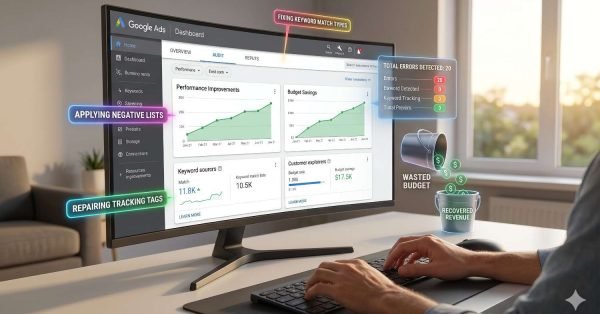
PPC marketing, or pay-per-click marketing, is a digital advertising model in which businesses pay a fee each time a user clicks on one of their ads — buying traffic directly rather than earning it through organic search. Unlike traditional advertising that charges for exposure, PPC charges only for action, making it one of the most measurable and accountable channels in digital marketing. For business owners and marketers evaluating paid media, understanding how PPC works is the foundation of every informed budget decision.
Ignoring PPC means leaving immediate, intent-driven traffic on the table while competitors capture customers who are actively searching for what you sell.
This guide covers what PPC marketing is, how ad auctions work, the main types of PPC ads, how campaigns are structured, how PPC compares to SEO, how to measure performance, what PPC costs, and the most common mistakes beginners make.
What Is PPC Marketing?
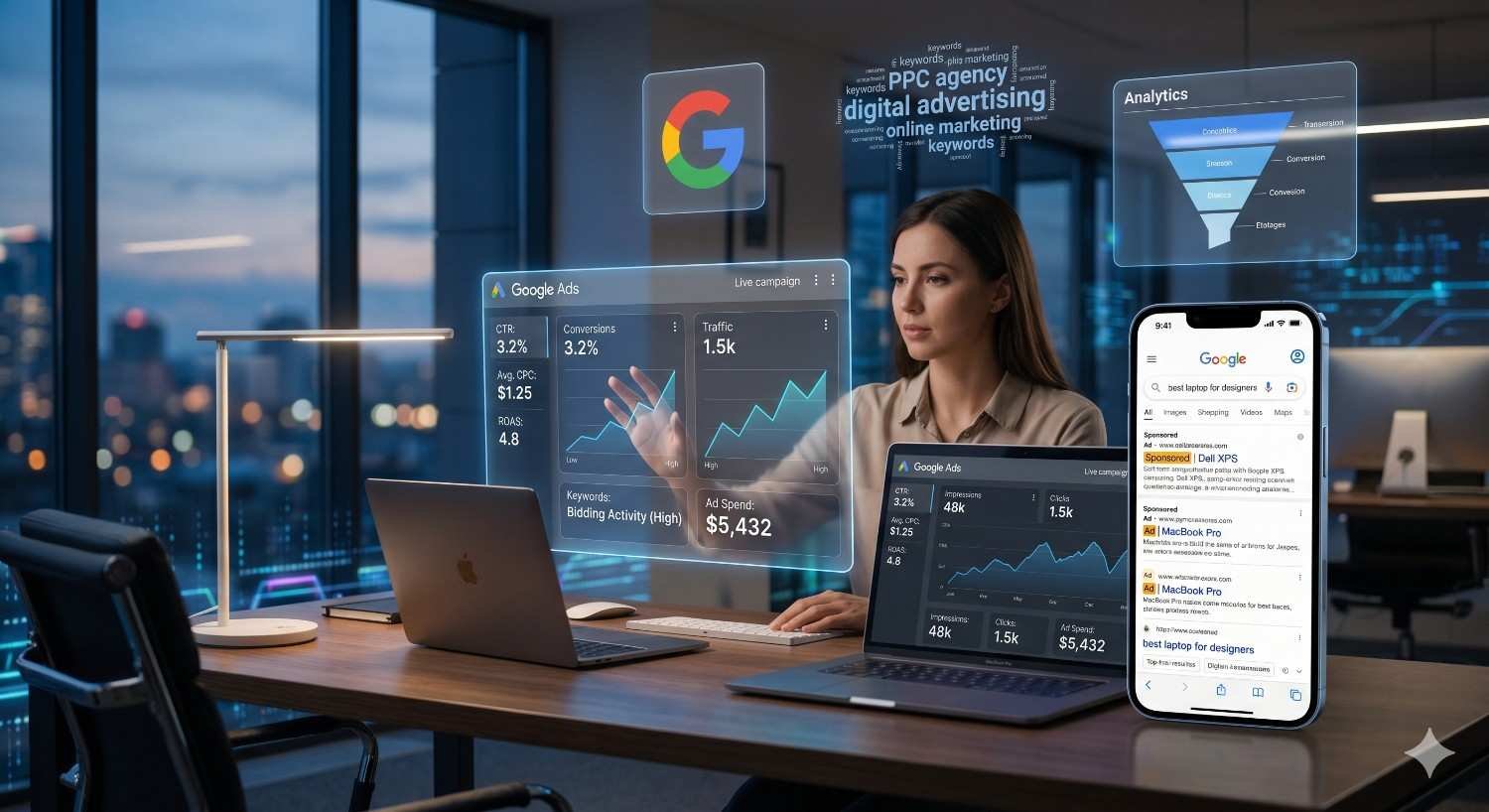
PPC marketing is a digital advertising model in which advertisers pay a fee each time a user clicks on their ad. The core mechanic is simple: you create an ad, set a bid for how much you are willing to pay per click, and your ad competes in an automated auction every time a relevant search query is entered. You pay only when someone clicks — not when your ad is shown.
This distinguishes PPC from impression-based advertising models. In a cost-per-thousand-impressions (CPM) model, advertisers pay for every 1,000 times their ad is displayed, regardless of whether anyone clicks. In a cost-per-acquisition (CPA) model, advertisers pay only when a specific conversion action occurs, such as a purchase or form submission. PPC sits between these two: it charges per click, making it a performance-based model directly tied to user action rather than passive exposure.
The most widely used PPC platform is Google Ads, which places paid results at the top and bottom of Google’s search engine results pages (SERPs). Microsoft Ads (Bing) operates on the same model. Social platforms including Meta, LinkedIn, and TikTok also use pay-per-click pricing for their advertising products, though the targeting mechanics differ from search-based PPC.
For businesses, PPC offers a direct path to visibility in front of users who are actively searching for relevant products or services. A new website with no organic authority can appear at the top of Google search results on day one of a campaign — something that would take months or years to achieve through SEO alone.
How PPC Differs from Other Digital Advertising Models
| Ad Model | What You Pay For | Best For |
| PPC (Pay-Per-Click) | Each click on your ad | Intent-driven traffic, lead generation |
| CPM (Cost-Per-Thousand Impressions) | Every 1,000 ad views | Brand awareness, reach campaigns |
| CPA (Cost-Per-Acquisition) | Each completed conversion | Performance-focused campaigns with defined goals |
The PPC model is particularly well-suited for businesses with measurable conversion goals — a contact form submission, a product purchase, a phone call — because every dollar spent is directly traceable to a click, and every click can be traced to a conversion outcome. This accountability makes PPC one of the most beginner-friendly paid channels for businesses that need to justify marketing spend with clear data.
For a deeper breakdown of how pay-per-click advertising is defined across different platforms and contexts, our complete guide to pay-per-click advertising covers the full definition, historical context, and how the model has evolved across search, social, and display channels.
How Does PPC Advertising Work?
Every time a user enters a search query into Google, an automated auction runs in milliseconds. Advertisers who have bid on keywords matching that query compete for available ad placements. The winner is not simply the highest bidder — Google uses a combination of bid amount and ad quality to determine which ads appear, in what order, and at what cost.
This system is designed to reward relevance. An advertiser with a highly relevant, well-structured ad can outrank a competitor with a higher bid, and pay less per click in the process. Understanding this mechanic is the single most important insight for any business entering PPC for the first time.
The Ad Auction Process Explained
- A user enters a search query into Google.
- Google identifies all advertisers bidding on keywords that match the query.
- Each advertiser’s Ad Rank is calculated using their bid and Quality Score.
- Ads are displayed in order of Ad Rank — highest to lowest.
- The advertiser is charged only when a user clicks on their ad.
This process repeats for every single search query, across billions of searches per day, in real time.
What Is Quality Score and Why Does It Matter?
Quality Score is Google’s 1–10 rating of the relevance and quality of your keywords, ads, and landing pages. A score of 10 indicates maximum relevance; a score of 1 indicates poor alignment between what you are bidding on and what you are showing users.
Quality Score is calculated from three components: expected click-through rate (how likely users are to click your ad), ad relevance (how closely your ad matches the search query), and landing page experience (how useful and relevant your landing page is to users who click).
The business implication is significant: a higher Quality Score lowers your cost per click and improves your ad position. Two advertisers bidding the same amount will receive different CPCs and placements based on their Quality Scores. Investing in relevance — through tighter keyword targeting, stronger ad copy, and better landing pages — directly reduces what you pay for every click.
The mechanics behind ad auctions are more nuanced than they appear at the surface, our PPC auction process guide breaks down every factor that determines Ad Rank, how Quality Score is calculated across its three components, and what advertisers can do to win more auctions at a lower cost per click.
Types of PPC Ads and Platforms
PPC advertising is not limited to Google search results. The pay-per-click model operates across search engines, social media platforms, e-commerce networks, and content websites — each with distinct ad formats, targeting capabilities, and use cases. Understanding the landscape helps businesses choose the right channel for their goals before committing budget.
| Ad Type | Primary Platforms | What It Looks Like | Best For |
| Search Ads | Google Ads, Microsoft Ads | Text ads in SERP results | High-intent keyword targeting |
| Display Ads | Google Display Network | Banner/image ads on websites | Brand awareness, retargeting |
| Social Media PPC | Meta, LinkedIn, TikTok | Image/video ads in social feeds | Demographic and interest targeting |
| Shopping Ads | Google Shopping | Product images with prices in SERPs | E-commerce product promotion |
| Video Ads | YouTube (Google Ads) | Pre-roll and in-stream video ads | Brand awareness, product demonstration |
Search Ads (Google Ads and Microsoft Ads)
Search ads appear at the top and bottom of search engine results pages when users search for specific keywords. They look similar to organic results but are labeled as sponsored. Google Ads is the dominant platform, reaching users across Google Search, Google Maps, and Google’s partner search network. Microsoft Ads (formerly Bing Ads) operates on the same model across Bing, Yahoo, and partner sites.
The defining advantage of search ads is intent. Users who trigger a search ad are actively looking for something — they have expressed a need through their search query. This makes search ads one of the highest-converting PPC formats for businesses with a clear product or service offering.

Display Ads and the Google Display Network
Display ads are visual banner ads — images, graphics, or animated creatives — that appear across websites, apps, and platforms within the Google Display Network (GDN). The GDN reaches over 2 million websites and apps, giving advertisers access to a vast audience beyond the search results page.
Unlike search ads, which target users based on what they are searching for, display ads target users based on who they are — their interests, demographics, browsing behavior, and past interactions with your website. Display advertising is particularly effective for brand awareness campaigns and retargeting — showing ads to users who have previously visited your site but did not convert.
Social Media PPC (Meta, LinkedIn, TikTok)
Social media PPC runs on platforms including Meta (Facebook and Instagram), LinkedIn, and TikTok. Each platform charges on a pay-per-click or pay-per-impression basis and offers sophisticated audience targeting based on demographics, interests, job titles, behaviors, and lookalike audiences.
Meta Ads are well-suited for B2C businesses targeting broad consumer audiences. LinkedIn Ads are the strongest platform for B2B campaigns targeting professionals by job title, industry, company size, or seniority level. TikTok Ads reach younger, mobile-first audiences and perform well for brands with strong visual or video creative.
Shopping Ads and Video Ads
Google Shopping ads display product images, prices, and store names directly in search results — making them highly effective for e-commerce businesses promoting specific products. Shopping ads are driven by a product feed rather than keyword bids, and they appear when a user’s search query matches a product in your inventory.
Video ads run primarily on YouTube through Google Ads. They appear as pre-roll ads before videos, in-stream ads during videos, or as discovery ads in YouTube search results. Video advertising is most effective for brand awareness, product demonstrations, and reaching audiences at the top of the funnel.
Each platform operates differently in terms of targeting capabilities, ad formats, and cost structures, our guide to PPC advertising platforms covers every major channel in detail, including how to choose the right platform mix based on your audience, industry, and campaign objectives.
Key Components of a PPC Campaign
A PPC campaign is built on four structural components: keywords, ad copy, landing pages, and bidding strategies. Each component directly influences campaign performance, cost efficiency, and conversion outcomes. Understanding how they work together — and how weaknesses in any one component affect the others — is essential for anyone building or evaluating a PPC campaign.
Keywords and Match Types
Keywords are the search terms advertisers bid on to trigger their ads. When a user’s search query matches a keyword in your campaign, your ad becomes eligible to enter the auction. Keyword selection determines who sees your ads — and who does not.
Google Ads offers three primary keyword match types. Broad match shows your ad for searches related to your keyword, including synonyms and variations — offering maximum reach but lower precision. Phrase match shows your ad for searches that include your keyword phrase in the correct order, with words before or after permitted. Exact match shows your ad only when the search query matches your keyword precisely, offering the highest relevance and lowest wasted spend.
Negative keywords are equally important: they are terms you explicitly exclude from triggering your ads. A business selling premium software, for example, would add “free” as a negative keyword to avoid paying for clicks from users seeking no-cost alternatives. Negative keyword management is one of the most effective budget protection tools in PPC.
Ad Copy and Creative
Ad copy is the text users see when your ad appears in search results. For search ads, this includes up to three headlines (each up to 30 characters), two description lines (each up to 90 characters), and a display URL. Google’s responsive search ads allow advertisers to provide multiple headline and description variations, which Google then tests and optimizes automatically.
Strong ad copy serves two purposes: it attracts clicks from the right users (improving CTR) and it signals relevance to Google (improving Quality Score). Ad copy that closely mirrors the user’s search query and clearly communicates the value of clicking — through a specific benefit, offer, or call to action — consistently outperforms generic copy.
Landing Pages and Conversion Optimization
The landing page is where users arrive after clicking your ad. It is the single most important factor in determining whether a click becomes a conversion. A landing page that is directly relevant to the ad and the search query — matching the user’s intent precisely — improves both conversion rate and Quality Score.
A high-converting landing page typically includes a clear headline that matches the ad’s promise, a focused call to action, social proof (testimonials, reviews, or trust signals), and minimal distractions. Sending paid traffic to a generic homepage rather than a dedicated, intent-matched landing page is one of the most common and costly mistakes in PPC.
Bidding Strategies
Bidding strategies determine how Google spends your budget and how much you pay per click. Manual CPC bidding gives advertisers direct control over individual keyword bids. Automated bidding strategies — collectively called Smart Bidding — use Google’s machine learning to optimize bids in real time based on your campaign goal.
Common Smart Bidding strategies include Maximize Clicks (spend the budget to get as many clicks as possible), Maximize Conversions (spend the budget to get as many conversions as possible), Target CPA (aim for a specific cost per acquisition), and Target ROAS (aim for a specific return on ad spend). The right strategy depends on your campaign objective, data volume, and how much conversion history your account has accumulated.
Building a campaign that converts requires understanding how each of these components interacts, our PPC campaign structure guide walks through every layer of campaign architecture, from account structure and ad group organization to keyword match type selection, ad copy frameworks, and bidding strategy configuration.
PPC vs. SEO: Which Channel Is Right for Your Business?
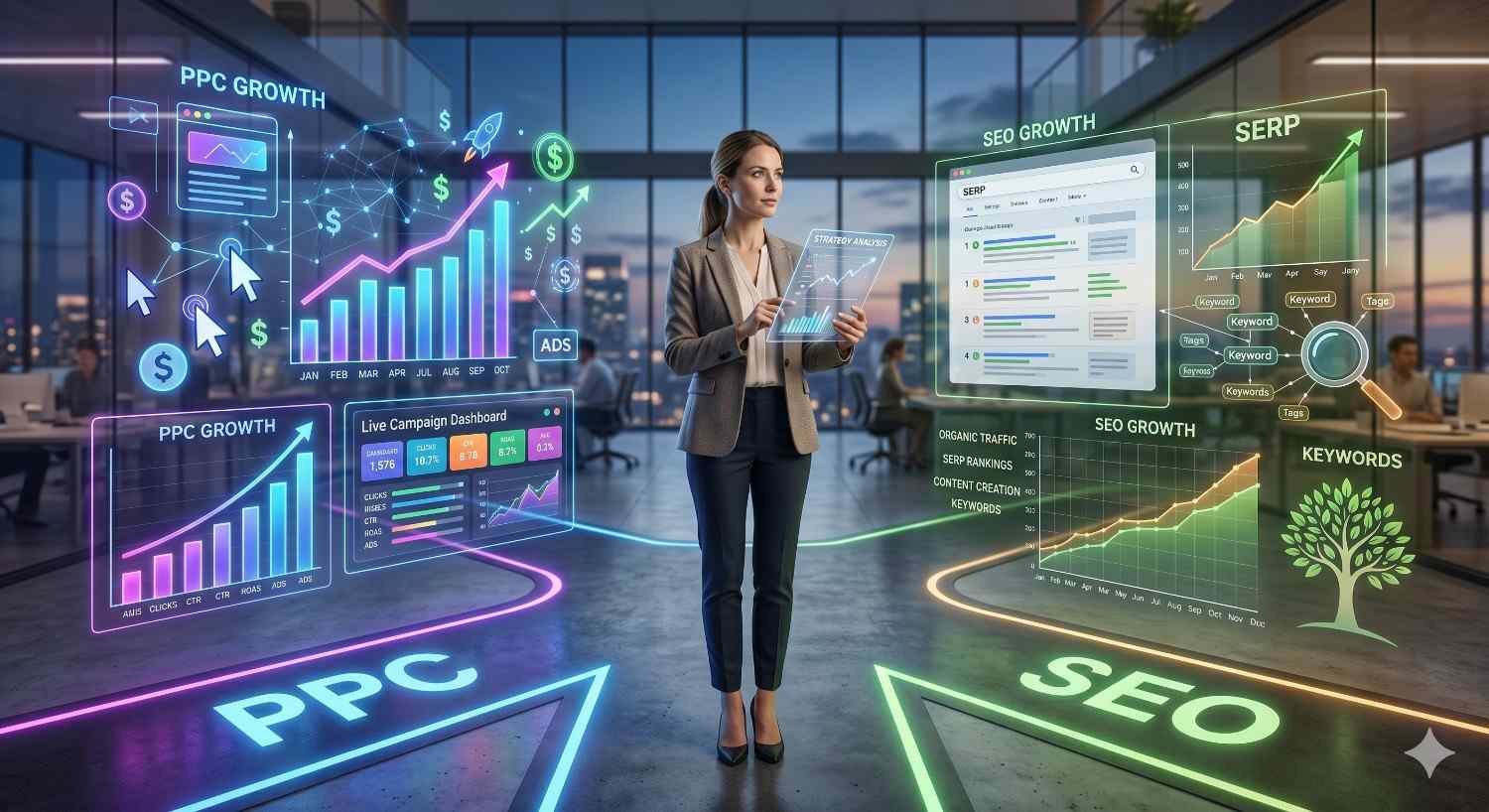
PPC and SEO are the two primary channels for capturing search traffic — but they operate on fundamentally different models, timelines, and cost structures. Understanding the distinction helps businesses allocate budget strategically rather than defaulting to one channel without context.
| Dimension | PPC | SEO |
| Speed of results | Immediate (same day) | Months to years |
| Cost structure | Pay per click (ongoing) | Time and resource investment (compounds) |
| Sustainability | Stops when budget stops | Continues after investment |
| Best for | New sites, launches, competitive markets, time-sensitive offers | Established sites, content-driven growth, long-term ROI |
When PPC Delivers Faster Results
PPC is the stronger choice when speed is the priority. A new website with no organic authority can appear at the top of Google search results on the first day of a campaign. This makes PPC particularly valuable for product launches, where waiting months for organic rankings is not viable. Seasonal campaigns — holiday promotions, limited-time offers, event-driven advertising — benefit from PPC’s ability to activate and deactivate instantly.
In highly competitive markets where organic rankings for target keywords take 12–24 months to achieve, PPC provides immediate visibility while SEO builds in the background. For businesses with a defined conversion goal and a budget to sustain campaigns, PPC can generate measurable ROI within weeks.
When SEO Builds More Sustainable Growth
SEO is the stronger long-term investment for businesses that can afford to wait for results. Organic traffic does not stop when a budget runs out — a well-ranked page continues to generate clicks, leads, and revenue indefinitely. According to BrightEdge research, organic search drives 53% of all website traffic on average, making it the single largest traffic channel for most businesses.
For businesses in industries with high CPCs — legal services, insurance, financial products — the cost of sustaining PPC campaigns long-term can exceed the investment required to build organic authority. SEO compounds: a strong content and link-building strategy built over 12–24 months creates an asset that appreciates in value rather than depleting with each click.
Most businesses benefit from running both channels in parallel — using PPC for immediate visibility and conversion testing while SEO builds sustainable organic authority over time.
For businesses that need sustainable organic growth alongside their paid campaigns, working with a team that understands both channels, our professional SEO services provide the technical foundation, content strategy, and authority building that compound over time while PPC delivers immediate visibility.
Choosing between PPC and SEO, or determining the right budget split between them — depends on your industry, timeline, and growth stage, which is why our PPC vs. SEO comparison guide covers both channels side by side across cost, timeline, scalability, and ROI — with a framework for deciding which to prioritize first.
How to Measure PPC Performance
PPC is one of the most measurable marketing channels available. Every click, impression, conversion, and dollar spent is tracked and reportable in real time through Google Ads and Google Analytics. The challenge for most beginners is not a lack of data — it is knowing which metrics matter and what they indicate about campaign health.
| Metric | What It Measures | Why It Matters |
| Click-Through Rate (CTR) | Clicks / Impressions | Measures ad appeal and relevance |
| Conversion Rate | Conversions / Clicks | Measures landing page effectiveness |
| Cost Per Click (CPC) | Total Cost / Total Clicks | Measures traffic cost efficiency |
| Cost Per Acquisition (CPA) | Total Cost / Total Conversions | Measures conversion cost efficiency |
| Return on Ad Spend (ROAS) | Revenue / Ad Spend | Measures overall campaign profitability |
Click-Through Rate, Conversion Rate, and ROAS
Click-through rate (CTR) is the percentage of users who click your ad after seeing it — calculated as clicks divided by impressions. A higher CTR indicates that your ad is relevant and compelling to the audience seeing it. CTR also directly influences Quality Score, which in turn affects your CPC and ad position.
Conversion rate is the percentage of users who complete a desired action after clicking your ad — calculated as conversions divided by clicks. It measures how effectively your landing page turns traffic into outcomes. A campaign can have a strong CTR but a poor conversion rate, indicating that the ad attracts clicks but the landing page fails to convert.
Return on ad spend (ROAS) is the revenue generated for every dollar spent on advertising — calculated as revenue divided by ad spend. A ROAS of 4 means you generate $4 in revenue for every $1 spent. ROAS is the primary profitability metric for e-commerce campaigns and any business with trackable revenue outcomes.
Cost Per Click and Cost Per Acquisition
Cost per click (CPC) is the average amount you pay for each click on your ad — calculated as total cost divided by total clicks. CPC measures traffic cost efficiency: a lower CPC means you are acquiring traffic more cheaply, though CPC alone does not indicate whether that traffic is converting.
Cost per acquisition (CPA) is the average cost to generate one conversion — calculated as total cost divided by total conversions. CPA is the most important metric for businesses with a defined conversion goal, because it directly answers the question: “How much does it cost me to acquire one customer, lead, or sale?” A CPA below your target margin indicates a profitable campaign; a CPA above it indicates a campaign that needs optimization.
Tracking these metrics is only the first step — understanding what benchmarks to aim for, how to interpret performance trends, and which metrics to prioritize by campaign goal requires a deeper framework, which our PPC metrics and KPIs guide covers in full, including industry benchmarks, reporting cadences, and how to connect campaign data to business revenue.

How Much Does PPC Advertising Cost?
PPC advertising costs vary significantly based on industry, keyword competition, geographic targeting, and campaign quality. There is no single answer to “how much does PPC cost” — but there are reliable ranges and variables that help businesses set realistic expectations before committing budget.
WordStream’s industry benchmark data shows that average Google Ads CPCs range from under $1 in low-competition niches to $50 or more in high-competition industries such as legal services, insurance, and financial products. The average CPC across all industries sits around $2–$4 for search ads. Monthly budgets for small businesses typically range from $500 to $5,000, though this varies widely by industry and campaign scope.
PPC costs are not fixed — they fluctuate based on auction dynamics, seasonality, and competitor behavior. A keyword that costs $2 per click in January may cost $5 in December if competitor bidding increases. Understanding the variables that drive cost is more useful than memorizing a single benchmark figure.
What Affects Your Cost Per Click?
Five primary factors determine your cost per click in any PPC campaign:
- Keyword competition: More advertisers bidding on the same keyword drives up the auction price.
- Quality Score: Higher relevance lowers your CPC — Google rewards well-structured, relevant campaigns with lower costs.
- Industry: Legal, financial, and insurance keywords consistently carry the highest CPCs due to high customer lifetime value.
- Geographic targeting: Ads targeting high-cost metropolitan areas typically cost more than those targeting smaller markets.
- Device targeting: CPCs often differ between desktop and mobile, depending on where your audience converts.
Setting a realistic PPC budget requires understanding your industry’s average CPC, your target CPA, and how much traffic volume you need to generate meaningful results, our PPC advertising costs and budgeting guide breaks down cost benchmarks by industry, explains how to calculate a starting budget, and shows how to scale spend profitably as campaigns mature.
Common PPC Mistakes Beginners Make
Most PPC budget waste is preventable. The mistakes that drain campaigns are not random — they follow predictable patterns that beginners encounter repeatedly. Knowing what to watch for before launching a campaign is significantly more cost-effective than discovering these errors after weeks of wasted spend.
The most common PPC mistakes include:
- Using broad match keywords without negative keyword lists: Broad match triggers ads for loosely related searches, many of which are irrelevant. Without negative keywords to filter out poor-fit queries, budget is consumed by clicks that will never convert.
- Sending traffic to a generic homepage: A homepage is designed for multiple audiences and purposes. A PPC landing page should match the specific intent of the ad — sending paid traffic to a homepage typically results in high bounce rates and low conversion rates.
- Not setting up conversion tracking: Without conversion tracking, there is no way to know which keywords, ads, or campaigns are generating results. Running PPC without conversion tracking is equivalent to spending money without knowing what it produces.
- Failing to test ad copy: Running a single ad variation with no testing means leaving performance improvements undiscovered. Even small improvements in CTR compound significantly over time.
- Ignoring search term reports: The search term report shows the actual queries that triggered your ads. Reviewing it regularly reveals irrelevant traffic, new negative keyword opportunities, and new keyword ideas.
- Setting and forgetting campaigns: PPC campaigns require ongoing optimization. Bids, budgets, ad copy, and targeting all need regular review as market conditions, competitor behavior, and Quality Scores change.
Structural and Strategic Errors That Waste Budget
PPC mistakes fall into two categories. Structural mistakes involve poor campaign architecture: incorrect match types, missing negative keywords, disorganized ad groups, and campaigns that mix unrelated keywords. These errors cause irrelevant traffic and poor Quality Scores, which raise CPCs and lower ad positions.
Strategic mistakes involve higher-level decisions: choosing the wrong platform for the audience, targeting too broad a geographic area, setting unrealistic budgets relative to CPC levels, or launching campaigns without a clear conversion goal. Strategic errors are often more expensive than structural ones because they affect the entire campaign direction rather than individual keywords or ads.
Each of these mistakes has a specific fix — and catching them early can save thousands in wasted ad spend, which is why our guide to avoiding PPC mistakes covers the full list of structural and strategic errors, explains why each happens, and provides the exact corrective steps to take before launching or auditing any campaign.
Is PPC Marketing Right for Your Business?
PPC is not the right channel for every business at every stage. It is most effective when specific conditions are in place — and understanding those conditions before committing budget prevents costly misalignment between channel and business readiness.
PPC is likely the right fit if you have a defined conversion goal (a product purchase, a form submission, a phone call), a landing page designed to convert paid traffic, a budget that can sustain campaigns long enough to gather meaningful data (typically 60–90 days minimum), and a market where users are actively searching for what you offer. Businesses entering competitive markets where organic rankings take 12–24 months to achieve, or those running time-sensitive promotions, are particularly well-positioned to benefit from PPC’s immediacy.
PPC may not be the right first step if your profit margins are too thin to absorb the cost of clicks before conversion rates are optimized, if you have no landing page infrastructure in place, or if conversion tracking has not been configured. Launching PPC without these foundations in place means paying for data you cannot act on.
A practical self-assessment framework:
- Do you have a specific, measurable conversion goal? (Yes / No)
- Do you have a dedicated landing page for paid traffic? (Yes / No)
- Do you have conversion tracking configured in Google Ads and Google Analytics? (Yes / No)
- Can you sustain a minimum monthly budget for 60–90 days? (Yes / No)
- Are users actively searching for your product or service on Google? (Yes / No)
If you answered yes to four or five of these questions, PPC is likely a viable channel for your business. If you answered no to three or more, addressing those gaps first will significantly improve your results when you do launch.
If you are ready to explore whether PPC, SEO, or a combined strategy is the right fit for your growth goals, the White Label SEO Service team can assess your current position, competitive landscape, and budget to build a channel strategy that delivers measurable, sustainable results.
Conclusion
PPC marketing is a performance-based digital advertising model built on four interconnected components — keyword targeting, ad copy, landing pages, and bidding strategies — operating across search, display, social, shopping, and video channels through an automated auction system that rewards relevance as much as budget.
Understanding PPC at this foundational level opens the door to every deeper resource in this guide — from auction mechanics and campaign structure to platform selection, performance measurement, and cost management — each of which has a dedicated spoke covering the full strategic and tactical detail.
At White Label SEO Service, we help businesses build channel strategies that combine the immediacy of PPC with the compounding returns of SEO — contact our team to find out which approach fits your growth stage, budget, and competitive landscape.
Frequently Asked Questions
What does PPC stand for in marketing?
PPC stands for pay-per-click. It is a digital advertising model in which advertisers pay a fee each time a user clicks on their ad, rather than paying for impressions or reach.
How does a PPC auction work?
When a user enters a search query, Google runs an automated auction among advertisers bidding on matching keywords. Each advertiser’s Ad Rank — determined by their bid and Quality Score — decides which ads appear and in what order.
What is a good cost per click for PPC?
A good CPC depends on your industry and conversion rate. Average Google Ads CPCs range from under $1 in low-competition niches to $50 or more in legal and financial services. The right CPC is one that keeps your cost per acquisition below your target margin.
What is the difference between PPC and SEO?
PPC delivers immediate paid traffic by charging per click, while SEO builds organic rankings over time without per-click costs. PPC stops generating traffic when budget runs out; SEO traffic compounds and continues after the initial investment.
How long does it take to see results from PPC?
PPC can generate traffic and conversions on the same day a campaign launches. However, meaningful performance data — enough to optimize bids, copy, and targeting — typically requires 60–90 days of consistent campaign activity.
What is Quality Score in Google Ads?
Quality Score is Google’s 1–10 rating of the relevance of your keywords, ads, and landing pages. A higher Quality Score lowers your cost per click and improves your ad position, rewarding advertisers who build tightly relevant campaigns.
How much should a small business spend on PPC?
Most small businesses start with a monthly PPC budget between $500 and $2,000, depending on industry CPC levels and campaign goals. The minimum viable budget is one that generates enough clicks to produce statistically meaningful conversion data — typically 100 or more clicks per month per campaign.