

White label SEO services allow agencies to resell expert-level search optimization under their own brand—without building an in-house team. This partnership model has transformed how digital marketing agencies, web developers, and consultants deliver SEO results while maintaining healthy profit margins.
Whether you’re exploring white label SEO to expand service offerings or seeking ways to scale your existing client base, understanding the complete landscape matters. This guide covers everything from pricing structures and provider selection to implementation workflows and advanced scaling strategies that drive sustainable agency growth.

What Is White Label SEO?
White label SEO is a business arrangement where a specialized SEO provider delivers services that another company rebrands and sells as their own. The end client never knows a third party performed the work. Your agency maintains full client ownership while leveraging external expertise for execution.
Think of it like private-label products in retail. A manufacturer produces goods that retailers sell under their own brand names. In white label SEO, the “manufacturer” handles technical audits, content creation, link building, and reporting—all delivered with your agency’s branding, logo, and communication style.
This model differs fundamentally from traditional outsourcing because the relationship remains invisible to your clients. You’re not simply hiring contractors; you’re accessing a complete fulfillment infrastructure designed specifically for resale.
How White Label SEO Differs from Outsourcing
Traditional outsourcing involves hiring external help for specific tasks while maintaining visibility of that relationship. Your client might know you work with freelancers or contractors. White label SEO operates under complete confidentiality.
Key distinctions include:
The branding element separates these models most clearly. Outsourced work often arrives with the contractor’s watermarks, templates, or communication styles. White label providers deliver everything customized to your brand—reports feature your logo, emails come from your domain, and all client-facing materials reflect your agency identity.
Accountability structures also differ significantly. Outsourced contractors typically work project-to-project with limited integration into your processes. White label partners function as an extension of your team, following your workflows, meeting your deadlines, and maintaining your quality standards consistently.
The scalability factor matters too. Outsourcing requires finding, vetting, and managing multiple contractors as you grow. White label providers offer built-in capacity to handle increased volume without additional recruitment on your end.
The White Label SEO Business Model Explained
The white label model operates through a three-party structure that creates value for everyone involved. Understanding this dynamic helps you maximize the arrangement’s potential.
Your agency serves as the client-facing entity. You handle sales, account management, strategy discussions, and relationship building. Your brand reputation stays front and center throughout the engagement.
The white label provider manages execution. They employ SEO specialists, content writers, link builders, and technical experts who perform the actual optimization work. Their infrastructure, tools, and processes power the deliverables.
Your clients receive professional SEO services without knowing about the provider relationship. They experience your agency’s expertise, communication, and results—building loyalty to your brand specifically.
Revenue flows from client to agency to provider, with your agency capturing the margin between what clients pay and what the provider charges. This spread typically ranges from 30% to 100% markup depending on service type, client size, and competitive positioning.
Who Should Use White Label SEO Services?
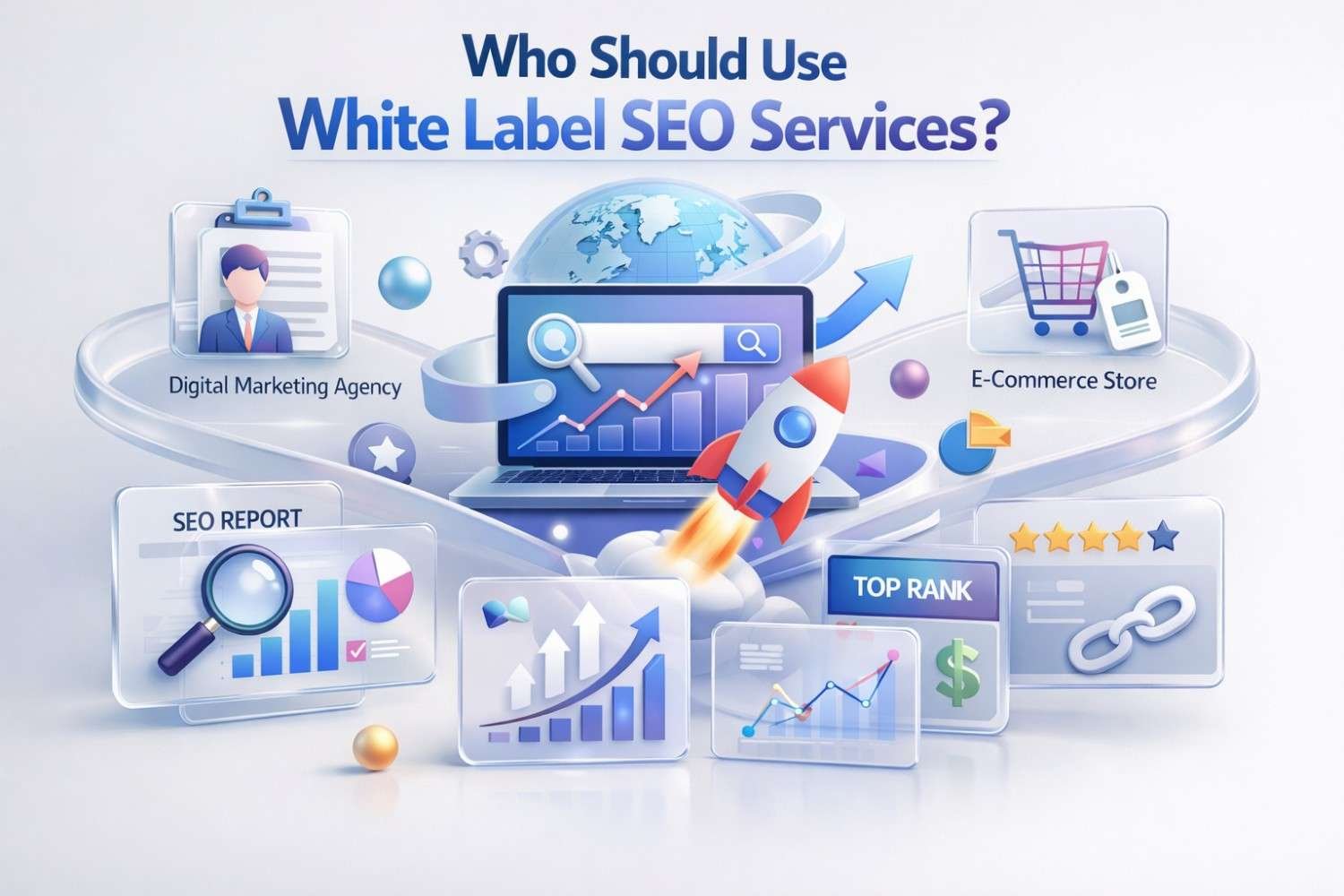
White label SEO serves organizations that want to offer search optimization without building dedicated internal capabilities. The model works particularly well for companies already serving clients who need SEO but lack the specialized expertise or capacity to deliver it themselves.
Digital Marketing Agencies
Marketing agencies represent the largest white label SEO customer segment. These firms typically offer services like paid advertising, social media management, email marketing, and branding—but clients increasingly expect SEO as part of comprehensive digital strategies.
Building an in-house SEO team requires significant investment. You need technical specialists, content strategists, link builders, and analysts. Training takes months. Tool subscriptions add up quickly. White label partnerships let agencies add SEO to their service menu immediately while maintaining focus on core competencies.
Agencies also benefit from the expertise depth white label providers offer. SEO evolves constantly with algorithm updates, new ranking factors, and shifting best practices. Dedicated providers stay current because SEO is their entire business—not just one service among many.
Web Design & Development Companies
Web development firms encounter SEO requests constantly. Clients understand that beautiful websites mean nothing without traffic. Yet most development teams lack SEO expertise beyond basic technical implementation.
White label SEO creates natural upsell opportunities for development companies. After launching a new site, you can offer ongoing optimization services that drive traffic to the investment clients just made. This extends client relationships beyond one-time projects into recurring revenue streams.
The technical foundation developers provide also makes SEO implementation smoother. Clean code, proper site architecture, and mobile responsiveness give white label providers a strong starting point for optimization work.
PR & Communications Firms
Public relations agencies increasingly compete with digital marketing firms for client budgets. Executives want measurable results, and organic search visibility delivers quantifiable outcomes that traditional PR metrics sometimes lack.
White label SEO helps PR firms demonstrate digital impact alongside media placements. Link building campaigns complement earned media strategies. Content optimization ensures press coverage and thought leadership pieces actually rank for relevant searches.
The content creation capabilities PR teams possess also align well with SEO requirements. White label providers can optimize existing PR content while agencies continue producing the strategic messaging they excel at.
Freelance Marketing Consultants
Independent consultants face unique scaling challenges. You can only bill for hours you personally work, creating income ceilings that limit growth. White label SEO transforms consultants into agency-like operations without hiring employees.
Freelancers gain the ability to take on larger clients requiring comprehensive services. Instead of referring SEO work elsewhere—and losing that revenue—consultants can fulfill requests while maintaining client relationships.
The model also provides backup capacity during busy periods. Rather than turning away work or burning out, consultants can route overflow to white label partners while focusing on high-value strategic activities.

SaaS Companies Offering Marketing Tools
Software companies serving marketers often receive requests for done-for-you services. Customers want the results their tools promise but lack time or expertise to execute strategies themselves.
White label SEO lets SaaS companies offer managed services alongside their platforms. This creates additional revenue streams, increases customer lifetime value, and reduces churn by delivering outcomes rather than just capabilities.
The data these platforms generate also enhances white label SEO effectiveness. Providers can leverage tool insights to inform strategy, creating tighter integration between software and services.
Benefits of White Label SEO for Agencies
The advantages of white label SEO extend beyond simple convenience. Strategic use of these partnerships can fundamentally transform agency economics, capabilities, and competitive positioning.
Scale Your Agency Without Hiring
Traditional agency growth requires proportional headcount increases. More clients mean more employees, which means more management overhead, office space, benefits, and HR complexity. White label SEO breaks this linear relationship.
With white label partnerships, your capacity expands on demand. Taking on five new SEO clients doesn’t require hiring five new specialists. The provider absorbs fulfillment volume while you focus on sales and account management—the activities that actually drive growth.
This scalability proves especially valuable during growth spurts. Agencies often win multiple clients simultaneously through referrals or successful pitches. White label providers can ramp up immediately rather than forcing you to delay onboarding while recruiting.
Reduce Operational Costs by 40-60%
The fully-loaded cost of in-house SEO talent significantly exceeds base salaries. Factor in benefits, payroll taxes, training, tools, management time, and overhead allocation—and each SEO specialist costs far more than their compensation suggests.
White label pricing typically runs 40-60% below equivalent in-house costs. Providers achieve efficiency through specialization, scale, and geographic arbitrage. They spread tool costs across many clients, develop streamlined processes, and often operate in lower-cost markets.
These savings flow directly to your bottom line or enable more competitive client pricing. Either way, the economic advantage compounds as you scale—making white label increasingly attractive for growing agencies.
Access Expert-Level SEO Talent Instantly
Finding qualified SEO professionals remains challenging. The field evolves rapidly, creating skill gaps even among experienced practitioners. Truly expert-level talent commands premium compensation and often prefers in-house roles at major brands.
White label providers aggregate specialized talent you couldn’t access individually. Their teams include technical SEO architects, content strategists, link building specialists, and analytics experts—each focused on their specific discipline rather than generalist roles.
This expertise depth translates to better client results. Specialists outperform generalists on complex challenges. Your clients benefit from expert execution while your agency captures the relationship value.
Expand Service Offerings Overnight
Adding new services traditionally requires months of preparation. You need to hire specialists, develop processes, create deliverable templates, and build case studies before confidently selling new capabilities.
White label partnerships compress this timeline dramatically. Providers already have established processes, proven methodologies, and track records you can leverage. Your agency can begin selling comprehensive SEO services within days of signing a partnership agreement.
This speed matters competitively. When clients request services you don’t currently offer, the ability to say “yes” immediately—rather than “we’re building that capability”—wins business and strengthens relationships.
Improve Client Retention Rates
Client churn devastates agency economics. Acquiring new clients costs significantly more than retaining existing ones. SEO services create natural retention advantages through their ongoing nature and compounding results.
Unlike project-based work that concludes, SEO requires continuous effort. Rankings need maintenance. Content needs updating. Link profiles need building. This ongoing requirement creates recurring revenue relationships that extend client lifetime value.
The results SEO delivers also build switching costs. Clients who achieve strong rankings through your agency face real risks in changing providers. This performance-based loyalty strengthens retention beyond contractual obligations.
Focus on Core Business & Client Relationships
Agency principals often find themselves pulled into fulfillment work that distracts from higher-value activities. When you’re personally optimizing meta tags or reviewing link prospects, you’re not selling, strategizing, or building relationships.
White label SEO frees leadership time for activities that actually grow the business. Client acquisition, strategic planning, partnership development, and team leadership deserve executive attention—not task-level execution.
This focus improvement often generates returns exceeding the direct cost savings. An agency owner spending 20 hours weekly on fulfillment could redirect that time toward business development activities with far higher ROI.
Mitigate Business Risk
Concentrating SEO capabilities in a small internal team creates vulnerability. Key employee departures can devastate client delivery. Skill gaps in specific areas limit the clients you can serve effectively.
White label providers distribute this risk across larger teams with redundant capabilities. If one specialist leaves, others continue delivering. If a particular project requires unusual expertise, the provider’s broader team likely includes relevant experience.
The financial risk profile also improves. Fixed employee costs become variable expenses that scale with revenue. During slow periods, you’re not carrying payroll for underutilized staff. During growth phases, you’re not scrambling to hire fast enough.
How White Label SEO Works (Step-by-Step)
Understanding the operational mechanics of white label SEO helps you implement partnerships effectively. The process follows predictable stages from provider selection through ongoing optimization.
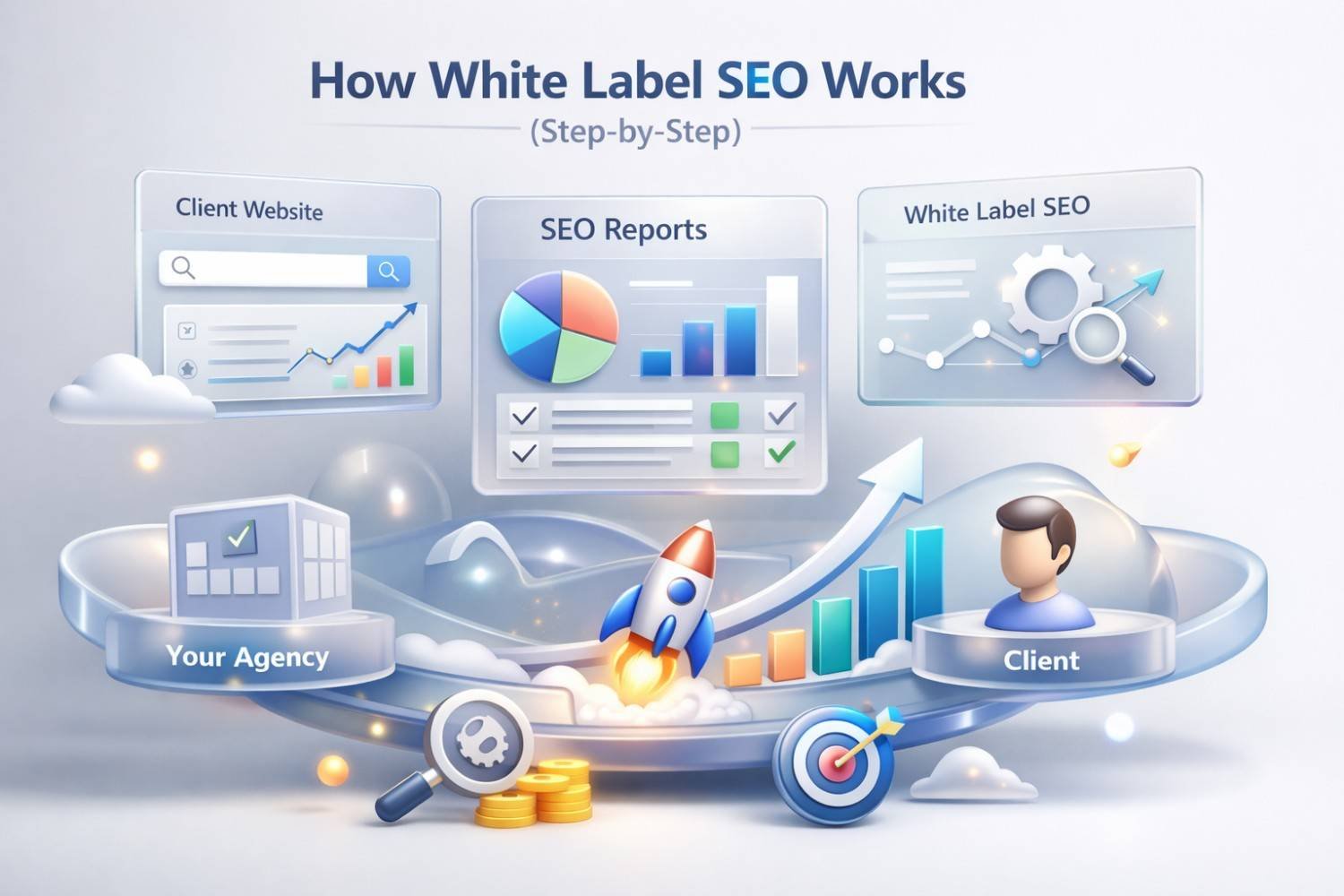
The Three-Party Model
Every white label SEO engagement involves three distinct parties with specific roles and responsibilities. Clarity about these roles prevents confusion and ensures smooth operations.
Your agency owns the client relationship entirely. You handle sales conversations, contract negotiations, strategic discussions, and ongoing communication. Clients view you as their SEO provider—because functionally, you are.
The white label provider handles execution and fulfillment. They perform technical audits, create content, build links, generate reports, and implement optimizations. Their work appears under your brand throughout.
Your client receives SEO services and results. They interact exclusively with your agency, receive your branded deliverables, and build loyalty to your organization. The provider relationship remains invisible.
Communication flows through your agency as the central hub. Clients never contact providers directly. Providers never reach out to clients independently. You maintain complete control over the relationship and messaging.
Step 1: Finding the Right Provider
Provider selection determines partnership success more than any other factor. The evaluation process should be thorough, structured, and focused on long-term fit rather than just pricing.
Start by defining your requirements clearly. What services do you need? What volume do you anticipate? What quality standards must providers meet? What communication expectations exist? Document these criteria before beginning your search.
Research potential providers through multiple channels. Industry directories, peer recommendations, conference connections, and online reviews all provide useful signals. Create a shortlist of 5-10 candidates for deeper evaluation.
Request detailed information from shortlisted providers. Ask for case studies, sample deliverables, process documentation, and client references. Evaluate their communication responsiveness during this phase—it predicts future partnership dynamics.
Step 2: Onboarding Your First Client
The initial client engagement establishes patterns that persist throughout the partnership. Invest extra attention in this phase to build strong foundations.
Gather comprehensive client information before engaging your provider. Business goals, target audiences, competitive landscape, existing assets, and historical performance data all inform strategy development. The more context you provide, the better results you’ll achieve.
Communicate client expectations clearly to your provider. Deadlines, deliverable formats, communication preferences, and success metrics should be explicit from the start. Ambiguity creates problems that compound over time.
Establish review and approval workflows before work begins. Who reviews deliverables? What turnaround times apply? How do revision requests work? Defining these processes prevents delays and frustration later.
Step 3: Strategy Development & Approval
Effective SEO requires strategic foundations before tactical execution. White label providers should develop comprehensive strategies that you review and approve before implementation begins.
Strategy documents typically include competitive analysis, keyword research, technical audit findings, content recommendations, and link building approaches. Review these materials carefully—they guide all subsequent work.
Provide feedback and request revisions as needed. Your understanding of the client’s business, industry, and preferences adds value that providers can’t replicate. Collaborative strategy development produces better outcomes than passive acceptance.
Present strategies to clients for their input and approval. This step ensures alignment with business objectives and surfaces any concerns before significant work begins. Client buy-in improves cooperation throughout the engagement.
Step 4: Campaign Execution
With strategy approved, providers begin implementation work. This phase involves the actual optimization activities that drive results.
Technical SEO work typically starts first. Site audits identify issues requiring attention. Fixes improve crawlability, indexation, and technical performance. These foundational improvements enable other optimization efforts to succeed.
Content creation and optimization follow technical work. New pages target identified keyword opportunities. Existing content receives updates improving relevance and comprehensiveness. Internal linking structures strengthen topical authority.
Link building campaigns build external authority over time. Outreach efforts secure placements on relevant websites. Digital PR generates coverage and mentions. These activities compound gradually, producing results over months rather than days.
Step 5: Reporting & Client Communication
Regular reporting maintains client confidence and demonstrates value. White label providers generate reports that you customize and present to clients.
Establish reporting cadences that match client expectations. Monthly reports work for most engagements, though some clients prefer weekly updates or quarterly strategic reviews. Consistency matters more than frequency.
Review provider reports before client delivery. Add context, insights, and recommendations that reflect your understanding of the client’s business. This value-add differentiates your agency from providers who simply pass through generic reports.
Schedule regular client calls to discuss results and plans. Written reports provide documentation, but conversations build relationships. Use reporting as an opportunity for strategic discussions, not just data delivery.
Step 6: Ongoing Optimization & Scaling
SEO success requires continuous refinement based on performance data. Initial strategies evolve as results reveal what works and what needs adjustment.
Monitor key metrics consistently. Rankings, traffic, conversions, and engagement data all inform optimization decisions. Share performance insights with providers to guide their ongoing work.
Request strategy adjustments when data suggests changes. Keyword targets may shift based on competitive dynamics. Content priorities may evolve as some topics outperform others. Link building approaches may need refinement based on acquisition success rates.
Scale successful engagements by expanding scope. Clients achieving results often want more—additional keywords, new content types, expanded link building. White label partnerships accommodate this growth without proportional agency investment.
Complete List of White Label SEO Services
White label providers offer comprehensive service menus covering all aspects of search optimization. Understanding available services helps you match client needs with appropriate solutions.
Technical SEO Services
Technical SEO ensures search engines can effectively crawl, index, and understand websites. These foundational services enable all other optimization efforts to succeed.
Site Audits & Crawl Analysis
Comprehensive site audits identify technical issues affecting search performance. Crawl analysis reveals how search engines experience websites—including errors, warnings, and optimization opportunities.
Audit deliverables typically include prioritized issue lists, implementation recommendations, and benchmark metrics. Regular audits track progress and identify new issues as sites evolve.
Site Speed Optimization
Page speed directly impacts rankings and user experience. Speed optimization involves image compression, code minification, caching implementation, and server configuration improvements.
Providers analyze Core Web Vitals metrics and implement fixes addressing specific performance bottlenecks. Mobile speed receives particular attention given Google’s mobile-first indexing approach.
Mobile Optimization
Mobile-first indexing means Google primarily uses mobile versions of pages for ranking and indexing. Mobile optimization ensures sites perform well on smartphones and tablets.
This work includes responsive design verification, mobile usability testing, and touch-friendly interface improvements. Providers identify and fix mobile-specific issues that desktop testing might miss.
Schema Markup Implementation
Structured data helps search engines understand page content and enables rich results in search listings. Schema markup implementation adds this machine-readable context to websites.
Common schema types include Organization, LocalBusiness, Product, Article, FAQ, and HowTo. Proper implementation can significantly improve click-through rates from search results.
On-Page SEO Services
On-page optimization improves individual page relevance for target keywords. These services directly influence how search engines understand and rank specific content.
Keyword Research & Mapping
Effective SEO starts with understanding what audiences search for. Keyword research identifies valuable terms with appropriate search volume and competition levels.
Keyword mapping assigns target terms to specific pages, ensuring comprehensive coverage without internal competition. This strategic foundation guides all subsequent content and optimization work.
Meta Tag Optimization
Title tags and meta descriptions influence both rankings and click-through rates. Optimization involves crafting compelling, keyword-relevant tags for all important pages.
Providers analyze existing tags, identify improvement opportunities, and create optimized versions following current best practices. Ongoing monitoring ensures tags remain effective as search landscapes evolve.
Content Optimization
Existing content often underperforms due to optimization gaps. Content optimization improves relevance, comprehensiveness, and user experience for target keywords.
This work includes keyword integration, heading structure improvements, readability enhancements, and multimedia additions. Optimized content typically sees ranking improvements within weeks of implementation.
Internal Linking Strategy
Internal links distribute authority throughout websites and help search engines understand content relationships. Strategic internal linking improves rankings for important pages.
Providers analyze existing link structures, identify opportunities, and implement improvements. Anchor text optimization and link placement both receive attention in comprehensive strategies.
Off-Page SEO Services
Off-page optimization builds external signals that influence search rankings. These activities occur outside your client’s website but significantly impact their search visibility.
Link Building Campaigns
Backlinks remain among the strongest ranking factors. Link building campaigns secure placements on relevant, authoritative websites that pass ranking value.
Quality matters more than quantity in modern link building. Providers focus on earning links from topically relevant sites with genuine authority—avoiding manipulative tactics that risk penalties.
Digital PR
Digital PR generates coverage, mentions, and links through newsworthy content and media outreach. This approach builds brand awareness while earning valuable backlinks.
Campaigns might include data studies, expert commentary, newsjacking, and resource creation. The resulting coverage often produces links from high-authority news and industry publications.
Brand Mention Monitoring
Unlinked brand mentions represent link building opportunities. Monitoring identifies when clients are mentioned without corresponding links, enabling outreach to convert mentions into backlinks.
Providers track mentions across web, social, and news sources. Systematic outreach converts a meaningful percentage of unlinked mentions into valuable backlinks.
Content Services
Content fuels SEO success. White label content services provide the articles, pages, and assets that attract search traffic and earn backlinks.
Blog Content Creation
Regular blog publishing builds topical authority and targets long-tail keywords. White label providers create optimized articles matching client voice and quality standards.
Content calendars ensure consistent publishing. Topic selection aligns with keyword research and audience interests. Quality control processes maintain standards across high-volume production.
Landing Page Copywriting
Conversion-focused landing pages require different approaches than informational content. Landing page copywriting balances SEO optimization with persuasive messaging that drives action.
Providers create pages targeting commercial keywords while incorporating conversion elements like clear value propositions, social proof, and compelling calls-to-action.
Content Strategy Development
Effective content requires strategic planning beyond individual piece creation. Content strategy development defines topics, formats, publishing cadences, and success metrics.
Strategies align content efforts with business objectives and keyword opportunities. Competitive analysis identifies gaps and opportunities in client content landscapes.
Local SEO Services
Local SEO helps businesses appear in location-based searches. These services prove essential for clients serving geographic markets.
Google Business Profile Management
Google Business Profiles significantly influence local search visibility. Management services optimize profiles, maintain accurate information, and leverage available features.
Providers handle category selection, attribute optimization, photo uploads, post publishing, and Q&A management. Regular attention ensures profiles remain competitive and accurate.
Citation Building
Local citations—mentions of business name, address, and phone number—influence local rankings. Citation building establishes consistent listings across relevant directories.
Providers identify appropriate directories, create optimized listings, and ensure NAP consistency. Ongoing monitoring catches and corrects inaccuracies that could harm rankings.
Review Management
Reviews impact both rankings and conversion rates. Review management services help clients generate more reviews and respond appropriately to feedback.
Strategies include review request automation, response templates, and reputation monitoring. Providers help clients build review profiles that support both SEO and business objectives.
Reporting & Analytics Services
Data-driven SEO requires robust reporting and analytics capabilities. White label providers deliver insights that demonstrate value and guide optimization decisions.
Reports typically cover rankings, traffic, conversions, and technical health. Customization options allow agencies to emphasize metrics most relevant to specific clients.
Analytics setup ensures proper tracking configuration. Goal tracking, event measurement, and attribution modeling provide the data foundation for meaningful reporting.
White Label SEO Pricing: What to Expect
Understanding white label SEO economics helps you price services profitably while remaining competitive. Pricing structures vary significantly across providers and service types.
Common Pricing Models Explained
White label providers offer several pricing structures, each with distinct advantages and considerations. Selecting the right model depends on your business needs and client relationships.
Monthly Retainer Pricing
Retainer arrangements provide ongoing services for fixed monthly fees. This model offers predictable costs and consistent service delivery.
Retainers typically include defined service scopes—specific deliverables, hour allocations, or activity levels. Pricing usually ranges from $500 to $5,000+ monthly depending on scope and provider positioning.
The retainer model works well for ongoing SEO engagements requiring consistent attention. Predictable costs simplify client pricing and agency financial planning.
Per-Project Pricing
Project-based pricing charges fixed fees for defined deliverables. This model suits one-time needs like site audits, content batches, or technical implementations.
Project pricing provides cost certainty for specific outcomes. Clients know exactly what they’ll pay for defined deliverables. Agencies can mark up project fees with clear margin visibility.
This model works less well for ongoing optimization requiring continuous attention. SEO success typically requires sustained effort rather than one-time projects.
Hourly Rate Pricing
Hourly billing charges for actual time spent on client work. This model offers flexibility but creates cost uncertainty.
Hourly rates typically range from $50 to $200+ depending on provider expertise and location. The model suits variable-scope work where requirements evolve unpredictably.
Agencies often prefer converting hourly provider costs into fixed client pricing. This approach captures efficiency gains while providing clients with cost predictability.
Performance-Based Pricing
Performance models tie compensation to results achieved. Providers might charge based on rankings achieved, traffic generated, or leads produced.
This model aligns provider incentives with client outcomes. However, SEO’s complexity and external factors make pure performance pricing challenging to implement fairly.
Hybrid approaches combining base fees with performance bonuses often work better than purely results-based arrangements.
Average Costs by Service Type
White label SEO costs vary significantly by service type, provider quality, and geographic factors. Understanding typical ranges helps you evaluate proposals and set client pricing.
Technical SEO audits typically cost $300-$1,500 depending on site size and complexity. Comprehensive audits with detailed recommendations command premium pricing.
Monthly SEO retainers range from $500-$5,000+ for white label fulfillment. Entry-level packages cover basic optimization while premium tiers include comprehensive services.
Content creation costs $0.10-$0.50+ per word for quality SEO content. Specialized topics, research requirements, and expertise levels influence pricing.
Link building ranges from $100-$1,000+ per link depending on target site authority and acquisition difficulty. Quality links from authoritative sites command significant premiums.
Local SEO packages typically run $300-$1,000 monthly for comprehensive local optimization including GBP management, citations, and review support.
What Affects Cost
Multiple factors influence white label SEO pricing beyond basic service selection. Understanding these variables helps you evaluate proposals accurately.
Provider expertise and reputation significantly impact pricing. Established providers with strong track records charge premiums reflecting their demonstrated capabilities.
Geographic location affects costs through labor market differences. Providers in lower-cost regions often offer competitive pricing while maintaining quality standards.
Service scope and customization influence pricing. Standardized packages cost less than highly customized approaches requiring additional planning and coordination.
Volume commitments often unlock discounts. Providers offer better rates for agencies committing to minimum monthly volumes or long-term contracts.
Turnaround requirements affect pricing. Rush work commands premiums while flexible timelines may qualify for discounts.

How to Price White Label SEO for Your Clients
Client pricing requires balancing competitiveness with profitability. Several approaches help agencies find optimal price points.
Cost-plus pricing adds fixed markups to provider costs. This straightforward approach ensures minimum margins but may leave money on the table.
Value-based pricing charges based on client outcomes rather than provider costs. This approach captures more value when delivering significant results.
Competitive pricing aligns with market rates regardless of costs. This approach requires understanding local market dynamics and competitor positioning.
Tiered packaging offers good-better-best options at different price points. This approach captures different client segments while simplifying sales conversations.
Markup Strategies for Maximum Profit
Markup optimization significantly impacts agency profitability. Strategic approaches capture more value without pricing yourself out of markets.
Standard markups typically range from 50-100% on white label costs. A $1,000 provider cost becomes $1,500-$2,000 client pricing.
Value-based premiums justify higher markups for high-impact services. Link building and content often support larger markups than technical work.
Bundled pricing combines services into packages with blended margins. Lower-margin services offset by higher-margin components improve overall profitability.
Retainer structures often support better margins than project pricing. Ongoing relationships justify premium positioning versus one-time engagements.
ROI Expectations
Understanding realistic ROI timelines helps set appropriate client expectations. SEO delivers compounding returns over time rather than immediate results.
Initial results typically appear within 3-6 months for most engagements. Technical improvements and content optimization produce early wins while link building compounds gradually.
Significant traffic growth usually requires 6-12 months of consistent effort. Competitive keywords take longer while less contested terms may rank faster.
Full ROI realization often takes 12-24 months for comprehensive SEO programs. The investment nature of SEO means patience produces the best returns.
Setting realistic expectations prevents client frustration and supports retention. Agencies that overpromise early results often face difficult conversations later.
How to Choose the Best White Label SEO Provider
Provider selection determines partnership success more than any other decision. Systematic evaluation processes identify partners aligned with your needs and standards.
Essential Criteria Checklist
Evaluate potential providers against comprehensive criteria covering capabilities, processes, and fit factors.
Service capabilities must match your client needs. Verify providers offer all services you plan to resell with appropriate depth and quality.
Communication responsiveness predicts partnership dynamics. Providers slow to respond during sales processes often remain slow after signing.
Reporting capabilities should meet your branding and customization requirements. Review sample reports to verify quality and flexibility.
Scalability matters for growing agencies. Confirm providers can handle increased volume without quality degradation.
Pricing transparency prevents surprises. Clear pricing structures without hidden fees support accurate client quoting.
Contract flexibility protects your interests. Avoid long-term commitments until partnerships prove successful.
Questions to Ask Before Signing
Direct questions reveal important information that marketing materials may obscure. Ask potential providers these key questions.
“What is your team structure and who will work on my accounts?” Understanding staffing helps assess capability and consistency.
“How do you handle communication and what response times can I expect?” Clear expectations prevent frustration later.
“Can you provide references from similar agencies?” Speaking with current clients reveals real partnership dynamics.
“What happens if I’m unsatisfied with deliverable quality?” Understanding revision and escalation processes matters.
“How do you stay current with SEO changes and algorithm updates?” Ongoing education indicates commitment to quality.
“What tools and technologies do you use?” Tool access and capabilities affect deliverable quality.
Red Flags to Watch Out For
Warning signs during evaluation often predict partnership problems. Watch for these concerning indicators.
Guaranteed rankings promises indicate either dishonesty or risky tactics. No provider can guarantee specific positions given search algorithm complexity.
Unusually low pricing often reflects quality compromises. Sustainable SEO requires real expertise and effort that costs money.
Vague processes suggest disorganization. Quality providers explain their methodologies clearly and confidently.
Poor communication during sales predicts worse communication after signing. Responsiveness matters throughout partnerships.
No references available raises questions about track record. Established providers should have satisfied clients willing to speak.
Pressure tactics indicate desperation. Quality providers confident in their value don’t need high-pressure sales approaches.
How to Evaluate Quality & Track Record
Assessing provider quality requires looking beyond marketing claims to actual evidence of capability and results.
Case studies demonstrate real results achieved for real clients. Look for specific metrics, timelines, and methodologies rather than vague success claims.
Sample deliverables reveal actual quality levels. Request examples of audits, content, reports, and other deliverables you’ll receive.
Client references provide unfiltered feedback. Ask references about communication, quality, responsiveness, and overall satisfaction.
Online reviews offer additional perspectives. Check industry directories, Google reviews, and social media for client feedback.
Team credentials indicate expertise levels. Review team member backgrounds, certifications, and experience.
Testing with a Trial Project
Trial engagements reduce risk by demonstrating actual partnership dynamics before major commitments.
Start small with a limited-scope project. A single audit, content batch, or one-month retainer tests capabilities without significant exposure.
Evaluate thoroughly during trials. Assess quality, communication, timeliness, and overall experience against your standards.
Provide feedback and observe responses. How providers handle constructive criticism reveals partnership potential.
Expand gradually after successful trials. Increase scope incrementally rather than jumping to full commitment immediately.
Top White Label SEO Providers Compared
The white label SEO market includes numerous providers with varying specializations, pricing, and quality levels. Research current options thoroughly as the landscape evolves continuously.
Established agencies often offer white label services alongside direct client work. These providers bring proven methodologies but may prioritize their own clients.
Dedicated white label providers focus exclusively on agency partnerships. Their business models align completely with reseller success.
Offshore providers offer cost advantages but may present communication or quality challenges. Careful vetting identifies quality options in this category.
Specialized providers focus on specific services like link building or content. These partners work well for agencies needing particular capabilities rather than comprehensive fulfillment.
White Label SEO vs. Alternatives
White label SEO represents one approach among several for delivering search optimization services. Understanding alternatives helps you choose the right model for your situation.
White Label vs. In-House Team
Building internal SEO capabilities offers control and integration advantages but requires significant investment.
In-house advantages include direct management, cultural alignment, and institutional knowledge development. Your team understands your clients deeply and can respond quickly to needs.
In-house challenges include recruitment difficulty, training requirements, tool costs, and capacity limitations. Building comprehensive capabilities takes years and substantial investment.
White label advantages include immediate capability, scalability, and cost efficiency. You access expert-level execution without building infrastructure.
White label challenges include less direct control, communication overhead, and margin sharing. You depend on external partners for delivery quality.
Best fit guidance: In-house works well for agencies with sufficient scale to justify dedicated staff and desire for maximum control. White label suits agencies wanting SEO capabilities without major infrastructure investment.
White Label vs. Freelancers
Freelance contractors offer another external fulfillment option with different characteristics than white label providers.
Freelancer advantages include flexibility, direct relationships, and potentially lower costs. You work directly with individuals rather than through organizational layers.
Freelancer challenges include capacity limitations, reliability risks, and management overhead. Finding, vetting, and coordinating multiple freelancers requires significant effort.
White label advantages include built-in capacity, redundancy, and streamlined management. Providers handle staffing, tools, and processes internally.
White label challenges include less flexibility and potentially higher costs than individual freelancers. Organizational structures add overhead.
Best fit guidance: Freelancers work well for agencies with limited, predictable needs and capacity to manage contractor relationships. White label suits agencies wanting turnkey fulfillment without management burden.
White Label vs. Referral Partnerships
Referring SEO work to other agencies represents the simplest approach but sacrifices revenue and relationship control.
Referral advantages include zero fulfillment responsibility and potential referral fees. You maintain focus on core services while clients get SEO help.
Referral challenges include lost revenue, relationship risk, and limited control. Referred clients may not return for other services.
White label advantages include revenue capture, relationship ownership, and service integration. You maintain client relationships while expanding capabilities.
White label challenges include fulfillment responsibility and quality dependence. You’re accountable for results even when others execute.
Best fit guidance: Referrals work for agencies with no interest in SEO revenue or capabilities. White label suits agencies wanting to capture SEO opportunities while maintaining client relationships.
Hybrid Approaches That Work
Many successful agencies combine approaches rather than choosing single models exclusively.
Core in-house with white label overflow maintains internal capabilities for key accounts while using partners for capacity expansion. This approach balances control with scalability.
Specialized white label partnerships use different providers for different services. One partner handles technical SEO while another focuses on content. This approach optimizes for expertise.
Graduated transition starts with white label and builds in-house over time. Agencies learn SEO through partnerships before investing in internal capabilities.
Client-specific approaches match fulfillment models to client needs. High-touch accounts receive in-house attention while standard engagements use white label fulfillment.
Implementing White Label SEO in Your Agency
Successful white label implementation requires systematic preparation and ongoing management. Following structured approaches prevents common problems and accelerates results.
Onboarding Checklist
Thorough onboarding establishes foundations for successful partnerships. Complete these steps before launching client work.
Define service packages you’ll offer clients. Map provider capabilities to client-facing offerings with clear scope definitions.
Establish pricing for all services. Calculate markups ensuring profitability while remaining competitive.
Create intake processes for gathering client information. Standardized questionnaires ensure providers receive necessary context.
Set up communication channels with your provider. Determine primary contacts, escalation paths, and response expectations.
Develop branded templates for client deliverables. Provide providers with logos, color schemes, and formatting requirements.
Train your team on new capabilities and processes. Everyone client-facing should understand offerings and workflows.
Document workflows for common scenarios. Written procedures ensure consistency as you scale.
Integrating into Your Existing Workflow
White label services should enhance rather than disrupt existing operations. Thoughtful integration maintains efficiency.
Map touchpoints where white label work intersects with existing processes. Identify handoff points, approval requirements, and communication needs.
Update project management systems to accommodate new workflows. Create templates, task lists, and tracking mechanisms for SEO engagements.
Establish review processes for provider deliverables. Determine who reviews what, turnaround expectations, and quality standards.
Integrate reporting with existing client communication. Decide how SEO reports fit with other deliverables and meeting cadences.
Align billing processes with new services. Update invoicing templates and accounting procedures for SEO revenue.
Training Your Team
Team preparation ensures smooth client experiences and effective provider collaboration.
Sales training helps team members confidently discuss SEO services. Cover capabilities, pricing, timelines, and common objections.
Account management training prepares client-facing staff for SEO conversations. Basic SEO literacy enables meaningful client discussions.
Process training ensures everyone understands workflows. Document procedures and conduct walkthroughs for all involved team members.
Ongoing education maintains current knowledge. SEO evolves constantly—regular updates keep teams informed about changes.
Client Management & Communication
Effective client communication maintains satisfaction and demonstrates value throughout engagements.
Set expectations clearly during sales and onboarding. Realistic timelines and outcome projections prevent disappointment.
Establish communication cadences matching client preferences. Regular touchpoints maintain engagement without overwhelming busy clients.
Translate technical details into business language. Clients care about results, not SEO jargon. Frame updates in terms of business impact.
Proactively address concerns before they escalate. Regular check-ins surface issues early when they’re easier to resolve.
Quality Assurance Framework
Systematic quality control ensures consistent deliverable standards across all client engagements.
Define quality standards explicitly. Document expectations for all deliverable types with examples of acceptable and unacceptable work.
Implement review processes for all client-facing materials. Nothing should reach clients without appropriate review.
Track quality metrics over time. Monitor revision rates, client feedback, and outcome achievement to identify improvement opportunities.
Provide feedback loops to providers. Constructive feedback helps partners improve and align with your standards.
Escalate issues promptly when quality falls short. Address problems immediately rather than allowing patterns to develop.
White Label SEO Reporting Best Practices
Reporting demonstrates value, maintains client confidence, and guides optimization decisions. Effective reporting practices strengthen client relationships and support retention.
Essential KPIs to Track
Focus reporting on metrics that matter to clients and indicate SEO health.
Organic traffic measures visitors arriving through unpaid search results. Track total sessions, users, and pageviews from organic sources.
Keyword rankings show visibility for target terms. Monitor positions for priority keywords and track movement over time.
Conversion metrics connect SEO to business outcomes. Track goal completions, leads, sales, or other valuable actions from organic traffic.
Technical health scores indicate site optimization status. Report on Core Web Vitals, crawl errors, and indexation metrics.
Backlink metrics measure authority building progress. Track new links acquired, referring domain growth, and authority scores.
Engagement metrics reveal content quality signals. Monitor bounce rates, time on page, and pages per session.
Creating Branded Client Reports
Professional branded reports reinforce your agency identity and demonstrate attention to detail.
Consistent branding across all reports builds recognition. Use your logo, colors, and fonts throughout deliverables.
Executive summaries lead reports with key insights. Busy clients appreciate quick overviews before detailed data.
Visual data presentation improves comprehension. Charts, graphs, and trend lines communicate more effectively than raw numbers.
Contextual commentary adds value beyond data. Explain what metrics mean and what actions they suggest.
Action items make reports actionable. Include specific recommendations and next steps in every report.
Reporting Frequency Recommendations
Match reporting cadences to client needs and engagement complexity.
Monthly reports work well for most ongoing engagements. This frequency provides meaningful data while avoiding information overload.
Weekly updates suit clients wanting closer involvement or during intensive campaign phases. Brief summaries maintain engagement without excessive detail.
Quarterly reviews provide strategic perspective. Longer timeframes reveal trends and support planning discussions.
Real-time dashboards offer always-available access for data-hungry clients. Self-service options reduce reporting burden while satisfying information needs.
Tools for Automated White Label Reporting
Automation reduces reporting effort while maintaining quality and consistency.
Agency Analytics provides white-label reporting with extensive customization options. The platform integrates multiple data sources into branded reports.
Whatagraph offers visual reporting templates designed for agency use. Automated data pulling reduces manual effort significantly.
DashThis creates customizable dashboards and reports with white-label capabilities. The platform supports numerous integrations.
Google Looker Studio provides free reporting with extensive customization. While requiring more setup, it offers powerful capabilities at no cost.
SEMrush and Ahrefs include reporting features within their SEO platforms. These tools generate reports directly from their data.
White Label SEO Best Practices
Following established best practices maximizes partnership success and client satisfaction. These guidelines reflect lessons learned across many agency-provider relationships.
Communication Best Practices
Effective communication prevents problems and strengthens partnerships.
Establish clear channels for different communication types. Routine updates might use email while urgent issues warrant calls or instant messaging.
Set response expectations explicitly. Agreed turnaround times prevent frustration from misaligned assumptions.
Document important decisions in writing. Email confirmations create records preventing later disputes about agreements.
Schedule regular check-ins beyond project-specific communication. Relationship maintenance conversations surface issues before they escalate.
Provide context with requests. Background information helps providers deliver better results than bare instructions.
Setting Realistic Expectations
Appropriate expectations support client satisfaction and long-term retention.
Educate clients about SEO timelines during sales. Understanding that results take months prevents early frustration.
Avoid guarantees about specific rankings or traffic levels. Too many variables affect outcomes to promise particular results.
Celebrate early wins while maintaining perspective. Quick improvements build confidence while you work toward larger goals.
Communicate challenges proactively. Clients appreciate honesty about difficulties more than discovering problems later.
Adjust expectations when circumstances change. Algorithm updates, competitive shifts, or client changes may require recalibrating projections.
Building Long-Term Provider Relationships
Strong provider relationships improve results and reduce friction over time.
Treat providers as partners rather than vendors. Collaborative relationships produce better outcomes than transactional ones.
Provide constructive feedback regularly. Specific, actionable input helps providers improve and align with your needs.
Share client context beyond minimum requirements. Understanding client businesses helps providers deliver more relevant work.
Pay promptly and honor commitments. Reliable agency partners receive priority attention from providers.
Invest in relationship building beyond transactions. Occasional calls, conference meetings, or appreciation gestures strengthen partnerships.
Maintaining Brand Consistency
Consistent branding across all deliverables reinforces your agency identity.
Provide comprehensive brand guidelines to providers. Include logos, colors, fonts, voice guidelines, and formatting preferences.
Review deliverables before client distribution. Catch branding inconsistencies before they reach clients.
Update providers when branding evolves. Changes to your identity should flow through to all deliverables promptly.
Create templates for common deliverables. Standardized formats ensure consistency while reducing provider effort.
Potential Drawbacks & How to Overcome Them
White label SEO offers significant advantages but presents challenges requiring proactive management. Understanding potential issues helps you prevent or address them effectively.
Quality Control Concerns (+ Solutions)
Maintaining quality standards when others execute work requires deliberate effort.
The challenge: You’re accountable for deliverables you didn’t create. Quality variations affect your reputation regardless of who performed the work.
Solutions:
- Establish explicit quality standards with documented examples
- Implement review processes for all client-facing deliverables
- Provide specific feedback when work falls short
- Track quality metrics to identify patterns
- Address persistent issues directly with provider leadership
Communication Challenges (+ Solutions)
Adding parties to client relationships creates communication complexity.
The challenge: Information must flow through multiple parties without distortion or delay. Miscommunication causes errors, delays, and frustration.
Solutions:
- Establish clear communication protocols and channels
- Document important decisions and agreements in writing
- Schedule regular sync meetings with providers
- Use project management tools for transparency
- Designate specific contacts for different issue types
Less Direct Control (+ Solutions)
External execution means less direct influence over work quality and timing.
The challenge: You can’t directly manage provider staff or observe their work processes. This distance limits your ability to ensure standards.
Solutions:
- Select providers carefully based on demonstrated quality
- Establish clear expectations and standards upfront
- Implement systematic review processes
- Build relationships with specific provider team members
- Maintain backup provider options for contingencies
Margin Pressure (+ Solutions)
Provider costs reduce margins compared to fully in-house execution.
The challenge: Sharing revenue with providers limits profitability. Competitive pressure may squeeze margins further.
Solutions:
- Price services based on value delivered, not just costs
- Negotiate volume discounts as you scale
- Focus on high-margin services where possible
- Add value through strategy and relationships to justify premiums
- Continuously optimize provider costs through negotiation and alternatives
Provider Dependency (+ Solutions)
Relying on external partners creates business continuity risks.
The challenge: Provider problems become your problems. Quality declines, capacity issues, or business failures affect your clients.
Solutions:
- Maintain relationships with backup providers
- Avoid over-concentration with single providers
- Build some internal capabilities as insurance
- Include termination provisions in contracts
- Monitor provider health and stability indicators
Common White Label SEO Mistakes to Avoid
Learning from others’ mistakes prevents costly errors. These common pitfalls derail many white label partnerships.
Choosing Based on Price Alone
Lowest-cost providers rarely deliver best value. Quality differences significantly impact client results and satisfaction.
The mistake: Selecting providers primarily based on pricing without adequate quality evaluation. Cheap services often prove expensive through poor results, rework, and client churn.
Better approach: Evaluate providers holistically considering quality, communication, reliability, and fit alongside pricing. Invest in quality that supports client retention and referrals.
Poor Communication Protocols
Undefined communication expectations create friction and errors.
The mistake: Starting partnerships without clear agreements about communication channels, response times, and escalation procedures. Ambiguity causes frustration and mistakes.
Better approach: Establish explicit communication protocols before beginning work. Document expectations, designate contacts, and agree on response standards.
Overpromising to Clients
Unrealistic commitments damage credibility and relationships.
The mistake: Making guarantees about rankings, traffic, or timelines that SEO realities can’t support. Overpromising creates disappointed clients regardless of actual results.
Better approach: Set realistic expectations based on honest assessment of opportunities and timelines. Under-promise and over-deliver rather than the reverse.
Neglecting Quality Control
Assuming provider work meets standards without verification risks client relationships.
The mistake: Passing provider deliverables to clients without review. Quality variations damage your reputation even when others created the work.
Better approach: Implement systematic review processes for all client-facing deliverables. Catch and correct issues before they reach clients.
Not Having an Exit Strategy
Provider relationships sometimes need to end. Preparation makes transitions smoother.
The mistake: Becoming so dependent on single providers that changing becomes extremely difficult. Lack of alternatives creates vulnerability.
Better approach: Maintain relationships with backup providers. Document processes so transitions remain manageable. Include reasonable termination provisions in contracts.
Advanced Strategies for White Label SEO Success
Beyond basic implementation, advanced strategies help agencies maximize white label partnership value.
Scaling from 10 to 100+ Clients
Growth requires evolving processes and relationships as volume increases.
Systematize everything that can be standardized. Documented processes enable consistent execution at scale.
Negotiate volume arrangements as client counts grow. Larger commitments should unlock better pricing and priority service.
Invest in automation for repetitive tasks. Reporting, communication, and project management tools reduce per-client effort.
Build provider relationships at leadership levels. Strategic partnerships provide flexibility and support that transactional relationships lack.
Develop specializations that differentiate your agency. Focused expertise commands premium pricing and attracts ideal clients.
Leveraging AI Tools in White Label SEO
Artificial intelligence increasingly enhances SEO capabilities and efficiency.
Content assistance tools help create and optimize content faster. AI supports research, drafting, and optimization while humans provide strategy and quality control.
Analysis automation processes large datasets efficiently. AI identifies patterns and opportunities that manual analysis might miss.
Reporting enhancement through AI-powered insights adds value to standard metrics. Automated commentary and recommendations improve report usefulness.
Workflow optimization using AI tools reduces manual effort. Automation handles routine tasks while humans focus on strategy and relationships.
Expanding to International Markets
Global expansion opens new opportunities but requires adapted approaches.
Language capabilities matter for international SEO. Ensure providers can deliver quality content in target languages.
Local search understanding varies by market. Different countries have different search behaviors and ranking factors.
Cultural adaptation affects content effectiveness. What works in one market may not resonate in others.
Technical considerations include hreflang implementation, country-specific domains, and international hosting.
Creating Productized Service Packages
Standardized packages simplify sales and improve operational efficiency.
Define clear tiers with specific deliverables and pricing. Good-better-best structures capture different client segments.
Standardize processes for each package level. Consistent execution enables efficient delivery at scale.
Create sales materials explaining package differences. Clear comparisons help clients choose appropriate options.
Build upsell paths between tiers. Clients should have natural progression options as needs grow.
The Future of White Label SEO Services
Understanding industry direction helps agencies prepare for evolving opportunities and challenges.
AI & Automation Impact
Artificial intelligence continues transforming SEO execution and capabilities.
Content creation increasingly involves AI assistance. Tools help produce content faster while human oversight ensures quality and strategy alignment.
Technical analysis benefits from AI processing power. Automated audits and recommendations improve efficiency and comprehensiveness.
Predictive capabilities help anticipate ranking changes and opportunities. AI models identify patterns humans might miss.
Efficiency gains from automation may pressure pricing. Providers achieving efficiency advantages can offer competitive rates.
Evolving Service Offerings
White label services continue expanding beyond traditional SEO boundaries.
Integrated digital marketing packages combine SEO with related services. Comprehensive offerings meet client desires for unified solutions.
Specialized verticals develop industry-specific expertise. Healthcare, legal, e-commerce, and other sectors have unique SEO requirements.
Technical sophistication increases as search engines evolve. Core Web Vitals, structured data, and technical factors gain importance.
Content quality standards continue rising. Thin content strategies give way to comprehensive, expert-level material.
Industry Consolidation Trends
Market dynamics continue reshaping the white label landscape.
Provider consolidation creates larger, more capable partners. Acquisitions combine complementary capabilities and client bases.
Platform integration embeds SEO within broader marketing technology stacks. Standalone SEO tools increasingly connect with comprehensive platforms.
Quality differentiation separates premium providers from commodity services. Agencies increasingly choose partners based on quality rather than just price.
Specialization opportunities emerge as markets mature. Focused expertise in specific services or industries creates competitive advantages.
Conclusion: Is White Label SEO Right for Your Agency?
White label SEO offers compelling advantages for agencies wanting to expand capabilities without building internal infrastructure. The model provides immediate access to expert execution, scalable capacity, and cost-efficient fulfillment that supports profitable growth.
Success requires careful provider selection, systematic implementation, and ongoing quality management. Agencies that invest in strong partnerships and effective processes consistently outperform those treating white label as simple outsourcing.
At White Label SEO Service, we help agencies build sustainable organic growth through comprehensive SEO fulfillment. Contact our team to explore how white label partnership can accelerate your agency’s success.
Frequently Asked Questions
Is white label SEO worth it?
White label SEO proves worthwhile for agencies wanting SEO capabilities without building in-house teams. The model reduces costs by 40-60% compared to internal staffing while providing immediate access to expert execution. Agencies typically see positive ROI within the first few client engagements.
How much can I markup white label SEO?
Standard markups range from 50-100% on white label costs, though value-based pricing can support higher margins. A $1,000 provider cost typically becomes $1,500-$2,000 client pricing. Premium positioning, specialized expertise, and strong client relationships justify higher markups.
Do clients know about white label providers?
Clients typically don’t know about white label arrangements unless you disclose them. The model specifically maintains confidentiality—all deliverables carry your branding, and providers never contact clients directly. Your agency remains the sole client-facing entity throughout engagements.
What’s the difference between white label and reseller SEO?
The terms are often used interchangeably, though some distinguish them by branding depth. White label typically implies complete rebranding with your agency identity throughout. Reseller arrangements may involve less customization. In practice, most providers offer similar confidential fulfillment regardless of terminology.
How do I transition from white label to in-house?
Transitioning involves gradually building internal capabilities while reducing provider dependence. Start by hiring for high-volume or strategic services while maintaining white label for specialized needs. Document processes, develop training programs, and transition clients systematically rather than abruptly.
What services can be white labeled?
Virtually all SEO services can be white labeled including technical audits, on-page optimization, content creation, link building, local SEO, and reporting. Comprehensive providers offer full-service fulfillment while specialized partners focus on specific capabilities like content or links.
How long does it take to see results from white label SEO?
SEO timelines remain consistent regardless of fulfillment model. Initial improvements typically appear within 3-6 months, with significant results developing over 6-12 months. Competitive keywords and new websites generally require longer timeframes than established sites targeting less competitive terms.