
SEO services are professional services that help businesses improve their visibility in organic search engine results through technical optimization, content development, and authority building — driving sustainable traffic, leads, and revenue without paying for every click.
For business owners and marketing teams, understanding what SEO services actually include is the difference between making a confident investment decision and wasting budget on tactics that do not deliver.
This guide covers what SEO services are, how search engines work, the four core components of SEO, realistic timelines, how to measure results, types of SEO services, pricing, and how to choose the right provider.
What Are SEO Services?
SEO services are professional digital marketing services that improve a website’s visibility in organic — meaning unpaid — search engine results. SEO stands for Search Engine Optimization, and the services built around it are designed to help businesses rank higher on Google, Bing, and other search engines when potential customers search for relevant products, services, or information.
Unlike paid advertising, where visibility stops the moment a campaign budget runs out, SEO builds compounding organic visibility over time. A well-executed SEO strategy attracts qualified traffic continuously — without paying for each individual click.
SEO services are not a single tactic. They are a multi-disciplinary strategy that spans technical website optimization, content creation, and authority building. A business investing in SEO is investing in its long-term digital infrastructure — the kind that generates traffic, leads, and revenue months and years after the initial work is done.
It is also worth clarifying what SEO services are not. They are not paid search advertising (PPC), social media marketing, or email marketing — though all of these can complement an SEO strategy. SEO is specifically focused on improving organic search visibility through search engine algorithms, not through paid placement.
How Search Engines Work: The Foundation of SEO
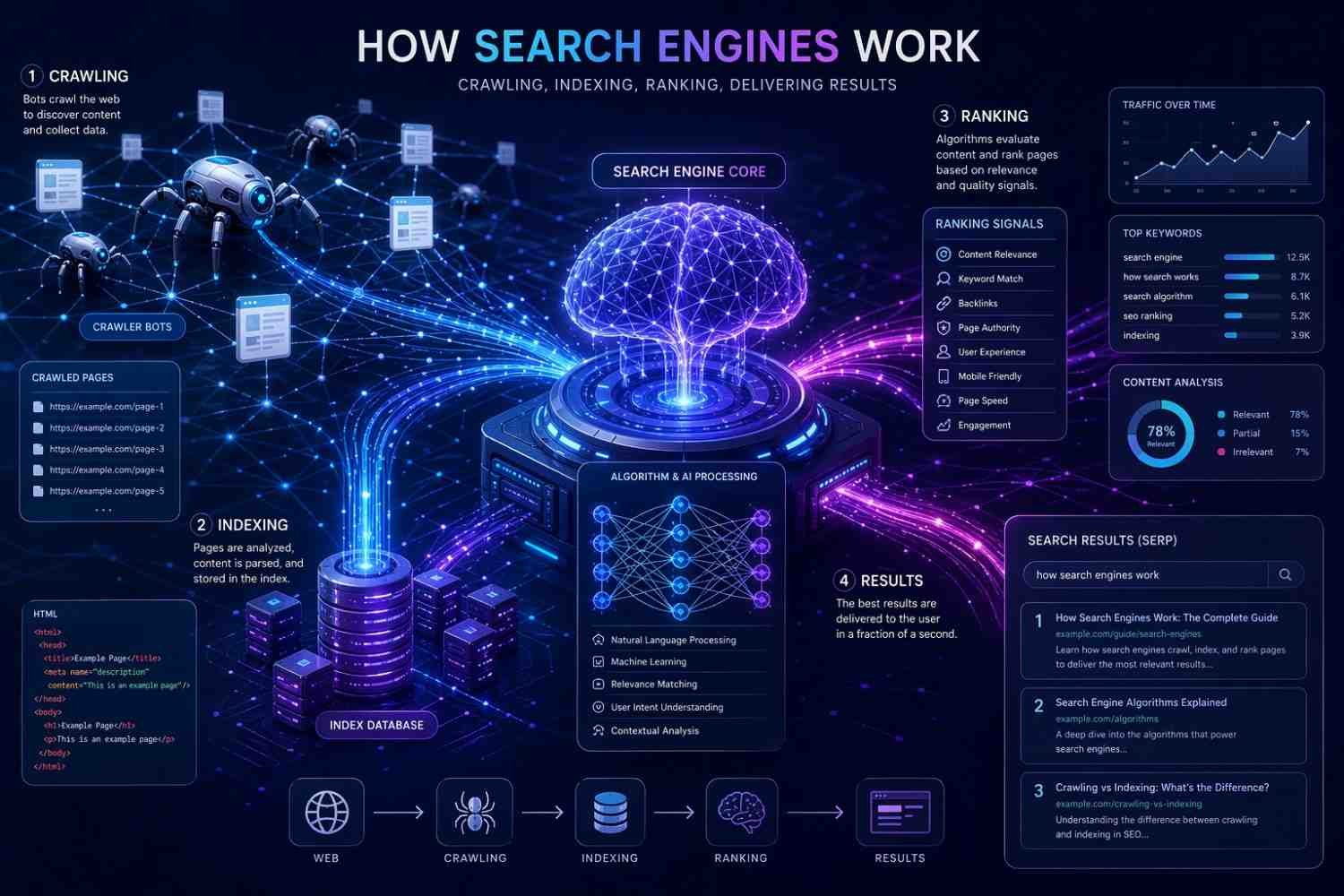
Before investing in SEO services, it helps to understand the system those services are designed to influence. Search engines like Google operate through a three-stage process: crawling, indexing, and ranking.
Crawling is the discovery phase. Search engine bots — called crawlers or spiders — continuously scan the web, following links from page to page to discover new and updated content. If a page cannot be crawled, it cannot be found.
Indexing is the storage phase. Once a page is crawled, its content is analyzed and stored in a massive database called the search index. Pages that are not indexed cannot appear in search results, regardless of their quality.
Ranking is the evaluation phase. When a user enters a search query, Google’s algorithm evaluates every indexed page relevant to that query and ranks them in order of relevance, authority, and quality. Google uses hundreds of ranking signals — from content relevance and backlink authority to page speed and mobile usability — to determine which pages appear at the top of the results.
SEO services are designed to optimize every stage of this process. Technical SEO ensures pages can be crawled and indexed. Content strategy ensures pages are relevant to the right queries. Authority building ensures pages are trusted enough to rank competitively.
Understanding how search engines evaluate and rank content is the starting point for every effective SEO strategy, our complete guide to how search engines work breaks down the full crawling, indexing, and ranking process in detail, including how Google’s algorithm weighs different ranking signals.
The Core Components of SEO Services
Effective SEO services are not built on a single tactic. They are built on four interconnected disciplines that work together to improve search visibility across every dimension Google evaluates. Understanding these four pillars is essential for any business owner evaluating an SEO investment.
Technical SEO
Technical SEO addresses the infrastructure of a website — the behind-the-scenes elements that determine whether search engines can access, understand, and rank its content. Without a solid technical foundation, even the best content and strongest backlinks will underperform.
On-Page SEO
On-page SEO covers the optimization of individual web pages — including the content itself, title tags, headers, and internal links — to signal relevance to search engines and match the intent of the users searching for that topic.
Off-Page SEO and Link Building
Off-page SEO focuses on building the external signals — primarily backlinks from other authoritative websites — that tell search engines a site is trustworthy and worth ranking. Authority is earned, not assumed.
SEO Content Strategy
Content strategy is the planning and creation of content that targets the right search queries, satisfies user intent, and builds topical authority across a subject domain. Content is the medium through which all other SEO efforts deliver value.
Each of these four pillars is covered in depth in its own dedicated section below. Together, they form the complete framework of what professional SEO services deliver.
Technical SEO Services: Building the Right Foundation
Technical SEO is the optimization of a website’s infrastructure to ensure search engines can crawl, index, and rank its content effectively. It is the foundation on which every other SEO effort is built — and the area most often neglected by businesses that focus exclusively on content or links.
A technically sound website loads quickly, works flawlessly on mobile devices, uses secure HTTPS connections, and provides clear signals to search engine crawlers about which pages to index and how to understand the site’s structure. When these fundamentals are broken, rankings suffer regardless of content quality.
Key technical SEO priorities include:
- Site speed and Core Web Vitals — Google uses page experience signals, including loading speed, interactivity, and visual stability, as direct ranking factors
- Mobile optimization — with mobile devices accounting for the majority of searches globally, mobile-first indexing means Google primarily evaluates the mobile version of a site
- Crawlability and indexability — XML sitemaps, robots.txt configuration, and internal link architecture guide search engine crawlers to the right pages
- Structured data and schema markup — helps search engines understand the context and meaning of content, enabling rich results in the SERP
- HTTPS security — a confirmed Google ranking signal and a trust signal for users
- Site architecture — a logical, flat URL structure reduces crawl depth and distributes link equity efficiently
Technical SEO is the infrastructure layer that every other SEO effort depends on, our technical SEO guide covers every audit point, optimization priority, and implementation checklist your site needs to build a crawlable, indexable, and ranking-ready foundation.

On-Page SEO: Optimizing What Search Engines Read
On-page SEO is the optimization of individual web pages to align with search intent and signal relevance to search engines. Where technical SEO ensures a site can be found, on-page SEO ensures that what search engines find is worth ranking.
Every page on a website is an opportunity to rank for a specific search query. On-page SEO is the discipline of making sure each page communicates its topic clearly, matches the intent of the user searching for it, and provides enough depth and quality to compete with other pages targeting the same query.
The key elements of on-page SEO include:
- Title tags — the clickable headline in search results; the single most important on-page ranking signal
- Meta descriptions — the summary text below the title in the SERP; influences click-through rate
- Header hierarchy (H1, H2, H3) — organizes content for both users and search engines; signals topic structure
- Keyword placement — natural integration of target keywords and semantic variations throughout the content
- Content quality and depth — comprehensive, accurate, and useful content that fully satisfies the user’s search intent
- Internal linking — connects related pages within the site, distributing authority and helping users navigate
- Image optimization — descriptive alt text and compressed file sizes improve both accessibility and page speed
- URL structure — clean, descriptive URLs that reflect page content
Every page on your website is an opportunity to rank for a specific query, our on-page SEO optimization guide walks through every element that search engines evaluate on a page level, from title tag construction to content depth and internal link architecture.
Off-Page SEO and Link Building: Earning Authority
Off-page SEO refers to actions taken outside a website that influence its authority and trustworthiness in the eyes of search engines. The primary off-page signal is backlinks — links from other websites pointing to yours.
Search engines treat backlinks as votes of confidence. When a reputable, relevant website links to your content, it signals that your content is credible and worth referencing. The more high-quality backlinks a page earns, the more authority it accumulates — and the more competitive it becomes in search rankings.
The critical distinction in link building is quality over quantity. According to research from Ahrefs, 90.63% of pages get zero organic traffic from Google, and a lack of backlinks is one of the primary reasons. A single editorial link from a high-authority, topically relevant website carries significantly more ranking power than dozens of links from low-quality or unrelated sources.
What makes a quality backlink:
- Relevance — the linking site covers topics related to your industry or content
- Authority — the linking site has strong domain authority and earns its own backlinks
- Editorial context — the link appears naturally within relevant content, not in a footer or sidebar
- Anchor text — the clickable text of the link describes the destination page accurately
- Dofollow status — passes link equity to the destination page
Beyond backlinks, off-page SEO also includes brand mentions, digital PR, and social signals — all of which contribute to a site’s perceived authority and trustworthiness.
Building a strong backlink profile is one of the most impactful, and most misunderstood, aspects of SEO, which is why our link building services guide covers every legitimate acquisition strategy, from digital PR and editorial outreach to content-driven link earning and authority benchmarking.
SEO Content Strategy: Creating Content That Ranks
Content is the medium through which SEO delivers value to both users and search engines. Without content, there is nothing to rank. Without a strategy, content creation becomes guesswork — producing pages that attract no traffic and serve no business purpose.
An SEO content strategy is the systematic planning and creation of content that targets specific search queries, satisfies the intent behind those queries, and builds topical authority across a subject domain. It is what separates businesses that rank consistently from those that publish content without results.
Modern SEO content strategy is shaped by Google’s E-E-A-T framework — Experience, Expertise, Authoritativeness, and Trustworthiness. Google’s Search Quality Evaluator Guidelines make clear that content demonstrating genuine first-hand experience and subject matter expertise is evaluated more favorably than content that simply targets keywords without depth.
Topical authority is the strategic goal. Rather than creating isolated pages targeting individual keywords, a topical authority approach builds comprehensive coverage of an entire subject domain — a pillar page covering the broad topic, supported by cluster pages covering every subtopic in depth. This architecture signals to search engines that a site is a comprehensive, trustworthy resource on its subject.
Content is the medium through which SEO delivers value to both users and search engines, our SEO content strategy guide explains how to build a content plan that targets the right queries, establishes topical authority, and converts organic traffic into measurable business outcomes.
Keyword Research: The Strategic Core of SEO
Keyword research is the process of identifying the specific terms and phrases your target audience uses when searching for products, services, or information related to your business. It is the intelligence layer that makes every other SEO decision more precise — and the starting point for any effective SEO strategy.
Without keyword research, content creation and optimization are based on assumptions. With it, every page targets a specific, validated search opportunity with known demand, competition level, and user intent.
The key metrics in keyword research are:
- Search volume — how many times a keyword is searched per month; indicates demand
- Keyword difficulty — how competitive a keyword is to rank for; indicates effort required
- Search intent — what the user actually wants when they search that term (information, comparison, purchase, navigation)
- Long-tail keywords — longer, more specific phrases with lower volume but higher conversion intent and lower competition
Aligning keyword research with business goals is what separates effective SEO from traffic-chasing. Ranking for keywords that attract your ideal customers — not just any visitors — is what drives leads and revenue from organic search.
Keyword research is the intelligence layer that makes every other SEO decision more precise, our keyword research guide walks through every method, tool, and prioritization framework needed to identify the highest-value search opportunities for your specific business and market.

Local SEO Services: Visibility in Your Market
Local SEO is the process of optimizing a business’s online presence to appear in location-based search results — including Google’s local pack (the map results that appear at the top of the SERP for local queries) and organic results for geographically targeted searches.
For businesses that serve customers in specific geographic areas — whether a single city, a service region, or multiple locations — local SEO is often the highest-ROI SEO investment available. According to Google, 76% of people who search for something nearby on their smartphone visit a related business within a day, and 28% of those searches result in a purchase.
Local SEO is distinct from national or international SEO in both strategy and execution. The key components include:
- Google Business Profile optimization — the primary driver of local pack visibility; includes accurate business information, categories, photos, and review management
- Local citations — consistent mentions of a business’s name, address, and phone number (NAP) across directories and data aggregators
- Local keyword targeting — optimizing pages for geo-specific search queries (e.g., “SEO agency in London”)
- Local link building — earning backlinks from locally relevant websites, directories, and publications
- Review management — generating and responding to customer reviews, which influence both local rankings and click-through rates
For businesses that serve customers in specific geographic areas, local search visibility can be the single highest-ROI SEO investment available, our local SEO services guide covers every component of a local SEO strategy, from Google Business Profile optimization to citation building and local link acquisition.
SEO Audits: Diagnosing What Holds Your Site Back
An SEO audit is a comprehensive analysis of a website’s technical health, content quality, and backlink profile to identify the specific issues and opportunities preventing it from ranking higher in search results. It is the diagnostic foundation of any serious SEO engagement.
Before any optimization work begins, an audit establishes the current state of a site — what is working, what is broken, and what is missing. Without this baseline, SEO work risks addressing the wrong problems or missing the highest-impact opportunities entirely.
A professional SEO audit covers three primary dimensions:
Technical audit — crawl errors, indexation issues, site speed problems, mobile usability failures, duplicate content, broken links, redirect chains, and structured data errors.
Content audit — keyword targeting gaps, thin or low-quality pages, content cannibalization (multiple pages competing for the same keyword), missing meta data, and opportunities to improve existing content.
Backlink audit — analysis of the existing link profile, identification of toxic or low-quality links that may be suppressing rankings, and benchmarking against competitor backlink profiles to identify authority gaps.
Most professional SEO engagements begin with an audit because it creates a prioritized roadmap — directing resources toward the changes that will have the greatest impact on rankings and traffic.
An SEO audit is typically the first step in any serious SEO engagement because you cannot fix what you have not diagnosed, our SEO audit guide covers every dimension of a professional audit, from technical crawl analysis and content gap identification to backlink profile assessment and competitive benchmarking.
How Long Does SEO Take? Timelines and Realistic Expectations
One of the most common questions from business owners investing in SEO is: how long will it take to see results? The honest answer is that SEO is a long-term strategy — and understanding realistic timelines is essential for making a sound investment decision.
Most businesses begin seeing measurable SEO results within 3–6 months. Meaningful organic traffic growth typically occurs between 6–12 months. Competitive keyword dominance — ranking in the top three positions for high-volume, high-competition terms — often requires 12–24 months of consistent, strategic effort.
These are not arbitrary ranges. They reflect how search engines evaluate and reward new content and authority signals over time.
Factors that influence SEO speed:
- Site age and existing authority — established sites with existing backlink profiles and indexed content typically see results faster than brand-new domains
- Competition level — ranking for “best running shoes” requires far more time and resources than ranking for “custom running shoes for flat feet in Manchester”
- Technical health — sites with significant technical issues require remediation before ranking improvements can occur
- Content quality and volume — comprehensive, well-optimized content accelerates topical authority building
- Budget and resource investment — more resources applied consistently produces faster results
- Algorithm updates — Google’s ongoing algorithm changes can accelerate or temporarily disrupt progress
The compounding nature of SEO is its most powerful characteristic. Unlike paid advertising, where traffic stops the moment the budget runs out, SEO builds an asset. Rankings earned through quality content and legitimate authority building continue to deliver traffic and leads long after the initial investment.
A study by Ahrefs found that only 5.7% of newly published pages reach the top 10 within a year, with most top-ranking pages being 2–3 years old — reinforcing that SEO rewards sustained, strategic investment over time.
SEO timelines are one of the most misunderstood aspects of organic search investment, and setting accurate expectations from the start is critical to long-term success — our SEO timeline and results guide <!–NEW PAGE NEEDED–> breaks down exactly what to expect month by month, which milestones signal healthy progress, and how to distinguish slow-building momentum from a strategy that needs adjustment.

How to Measure SEO Success: KPIs and Reporting
Measuring SEO success requires looking beyond keyword rankings alone. Rankings are a leading indicator — they tell you where you stand in the SERP. But the metrics that matter most to a business are the ones that connect organic search activity to revenue outcomes.
The most important SEO KPIs for business owners are:
- Organic traffic — the total number of visitors arriving from unpaid search results; the primary volume metric
- Keyword ranking positions — where specific target pages rank for their target queries; tracks progress toward visibility goals
- Click-through rate (CTR) — the percentage of users who click on a search result after seeing it; influenced by title tags, meta descriptions, and SERP features
- Conversion rate from organic traffic — the percentage of organic visitors who complete a desired action (form submission, purchase, phone call)
- Leads and revenue from organic search — the ultimate business-impact metric; connects SEO investment to bottom-line outcomes
- Backlink growth — the rate at which new referring domains are acquired; indicates authority-building momentum
- Impressions — how often pages appear in search results; useful for identifying ranking opportunities not yet converting to clicks
The tools that make this measurement possible are Google Analytics (for traffic and conversion data) and Google Search Console (for impressions, clicks, CTR, and ranking position data). Both are free and provide the foundational data layer for any SEO reporting framework.
Tracking the right metrics is what separates an SEO strategy that delivers business results from one that only improves rankings, our SEO reporting and analytics guide covers every KPI worth tracking, how to interpret performance data, and how to build reports that connect organic search activity to revenue outcomes.
Types of SEO Services: Which Is Right for Your Business?
Not all SEO services are the same. The right type of SEO strategy depends on your business model, geographic scope, industry, and growth goals. Understanding the main categories helps business owners identify which approach fits their situation.
Local SEO vs. National SEO vs. International SEO
Local SEO targets customers in specific geographic areas — cities, regions, or service zones. It is the right choice for brick-and-mortar businesses, service-area businesses, and multi-location brands. The primary focus is Google’s local pack and geo-targeted organic results.
National SEO targets broader, non-geographic keywords across an entire country. It is appropriate for e-commerce businesses, SaaS companies, and service providers without geographic restrictions. Competition is typically higher, and timelines are longer.
International SEO targets multiple countries or languages simultaneously. It requires technical implementation of hreflang tags, country-specific domain or subdirectory structures, and localized content strategies for each target market.
E-Commerce SEO
E-commerce SEO addresses the unique challenges of online retail — optimizing product pages, category pages, and site architecture for both search engines and purchasing intent. It includes product schema markup, faceted navigation management, and conversion-focused content optimization.
White Label SEO Services
White label SEO is a delivery model in which an SEO agency provides services under another agency’s brand. It allows marketing agencies, web design firms, and consultants to offer SEO to their clients without building an in-house SEO team. The white label provider handles all execution while the reselling agency maintains the client relationship.
Choosing the right type of SEO service for your business model and growth stage is a strategic decision that directly affects your ROI, our SEO packages and pricing guide breaks down which service type fits which business scenario, what each package typically includes, and how to evaluate options based on your specific goals and budget.
In-House SEO vs. SEO Agency vs. Freelancer: Comparing Your Options
Once a business decides to invest in SEO, the next decision is how to deliver it. There are three primary models: building an in-house SEO team, hiring an SEO agency, or working with an SEO freelancer. Each has distinct advantages and trade-offs.
In-house SEO team — An internal team offers deep brand knowledge, direct integration with other marketing functions, and full control over strategy and execution. The trade-off is cost: a capable in-house SEO team requires significant salary investment, and building the full range of expertise needed (technical SEO, content, link building, analytics) typically requires multiple specialists.
SEO agency — An agency provides access to a full team of specialists across all SEO disciplines, established processes, and the ability to scale quickly. Agencies typically have broader industry experience and access to premium tools. The trade-off is less direct control and a higher monthly investment than a single freelancer.
SEO freelancer — A freelancer offers flexibility and lower cost than an agency, and can be highly effective for specific, well-defined SEO tasks. The trade-off is limited capacity — a single freelancer cannot cover the full breadth of a comprehensive SEO strategy simultaneously.
| Factor | In-House | Agency | Freelancer |
| Cost | High (salaries + tools) | Medium-High (retainer) | Low-Medium (hourly/project) |
| Expertise breadth | Depends on team size | Broad (multi-specialist) | Narrow (individual skills) |
| Scalability | Limited by headcount | High | Low |
| Brand knowledge | Deep | Requires onboarding | Requires onboarding |
| Best for | Large businesses with sustained SEO needs | SMEs to enterprise needing full-service execution | Specific tasks or limited budgets |
Each delivery model has distinct advantages depending on your business size, budget, and how quickly you need to scale, our guide to choosing an SEO agency provides a complete decision framework, including the questions to ask, the red flags to watch for, and the criteria that separate high-performing SEO partners from underperforming ones.
How to Choose an SEO Agency: What to Look For
Choosing the right SEO agency is one of the most consequential decisions in a business’s digital marketing strategy. The wrong choice wastes budget and time. The right choice builds a compounding organic growth asset that delivers returns for years.
Green flags — what a trustworthy SEO agency demonstrates:
- Transparent reporting — clear, regular reports showing organic traffic, rankings, and business-impact metrics; not just vanity numbers
- Realistic expectations — honest about timelines and what is achievable; no promises of guaranteed #1 rankings (which are impossible to guarantee legitimately)
- Clear strategy explanation — able to explain exactly what they will do, why, and how it connects to your business goals
- Proven results — case studies, client references, and demonstrated performance in relevant industries
- White hat methodology — all tactics align with Google’s Webmaster Guidelines; no shortcuts that risk penalties
- Communication quality — responsive, proactive, and able to explain technical concepts in business terms
Red flags — warning signs of a low-quality or risky SEO provider:
- Guaranteed #1 rankings — no legitimate SEO provider can guarantee specific ranking positions
- Vague strategy explanations — “we have a proprietary process” without specifics is a warning sign
- Suspiciously low pricing — SEO done properly requires significant expertise and time; extremely low prices often indicate low-quality or black hat tactics
- No reporting or opaque reporting — if you cannot see what is being done and what results it is producing, that is a problem
- Pressure to sign long contracts immediately — reputable agencies are confident enough in their results to offer reasonable terms
If you are evaluating SEO partners and want to see how a data-driven, transparent approach to organic growth works in practice, White Label SEO Service’s full-service SEO offering provides the strategic depth, reporting clarity, and execution capability that growing businesses need.
Choosing the right SEO partner is one of the most consequential decisions in your digital marketing strategy, our SEO agency selection guide provides a complete vetting framework, including the exact questions to ask, the contract terms to scrutinize, and the performance benchmarks to set before signing.
How Much Do SEO Services Cost?
SEO pricing varies significantly based on the scope of services, the competitiveness of the target market, and the expertise of the provider. Understanding the pricing landscape helps business owners evaluate quotes accurately and avoid both overpaying and underinvesting.
Typical SEO pricing ranges:
- Small business SEO (local or niche markets): $500–$2,000 per month
- Mid-market SEO (regional or moderately competitive national markets): $2,000–$5,000 per month
- Competitive national or enterprise SEO: $5,000–$15,000+ per month
- Project-based SEO (audits, one-time optimization): $1,000–$10,000+ depending on scope
- Hourly SEO consulting: $100–$300+ per hour
What drives SEO pricing:
- Competition level — more competitive markets require more content, more link building, and more ongoing optimization
- Scope of services — a full-service engagement covering technical SEO, content, and link building costs more than a single-service retainer
- Market size — national and international campaigns require greater resource investment than local campaigns
- Agency expertise and track record — experienced agencies with proven results command higher rates
The most important framing for SEO pricing is ROI, not cost. An SEO investment that generates $50,000 in annual revenue from organic traffic is worth $5,000 per month. The question is not “how much does SEO cost?” but “what return does this investment generate?”
Extremely low SEO pricing — below $350–$500 per month — is almost always a red flag. Effective SEO requires significant expertise, time, and resources. Providers offering SEO at very low prices typically cut corners in ways that either produce no results or, worse, risk Google penalties.
SEO pricing varies significantly based on scope, competition, and strategy depth, and understanding what drives those differences is essential to making a sound investment decision, our SEO pricing and packages guide breaks down every pricing model, what each tier typically delivers, and how to evaluate whether a quote represents genuine value or a race to the bottom.
Common SEO Mistakes That Undermine Results
Even with the right intentions, many businesses make SEO decisions that undermine their results — sometimes significantly. Understanding the most common mistakes helps business owners avoid them and evaluate whether their current SEO strategy is on the right track.
Targeting keywords with the wrong intent — Ranking for keywords that attract the wrong audience generates traffic without conversions. A B2B software company ranking for “what is CRM software” attracts informational searchers, not buyers. Keyword strategy must align with business goals, not just search volume.
Neglecting technical SEO foundations — Content and link building efforts are undermined by a technically broken site. Crawl errors, slow page speed, and indexation issues prevent even excellent content from ranking.
Building low-quality or purchased backlinks — Link schemes — buying links, participating in private blog networks, or using automated link building tools — violate Google’s guidelines and risk manual penalties or algorithmic suppression. Google’s spam policies explicitly prohibit any links intended to manipulate PageRank.
Creating thin or duplicate content — Pages with insufficient depth, copied content, or near-duplicate variations compete against each other and dilute topical authority. Every page should serve a distinct purpose and provide genuine value.
Expecting immediate results — Treating SEO as a short-term tactic leads to premature strategy changes that reset progress. SEO requires sustained investment over months and years to deliver its full compounding returns.
Ignoring mobile optimization — With Google’s mobile-first indexing, a poor mobile experience directly suppresses rankings across all devices.
Understanding the difference between SEO practices that build lasting authority and those that risk Google penalties is critical for any business investing in organic growth, our white hat vs. black hat SEO guide explains every high-risk tactic to avoid, how Google detects and penalizes manipulative practices, and what a sustainable, penalty-proof SEO strategy looks like.
Conclusion
SEO services encompass the full spectrum of technical optimization, content strategy, authority building, and performance measurement that drives sustainable organic search visibility, qualified traffic, and measurable business growth.
The businesses that win in organic search are those that treat SEO as a long-term infrastructure investment — building topical authority, technical excellence, and backlink credibility consistently over time rather than chasing short-term ranking shortcuts.
At White Label SEO Service, we build data-driven SEO strategies that connect search visibility to real business outcomes — traffic, leads, and revenue — with the transparency and strategic depth your growth requires.
Frequently Asked Questions
What is the difference between SEO and paid search advertising?
SEO improves organic — unpaid — search visibility through content, technical optimization, and authority building. Paid search (PPC) places ads at the top of the SERP for a fee. SEO builds compounding long-term visibility; PPC delivers immediate but temporary traffic that stops when the budget runs out.
How do I know if my website needs SEO services?
If your website is not appearing on the first page of Google for searches your potential customers are making, you need SEO. Signs include low organic traffic, poor keyword rankings, technical site errors, and competitors consistently outranking you for relevant queries.
Can I do SEO myself, or do I need to hire an agency?
Basic on-page SEO can be managed in-house with the right knowledge and tools. However, a comprehensive SEO strategy — covering technical optimization, content strategy, and link building simultaneously — typically requires specialist expertise that most in-house teams do not have across all three disciplines.
What is the difference between white hat and black hat SEO?
White hat SEO uses tactics that comply with Google’s guidelines — quality content, legitimate link earning, and technical best practices. Black hat SEO uses manipulative shortcuts — link schemes, keyword stuffing, and cloaking — that violate guidelines and risk penalties. White hat SEO builds sustainable rankings; black hat SEO risks losing them entirely.
How often should SEO strategy be reviewed and updated?
SEO strategy should be reviewed monthly through performance reporting and adjusted quarterly based on ranking progress, algorithm updates, and competitive changes. Major strategic reviews — including full audits — are typically conducted annually or when significant ranking drops occur.
What is the ROI of SEO services?
SEO ROI varies by industry, competition, and investment level, but organic search consistently delivers strong long-term returns. BrightEdge research found that organic search drives 53% of all website traffic, making it the single largest digital traffic channel for most businesses. The compounding nature of SEO means ROI typically increases over time as authority and rankings build.
What happens to my SEO rankings if I stop investing in SEO?
Rankings earned through legitimate SEO do not disappear immediately when investment stops, but they will gradually decline as competitors continue optimizing and as content becomes outdated. Technical issues left unaddressed will also accumulate. SEO is an ongoing investment — pausing it means ceding ground to competitors who continue building.