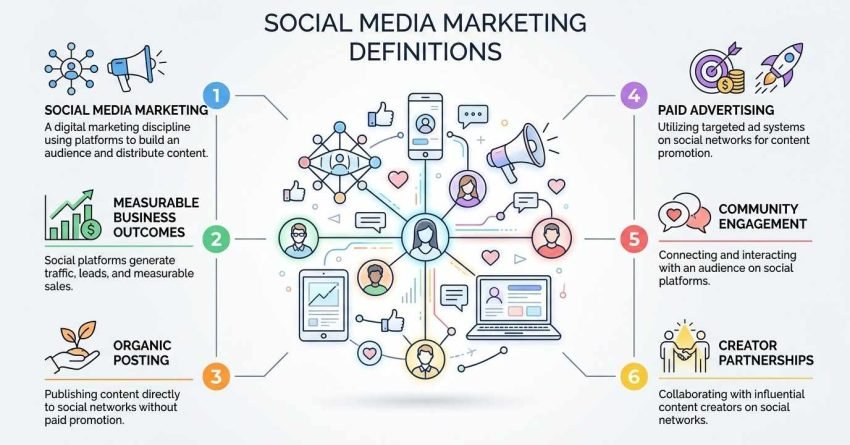
Social media marketing is a digital marketing discipline that uses social platforms to build an audience, distribute content, and generate measurable business outcomes such as traffic, leads, and sales. It covers organic posting, paid advertising, community engagement, and creator partnerships across networks where your customers already spend their attention.
Social platforms now sit between discovery and purchase for most consumer and B2B categories. Ignoring them means competitors shape your reputation, capture your demand, and answer your buyers’ questions first.
This guide covers what social media marketing means and how it works mechanically, which platforms serve which audiences, how to build a strategy and produce content that performs, how paid social and creator partnerships fit in, what tools and workflows you need, and how to measure results, timelines, and costs honestly.
What Social Media Marketing Actually Means
Social media marketing is the practice of creating and distributing content on social platforms to reach a defined audience and move that audience toward a business goal. I treat it as three jobs running at once: publishing content, buying attention, and talking to people who respond.
The word “marketing” matters here. Posting is not marketing. Marketing means a goal exists, a measurement exists, and a decision gets made when the numbers come back.
Most beginners confuse activity with strategy. I have watched businesses publish daily for a year with no defined audience, no offer, and no tracking, then conclude social media does not work for them.
The Difference Between Organic and Paid Social
Organic social media marketing is unpaid content distributed to followers and algorithmic feeds, while paid social is advertising bought through a platform’s ad auction to reach a targeted audience. Organic builds trust slowly and cheaply. Paid buys reach instantly and predictably.
I use both together on almost every account I touch. Organic content tells me what resonates, and paid budget scales whatever already proved itself.
How Social Media Marketing Differs From Social Media Management
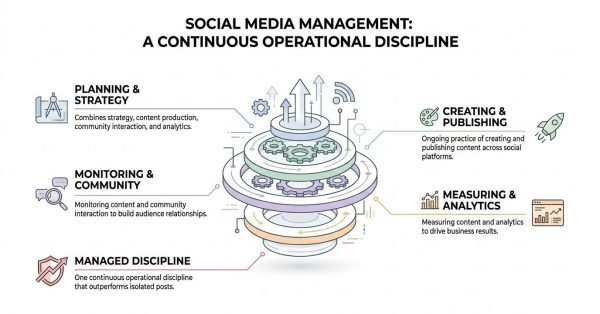
Social media management is the operational work of scheduling, publishing, moderating, and responding, while social media marketing is the strategic discipline that decides what gets published and why. Management executes. Marketing directs.
A lot of agencies sell management and call it marketing. The difference shows up in whether anyone can explain what a post was supposed to achieve.
Why Social Media Marketing Matters for Business Growth
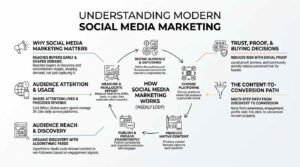
Social media marketing matters because it reaches buyers during the discovery and consideration stages, before they ever type a branded search into Google. It shapes demand rather than just capturing it.
According to DataReportal’s Digital 2024 report, 5.04 billion people use social media worldwide, spending an average of 2 hours 23 minutes per day across platforms. That is where attention lives, and attention precedes revenue.
Audience Reach and Discovery
Social platforms distribute content to people who have never heard of you, which is something your website cannot do on its own. Algorithmic feeds push relevant content to non-followers based on engagement signals, creating discovery at zero media cost.
I see this most clearly with short-form video, where a single post can reach ten times a brand’s follower count. That reach is unpredictable, which is why it supplements rather than replaces paid distribution.
Trust, Proof, and Buying Decisions
Buyers check your social profiles before they buy, and an empty or abandoned profile costs you deals. Sprout Social research found that 68% of consumers follow brands on social media specifically to stay informed about new products and services.
Social proof does quiet work. Reviews, comments, customer photos, and visible community activity all reduce the perceived risk of buying from a company a prospect has never met.
How Social Media Marketing Works
Social media marketing works by publishing content that earns engagement, which signals relevance to the platform algorithm, which expands distribution, which builds audience and drives qualified traffic toward an offer. Each step feeds the next.
Here is the sequence I follow on every account:
- Define the audience and the business outcome the channel is responsible for
- Choose platforms where that audience is genuinely active
- Produce content formats native to each platform
- Publish consistently and respond to everyone who engages
- Measure what drove traffic, leads, or sales, then reallocate effort toward it
That loop repeats weekly. The discipline is in step five, which most teams skip.
The Content-to-Conversion Path
Content rarely converts on the first touch, so the path runs from awareness content, to engagement, to profile visit, to link click, to conversion on your own property. Each stage loses people, and that is normal.
I plan content for each stage rather than expecting one post to do everything. A video that earns reach and a post that drives clicks are different jobs.
How Social Algorithms Decide What Gets Seen
Social algorithms rank content by predicted engagement, using signals such as watch time, comments, shares, saves, and early interaction velocity in the first minutes after publishing. Follower count matters far less than it used to.
Shares and saves carry the most weight on most platforms because they indicate value rather than reflex. I optimise for those two before I worry about likes.
The Major Social Media Platforms and Who They Serve
No business should be active on every platform, so platform selection is the highest-leverage decision in social media marketing. Each network attracts a different audience, rewards a different format, and supports a different buying motion.
This table shows where each major platform fits:
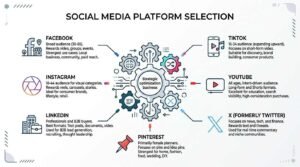
| Platform | Primary audience | Best formats | Strongest use case |
| Broad, skews 30–65 | Video, groups, events | Local business, community, paid reach | |
| 18–44, visual categories | Reels, carousels, stories | Consumer brands, lifestyle, retail | |
| Professionals, B2B buyers | Text posts, documents, video | B2B lead generation, recruiting, thought leadership | |
| TikTok | 16–34, expanding upward | Short-form video | Discovery, brand building, consumer products |
| YouTube | All ages, intent-driven | Long-form and Shorts | Education, search visibility, high-consideration purchases |
| X | News, tech, finance | Text, threads | Real-time commentary, niche communities |
| Planners, majority female | Pins, idea pins | Home, fashion, food, wedding, DIY |
Facebook and Instagram
Facebook and Instagram share an ad platform, which makes them the default starting point for most businesses running paid social. Meta’s targeting, reporting, and creative tools are the most mature available.
Instagram carries the discovery upside through Reels. Facebook carries the depth through Groups and local reach.
LinkedIn is the primary platform for B2B social media marketing because it combines professional identity data with a feed that rewards written expertise. Targeting by job title, company size, and industry is unmatched.
Organic reach on LinkedIn remains unusually generous compared to consumer platforms. That window has been narrowing, but it is still open.
TikTok and Short-Form Video
TikTok rewards content quality over follower count more aggressively than any other platform, which gives new accounts a genuine chance at reach. The tradeoff is production volume.
Short-form video now runs across every major network, so one strong video asset usually gets repurposed to Reels, Shorts, and TikTok simultaneously.
X, Pinterest, and YouTube
X suits real-time commentary and technical communities. Pinterest functions closer to a visual search engine and drives strong referral traffic in home, food, and fashion categories.
YouTube deserves separate consideration because it is a search engine as much as a social network. Its content keeps producing views for years rather than days.
Choosing Platforms Instead of Claiming All of Them
Start with one or two platforms and do them properly rather than spreading thin across six. I ask three questions: where is the audience, which format can we produce consistently, and which platform supports the buying motion.
Consistency on two channels beats presence on six. Every time.
Building a Social Media Marketing Strategy
A social media marketing strategy is a documented plan that defines the audience, the platforms, the content themes, the publishing cadence, and the metrics that determine success. Without it, teams default to posting whatever is convenient.
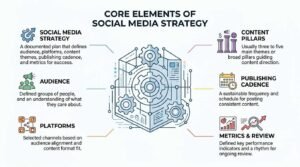
Build the strategy in this order:
- Name the business outcome the channel owns
- Define the audience and what they care about
- Select platforms based on audience and format fit
- Set content pillars, usually three to five themes
- Set cadence and resourcing you can actually sustain
- Define the metrics and the review rhythm
Setting Goals That Map to Business Outcomes
Goals should connect to revenue, pipeline, or retention rather than stopping at followers. I translate every social goal into a downstream number: qualified traffic, email signups, booked calls, or purchases.
Follower growth is a leading indicator, not an outcome. It is worth tracking and worth nothing on its own.
Defining Your Audience and Positioning
Audience definition means naming who you serve, what problem they have, and what they already believe about it. Positioning is the angle that makes your content different from the eleven competitors saying the same thing.
Most beginner content fails on positioning rather than production quality. Generic advice gets ignored regardless of how well it is filmed.
Competitive and Category Research
Competitive research on social media means studying what content earns engagement in your category, not copying what competitors publish. I look for the posts that outperformed their account average, since those reveal genuine audience interest.
Category research also shows format norms. Some niches reward polish, others punish it.
Content Types That Perform on Social Media
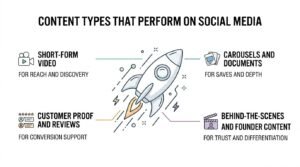
The formats that consistently perform are short-form video, educational carousels, customer proof, and behind-the-scenes content, because each one gives the viewer a reason to stop scrolling. Format follows platform, but these four travel well.
- Short-form video for reach and discovery
- Carousels and documents for saves and depth
- Customer proof and reviews for conversion support
- Behind-the-scenes and founder content for trust and differentiation
Short-Form Video
Short-form video is the dominant distribution format across Instagram, TikTok, YouTube, and Facebook, and platforms actively prioritise it in feeds. It is also the cheapest reach available to a business with no ad budget.
I care about the first two seconds more than the rest of the video. Retention is decided there.
Static Posts, Carousels, and Graphics
Carousels perform well for educational content because each swipe is an engagement signal and the format encourages saves. On LinkedIn, document posts play the same role.
Static graphics still work for announcements, quotes, and data points. They just rarely drive discovery.
User-Generated Content and Social Proof
User-generated content is content created by customers rather than the brand, and it converts better than brand-produced content because it carries independent credibility. Reposting it also costs almost nothing.
I ask for it directly. Most satisfied customers will provide it if someone actually requests it.
Content Planning and Publishing Cadence
Publishing cadence is the frequency and rhythm of posting on each platform, and consistency matters more than volume. A sustainable three posts a week beats an unsustainable daily schedule abandoned in month two.
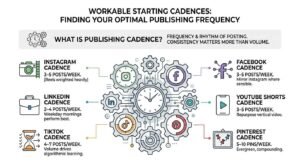
This table shows workable starting cadences:
| Platform | Beginner cadence | Notes |
| 3–5 posts/week | Reels weighted heavily | |
| 2–4 posts/week | Weekday mornings perform best | |
| TikTok | 4–7 posts/week | Volume drives algorithmic learning |
| 3–5 posts/week | Mirror Instagram where sensible | |
| YouTube Shorts | 3–5 posts/week | Repurpose vertical video |
| 5–10 pins/week | Evergreen, compounding |
Building a Content Calendar
A content calendar maps what gets published, on which platform, on which date, against which content pillar. I plan two to four weeks ahead and leave room for reactive content.
Batching production saves more time than any scheduling tool. One filming session usually covers three weeks.
How Often to Post on Each Platform
Post frequency should match what you can sustain at a quality bar you are willing to defend. Platforms reward regularity because it produces reliable data about your account.
Dropping from daily to three times weekly rarely hurts performance. Stopping for six weeks does.
Community Management and Engagement
Community management is the practice of responding to comments, messages, mentions, and reviews to build relationships and protect brand reputation. It is the half of social media marketing that most teams under-resource.
Replies are ranking signals as well as customer service. Early comment activity influences how far a post travels.
Responding, Moderating, and Building Relationships
I set a response window of a few hours during business days and treat DMs as a sales channel rather than an inbox. Moderation guidelines matter once volume grows, since unmanaged comment sections damage trust quickly.
Engaging on other accounts also counts. Commenting thoughtfully in your category builds more reach than another post some weeks.
Paid Social Media Advertising Fundamentals
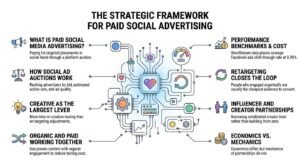
Paid social media advertising is the practice of buying targeted placements in social feeds through a platform auction, paying for impressions, clicks, or conversions. It delivers predictable reach that organic content cannot guarantee.
Meta reported an average cost per thousand impressions that varies widely by industry, but WordStream’s benchmark data places the average Facebook ads click-through rate at 0.90% across industries. Small budgets can produce meaningful learning at $20 to $50 per day.
How Social Ad Auctions Work
Social ad auctions rank advertisers by a combination of bid, estimated action rate, and ad quality, so the highest bidder does not automatically win. Better creative literally lowers your cost.
That is why I spend more time on creative testing than on targeting adjustments. Creative is the largest lever available.
Organic and Paid Working Together
The strongest paid social campaigns promote content that already earned organic engagement, because proven creative reduces testing cost. Organic becomes the testing ground; paid becomes the amplifier.
Retargeting closes the loop. People who engaged organically are usually the cheapest audience to convert.
Influencer and Creator Partnerships
Influencer marketing is a form of social media marketing where a brand pays or partners with a content creator to reach that creator’s established audience. It borrows trust rather than building it from zero.
Creator partnerships now range from large-scale sponsorships to affiliate-style arrangements with micro-creators. The economics differ; the mechanics do not.
Choosing Partners by Audience Fit, Not Follower Count
Audience fit and engagement quality predict results far better than follower count, which is why micro-creators frequently outperform larger accounts. A creator with 8,000 genuinely engaged followers in your category beats one with 200,000 general followers.
I check comment quality before I check reach. Real conversations indicate a real audience.
Social Media Marketing Tools and Workflow
Social media marketing tools fall into four categories: scheduling and publishing, creative production, social listening, and analytics and reporting. Most teams need one tool per category and nothing more.
- Scheduling: Buffer, Later, Hootsuite, Metricool, or native platform schedulers
- Creative: Canva, CapCut, Adobe Express
- Listening: Brand24, Mention, or native platform alerts
- Analytics: Native platform insights plus Google Analytics 4
Scheduling and Publishing Tools
Scheduling tools let you plan and queue content in advance, which protects consistency when the week gets busy. Native schedulers are free and increasingly capable.
I start clients on free native tools and only move them to paid platforms once approval workflows or multi-account management genuinely require it.
Creative, Listening, and Reporting Tools
Creative tools matter more than scheduling tools, because production capacity is the real bottleneck for most teams. Listening tools catch mentions and complaints you would otherwise miss.
Reporting should pull platform data alongside website analytics. Social metrics in isolation never tell you whether the channel earned its budget.
Measuring Social Media Marketing Performance
Social media marketing performance is measured across three layers: reach metrics, engagement metrics, and business metrics such as traffic, leads, and revenue. Only the third layer justifies budget.
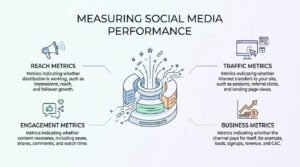
This table separates the metrics worth reporting from the ones worth ignoring:
| Metric type | Examples | What it tells you |
| Reach | Impressions, reach, follower growth | Whether distribution is working |
| Engagement | Saves, shares, comments, watch time | Whether content resonates |
| Traffic | Sessions, referral clicks, landing page views | Whether interest transfers to your site |
| Business | Leads, signups, revenue, CAC | Whether the channel pays for itself |
Vanity Metrics vs. Business Metrics
Vanity metrics are numbers that rise without affecting revenue, such as follower count, impressions, and likes taken in isolation. They are useful as diagnostics and useless as goals.
I report them; I just never lead with them. A report that opens with follower growth is usually hiding a weak conversion story.
Attribution and the Tracking Problem
Social media attribution is difficult because much of its influence happens in-feed, without a click, and surfaces later as direct or branded search traffic. Last-click reporting systematically undervalues social.
I use UTM parameters on every link, plus a self-reported attribution question on forms. Together they close most of the gap.
Reporting Cadence That Actually Informs Decisions
Monthly reporting works for most businesses, with a lighter weekly check on content performance to guide the next batch. Reviewing daily invites is an overreaction to normal variance.
Every report should end with a decision. If nothing changes because of it, the report is theatre.
How Long Social Media Marketing Takes to Work
Social media marketing typically takes three to six months of consistent publishing to produce reliable engagement and traffic, and six to twelve months to influence measurable revenue. Paid social produces data within days but still needs weeks to optimise.
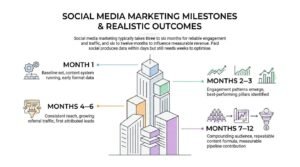
These are the milestones I set expectations against:
| Timeframe | Realistic outcome |
| Month 1 | Baseline set, content system running, early format data |
| Months 2–3 | Engagement patterns emerge, best-performing pillars identified |
| Months 4–6 | Consistent reach, growing referral traffic, first attributed leads |
| Months 7–12 | Compounding audience, repeatable content formula, measurable pipeline contribution |
Realistic Milestones by Month
Progress rarely looks linear, because one strong post can compress months of audience growth into a week. I judge the first quarter on process adherence rather than results.
The accounts that fail almost always quit between month two and month four. That is the exact window where the data starts becoming useful.
What Social Media Marketing Costs
Social media marketing costs vary by delivery model, with US small businesses typically spending $1,000 to $5,000 per month for agency management, $500 to $2,500 for a freelancer, and $40,000 to $75,000 annually for an in-house hire before ad spend. Ad budgets sit separately.
| Model | Typical monthly cost | Best for |
| DIY / founder-led | $0–$300 (tools only) | Pre-revenue, very early stage |
| Freelancer | $500–$2,500 | Single-platform focus, limited scope |
| Agency | $1,000–$5,000+ | Multi-platform, strategy plus execution |
| In-house | $3,500–$6,500 | Sustained volume, brand-critical channel |
In-House, Freelance, and Agency Models
In-house teams offer the deepest brand knowledge, freelancers offer the lowest cost, and agencies offer strategic breadth with production capacity. The right choice depends on volume and how central the channel is to revenue.
I recommend founder-led content early, because authenticity outperforms polish at small scale. Outsource once the bottleneck becomes time rather than skill.
Budget Allocation Between Content and Ads
A workable starting split allocates roughly 60% of budget to content production and 40% to paid amplification, then shifts toward paid as winning creative emerges. Spending on ads before you have proven creative wastes money.
Never buy distribution for content that failed organically. Paid reach amplifies whatever the content already does, including failure.
How Social Media Marketing Connects to SEO and the Wider Funnel
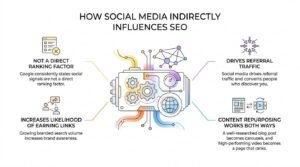
Social media does not directly improve search rankings, but it influences SEO indirectly by driving referral traffic, growing branded search volume, and increasing the likelihood that content earns links and citations. Google has consistently stated social signals are not a direct ranking factor.
The practical overlap is real regardless. Content that performs on social usually performs in search, because both reward genuine usefulness.
Brand Search, Referral Traffic, and Signal Overlap
Growing brand awareness on social increases branded search volume, which is one of the strongest correlating signals with organic visibility. People who discover you on TikTok often convert through Google.
Repurposing works in both directions too. A well-researched blog post becomes five carousels, and a high-performing video becomes a page that ranks.
Common Social Media Marketing Mistakes Beginners Make
The most damaging beginner mistakes are spreading across too many platforms, posting without a defined audience, and abandoning the channel before data accumulates. Each one wastes months of effort.
- Claiming six platforms and sustaining none
- Posting promotional content exclusively
- Ignoring comments and messages
- Copying competitors instead of positioning against them
- Measuring followers instead of business outcomes
- Buying ads before proving creative organically
- Quitting in month three
I have seen every one of these sink an otherwise good business. The last one is the most common and the most expensive.
So how do you know whether social media marketing is worth it for your business?
Deciding Whether Social Media Marketing Fits Your Business
Social media marketing suits businesses whose customers make discovery-driven or trust-driven purchases, and fits poorly where demand is purely transactional and search-led. The honest answer depends on how your buyers actually decide.
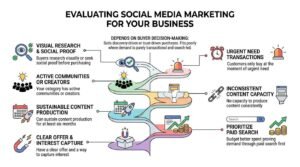
Social media marketing is likely worth it if:
- Your buyers research visually or seek social proof before purchasing
- Your category has active communities or creators
- You can sustain content production for at least six months
- You have a clear offer and a way to capture interest
It is likely a poor fit if:
- Your customers only buy at the moment of urgent need
- You have no capacity to produce content consistently
- Your budget is better spent proving demand through paid search first
When to Start, When to Wait, and When to Outsource
Start when you have a clear offer and a defined audience, wait if you are still testing product-market fit, and outsource once the constraint becomes production time rather than strategic clarity. An outsourcing strategy you do not yet have rarely works.
The order matters. Clarity, then consistency, then scale.
Conclusion
Social media marketing combines platform selection, content production, community engagement, paid amplification, and measurement into one system built around a defined business outcome.
Every element covered here connects to a deeper discipline, from platform-specific strategy to paid social mechanics and attribution modelling worth exploring individually.
We build sustainable organic growth systems at White Label SEO Service, and we would welcome the chance to map yours.
Frequently Asked Questions
Is social media marketing still effective in 2025?
Yes, social media marketing remains effective because platforms still drive discovery and purchase decisions. Organic reach is harder than it was, so results now require better content and some paid support.
How many platforms should a beginner start with?
Start with one or two platforms where your audience is genuinely active. Consistency on two channels outperforms scattered presence on six, and it keeps production demands realistic for small teams.
Do I need paid ads to succeed on social media?
No, but paid ads accelerate results considerably. Organic content can work alone with strong creative and patience, while even small ad budgets make reach far more predictable.
How much should a small business spend on social media marketing?
Most US small businesses spend $1,000 to $5,000 monthly for agency support, plus a separate ad budget. Founder-led content costs almost nothing beyond time and basic tools.
What is a good engagement rate on social media?
A good engagement rate sits around 1% to 3% on Instagram and above 2% on LinkedIn. Rates vary by platform, follower count, and industry, so track your own trend.
Does social media marketing help SEO?
Social media does not directly improve rankings, but it helps indirectly. It drives referral traffic, grows branded search volume, and increases the chance your content earns links.
Should I hire an agency or keep social media in-house?
Keep it in-house when brand voice and speed matter most. Hire an agency when production capacity, paid media expertise, or multi-platform strategy exceeds what your team can sustain.