SEO agencies are teams of specialists who manage search optimization through structured processes, while freelancers are independent contractors who handle SEO work solo, usually at a lower cost but with narrower capacity. I’ve watched businesses make this decision based on price alone, and it rarely ends well. The right choice depends on your budget, growth stage, and how much oversight you actually want to provide.
Picking the wrong option wastes months of budget and stalls growth. I’ve seen both paths work and both fail for reasons that had nothing to do with talent.
This guide covers what agencies and freelancers actually offer, how their pricing and expertise compare, what scalability and risk look like on each side, and which businesses tend to fit each model best. I’ll also cover hybrid setups and the questions worth asking before you commit.
What Is an SEO Agency?
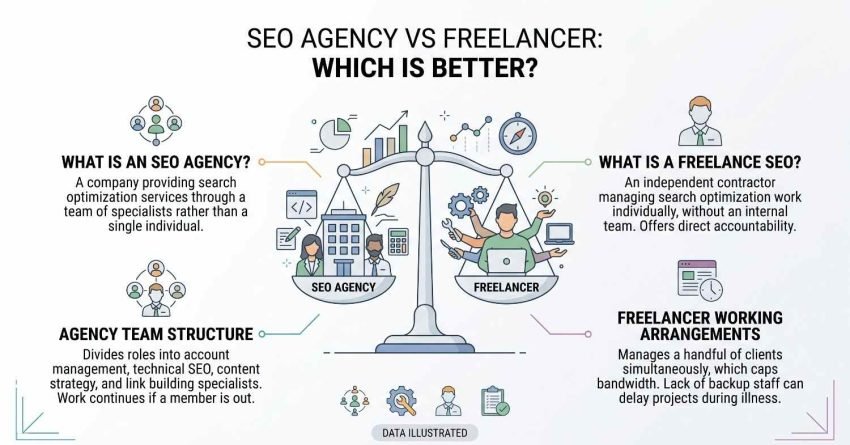
An SEO agency is a company that provides organic search optimization services through a team of specialists rather than a single individual. I think of agencies as infrastructure; they bring process, redundancy, and a bench of skills that no one person can replicate alone.
Agencies typically assign an account manager, a technical SEO lead, a content strategist, and a link building specialist to each client account. This structure means work continues even if one team member is out sick or leaves the company.
Core Services Agencies Typically Offer
Most agencies bundle technical SEO audits, content strategy, on-page optimization, and link acquisition into a single retainer. I usually see agencies also include monthly reporting and strategy calls as part of the package.
Some agencies specialize narrowly, focusing only on local SEO or e-commerce SEO. Others position themselves as full-service providers covering every discipline from crawl budget optimization to digital PR.
Team Structure and Specialization Model
Agency team structure usually separates strategy, execution, and reporting into distinct roles staffed by different specialists. I’ve found this division valuable because a technical SEO expert rarely writes great content, and a content writer rarely understands server log analysis.
This specialization model is why agencies can typically execute complex technical SEO audits faster than a generalist working alone. A team with defined roles simply covers more ground per week.
What Is a Freelance SEO Professional?
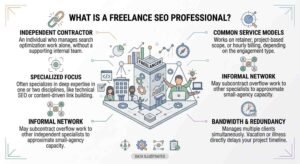
A freelance SEO professional is an independent contractor who manages search optimization work individually, without a supporting internal team. I like working with strong freelancers because the accountability is direct; there’s no account manager buffering the relationship.
Freelancers often specialize in one or two disciplines, such as technical SEO or content-driven link building, rather than covering the full spectrum. This narrower focus can mean deeper expertise in that specific area.
Common Freelancer Service Models
Freelancers typically work on retainer, project-based scope, or hourly billing depending on the engagement type. I see project-based work most often with smaller businesses that need a defined deliverable, like a one-time technical audit.
Some freelancers subcontract overflow work to other independent specialists when a project needs a skill outside their core expertise. This creates an informal network that can approximate small-agency capacity without the overhead.
Typical Freelancer Working Arrangements
Most freelancers manage a handful of clients simultaneously, which caps how much bandwidth any single account receives. I generally recommend asking directly how many active clients a freelancer is juggling before signing on.
Freelancers rarely offer 24/7 coverage or backup staff, so a freelancer’s vacation or illness directly delays your project timeline. This tradeoff sits at the center of the SEO agency vs freelancer decision for many growing businesses.
Cost Comparison: SEO Agency vs Freelancer Pricing
SEO agencies typically charge $1,500 to $10,000+ per month, while freelancers usually charge $50 to $200 per hour or $500 to $3,000 monthly. The gap reflects overhead agencies carry salaries, tools licensing, and management layers that freelancers don’t.
Average Agency Pricing Structures
Agency retainers commonly scale with scope, and a Backlinko survey of SEO pricing found the average monthly retainer sits around $2,819. Larger agencies serving enterprise clients often charge well above $10,000 per month for comprehensive programs.
Pricing usually bundles strategy, execution, and reporting into one fee rather than itemizing each task. I find this bundled structure makes budgeting predictable, even when it obscures where the money actually goes.
Average Freelancer Rate Structures
Freelancer rates vary enormously based on experience, ranging from $50 an hour for newer practitioners to $200+ an hour for specialists with a strong track record. Project-based freelance SEO audits often run $500 to $2,500 depending on site size and complexity.
Lower freelancer rates don’t always mean lower total cost, since limited capacity can stretch a project timeline and increase the effective hourly investment. I always ask freelancers for a realistic timeline estimate before comparing rates directly against agency quotes.
Expertise and Skill Set Differences
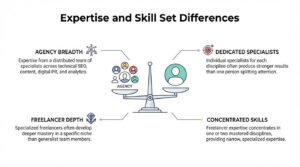
An SEO agency’s expertise comes from a distributed team of specialists, while a freelancer’s expertise concentrates in one or two disciplines they’ve mastered individually. I look at this less as “better or worse” and more as breadth versus depth.
Range of Specialists in an Agency Team
Agencies typically staff separate specialists for technical SEO, content, digital PR, and analytics rather than relying on one generalist. This breadth matters most for businesses with complex sites needing structured internal linking strategies alongside content and outreach work simultaneously.
A dedicated specialist for each discipline usually produces stronger results than a single person splitting attention across four skill sets. I’ve seen this play out clearly on large e-commerce sites with thousands of pages needing simultaneous technical and content fixes.
Depth vs Breadth in Freelancer Expertise
A specialized freelancer often develops deeper mastery in their chosen niche than a generalist team member covering that same discipline part-time. I’ve worked with freelance technical SEO specialists who out-diagnosed entire agency teams on crawl budget issues.
This depth advantage disappears once a project needs skills outside the freelancer’s specialty, since there’s no internal colleague to hand off the work. Businesses needing narrow, specialized expertise sometimes get better outcomes from a freelancer than from a generalist agency account manager.
Scalability: Which Option Grows With Your Business?
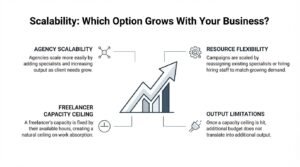
SEO agencies scale more easily than freelancers because they can add specialists and increase output as a client’s needs grow. A freelancer hits a hard capacity ceiling once their available hours are full, regardless of budget increases offered.
Agency Capacity for Scaling Campaigns
Agencies scale campaigns by reassigning existing specialists or hiring additional staff to match growing client demand. I’ve watched agencies double a client’s content output within a month simply by shifting internal resources.
This flexibility makes agencies a stronger fit for businesses anticipating rapid growth or seasonal spikes in SEO demand. Scaling with a freelancer usually means bringing on a second freelancer, which reintroduces coordination overhead.
Freelancer Capacity Limitations
A freelancer’s capacity is fixed by the hours available in their week, creating a natural ceiling on how much work they can absorb. Once that ceiling is hit, additional budget doesn’t translate into additional output.
Some freelancers manage this by subcontracting or forming loose collectives with other specialists. This approach can extend capacity somewhat but rarely matches the coordinated output of an established agency team.
Communication and Accountability Structures
Agencies typically communicate through structured account management, while freelancers communicate directly one-on-one without an intermediary layer. I’ve found both models work well, provided expectations are set clearly at the start.
Agency Reporting and Account Management
Agencies usually assign a dedicated account manager who provides monthly reports, strategy calls, and a single point of contact for questions. This structure adds a layer of accountability since performance data typically gets reviewed internally before it reaches the client.
Standardized reporting templates make it easier to compare performance across months. I generally recommend asking to see a sample report before signing, since reporting quality varies significantly from agency to agency.
Freelancer Direct Communication Style
Freelancers communicate directly, without an account manager filtering the conversation, which often means faster turnaround on questions. I appreciate this directness because there’s no confusion about who actually did the work.
Reporting formats vary widely by freelancer, and some provide only basic spreadsheets rather than polished dashboards. Businesses that value direct, unfiltered communication over polished presentation often prefer this arrangement.
Technology, Tools, and Reporting Capabilities
Agencies typically maintain enterprise licenses for tools like Ahrefs, Semrush, and specialized crawlers, while freelancers usually rely on individual-tier subscriptions. This difference affects the depth of data available for large or complex sites.
Enterprise Tools vs Individual Tool Access
Enterprise tool licenses give agency teams access to bulk crawling, historical data archives, and API integrations that individual-tier subscriptions typically restrict. I’ve seen this matter most on sites above 50,000 pages, where crawl limits on individual tool tiers become a real constraint.
Freelancers can often achieve comparable results on smaller sites using individual-tier tools, since crawl volume and data limits matter less below a certain site size. The tool gap narrows considerably for businesses with under 1,000 pages.
Risk Factors: Reliability and Business Continuity
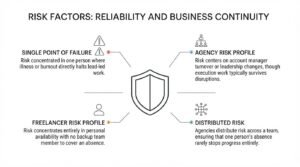
Freelancers carry higher single-point-of-failure risk than agencies, since illness, burnout, or a change in availability directly halts freelancer-led work. Agencies distribute this risk across a team, so one person’s absence rarely stops progress entirely.
Agency Risk Profile
An agency’s risk typically centers on account manager turnover or a decline in service quality following a merger or leadership change. Continuity of actual execution work usually survives these disruptions since the underlying team structure remains intact.
Freelancer Risk Profile
A freelancer’s risk concentrates entirely in their personal availability, since there’s no backup team member to cover an absence. I always ask freelancers directly what their contingency plan looks like if they become unavailable mid-project.
Some freelancers address this by maintaining relationships with trusted peers who can step in temporarily. This mitigation helps, but it rarely matches the seamless continuity an established agency team provides.
Speed and Turnaround Time Expectations
Agencies generally deliver faster turnaround on large-scope projects because multiple specialists can work in parallel, while freelancers execute tasks sequentially within their available hours. A technical audit and a content sprint can happen simultaneously inside an agency but typically happen one after another with a solo freelancer.
Freelancers can still outpace agencies on smaller, narrowly scoped tasks since there’s no internal handoff process slowing things down. Speed advantages shift depending entirely on project size and complexity.
Which Businesses Benefit Most From an Agency?
Growing mid-market and enterprise businesses with complex, multi-faceted SEO needs typically benefit most from hiring an agency. I recommend agencies specifically for businesses managing large sites, multiple product lines, or aggressive growth targets requiring parallel workstreams.
Businesses needing comprehensive link building campaigns alongside ongoing technical maintenance also tend to fit the agency model well, since that combination requires more hands than one freelancer can provide. Companies without in-house marketing leadership benefit from an agency’s structured account management filling that strategic gap.
Franchise businesses and multi-location companies managing local SEO across dozens of locations also lean toward agencies for the coordinated resourcing this work demands. The breadth of specialists becomes essential once a project spans multiple disciplines at once.
Which Businesses Benefit Most From a Freelancer?
Small businesses, solopreneurs, and startups with a narrow, well-defined SEO need typically benefit most from a freelancer. I recommend freelancers for businesses with tight budgets and a single clear objective, like fixing technical issues on a small site.
Local businesses targeting a single geographic area often get excellent results from a freelancer specializing in local search ranking factors, since the scope rarely requires a full team. Businesses that already have strong in-house marketing capability and just need specialized technical execution also fit this model well.
Startups validating product-market fit before committing to larger marketing budgets frequently start with a freelancer to keep costs flexible. This arrangement lets a business test SEO’s impact before scaling investment into a full agency retainer.
Hybrid Models: Combining Agency and Freelance Support
Some businesses combine an agency’s structured strategy with a freelancer’s specialized execution to get the benefits of both models. I’ve seen this work well when a company hires an agency for overall strategy and a freelance specialist for a narrow technical need the agency doesn’t cover in-house.
This hybrid approach requires more coordination from the business owner, since two separate parties need aligned priorities and shared reporting expectations. Businesses running hybrid models typically designate one internal point person to manage both relationships.
Red Flags to Watch for When Hiring Either Option
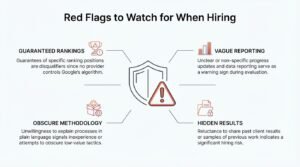
Vague reporting, guaranteed rankings, and reluctance to share past client results are warning signs regardless of whether you’re evaluating an agency or a freelancer. I treat any guarantee of a specific ranking position as an immediate disqualifier, since no legitimate provider controls Google’s algorithm.
Unwillingness to explain their process in plain language usually signals either inexperience or an attempt to obscure low-value tactics. I always ask for a sample of past work and a plain-language explanation of their exact methodology before signing anything.
Key Questions to Ask Before Making a Decision
The strongest filter question is simply asking how many active clients or accounts the provider currently manages. I follow this with questions about typical timelines, reporting cadence, and what happens if a key person becomes unavailable.
Asking for three references from clients with a similar business size and industry reveals more than any portfolio page. I also always ask what percentage of past clients renewed their contract after the first year, since renewal rates reveal actual satisfaction better than testimonials do.
How to Transition Between an Agency and a Freelancer
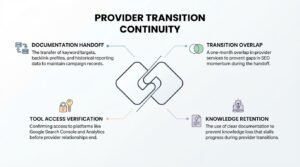
Businesses moving from a freelancer to an agency should request a full documentation handoff, including keyword targets, backlink profiles, and historical reporting data. I recommend overlapping the transition by a month wherever possible to avoid a gap in SEO momentum.
Businesses moving from an agency to a freelancer should confirm the freelancer can access existing tools like Google Search Console and Google Analytics before the agency relationship ends. Clear documentation prevents the kind of knowledge loss that stalls progress during any provider transition.
Conclusion
Agencies and freelancers each solve different problems: one brings scale and redundancy; the other brings direct, specialized focus. Your business size, budget, and growth trajectory should drive this decision.
Whichever path you choose, the fundamentals of technical SEO, content strategy, and authority building stay the same. Growth compounds when execution stays consistent over time.
We help businesses evaluate their SEO options and build sustainable strategies that fit their stage. Reach out to White Label SEO Service to map out the right approach for your growth goals.
Frequently Asked Questions
Is it cheaper to hire an SEO agency or a freelancer?
Freelancers are usually cheaper upfront, charging $50–$200 hourly versus agency retainers averaging around $2,800 monthly. Total cost can equalize if freelancer capacity limits extend project timelines significantly.
Can a freelancer handle enterprise-level SEO?
A single freelancer can struggle with enterprise-level SEO due to capacity and tool limitations on very large sites. Enterprise projects typically need the parallel workstreams only a team structure provides.
How long does it take to see results with either option?
Most SEO efforts take four to twelve months to show meaningful ranking movement, regardless of agency or freelancer. Agencies may accelerate this timeline slightly through parallel execution across specialists.
Do SEO agencies offer better reporting than freelancers?
Agencies typically provide more standardized, polished reporting through dedicated account management systems. Some freelancers offer equally detailed reports, though formats vary considerably by individual.
What happens if a freelancer becomes unavailable?
Work typically halts until the freelancer returns, since most freelancers lack backup staff to cover absences. This risk is one reason businesses ask about contingency plans before signing on.
Should a startup hire an agency or a freelancer first?
Startups with narrow, well-defined needs and tight budgets often start with a freelancer for flexibility. Startups with complex, multi-faceted needs may benefit more from an agency’s broader skill coverage.
Can I switch from a freelancer to an agency later?
Switching is common and manageable with proper documentation handoff of keywords, backlinks, and reporting history. Overlapping the transition by a month helps prevent momentum loss during the switch.