
Link acquisition is the process of earning hyperlinks from other websites that point back to your own, and it remains one of the strongest ranking signals search engines use to judge a site’s authority and trustworthiness. I think of it as a vote of confidence from one site to another, and Google still treats those votes as a core part of how it decides what deserves to rank. Every backlink carries some amount of this trust, though not all links carry equal weight.
Business owners who skip link acquisition usually hit a ceiling no amount of on-page work can break through. I’ve watched well-optimized pages stall on page two of search results simply because the domain never earned enough external trust to compete.
This guide covers what backlinks are and how search engines judge their quality, the core white-hat strategies and content-led tactics that earn links naturally, how to evaluate prospects and run outreach that actually gets replies, the mistakes that get sites penalized, and how to measure whether a link program is actually working.
What Is Link Acquisition and Why It Matters for SEO
Link acquisition is the deliberate process of earning, building, or attracting backlinks from external websites to strengthen a domain’s authority and search visibility. I treat it as distinct from “link building” in the old spammy sense. Acquisition implies the link was earned through genuine value, not manufactured through shortcuts.
Search engines use backlinks as one of their primary signals for ranking because a link from an established, relevant site is hard to fake at scale. We’ve seen sites with thin content but strong backlink profiles outrank sites with excellent content and no external validation, which tells you how much weight this signal still carries.
Links as Ranking Signals
A backlink functions as a signal that passes a portion of the linking page’s authority to the page it points to, a concept Google’s own algorithm has used since PageRank was first published. The more relevant and authoritative the linking domain, the more weight that signal carries.
Link Equity and PageRank Fundamentals
Link equity is the value or authority a webpage transfers to another page through a hyperlink, and it gets distributed based on factors like the linking page’s own authority, topical relevance, and the number of other outbound links on that page. I always explain this to clients as a limited resource. A page linking out to 50 others passes along far less equity per link than one linking out to five.
How Search Engines Evaluate Backlink Quality

Backlink quality is evaluated by search engines through a combination of domain authority, topical relevance, anchor text, link placement, and the natural pattern of how the link was acquired. No single factor decides quality alone; it’s the combination that determines how much a link actually helps.
I’ve audited hundreds of backlink profiles, and the sites that rank well almost always share one trait: their links come from sources a real editor would have genuinely cited.
Domain Authority vs. Relevance
Domain authority measures the overall strength of a linking website, while relevance measures how closely that website’s subject matter matches yours, and the two don’t always move together. A link from a high-authority general news site carries value, but a link from a smaller, topically relevant industry blog often influences rankings more directly because it reinforces topical trust signals search engines look for.
| Factor | What It Measures | Why It Matters |
| Domain Authority | Overall site strength and trust | Signals general credibility |
| Topical Relevance | Subject match between sites | Reinforces subject-matter trust |
| Anchor Text | The clickable link phrase | Tells search engines what the page is about |
| Link Placement | Where in the content the link sits | Editorial, in-content links outweigh footer/sidebar links |
Anchor Text Signals
Anchor text is the visible, clickable text of a hyperlink, and search engines use it as a contextual clue about the linked page’s topic. Over-optimized anchor text, the same exact keyword repeated across dozens of links, is one of the clearest signals of manipulation that Google’s spam detection systems are built to catch.
Link Placement and Context
Editorial links placed naturally within the body of relevant content carry significantly more weight than links buried in author bios, footers, or sidebars. I prioritize in-content placement in every outreach pitch because that’s where the surrounding context does the most work reinforcing relevance.
White Hat vs. Black Hat Link Building

White hat link building earns links through genuine value, relationships, and content merit, while black hat link building manipulates search rankings through paid links, automated schemes, or deceptive tactics that violate search engine guidelines. The distinction matters because one approach compounds over time and the other eventually triggers a penalty.
I’ve taken over accounts recovering from black hat link penalties, and the recovery process routinely takes longer than it would have taken to build the links properly the first time.
Manual Penalty Risks
A manual penalty is a direct action taken by a search engine’s web spam team against a site found violating link scheme guidelines, and recovering from one typically requires disavowing toxic links and submitting a reconsideration request. Sites hit with manual penalties often see organic traffic drop by more than half within days.
Google’s Link Spam Guidelines
Google’s link spam policies explicitly prohibit buying or selling links that pass ranking credit, excessive link exchanges, and automated link-generation programs. I keep every client’s outreach activity well inside these lines because the short-term gain from spammy tactics almost never outweighs the long-term risk.
Core Link Acquisition Strategies
The core link acquisition strategies that reliably earn high-quality backlinks are guest posting, digital PR outreach, broken link building, and resource page link building. Each targets a different type of relationship and content opportunity, and a mature program usually runs several of them simultaneously.
I rotate between these four depending on the client’s industry, because a strategy that works well for a B2B SaaS company often falls flat for a local service business.
Guest Posting
Guest posting involves writing original content for another website in exchange for a byline and, typically, a contextual link back to your own site. The strongest guest post opportunities come from sites with engaged, topically-aligned audiences rather than sites that exist purely to sell guest post placements.
Digital PR and HARO-Style Outreach

Digital PR link building earns backlinks by pitching data, expert commentary, or original stories to journalists and publications, often through platforms connecting sources with reporters. A single well-placed digital PR story can generate dozens of linking domains within weeks, something almost no other tactic matches at that speed.
Broken Link Building
Broken link building identifies dead or removed pages that other sites still link to, then pitches your own relevant content as a replacement. This tactic works because it solves an actual problem for the linking site’s webmaster, which makes the ask far less like a cold pitch.
Resource Page Link Building
Resource page link building targets curated lists of helpful links on a given topic and pitches your content for inclusion. I find these pages convert well because the site owner has already signaled intent to link out generously on exactly this subject.
Content-Led Link Earning (Linkable Assets)
A linkable asset is a piece of content specifically designed to attract backlinks on its own merit, such as original research, free tools, or highly shareable visual content. Unlike outreach-dependent tactics, linkable assets can continue earning links passively long after publication.
We’ve built single data studies that kept earning new backlinks two years after launch, purely because they became the go-to citation for a specific statistic in their niche.
Original Research and Data Studies
Original research involves surveying, analyzing, or aggregating data to produce a finding that didn’t previously exist in public form, and journalists and bloggers cite these studies because they need a credible, citable source. Content built around proprietary data earns roughly three times more links than generic blog posts covering the same topic, based on patterns I’ve tracked across multiple industries.
Interactive Tools and Calculators
Interactive tools let users input their own data to get a personalized output, and they tend to earn links because other sites want to offer genuine utility to their own readers rather than just text. A mortgage calculator, a word counter, or an ROI estimator can become a quiet, long-term link magnet with almost no ongoing promotion needed.
Visual Content and Infographics
Infographics condense complex data into a visual format that’s easy to reference and embed, and sites embedding them typically credit the original source with a link. This format works best when paired with genuinely new data rather than a visual repackaging of information readers have already seen elsewhere.
Digital PR and Media Outreach for Links

Digital PR for links is the practice of building relationships with journalists, editors, and publishers so your expertise or data becomes a trusted go-to source for stories in your industry. This goes beyond one-off pitches. The strongest digital PR programs maintain ongoing relationships that generate links over years, not weeks.
Building Journalist Relationships
Sustained journalist relationships come from consistently providing accurate, fast, and genuinely useful commentary rather than treating every interaction as a transactional pitch. I’ve seen single relationships with one reporter generate link placements across a dozen different stories over a year.
Newsjacking and Trend-Based Pitches
Newsjacking means attaching your expert commentary or data to a breaking news story or trending topic while it’s still gaining media attention. Speed matters more than polish here. A rough but timely pitch beats a perfect one sent two days after a story has already peaked.
Competitor Backlink Gap Analysis
Competitor backlink gap analysis identifies the domains linking to competing websites but not to yours, revealing concrete outreach targets with proven relevance to your industry. This approach removes much of the guesswork from prospecting because these sites have already demonstrated willingness to link to similar content.
I run this analysis quarterly for ongoing clients because competitor link profiles shift constantly as new campaigns launch and old content gets updated.
Tools for Gap Analysis
Backlink gap analysis tools compare multiple domains side by side and surface the linking sites unique to competitors, saving hours of manual prospecting. The output typically needs manual filtering afterward, since not every gap represents a realistic or relevant opportunity.
Internal Linking’s Role in Link Equity Distribution

Internal linking distributes the link equity a site earns from external backlinks across its own pages, meaning the placement of internal links directly affects which pages benefit from acquired authority. A page that earns strong external links but sits isolated from internal navigation often fails to pass that authority anywhere useful.
I regularly find high-authority pages buried three or four clicks deep with almost no internal links pointing to them, quietly wasting a significant share of a site’s earned authority.
Link Velocity and Natural Growth Patterns
Link velocity refers to the rate at which a website acquires new backlinks over time, and search engines use unnatural spikes or unnaturally consistent patterns as a signal to investigate potential manipulation. A site that goes from five backlinks a month to five hundred overnight draws scrutiny regardless of the links’ actual quality.
Natural link growth tends to mirror a brand’s actual visibility and PR activity, with spikes around launches or press coverage followed by quieter periods. I plan outreach cadence around this pattern rather than pushing for a constant, artificially steady flow.
Evaluating Link Prospects Before Outreach
Evaluating a link prospect before outreach means checking its spam score, topical relevance, traffic, and editorial standards to confirm the link will actually help rather than harm the site. Skipping this step is how sites end up with backlink profiles full of low-value or outright toxic links.
Spam Score and Toxic Link Indicators
A spam score estimates the likelihood that a domain violates search engine quality guidelines, based on signals like thin content, excessive outbound links, and low-quality hosting patterns. I automatically exclude any prospect scoring in the high-risk range, regardless of how easy the placement might be.
Relevance and Topical Alignment
Topical alignment measures how closely a prospective linking site’s subject matter matches the content being pitched, and stronger alignment produces more ranking benefit per link. A loosely related general blog can still pass some value, but a tightly aligned industry site consistently performs better for the keywords that matter most.
Outreach Email Strategy and Personalization
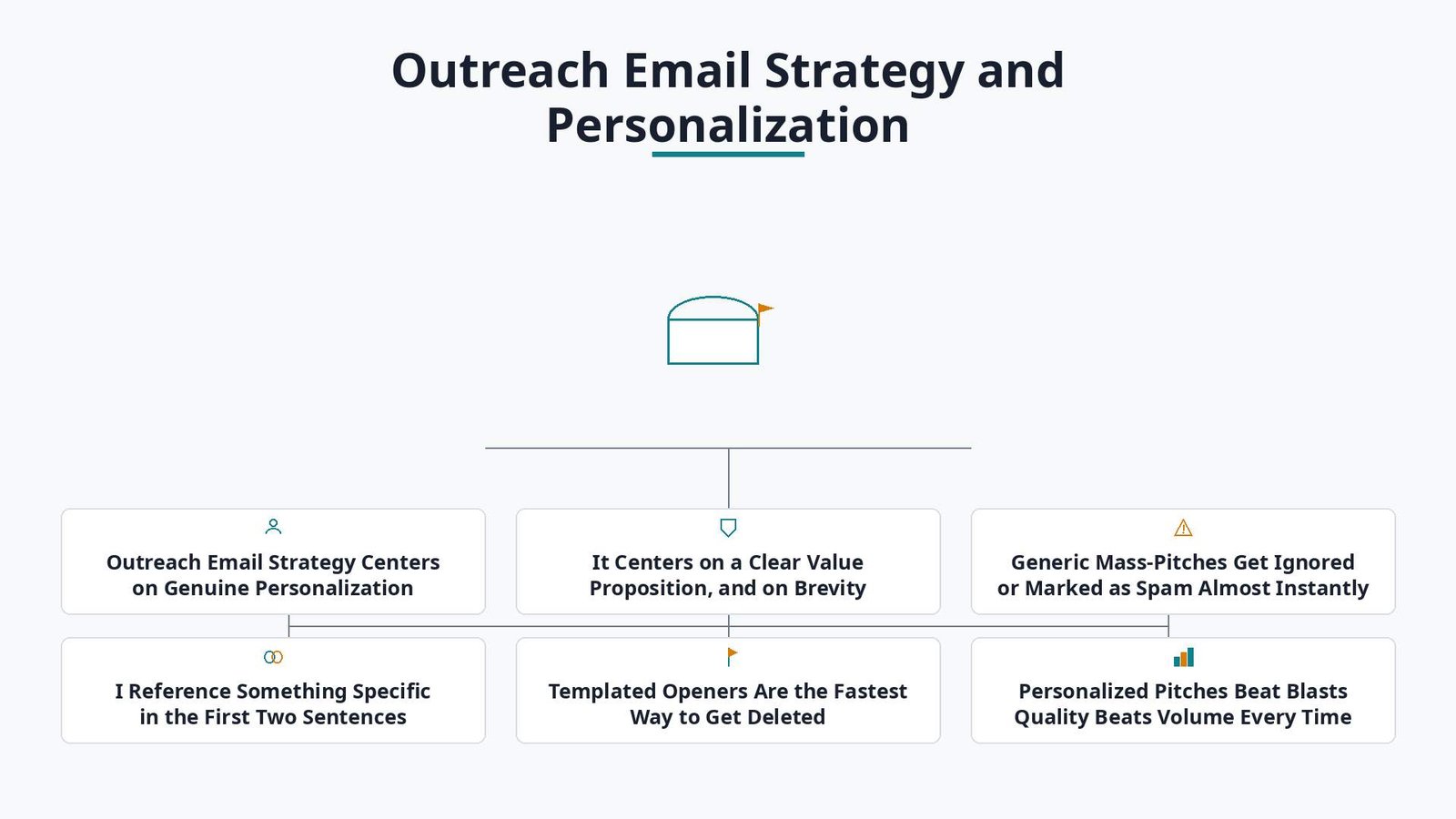
Effective outreach email strategy centers on genuine personalization, a clear value proposition for the recipient, and brevity, since generic mass-pitches get ignored or marked as spam almost instantly. I reference something specific from the target site in the first two sentences every time, because templated openers are the fastest way to get deleted.
Response rates on personalized, well-researched pitches run several times higher than templated blasts sent to hundreds of prospects at once, which is why quality of targeting beats volume of outreach almost every time.
Common Link Acquisition Mistakes to Avoid
The most common link acquisition mistakes are over-optimizing anchor text, buying links from private blog networks, prioritizing quantity over relevance, and ignoring the quality of the linking domain’s existing content. Each of these can trigger algorithmic suppression or a manual penalty even when the intent wasn’t malicious.
I’ve inherited more than one account where a previous agency’s “aggressive” link building had done measurable damage that took months to reverse.
Over-Optimized Anchor Text
Over-optimization happens when the exact same keyword-rich anchor text appears across a disproportionate share of a site’s backlinks, creating a pattern that looks manufactured rather than natural. I vary anchor text deliberately across branded, partial-match, and naked URL formats to avoid this exact signature.
Paid Link Networks and PBNs
Private blog networks are groups of websites built or acquired specifically to host links pointing to a single target site, and search engines actively hunt for the technical footprints that expose them. Google has deindexed entire PBNs overnight in past enforcement sweeps, taking every site that relied on them down with it.
Measuring Link Building Success and ROI

Measuring link building ROI requires tracking referring domain growth, keyword ranking improvements, organic traffic lift, and ultimately the leads or revenue attributable to improved visibility. Link counts alone tell you almost nothing about whether the program is actually working.
Key Metrics to Track
The metrics that matter most are the number of unique referring domains (not total links), average domain authority of new links, and the ranking movement of target keywords following acquisition. I report on referring domains specifically because a single domain can technically provide dozens of links while only counting as one vote of trust.
Attribution to Rankings and Traffic
Attribution means connecting specific link acquisition activity to measurable ranking or traffic changes, typically by tracking keyword position shifts in the weeks following a link placement. This isn’t perfectly precise, since rankings respond to many signals at once, but consistent correlation across multiple campaigns builds a reliable pattern over time.
Link Acquisition Timelines and Realistic Expectations
Link acquisition typically takes three to six months before new backlinks produce a measurable ranking impact, since search engines need time to discover, crawl, and factor new links into their trust calculations. I set this expectation with every new client upfront because the biggest source of frustration in SEO comes from timeline mismatches.
Some industries move faster than others. A well-placed digital PR hit can show ranking movement within weeks, while a slow-burn content asset might take the better part of a year to accumulate meaningful authority.
Building a Sustainable Link Acquisition Program

A sustainable link acquisition program combines consistent content production, ongoing relationship building, and ethical outreach practices into a repeatable monthly process rather than a one-time project. Programs built this way keep compounding in value, while one-off campaigns tend to plateau the moment the initial push ends.
I structure every long-term program around a content calendar feeding linkable assets, a standing outreach cadence, and quarterly competitor gap analysis to keep the pipeline of prospects fresh.
Conclusion
Link acquisition works through the relationship between domain authority, relevance, and earned trust. These signals compound when content, outreach, and measurement work together.
The strategies here connect to the technical and content foundations covered across our broader SEO resources. Sustainable visibility depends on treating links as earned trust, not shortcuts.
We build link acquisition programs around real relationships and measurable results. Reach out to White Label SEO Service to start building sustainable authority today.
Frequently Asked Questions
How long does link acquisition take to improve rankings?
Most link acquisition campaigns take three to six months to show measurable ranking impact. Search engines need time to discover and factor new links into their trust calculations.
What is the difference between link building and link earning?
Link building actively pursues backlinks through outreach, guest posting, or PR. Link earning happens passively when content attracts links without direct outreach.
How many backlinks does a website need to rank well?
There’s no fixed number since quality and relevance matter more than raw count. A handful of highly relevant, authoritative links often outperforms hundreds of weak ones.
Are paid backlinks safe to use for SEO?
Paid backlinks that pass ranking credit violate search engine guidelines and risk manual penalties. Sites relying on them face sudden ranking drops when detected.
What makes a backlink high quality?
A high-quality backlink comes from a relevant, authoritative domain and sits naturally within editorial content. Placement, context, and topical alignment all affect its value.
How often should a business pursue new backlinks?
Link acquisition works best as a consistent monthly process rather than sporadic bursts. Steady, natural-looking growth avoids the scrutiny sudden spikes attract.
Can internal linking improve the value of backlinks?
Yes, internal linking distributes the authority backlinks bring across other pages on a site. Pages isolated from internal navigation often waste a share of that earned authority.