I get asked this question constantly: should a business hire an SEO agency or build an in-house team? The right choice between agency SEO and in-house SEO depends on your budget, growth timeline, internal resources, and how much strategic control you want over execution. There’s no universal answer, only a better fit for your specific situation.
Getting this decision wrong wastes months of runway and thousands in payroll or retainer fees. I’ve watched businesses hire a full in-house team too early and burn cash before traffic ever moved. Others lean on agencies forever when a hybrid setup would serve them better.
This guide covers what each model actually looks like day-to-day, how their costs and timelines compare, the skills and tools each one requires, and the risk factors that rarely get discussed. I’ll also walk through when a hybrid approach outperforms picking just one.
What Agency SEO and In-House SEO Actually Mean
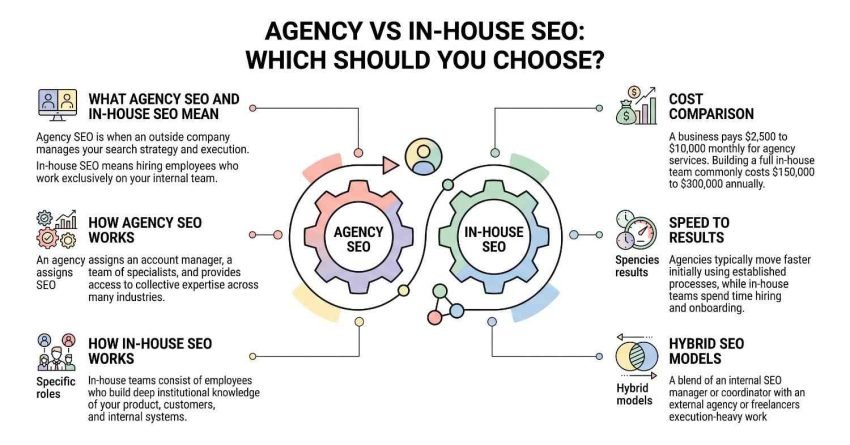
Agency SEO means an outside company manages your search strategy, execution, and reporting under a monthly retainer or project fee. In-house SEO means you hire employees who work exclusively on your organic search performance as part of your internal team.
I think of these as two different operating models, not two different SEO strategies. The tactics technical audits, content production, link acquisition stay largely the same. What changes is who executes them and how that execution gets managed.
How Agency SEO Works
An SEO agency typically assigns you an account manager, a team of specialists, and a shared pool of tools and processes refined across dozens of client accounts. You get access to collective expertise built from testing strategies across many industries and website types.
Agencies usually work from a defined scope of deliverables each month: audits, content, link building, and reporting. This structure works well for businesses that want expert execution without managing a team directly.
How In-House SEO Works
An in-house SEO team consists of employees who report directly to your marketing leadership and work solely on your website’s organic performance. They build deep institutional knowledge of your product, customers, and internal systems over time.
This model gives you direct oversight of daily priorities and immediate access to the people doing the work. The tradeoff is that you’re responsible for hiring, training, and retaining that talent yourself.
Hybrid SEO Models
A hybrid SEO model blends an internal SEO manager or coordinator with an external agency or freelance specialists handling execution-heavy work like content production or link building. Hybrid setups let a lean internal team focus on strategy while outsourcing production-heavy tasks that don’t require full-time headcount, an approach I’ll return to later in this guide.
Cost Comparison: Agency SEO vs In-House SEO Salaries
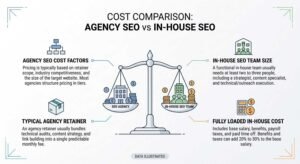
A mid-sized business typically pays between $2,500 and $10,000 per month for agency SEO services, while a single in-house SEO hire costs $60,000 to $110,000 annually in salary alone, before benefits, tools, and software subscriptions.
I always tell clients to calculate the fully loaded cost of an in-house hire, not just the base salary. Benefits, payroll taxes, and paid time off typically add 20% to 30% on top of salary, according to the Society for Human Resource Management.
Average Cost of an SEO Agency
SEO agencies price their retainers based on the scope of work, competitiveness of the industry, and the size of the target website. Most agencies structure pricing in tiers, so a startup targeting local keywords pays far less than an enterprise brand competing nationally.
An agency retainer typically bundles technical audits, content strategy, and link building into a single monthly fee. This makes budgeting predictable and avoids the overhead of employer payroll costs.
Average Cost of an In-House SEO Team
A functional in-house SEO team usually needs at least two to three people: a strategist, a content specialist, and someone handling technical execution or outreach. Building this team from scratch commonly costs $150,000 to $300,000 annually in combined salaries alone.
Beyond salaries, in-house teams need a budget for SEO software licenses, which frequently run $500 to $3,000 monthly depending on the tool stack chosen. This is a cost agencies typically absorb into their own overhead.
Expertise and Skill Set Requirements for Each Model
Building a fully capable in-house SEO function requires hiring across multiple specialized skill sets that rarely exist in one person. This is one of the most underestimated challenges businesses face when moving away from an agency model.
Technical SEO Skills Needed
Technical SEO work involves site architecture, crawlability, page speed, structured data, and indexation control. These skills demand familiarity with server-side concepts and development workflows that most content-focused marketers never learn.
Finding a single hire who can competently manage technical audits and fix implementation issues without developer support is genuinely rare. Most in-house teams eventually contract this work out even when everything else runs internally.
Content and Link Building Skills Needed
Content strategy for SEO requires keyword research, search intent mapping, and topical planning skills distinct from general copywriting ability. Link building demands outreach, relationship management, and digital PR skills that operate almost like a sales function.
I rarely see these skill sets combined in a single hire, which is why in-house teams of one person often struggle to keep pace with agency output across every discipline simultaneously.
Speed to Results: Which Model Delivers Faster ROI
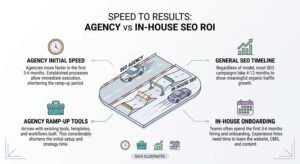
Agencies typically move faster in the first three to six months because they start executing immediately using established processes, whereas in-house teams often spend that same window hiring and onboarding. Most SEO campaigns, regardless of model, take four to twelve months to show meaningful organic traffic growth, according to industry benchmarks from Ahrefs.
An agency arrives with existing tools, templates, and workflows already built, which shortens the ramp-up period considerably. An in-house hire, even an experienced one, needs time to learn your website, your CMS, and your existing content before producing meaningful output.
Once an in-house team is fully ramped, though, it can move faster on urgent fixes since there’s no scope negotiation or ticket queue standing between a decision and its execution.
Scalability and Flexibility Differences
Agencies scale up or down instantly by adjusting your retainer, since they already employ the specialists needed across content, technical, and outreach work. In-house teams scale much slower because every increase in capacity requires a new hiring cycle.
This flexibility matters most for seasonal businesses or companies testing SEO investment before committing to permanent headcount. I’ve seen businesses double their agency scope during a product launch and scale back the following quarter without any layoffs or restructuring.
Tools and Technology Access in Each Model
SEO agencies typically maintain enterprise-level subscriptions to platforms like Ahrefs, Semrush, and Screaming Frog, spreading that cost across many client accounts. This gives smaller businesses access to tools that would be cost-prohibitive to license individually.
In-house teams need to budget separately for every tool in the stack, and smaller companies often end up working with limited or free-tier versions of critical software. This gap in tooling access can meaningfully limit the depth of keyword research and competitive analysis an in-house team can perform.
Control, Communication, and Reporting Structures
In-house SEO teams offer direct daily access to the people doing the work, meaning priorities can shift instantly without a change request or contract renegotiation. Agencies require structured communication channels, which can slow down urgent decisions but also enforce more disciplined reporting habits.
Reporting Cadence and Transparency
Most agencies provide monthly performance reports covering rankings, traffic, and conversions tied back to the agreed scope of work. In-house teams often report less formally since they sit inside existing team meetings, which can mean performance tracking becomes inconsistent without a deliberate process.
Strategic Alignment with Business Goals
An in-house SEO team develops deep familiarity with product positioning, sales cycles, and customer language over time, which naturally improves strategic alignment. Agencies close this gap through onboarding and regular strategy calls, but they rarely reach the same depth of institutional knowledge an internal employee builds.
Risk Factors: Turnover, Burnout, and Knowledge Gaps
In-house SEO hires carry turnover risk that agencies structurally avoid, since losing a single specialist can stall an entire campaign until a replacement is hired and trained. The average tenure for a marketing specialist role is under three years, according to Bureau of Labor Statistics data on job tenure trends.
Knowledge gaps compound this risk further, since a departing in-house SEO often takes undocumented processes and login access with them. Agencies mitigate this through team redundancy, where multiple specialists share account knowledge instead of concentrating it in one person.
When an SEO Agency Makes More Sense
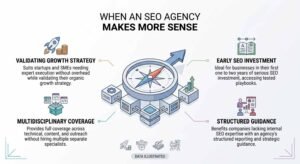
An SEO agency fits best for businesses that need expert execution without the overhead of building an internal team, particularly startups and SMEs still validating their organic growth strategy. Agencies also make sense when a business needs multidisciplinary coverage technical, content, and outreach without hiring three separate specialists.
I typically recommend an agency to businesses in their first one to two years of serious SEO investment, since they get access to tested playbooks instead of learning through internal trial and error. Companies without a marketing leader who understands SEO deeply also benefit from an agency’s structured reporting and strategic guidance.
Seasonal businesses and companies testing a new market before committing long-term also do better with an agency’s flexible scope. The ability to scale services up or down without a hiring or layoff cycle removes a major operational risk during uncertain growth periods.
When an In-House SEO Team Makes More Sense
In-house SEO tends to make more sense once a company reaches a scale where organic search is a primary growth channel and daily strategic alignment becomes critical. Large e-commerce sites, SaaS platforms with complex product catalogs, and publishers with high content velocity often outgrow what a shared agency team can dedicate to a single account.
Businesses with highly technical or regulated products also benefit from in-house SEO, since deep product knowledge often matters more than broad SEO experience for content accuracy. Building institutional knowledge inside the team reduces the onboarding friction that comes with rotating agency staff.
Companies with the budget to hire a full team strategist, content specialist, and technical lead get more direct control and faster internal decision-making once that team matures. This model rewards businesses that can commit to the twelve-plus months typically needed to build a fully functional internal function.
The Hybrid Model: Combining Agency and In-House SEO
A hybrid model pairs an internal SEO manager who owns strategy and stakeholder alignment with an external agency or freelancers handling content production, technical fixes, or link building. This structure gives a business direct oversight without needing to hire every specialist role internally.
I see this model working particularly well for mid-sized companies that have outgrown a pure agency relationship but aren’t ready to fund a five-person internal team. The internal hire manages priorities and business context while the agency supplies specialized execution capacity and overflow support during busy periods.
How to Evaluate an SEO Agency Before Hiring One
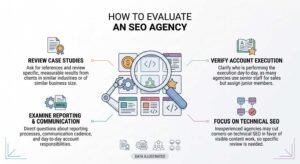
Evaluating an SEO agency starts with reviewing their case studies and asking for references from clients in a similar industry or business size. A credible agency shows specific, measurable results rather than vague claims about traffic or ranking improvements.
Ask directly about their reporting process, communication cadence, and who will actually work on your account day-to-day. Many agencies use senior staff for the sales process but assign junior team members to execution, which is worth clarifying upfront.
Review their approach to technical SEO specifically, since this is where inexperienced agencies most often cut corners in favor of faster, more visible content work.
Key Questions to Ask Before Choosing a Model
Before committing to either model, map out your growth timeline and ask whether you need results within six months or are building for a two-year horizon. Your answer changes which model fits, since agencies typically move faster initially while in-house teams compound value over a longer period.
Ask what internal bandwidth exists to manage either relationship, since agencies still require a point of contact who reviews reports and makes timely decisions. Consider your budget flexibility too, since in-house salaries are fixed costs regardless of performance, while agency retainers can often be adjusted based on results or scope changes.
Conclusion
Agency SEO and in-house SEO both work well when the model matches your budget, timeline, and internal capacity. Neither option guarantees success without clear strategy and consistent execution behind it.
Growth-stage businesses often start with an agency, then transition toward hybrid or in-house structures as organic search matures into a primary revenue channel.
We help businesses navigate exactly this decision. Talk to our White Label SEO Service team to build a growth plan suited to your stage.
Frequently Asked Questions
Is it cheaper to hire an SEO agency or an in-house team?
An SEO agency is almost always cheaper upfront, typically costing $2,500 to $10,000 monthly versus $60,000+ annually per in-house hire. In-house becomes more cost-effective only at significant scale with multiple specialists needed.
How long does it take to see results from in-house SEO?
In-house SEO typically takes four to twelve months to show meaningful traffic growth, similar to agency timelines. The ramp-up period is often longer due to hiring and onboarding before execution even begins.
Can a small business afford an in-house SEO specialist?
Most small businesses struggle to justify a $60,000+ salary for a single SEO hire when an agency can cover the same scope for a fraction of the cost. Agencies typically make more financial sense until a business reaches consistent six-figure marketing budgets.
Do agencies or in-house teams get better SEO results?
Neither model inherently produces better results; outcomes depend on skill, strategy, and consistency of execution. Agencies bring broader cross-industry experience, while in-house teams bring deeper product and audience knowledge.
What is a hybrid SEO model?
A hybrid SEO model combines an internal strategist or manager with an external agency or freelancers handling execution tasks like content or link building. This structure balances direct oversight with specialized outside capacity.
How many people do you need for an in-house SEO team?
A functional in-house SEO team typically needs at least two to three people covering strategy, content, and technical execution. Smaller teams often struggle to cover every discipline without contracting out gaps.
When should a business switch from an agency to in-house SEO?
Businesses typically switch to in-house SEO once organic search becomes a primary revenue channel, and budget supports a multi-person team long-term. This shift usually happens after twelve to twenty-four months of proven agency-driven growth.