White-label SEO reporting is a system that lets agencies deliver branded, client-facing performance reports without building the underlying reporting infrastructure themselves. I’ve watched agencies waste dozens of hours a month manually pulling data into spreadsheets before switching to a white-label solution. This guide is for agency owners, marketing managers, and in-house teams who need a scalable way to show clients real results.
Manual reporting doesn’t scale past a handful of clients before something breaks. Agencies that switch to white-label dashboards typically reclaim ten or more hours weekly across their account teams.
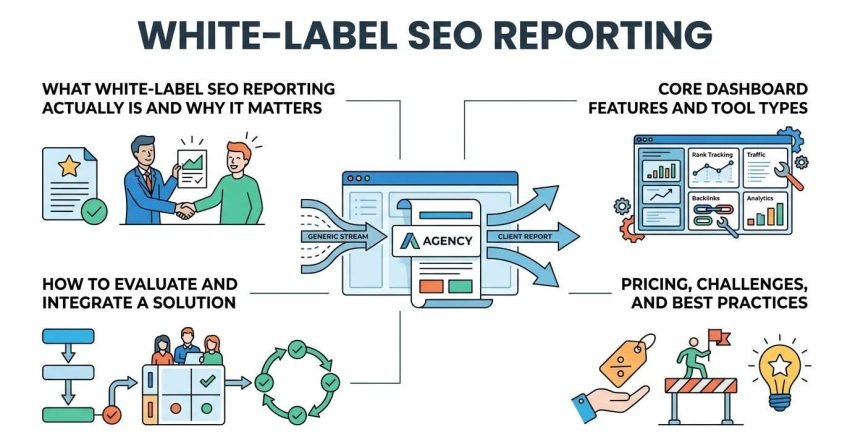
I’m covering what white-label SEO reporting actually is and why it matters, the core dashboard features and tool types available, how to evaluate and integrate a solution into your workflow, and the pricing, challenges, and best practices that come with running one at scale.
What Is White Label SEO Reporting?
White-label SEO reporting is a rebrandable system that packages SEO performance data rankings, traffic, backlinks, and conversions into client-ready reports under an agency’s own branding. I use this definition with every agency I talk to because it captures the two things that matter: the data and the branding layer sitting on top of it.
The client never sees the underlying software vendor. They see your logo, your color scheme, and your domain on every report that lands in their inbox. This matters because agency-client relationships depend heavily on perceived ownership of results, and a report bearing a third-party brand undercuts that.
Most platforms pull data automatically from Google Search Console, Google Analytics, and rank tracking APIs, then compile it into a dashboard or PDF. I’ve found the best implementations let agencies control not just the logo but the entire domain the client-facing portal lives on.
Why Agencies Need White Label Dashboards
Agencies need white-label dashboards because manual reporting consumes billable hours that should go toward strategy and execution instead. I’ve sat in on account reviews where an entire hour got burned just walking through screenshots pasted into a slide deck.
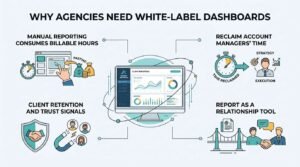
A Clutch survey on agency operations found that reporting and administrative tasks consume a meaningful share of account managers’ weekly time that white-label automation reclaims almost immediately.
Client retention improves too. When reports arrive on schedule, look professional, and show clear progress, clients trust the process even during the slower early months of an SEO campaign.
Client Retention and Trust Signals
Consistent, branded reporting is one of the strongest trust signals an agency can send during the first six months of a client relationship. Churn tends to spike when clients feel uncertain about what they’re paying for, and a recurring dashboard closes that information gap before doubt sets in.
I always tell newer account managers that a report is a relationship tool first and a data dump second.
How White Label SEO Reporting Works
White label SEO reporting works by connecting an agency’s client accounts to data sources through APIs, then automatically compiling that data into a rebranded dashboard or scheduled report. The agency configures the branding once, connects each client’s Google Search Console and Analytics properties, and the platform handles the rest.
Data pulls typically refresh daily or weekly, depending on the platform and plan tier. I’ve used tools where the sync happens overnight, so account managers walk in every morning to a dashboard that already reflects the previous day’s rankings and traffic.
Data Sources and Integrations
Most white-label platforms integrate with Google Search Console, Google Analytics, major rank tracking databases, and backlink indexes. Some also pull in call tracking or CRM data for agencies reporting on full-funnel results, not just organic visibility.
The strength of an integration list matters more than most agencies realize during initial tool selection. A platform that only connects to two or three data sources will eventually force a second tool into the stack.
Types of White Label SEO Reporting Tools
White label SEO reporting tools generally fall into three categories: standalone reporting platforms, all-in-one SEO suites with reporting built in, and custom-built dashboards using data visualization software. Each serves a different agency size and technical capacity.
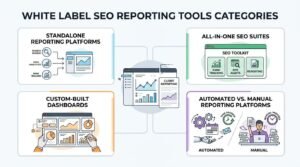
Standalone reporting platforms focus purely on presentation and automation, pulling data from other tools an agency already uses. All-in-one suites bundle rank tracking, site audits, and reporting into a single subscription, which suits smaller agencies wanting fewer vendors.
Automated vs. Manual Reporting Platforms
Automated platforms schedule and send reports without human intervention, while manual platforms still require someone to compile, format, and send each one. I’ve never met an agency past ten clients that stuck with manual reporting once they tried automation; the time savings are too obvious once you’ve felt it.
Core Features of a White Label SEO Dashboard
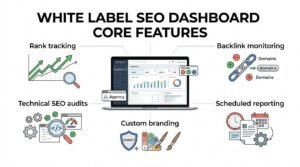
A white label SEO dashboard’s core features determine how much manual work an agency avoids and how professional the client experience feels. The following table shows what to expect across most reputable platforms.
| Feature | What It Does | Why It Matters |
| Rank tracking | Monitors keyword positions over time | Shows visible progress to clients |
| Backlink monitoring | Tracks new and lost backlinks | Demonstrates authority-building work |
| Technical SEO audits | Flags crawl errors, site speed issues | Surfaces problems before clients notice them |
| Custom branding | Applies agency logo, domain, colors | Reinforces agency identity |
| Scheduled reporting | Automates report delivery | Saves account management time |
Rank Tracking
Rank tracking monitors where a client’s target keywords sit in search results over a defined period, usually updated daily or weekly. It’s the single most-viewed metric in any client report I’ve ever put together, because it’s the easiest number for a non-technical client to understand.
Backlink Monitoring
Backlink monitoring tracks new links pointing to a client’s site along with any links lost during the reporting period. This gives agencies a documented trail of authority-building work that would otherwise be invisible to the client.
Technical SEO Audits
Technical SEO audits scan a website for crawl errors, broken links, slow-loading pages, and indexing problems on a recurring basis. Catching a crawl error before a client notices a traffic dip prevents an uncomfortable conversation later.
Customization and Branding Options
Customization options in white-label SEO reporting typically include logo placement, custom domains, color schemes, and report layout templates. The depth of customization varies enormously between platforms, and I’ve seen agencies choose a tool based on this factor alone.
Logo, Domain, and Color Scheme Control
Full white-label platforms let an agency host the client dashboard on its own subdomain, apply its logo to every PDF, and match its brand’s color palette throughout. Lower-tier platforms sometimes limit branding to just a logo in the header, which still shows the vendor’s name in the footer or URL.
White Label SEO Reporting vs. Building In-House Dashboards
White label SEO reporting and in-house dashboards differ mainly in development cost, time to launch, and ongoing maintenance responsibility. Building in-house gives full control but requires a dedicated development resource most agencies don’t have spare.
| Factor | White Label Platform | In-House Dashboard |
| Setup time | Days | Months |
| Development cost | Subscription fee | Developer salary/contract |
| Maintenance | Handled by vendor | Agency’s responsibility |
| Customization depth | Moderate to high | Unlimited |
| Data source flexibility | Pre-built integrations | Custom-built as needed |
Agencies with in-house development talent sometimes build custom dashboards to match a specific client vertical’s needs. Most agencies under fifty clients find the subscription cost of a white label tool far cheaper than a single developer’s salary.
How to Choose a White Label SEO Reporting Tool
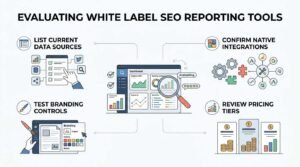
Choosing a white label SEO reporting tool comes down to evaluating data source compatibility, branding depth, pricing structure, and customer support quality. I walk every agency I advise through the same four-step evaluation before they commit to a subscription.
- List every data source the agency currently uses for client work
- Confirm the platform integrates with each of those sources natively
- Test the branding controls to see how much of the vendor’s identity remains visible
- Review the pricing tiers against the agency’s current and projected client count
Evaluation Criteria for Agencies
The strongest evaluation criteria weigh integration breadth, branding depth, and total cost per client above flashy dashboard visuals. A platform that looks impressive in a demo but only integrates with two data sources will frustrate an account team within a month.
Integrating White Label Reports Into Client Workflows
Integrating white-label reports into client workflows means setting a consistent delivery schedule, connecting each client’s accounts once, and training account managers on how to interpret the data before client calls. Most platforms support this through automated scheduling rather than manual sends.
Automation and Scheduling
Automation and scheduling features let agencies set reports to generate and send on a fixed cadence, typically weekly or monthly, without manual intervention. I recommend monthly for most retainer clients and weekly only for higher-touch, higher-budget accounts.
Common Metrics Included in White Label SEO Reports
Common metrics in white-label SEO reports include organic traffic, keyword rankings, conversion rates, backlink counts, and return on investment calculations. These five categories cover what most clients actually want to see, according to the agencies I’ve worked alongside.
Traffic, Rankings, Conversions, and ROI Data
Traffic data shows visitor volume trends, rankings show keyword position changes, conversions show goal completions tied to organic visits, and ROI data ties the whole campaign back to revenue impact. Clients focused purely on rankings often shift their attention to ROI once a campaign matures past its first two quarters.
Pricing Models for White Label SEO Reporting Solutions
Pricing models for white label SEO reporting solutions typically fall into per-client, tiered subscription, or flat-rate agency plans. Per-client pricing scales directly with an agency’s client count, which works well for smaller agencies but gets expensive fast at scale.
Tiered subscription plans bundle a set number of client slots into a monthly fee, stepping up in price as an agency grows past each threshold. Flat-rate agency plans charge one price regardless of client count, which tends to favor larger agencies running high client volumes.
Common Challenges With White Label SEO Reporting
Common challenges with white label SEO reporting include data accuracy discrepancies, integration limits, and client confusion over metrics they don’t fully understand. I’ve fielded plenty of client calls that started with “why do these numbers not match what I see in Google?”
Data Accuracy and Client Transparency Issues
Data accuracy issues usually stem from reporting lag between when Google updates its data and when the reporting platform syncs it. Being transparent about refresh timing upfront prevents most of the confused emails that would otherwise land in an account manager’s inbox.
Best Practices for Presenting SEO Reports to Clients

Best practices for presenting SEO reports to clients include leading with business outcomes, translating technical metrics into plain language, and scheduling a live walkthrough rather than sending a report cold. A PDF sitting unopened in an inbox does nothing for retention.
- Lead with the outcome the client cares about most, usually leads or revenue.
- Translate jargon like “domain authority” into plain business language
- Compare against the previous period, not just raw numbers
- Schedule a short call to walk through the report together
- End with next steps, not just historical data
How White Label SEO Reporting Supports Agency Growth
White-label SEO reporting supports agency growth by freeing account management hours that get reinvested into acquiring and servicing new clients. Every hour not spent formatting a spreadsheet is an hour available for strategy work that actually retains the account.
Agencies scaling past twenty or thirty clients almost always cite reporting automation as one of the operational changes that made the growth possible.
White Label SEO Reporting and Long-Term Client Relationships
Long-term client relationships benefit from white label reporting because consistent, professional communication builds the kind of trust that survives a slow month or two. SEO results fluctuate, and a client who understands the data trusts the process even when a single month dips.
I’ve seen accounts survive rocky quarters purely because the reporting relationship had already built enough goodwill to weather it.
Conclusion
White label SEO reporting connects agency branding to real performance data rankings, traffic, backlinks, and ROI inside one automated system. It fits into the broader toolkit agencies use to scale client management and strengthen retention over time. We build reporting into every engagement at White Label SEO Service, and we’re ready to help your agency scale with confidence.
Frequently Asked Questions
What does white label SEO reporting mean?
White label SEO reporting means an agency delivers SEO performance data to clients under its own branding rather than a third-party vendor’s. The underlying software stays invisible to the client throughout the relationship.
How much does white label SEO reporting cost?
White label SEO reporting typically costs between $50 and $500 monthly, depending on the pricing model and client volume. Per-client and tiered subscription plans are the two most common structures.
Can small agencies use white-label SEO dashboards?
Small agencies can and often benefit most from white-label SEO dashboards since they lack the resources to build reporting infrastructure in-house. Most platforms offer entry-level tiers suited to five or fewer clients.
What data sources connect to white label SEO reports?
White-label SEO reports commonly connect to Google Search Console, Google Analytics, rank tracking databases, and backlink indexes. Some platforms also support CRM and call tracking integrations.
How often should SEO reports be sent to clients?
Most agencies send SEO reports monthly, though higher-touch accounts sometimes receive weekly updates. The right cadence depends on the client’s budget and level of involvement.
Do white-label dashboards replace an account manager?
White-label dashboards don’t replace an account manager since interpreting data and building client relationships still require human judgment. The dashboard handles the data compilation, not the client conversation.
What is the difference between white-label reporting and a client portal?
White-label reporting refers to the branded reports themselves, while a client portal is the ongoing dashboard interface clients can log into anytime. Many platforms offer both under the same subscription.