White label SEO client management is the set of communication, reporting, and expectation-setting practices an agency or reseller uses to keep an end client satisfied without revealing that the SEO work is outsourced. I’ve watched partnerships collapse not because the rankings didn’t move, but because nobody managed the conversation around them. Good SEO work paired with poor client management still ends in churn.
Getting this relationship right protects revenue, referrals, and reputation for everyone in the chain. Getting it wrong costs contracts fast, and word travels quietly.
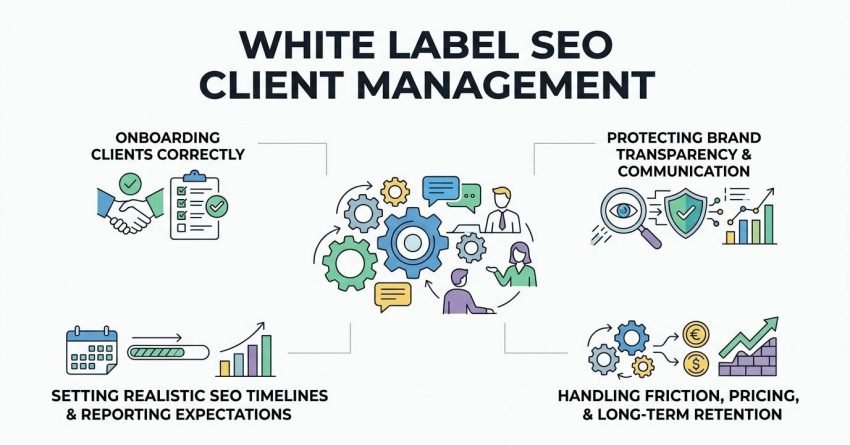
This guide covers what the white label client relationship actually involves, how to onboard clients correctly, how to protect brand transparency and communication, how to set realistic SEO timelines and reporting expectations, and how to handle friction, pricing, and long-term retention as the relationship matures.
What White Label SEO Client Management Actually Involves
White label SEO client management is the ongoing coordination between an SEO provider, a reseller (often an agency or freelancer), and the end client who ultimately pays for the results. I sit in the middle of this triangle constantly, and the role changes depending on who’s talking to whom.
The provider does the technical and content work. The reseller owns the client relationship and often the brand the client sees. The end client just wants traffic, leads, and clear answers.
Client management fits into the white label workflow at every touchpoint: onboarding, reporting, renewals, and escalations. A white label SEO reseller sits between the technical provider and the end client, translating deliverables into business outcomes the client actually cares about.
I’ve found the biggest friction point is the handoff when work moves from the provider’s technical language into something a business owner without an SEO background can understand.
The Agency-Reseller-Client Triangle
Three parties, three sets of expectations, one shared outcome. The provider needs clear scope. The reseller needs consistent, presentable deliverables. The client needs confidence that their investment is working.
I treat this triangle as a single system, because a breakdown at any point shows up in the client relationship eventually, even when the actual SEO work is solid.
Where Client Management Fits in the White Label Workflow
Client management isn’t a separate task bolted onto SEO delivery. It’s woven through discovery, execution, and reporting.
Every deliverable that reaches the end client passes through a relationship filter first: does this build trust or create confusion?
Why Client Relationship Management Makes or Breaks White Label Partnerships
Client relationship management determines whether a white label SEO partnership survives past the first ranking plateau. I’ve seen technically excellent SEO work lose a client because nobody explained why rankings dipped in month four.
SEO takes time, and that gap between effort and visible results is exactly where relationships either strengthen or fall apart.
The Cost of Poor Client Communication in Reseller Models
Poor communication in a reseller model compounds fast because the reseller absorbs the client’s frustration without always having the technical context to respond. A study by HubSpot found that 68% of customers leave a business due to perceived indifference rather than poor service quality itself.
That statistic tracks with what I see in white label SEO. Clients don’t leave because rankings are slow. They leave because nobody told them rankings would be slow.
Setting Up the Foundation: Onboarding White Label Clients Correctly

Correct white label client onboarding starts before any SEO work begins, with a discovery process that captures the client’s real business goals, not just their keyword wishlist. I never skip this step, even under deadline pressure.
Client Discovery and Expectation-Setting
Client onboarding for SEO services should map the client’s business priorities against realistic SEO outcomes before any contract is signed. This prevents the mismatch that causes early churn.
I ask about revenue goals, not just ranking goals. A client who wants leads cares less about position one than about the phone ringing.
Defining Scope, Deliverables, and Reporting Cadence
Scope needs to be written down in specific, measurable terms:
- Which keywords or keyword groups are being targeted
- What deliverables arrive monthly (content, links, technical fixes)
- How often reporting happens and in what format
- Who the client’s point of contact is
- What counts as “in scope” versus a paid add-on
Without this list in writing, scope creep starts within the first quarter.
Maintaining Brand Transparency in White Label Relationships
Brand transparency in white label SEO means deciding, upfront and deliberately, what the end client knows about who’s actually doing the work. Some resellers disclose it fully. Others keep the provider invisible entirely.
I don’t think there’s a universally correct answer here; it depends on the reseller’s positioning and the client’s sophistication.
Deciding What the End Client Sees vs. Doesn’t See
The safest default is treating every report, email, and call script as if the client will eventually see the provider’s name somewhere. White label reporting should carry the reseller’s branding consistently across every touchpoint, from dashboards to PDF exports.
Inconsistent branding is usually what breaks the illusion, not a slip of the tongue.
Communication Frameworks That Keep Clients Confident

A communication framework gives white label clients a predictable rhythm of contact, which matters more for retention than almost any single ranking improvement. I build these frameworks around frequency, format, and ownership.
Reporting Frequency and Formats
| Client Type | Recommended Frequency | Format |
| New client (0–3 months) | Weekly check-in + monthly report | Email summary + call |
| Established client (3–12 months) | Monthly | Dashboard + brief call |
| Mature client (12+ months) | Monthly or quarterly | Dashboard only, call on request |
This table reflects how contact frequency should taper as trust builds, not stay flat throughout the relationship.
Who Talks to the Client: Reseller or Agency
In most white label setups, the reseller owns direct client communication while the provider stays behind the curtain. I’ve worked both ways, and the reseller-led model protects the white label arrangement more reliably.
Setting Realistic SEO Timelines and Expectations With Clients
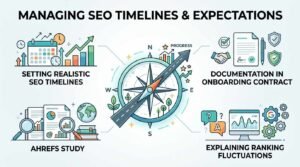
Setting realistic SEO timelines means telling clients, in writing, that meaningful organic growth typically takes four to six months to become visible and six to twelve months to compound. SEO timeline expectations should be documented in the onboarding contract, not explained verbally after a client starts asking questions.
An Ahrefs study of over 2 million keywords found that pages ranking in the top 10 results were on average over two years old, which reframes what “fast” actually means in organic search.
Explaining Ranking Fluctuations Without Losing Trust
Rankings fluctuate constantly, and Google runs multiple algorithm updates every year that shift positions temporarily. I explain this pattern during onboarding, not during the first dip, so the client already has context when it happens.
Managing Client Expectations Around SEO Reporting and KPIs
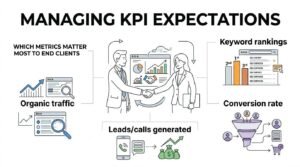
Managing KPI expectations means aligning on which metrics actually reflect business value before reporting begins, not after a client questions a report. Rankings alone tell an incomplete story.
Which Metrics Matter Most to End Clients
| Metric | What It Shows | Client Relevance |
| Organic traffic | Overall visibility trend | High |
| Keyword rankings | Position movement | Medium |
| Conversion rate | Traffic quality | High |
| Leads/calls generated | Business impact | Highest |
This table shows why leads and conversions typically matter more to a client than raw ranking position, even though rankings are easier to report.
Handling Difficult Client Situations in White Label SEO
Handling difficult client situations well requires acknowledging the problem directly instead of hiding behind technical jargon. I’ve found clients forgive slow results far more easily than they forgive silence.
Responding to Ranking Drops or Algorithm Updates
A ranking drop needs a same-week explanation, even if the explanation is “we’re still diagnosing this.” Silence after a visible drop is what triggers cancellation calls, not the drop itself.
Pricing, Contracts, and Scope Creep in White Label Client Relationships
Pricing and contract structure in white label SEO directly affects how much scope creep a reseller absorbs over time. Scope creep is the gradual expansion of deliverables beyond what a contract originally covers, without a corresponding increase in price.
Preventing Scope Creep Without Damaging Trust
I handle scope creep by offering the extra work as a clearly priced add-on rather than saying no outright. Clients respond better to “here’s what that would cost” than to a flat refusal.
Building Long-Term Retention Into White Label Client Relationships
Long-term retention in white label SEO comes from shifting the relationship from vendor to strategic partner over time. That shift usually happens somewhere between month six and month twelve, once initial results are visible.
Turning Reporting Calls Into Strategic Conversations
Reporting calls that only recite numbers eventually feel replaceable. I use these calls to discuss next-quarter strategy, which repositions the relationship around planning rather than just performance recaps.
Tools and Systems That Support Client Relationship Management
The right tools reduce the manual reporting burden that eats into actual strategy time. White-label SEO dashboards consolidate ranking, traffic, and conversion data into a single client-facing view, cutting report preparation time significantly.
Dashboards, White Label Reporting Software, and CRMs
I pair a reporting dashboard with a CRM that tracks every client touchpoint, because relationship history matters as much as ranking history when a renewal conversation comes up.
Common Mistakes That Damage White Label Client Relationships

The most damaging mistakes in white label client management are almost always about communication, not execution. Overpromising is the single most common one I encounter.
Overpromising Rankings and Timelines
Promising a specific ranking position or a specific month for results sets up a failure condition that has nothing to do with SEO quality. I never commit to a position; I commit to a process and a realistic range.
When and How to Scale White Label Client Management
Scaling client management becomes necessary once a reseller or agency passes roughly 15–20 active white label clients, when founder-led communication starts to break down. Scaling an agency’s client roster usually requires dedicated account management before it requires more SEO capacity.
Signs You Need Dedicated Account Management
Missed check-ins, delayed report reviews, and founders fielding basic status questions are the clearest signs that client management has outgrown a single person’s bandwidth.
Conclusion
Managing white label SEO client relationships comes down to onboarding clearly, reporting consistently, and communicating honestly when results plateau or dip.
The strongest partnerships treat clients as long-term stakeholders, not monthly invoices, connecting execution to real business outcomes.
We built White Label SEO Service to help agencies manage these relationships with the systems, reporting, and support that keep clients confident and retained.
Frequently Asked Questions
What is white label SEO client management?
White label SEO client management is the process of communicating, reporting, and setting expectations with an end client while an outside provider performs the SEO work. It keeps the relationship stable regardless of who executes the technical work.
How often should agencies report to white label clients?
New clients benefit from weekly check-ins plus a monthly report, while established clients typically move to monthly reporting alone. Frequency should decrease as trust and results build.
Should the end client know SEO work is outsourced?
This depends entirely on the reseller’s chosen positioning and isn’t a universal rule. Many resellers keep the provider undisclosed, while others build transparency into their pitch.
How do you set SEO timeline expectations with clients?
SEO timeline expectations should be documented in writing during onboarding, stating that visible results typically take four to six months. This prevents disputes later when rankings move gradually.
What causes most white label SEO client relationships to fail?
Poor communication causes most failures, not poor SEO performance itself. Clients tolerate slow progress far better than they tolerate silence or vague updates.
Who should communicate directly with the end client?
In most white label setups, the reseller communicates directly with the client while the provider remains behind the scenes. This preserves the reseller’s brand and the white label structure.
How do you handle a client who wants faster SEO results?
Acknowledge the request directly, then re-explain the realistic timeline tied to their specific competitive landscape. Offering a paid acceleration option, such as added content or links, can also address urgency without overpromising.