White label SEO quality standards are the measurable benchmarks for turnaround times, content depth, technical thresholds, and reporting cadence that define whether a provider’s work meets professional performance expectations. I’ve watched agencies lose clients not because rankings dropped, but because nobody agreed on what “quality” meant in the first place. These standards exist to close that gap.
Getting this wrong costs agencies client trust and revenue fast. We built this guide because vague expectations are the single biggest cause of failed white label partnerships.
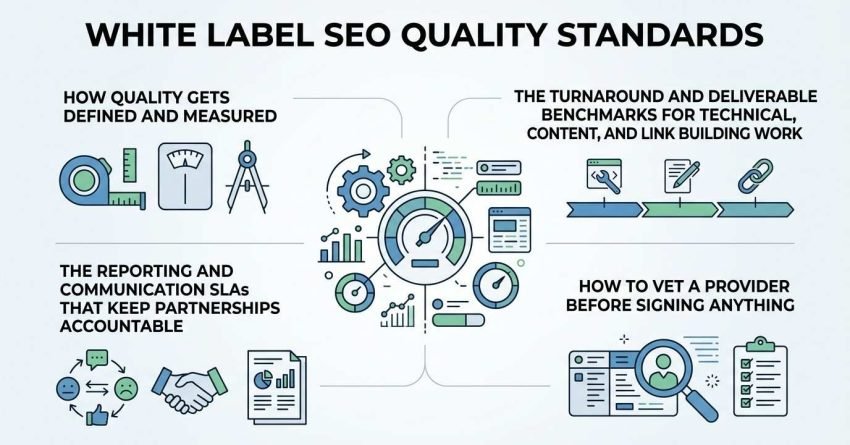
This guide covers how quality gets defined and measured, the turnaround and deliverable benchmarks for technical, content, and link building work, the reporting and communication SLAs that keep partnerships accountable, and how to vet a provider before signing anything.
What “Quality” Actually Means in White Label SEO
Quality in white label SEO is the degree to which delivered work meets predefined technical, content, and performance benchmarks agreed upon before the engagement starts. It isn’t a feeling. It’s a checklist.
I’ve seen two agencies use the word “quality” to mean completely different things: one meant “ranks improved,” the other meant “deliverables arrived on time and matched spec.” Both are valid, but only one protects you contractually.
Root Attributes of Quality SEO Work
Every reputable provider’s deliverables share certain root attributes regardless of niche: accuracy, originality, technical compliance, and timeliness. These are the baseline, not the differentiator.
We look at whether content passes plagiarism checks, whether technical fixes validate in Google Search Console, and whether links point to indexed, relevant pages. A content audit checks these attributes against the original brief before anything ships to the end client.
Why Quality Standards Vary Between Providers
Quality standards vary between providers because each one sets its own internal thresholds for word count, link authority, and technical accuracy unless a contract specifies otherwise. This is where agencies get burned.
I always tell partners: don’t assume “premium” means the same thing at two different vendors. Ask for their internal benchmark sheet before signing.
What Is an SLA in White Label SEO?

A service level agreement (SLA) is a documented commitment that defines turnaround times, quality thresholds, and communication standards a white label provider agrees to meet. It’s the contract behind the contract.
I’ve drafted SLAs for agencies handling hundreds of client sites, and the pattern is always the same: the more specific the SLA, the fewer disputes down the line. Vague SLAs create vague accountability.
Core Components of an SEO SLA
A functional SLA needs deliverable timelines, quality benchmarks, escalation procedures, and performance reporting cadence at minimum. Missing any one of these creates a blind spot.
We build SLAs around four pillars: what gets delivered, when, at what standard, and who’s accountable if it slips. A turnaround time benchmark sits inside this structure as one measurable component.
SLA vs. Standard Service Agreement
An SLA differs from a standard service agreement because it specifies measurable performance thresholds rather than just scope and payment terms. A service agreement says what you’ll do; an SLA says how well and how fast.
Most disputes I’ve mediated stem from agencies operating on a service agreement alone, with no measurable quality layer underneath it.
Turnaround Time Benchmarks for Common Deliverables

Turnaround benchmarks define the maximum acceptable time between a deliverable request and its completion, typically ranging from 24 hours for minor fixes to 30 days for full technical audits. These numbers should be written into the SLA, not assumed.
Technical Audit Turnaround
A full technical SEO audit for a mid-sized website typically takes 5 to 10 business days to complete and deliver. Sites above 10,000 pages often extend this window due to crawl budget and data processing time.
I’ve seen rushed audits miss crawl budget issues entirely because the provider compressed a two-week process into three days to hit an arbitrary deadline.
Content Deliverable Turnaround
Standard content deliverables blog posts, landing pages, and product descriptions typically ship within 3 to 7 business days from brief approval. Longer pillar content extends this to 10-14 days given research and structuring requirements.
Link Building Turnaround
Link building campaigns typically deliver placements within 30 to 60 days per batch, since outreach, negotiation, and publishing timelines aren’t fully controllable by the provider. Anyone promising links in 48 hours is cutting a corner somewhere.
Content Quality Benchmarks for White Label Deliverables
Content quality benchmarks specify minimum word counts, originality thresholds, and research depth requirements that deliverables must meet before client delivery. These numbers protect both the agency and the end client from thin, generic output.
Word Count & Depth Standards
Pillar content typically requires 3,000+ words, while supporting cluster articles run 1,200 to 2,000 words depending on topic complexity. Word count alone doesn’t guarantee quality, but falling short of these ranges usually signals under-researched coverage.
Originality & Plagiarism Thresholds
Content should score below 5% similarity on plagiarism detection tools like Copyscape or Originality.ai before it ships to a client. I run every deliverable through this check regardless of who wrote it; trust doesn’t replace verification.
Technical SEO Quality Standards
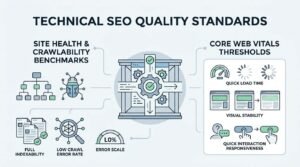
Technical SEO quality standards define the crawlability, indexability, and site health thresholds a deliverable must meet, typically measured through tools like Google Search Console and Screaming Frog. These are pass/fail benchmarks, not subjective judgments.
Site Health & Crawlability Benchmarks
A technically healthy site maintains a crawl error rate below 2% and full indexability for all priority pages. Anything above that threshold usually points to a structural problem needing immediate attention.
Core Web Vitals Thresholds
Google’s Core Web Vitals benchmark requires a Largest Contentful Paint under 2.5 seconds, Cumulative Layout Shift below 0.1, and Interaction to Next Paint under 200 milliseconds for a “good” page experience rating. Providers should report against these three metrics specifically, not vague “site speed” claims.
Link Building Quality Benchmarks
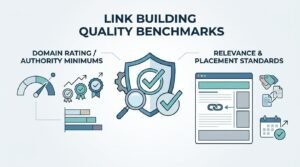
Link building quality benchmarks define the minimum domain authority, relevance, and placement standards a link must meet to count as a legitimate deliverable. Volume without these standards is just noise.
Domain Rating / Authority Minimums
Most reputable providers set a minimum Domain Rating (DR) or Domain Authority (DA) threshold of 20-30 for placements, with higher-tier packages requiring 40+. A link from a DR 10 site with no organic traffic isn’t a deliverable; it’s filler.
Relevance & Placement Standards
A quality link comes from a topically relevant page, sits within body content rather than a sidebar or footer, and remains live for at least 12 months. I’ve audited campaigns where half the “delivered” links disappeared within 90 days because they came from expired PBNs.
Reporting Standards & Deliverable Formats
Reporting standards specify which metrics, formats, and cadences a provider must follow when delivering performance data to the agency or end client. Reports without these standards tend to bury the signal in vanity metrics.
Required Reporting Metrics
A standard SEO report should include organic traffic, keyword ranking movement, backlinks acquired, and technical issues resolved during the period. Google Search Console data should back every ranking claim, not third-party rank trackers alone.
Reporting Frequency Benchmarks
Most SLAs specify monthly reporting as the baseline, with weekly summaries for active campaigns and quarterly strategic reviews. Skipping the quarterly review is the most common corner I see agencies cut once a client relationship feels “stable.”
Communication & Response Time SLAs
Communication SLAs define the maximum acceptable response time for support requests, typically ranging from 4 hours for urgent issues to 24-48 hours for standard inquiries. Silence is the fastest way to lose a white label partnership.
Standard Response Time Windows
Urgent technical issues should receive acknowledgment within 4 hours, while general questions warrant a 24-hour response window during business days. These windows should be written into the SLA with time zone specifications included.
Escalation Protocols
An escalation protocol defines who gets contacted, and how quickly, when a response time SLA is missed twice in a row. Without this, missed deadlines just repeat indefinitely with no accountability trigger.
Revision Policies & Quality Guarantees

Revision policies specify how many rounds of edits a client can request on a deliverable before additional fees apply, typically two rounds for content and one for technical implementations. Unlimited revisions sound generous but usually signal a pricing model that’s absorbing cost elsewhere.
Standard Revision Allowances
Most providers include two revision rounds for written content and one round for technical or link deliverables within the base fee. Anything beyond that scope should be quoted separately to protect margins on both sides.
Key Performance Indicators (KPIs) Used to Measure SLA Success
KPIs are the specific, measurable metrics used to verify whether a white label SEO provider is meeting the performance standards set in the SLA. Without KPIs, an SLA is just a list of promises with no verification method.
Ranking & Traffic KPIs
Ranking KPIs typically track keyword position movement, organic traffic growth, and share of voice against a defined set of target terms. An Ahrefs study of ranking data found that only 5.7% of newly published pages reach the top 10 within a year, which is why realistic KPI baselines matter more than aggressive promises.
Conversion & ROI KPIs
Conversion KPIs measure how organic traffic translates into leads, sales, or other defined business outcomes tracked through Google Analytics goal completions. Traffic growth without a matching conversion KPI tells an incomplete story to the end client.
How to Vet a White Label SEO Provider’s Quality Standards

Vetting a provider means reviewing their sample deliverables, SLA documentation, and client reporting history before signing any agreement. Skipping this step is how agencies inherit someone else’s problems.
Questions to Ask Before Signing
I always ask providers for a sample audit, a sample content piece, and their standard SLA document before committing to any retainer. If they hesitate to share any of the three, that hesitation is the answer.
Red Flags That Signal Poor SLA Enforcement
Red flags include missed deadlines with no communication, reports that lack raw data sources, and vague answers about link sourcing methods. Any one of these on its own might be an oversight; two or more together is a pattern.
I walked away from a vendor once because their “monthly report” was a screenshot with no exportable data behind it. That’s not a report; that’s a graphic.
Industry Benchmarks vs. Provider-Specific Standards
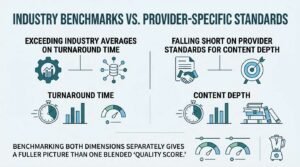
Industry benchmarks represent average performance across the SEO industry, while provider-specific standards are the specific thresholds an individual vendor commits to in writing. The two aren’t interchangeable, and conflating them causes mismatched expectations.
A provider might exceed industry averages on turnaround time but fall short on content depth; benchmarking both dimensions separately gives a fuller picture than one blended “quality score.”
How Contract Structure Impacts Quality Accountability
Contract structure determines how enforceable a quality standard actually is, since verbal commitments and informal understandings rarely hold up when a dispute arises. The SLA needs to live inside the master service agreement, not alongside it as a separate handshake deal.
I’ve seen strong verbal relationships fall apart the moment a deliverable slipped, simply because nothing was written down. Written benchmarks protect the relationship, not just the transaction.
Conclusion
Quality white label SEO depends on measurable SLAs covering turnaround, content depth, technical thresholds, and reporting cadence. Vague promises create disputes; documented benchmarks prevent them.
These standards connect directly to broader SEO strategy, timeline expectations, and long-term organic growth planning across any partnership. Providers who document benchmarks tend to retain clients longer.
We built our process around exactly these standards. Partner with White Label SEO Service to get documented SLAs, not assumptions.
Frequently Asked Questions
What is a good turnaround time for white label SEO deliverables?
Most standard deliverables should ship within 3-10 business days depending on complexity. Technical audits and pillar content take longer than single blog posts or minor fixes.
What DR minimum should white label link building target?
Reputable providers set a Domain Rating minimum of 20-30 for standard placements. Premium packages often require DR 40 or higher for stronger authority transfer.
How often should a white label SEO provider send reports?
Monthly reporting is the industry standard baseline for most SLAs. Active campaigns often add weekly summaries alongside quarterly strategic reviews.
What should be included in an SEO SLA?
An SEO SLA should include deliverable timelines, quality benchmarks, escalation procedures, and reporting cadence. Missing any of these creates ambiguity when disputes arise.
How many revisions should be included in white label SEO pricing?
Most base packages include two revision rounds for content and one for technical work. Additional revisions typically incur separate fees.
What response time should agencies expect for urgent issues?
Urgent technical issues should receive acknowledgment within 4 hours under most SLAs. General inquiries typically warrant a 24-hour response window.
How do you verify if a white label SEO provider is meeting quality standards?
Verification comes from comparing delivered work against the documented SLA benchmarks each month. Reviewing raw data in Google Search Console and Analytics confirms reported performance independently.