Organic search is unpaid traffic earned by ranking in a search engine’s algorithmic results, while paid search is traffic bought through an ad auction that places listings above or beside those results. Organic compounds slowly and costs nothing per click; paid delivers instantly and costs money per click.
I have watched businesses burn six figures on one channel while ignoring the other, and the loss almost always traces back to a single misunderstanding about how each one produces returns over time.
This guide covers what each channel actually is and how Google decides placement in both, the real cost and timeline differences, how to calculate ROI for each, click behavior and traffic quality, when each channel fits your situation, how to split budget across business stages, and how AI Overviews are reshaping the balance.
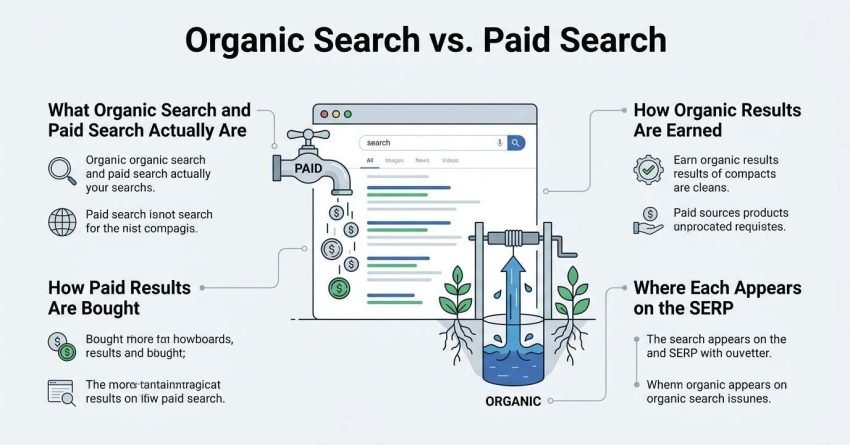
What Organic Search and Paid Search Actually Are
Organic search results are the unpaid listings a search engine ranks algorithmically based on relevance, authority, and user experience signals. Paid search results are advertisements placed through a real-time auction, where advertisers bid for position and pay only when someone clicks.
The distinction matters because the two channels behave like completely different assets on a balance sheet. One is rented attention. The other is owned attention that keeps producing after you stop paying.
I think of paid search as a tap and organic search as a well. Turn off the tap and the water stops that day.
How Organic Results Are Earned
Organic rankings are earned by publishing content that satisfies a query better than competing pages, supported by technical accessibility and external authority signals. No payment path exists into these positions.
Google crawls a page, indexes it, evaluates hundreds of signals, then ranks it against every other indexed page competing for that query. The process happens continuously and without human intervention on Google’s side.
That lack of a purchase option is exactly what makes organic positions defensible once you hold them.
How Paid Results Are Bought
Paid results are bought by entering a keyword auction, setting a maximum bid, and creating an ad that Google scores for quality and relevance. Position depends on bid amount multiplied by ad quality, not on bid amount alone.
You pay per click, not per impression, in the standard search campaign model. A click costs whatever the auction determined at that moment, which fluctuates by hour, device, and competitor activity.
Where Each Appears on the SERP
Paid results occupy the top of the search results page, typically the first two to four positions, labeled “Sponsored.” Organic results begin below that block and continue for roughly ten positions.
Between them sit SERP features: AI Overviews, People Also Ask boxes, local packs, image carousels that push organic listings further down on many commercial queries. That vertical compression is the single biggest structural change in search engine results page layout over the past three years.
How Google Decides What Ranks Organically
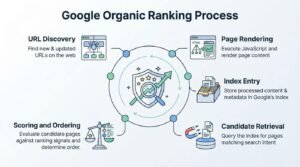
Google ranks organic results by evaluating whether a page matches query intent, whether the site demonstrates topical authority, and whether the page delivers a usable experience. These signals are weighted differently by query type and refreshed continuously.
The ranking process runs in a predictable sequence:
- Google discovers the URL through crawling or a sitemap submission
- The crawler renders the page and evaluates whether it is indexable
- The page enters the index with its extracted entities and topics mapped
- A query triggers retrieval of candidate pages from the index
- Ranking systems score and order candidates by relevance, authority, and experience
Relevance, Authority, and Experience Signals
Relevance measures how closely a page’s content matches the meaning behind a query, not just its keywords. Authority reflects how much the wider web and Google’s own systems trust the source on that subject. Experience covers speed, mobile usability, and whether the page delivers what the title promised.
I have never seen a page win a competitive query on one of these alone. Content quality without backlink authority stalls at page two on anything commercially valuable, and the reverse fails just as reliably.
Why Organic Position Cannot Be Purchased
Organic positions cannot be purchased because Google’s ad systems and ranking systems operate independently, with no data flow that lets ad spend influence algorithmic placement. Google has stated this repeatedly and publicly.
That separation is the foundation of the entire comparison. Every cost, timeline, and ROI difference in this guide flows from the fact that one channel accepts money and the other does not.
How the Paid Search Auction Actually Works
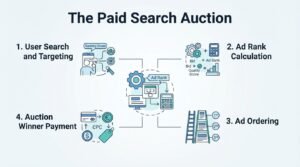
The paid search auction determines ad position by multiplying your maximum bid by a Quality Score that measures expected click-through rate, ad relevance, and landing page experience. A higher Quality Score buys better positions at lower cost per click.
Every auction runs in milliseconds, triggered fresh by each individual search. Position is never fixed and never guaranteed.
The auction resolves in four steps:
- A user searches a term matching your keyword and targeting settings
- Google calculates Ad Rank for each eligible advertiser
- Ads are ordered by Ad Rank, with the highest placed first
- The winner pays just enough to beat the next competitor’s Ad Rank, not their full bid
Bid, Quality Score, and Ad Rank
Ad Rank is the product of your bid and your Quality Score plus contextual factors like device, location, and expected ad extension impact. Two advertisers bidding identically can land in different positions if their Quality Scores differ.
Quality Score runs on a one-to-ten scale and is the lever most advertisers underuse. Improving landing page relevance tends to lower cost per click more reliably than raising bids.
What You Pay For and When
You pay only when someone clicks your ad, under the standard cost-per-click model that dominates search advertising. Impressions are free, which is why paid search delivers brand exposure alongside direct response.
The actual amount charged is almost always below your maximum bid, because the second-price auction mechanism only charges what was needed to hold position.
The Core Differences Between Organic and Paid Search
The table below compares organic and paid search across the nine attributes that most affect channel selection.
| Attribute | Organic Search | Paid Search |
| Cost per click | $0 | $1 to $50+ depending on industry |
| Time to first results | 3 to 12 months | Same day |
| Traffic after spend stops | Continues | Stops immediately |
| Position control | Indirect, earned | Direct, purchased |
| Scalability speed | Slow, compounding | Fast, budget-limited |
| Click-through rate | Higher on informational queries | Higher on transactional queries |
| Primary risk | Algorithm updates | Rising CPC, competitor bidding |
| Asset ownership | You own the ranking page | You rent the placement |
| Testing speed | Weeks to months | Hours to days |
Two rows in that table carry most of the strategic weight. Traffic after spend stops, and time to first results. Everything else is secondary to those two.
A business with runway can afford to wait for the compounding asset. A business without runway cannot, regardless of what the long-term math says about cost per acquisition.
Cost Structures: CPC Versus Compounding Investment
Paid search costs scale linearly with traffic, while organic search costs are largely fixed regardless of how much traffic a ranking page eventually delivers. Doubling paid traffic roughly doubles paid spend. Doubling organic traffic often costs nothing additional.
That asymmetry is the strongest financial argument for organic, and it only appears when you model costs over 24 months rather than 90 days.
What Paid Search Costs Per Click
The average cost per click across Google Search sits around $2 to $4 in most consumer categories, but legal, insurance, and B2B software routinely exceed $50 per click. WordStream’s Google Ads benchmark data places the cross-industry search average near $2.69.
Those averages hide enormous variance. I have managed accounts where a single high-intent keyword cost more than an entire month of content production.
Cost per click also rises over time in any category with new entrants, because the auction is competitive by design and has no ceiling.
What Organic Search Costs Per Month
Organic search costs are paid in content production, technical work, and authority building rather than per click. A functional program typically runs $1,500 to $10,000 per month depending on competitive intensity and how much of the work is done in-house.
The important distinction is what the spend buys. Paid spend buys this month’s clicks. Organic spend buys an asset that keeps producing clicks in month eighteen without further payment.
That is why SEO budget planning should be modeled as capital expenditure rather than a media buy.
Timelines: How Fast Each Channel Produces Results
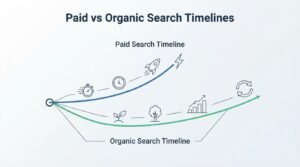
Paid search produces measurable traffic within hours of campaign launch, while organic search typically takes three to twelve months to generate meaningful traffic on competitive terms. That gap is the single largest practical difference between the two channels.
Neither timeline is negotiable through spending more. Paid cannot go faster than instant, and organic rarely goes faster than Google’s crawl, index, and trust-building cycle allows.
Paid Search Timeline
A paid campaign can serve its first impression within one hour of approval and generate statistically useful conversion data within two to four weeks. Optimization cycles then run continuously on that data.
That speed makes paid the correct tool for validating demand before committing to a long content program.
Organic Search Timeline
New pages on an established site often rank within four to eight weeks, while new domains typically need six to twelve months before competitive terms become reachable. An Ahrefs study of two million keywords found only 5.7% of pages reach the top 10 within a year of publication.
Domain age is not the causal factor. Accumulated authority and topical depth are, which is why domain authority growth tends to shorten ranking timelines for every subsequent page you publish.
How to Calculate ROI for Each Channel
ROI for both channels uses the same core formula: revenue attributed to the channel minus channel cost, divided by channel cost, but organic requires a longer measurement window because its returns arrive after its costs. Comparing them over identical short windows systematically undervalues organic.
I run both calculations on a rolling twelve-month basis rather than monthly. Anything shorter penalizes the compounding channel.
Paid Search ROI Formula
Paid search ROI equals attributed revenue minus ad spend, divided by ad spend, expressed as a percentage. The calculation is clean because cost and conversion are tied to the same click.
A campaign spending $10,000 and generating $35,000 in attributed revenue returns 250% ROI. That number is available within the same month the spend occurred.
Organic Search ROI Formula
Organic search ROI equals attributed revenue minus total program cost over the measurement period, divided by that program cost. The complication is that revenue in month twelve often stems from cost incurred in month three.
Here is the worked comparison I use with clients. A $60,000 annual organic program producing 8,000 monthly organic sessions at a 2% conversion rate and $400 average order value generates $768,000 in year-one revenue, a 1,180% return. The equivalent traffic bought at $3 per click would cost $288,000 annually and would stop the day payment stopped.
That gap is real, but it only exists if the program actually ranks. Failed organic programs return zero, which is a risk paid search does not carry in the same form.
Click-Through Behavior: Who Actually Gets the Clicks
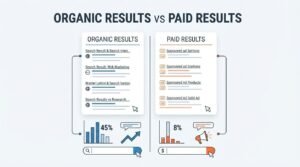
Organic results capture the majority of search clicks on most query types, though paid results win a larger share on high-commercial-intent terms. The split varies far more by query than by industry.
Sistrix analysis of 80 million keywords found the first organic position earns an average 28.5% click-through rate, with position two at 15.7% and position three at 11%. Ads typically capture between 2% and 6% of clicks on informational queries and considerably more on purchase-ready searches.
The practical read is that organic position one is worth roughly the same as a well-optimized ad in the top slot, without the per-click charge. Understanding how click-through rate by position shifts across query types tells you which channel deserves the keyword.
Traffic Quality and Intent Differences
Organic traffic tends to arrive earlier in the buying journey, while paid search traffic skews later because advertisers bid most aggressively on purchase-intent keywords. Neither is inherently higher quality; they serve different stages.
I see this pattern consistently in analytics. Organic sessions show longer average engagement and lower immediate conversion. Paid sessions convert faster and churn harder.
Trust is the other variable. A meaningful share of searchers skip sponsored listings deliberately, which means organic placement carries a credibility signal that paid placement cannot buy. That perception gap widens in industries where buyer intent signals already run high on skepticism.
Scalability, Ceilings, and Diminishing Returns
Paid search scales instantly up to the total available search volume for your keywords, then stops hard at that ceiling. Organic search scales more slowly but has no comparable ceiling, because each new ranking page adds capacity without adding cost.
Paid hits diminishing returns in a predictable way. You exhaust high-intent keywords, expand into broader terms, watch cost per acquisition climb, and eventually reach a point where the next dollar loses money.
Organic hits a different wall: production capacity. You can only publish and promote so much content at quality, which is why content velocity becomes the real constraint once technical foundations are sound.
Risk Profiles: What Can Go Wrong in Each Channel
Organic search carries algorithmic risk, where a core update can reduce visibility without warning. Paid search carries economic risk, where competitor bidding and platform changes raise costs until margins disappear.
The failure modes look different in practice:
- Organic: core algorithm updates, manual penalties, technical regressions, competitor content outpacing yours
- Paid: rising cost per click, account suspension, click fraud, bidding wars on brand terms
- Both: platform policy changes you do not control
Neither risk is eliminable. They are diversifiable, which is the strongest structural argument for running both channels rather than committing entirely to one.
When to Use Paid Search
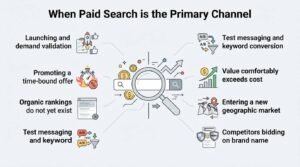
Paid search is the right primary channel when you need traffic faster than organic can deliver it, or when the economics of a specific keyword justify paying for every click. Seven conditions make paid the correct first choice:
- You are launching and need demand validation within weeks, not months
- You are promoting a time-bound offer, event, or seasonal product
- Your organic rankings do not yet exist for commercially critical terms
- You need to test messaging and keyword conversion rates quickly
- Your average order value or lifetime value comfortably exceeds cost per acquisition
- You are entering a new geographic market with no local authority
- Competitors are bidding on your brand name and intercepting your demand
I also run paid defensively on brand terms for nearly every client, regardless of organic strength. The cost is low, and the downside of ceding that click is not.
When to Use Organic Search
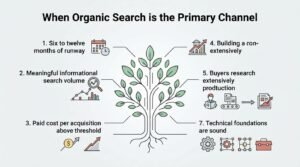
Organic search is the right primary channel when you can tolerate a delayed return in exchange for traffic that does not stop when spending stops. Seven conditions make organic the correct focus:
- You have at least six to twelve months of runway before results are required
- Your category has meaningful informational search volume, not just transactional
- Paid cost per acquisition is already above your sustainable threshold
- You are building a business asset intended to hold value over years
- Your buyers research extensively before purchasing
- You can commit to consistent content production rather than one-off campaigns
- Your technical foundations are sound or can be made sound
The second condition is the one most businesses skip. If nobody searches for the problem you solve, keyword research will tell you before you spend a year finding out the hard way.
When to Run Both Together
Running both channels together is correct whenever you have budget for paid and runway for organic, because each channel produces data and coverage the other cannot. This is the default recommendation for any business past initial validation.
The combination compounds in ways neither channel achieves alone. Paid reveals which keywords convert before you invest months in ranking for them. Organic reduces the volume of paid clicks you need to buy as rankings mature.
Keyword-Level Overlap Decisions
Bidding on keywords you already rank first for is usually wasteful, except on brand terms or when competitors occupy the ad block above you. Every other overlap should be evaluated by incremental conversion, not total conversion.
I pause paid on any non-brand keyword where organic holds position one or two and no competitor ads appear. The clicks were already free.
Using Paid Data to Direct Organic Strategy
Paid search conversion data is the fastest available signal for which keywords deserve organic investment. Ninety days of paid data tells you what twelve months of organic guessing would cost you to learn.
That feedback loop is the strongest practical reason to run a small paid budget even when organic is the primary strategy, and it makes conversion rate optimization measurable on both channels simultaneously.
How to Split Budget Between Organic and Paid
Budget allocation between organic and paid should shift as a business matures, moving from paid-heavy at launch toward organic-heavy at scale. The table below shows the split I recommend by stage.
| Business stage | Paid share | Organic share | Rationale |
| Pre-launch validation | 90% | 10% | Speed of learning outweighs asset building |
| Early growth, 0 to 12 months | 70% | 30% | Revenue now, foundations started |
| Established, 12 to 24 months | 50% | 50% | Organic beginning to carry volume |
| Mature, 24+ months | 30% | 70% | Organic carries baseline, paid covers gaps |
| Constrained budget, any stage | 60% | 40% | Paid funds the organic program |
These are starting points, not rules. A business with a six-week sales cycle and $80 average order value should weight paid harder than the table suggests, and one selling $50,000 enterprise contracts should weight organic harder.
Measuring Both Channels in One Reporting Framework
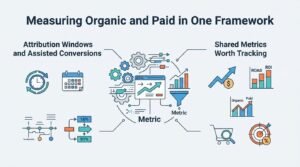
Measuring organic and paid in one framework requires shared conversion definitions, consistent attribution windows, and separate cost accounting for each channel. Most reporting failures trace to mismatched definitions rather than missing data.
I set a single conversion event, a single attribution model, and a single reporting period across both channels before a campaign launches. Retrofitting that later is painful.
Attribution Windows and Assisted Conversions
Attribution windows should match your actual sales cycle, not the platform default of 30 days. A 90-day B2B cycle measured on a 30-day window will credit paid for conversions that organic actually started.
Assisted conversions matter more than most teams admit. Organic frequently initiates sessions that paid later closes, and last-click reporting hides that contribution entirely.
Shared Metrics Worth Tracking
Track these five metrics identically across both channels:
- Cost per acquisition
- Conversion rate by landing page
- Revenue per session
- Assisted conversion volume
- Blended customer acquisition cost across all channels
Blended cost is the number that actually matters to the business. Channel-level figures inform tactics, but the blended figure determines whether the overall marketing attribution model is producing profit.
Which one should I choose if I can only afford one?
Common Mistakes Businesses Make Choosing Between Them
The most expensive mistake is judging organic search on a paid search timeline, then cancelling the program at month four just before results arrive. I have watched that decision destroy more marketing budget than any bidding error.
Other recurring failures:
- Comparing organic and paid ROI over identical 90-day windows
- Pausing paid entirely the moment organic rankings improve
- Treating organic as free because there is no cost per click
- Bidding on every keyword rather than only incremental ones
- Attributing all conversions to last click and concluding organic underperforms
Each of these comes from applying one channel’s logic to the other. They operate on different clocks and different cost curves.
How AI Overviews Are Changing the Organic–Paid Balance
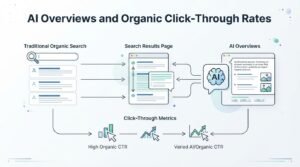
AI Overviews are compressing organic click-through rates on informational queries by answering questions directly on the results page, while leaving transactional queries largely intact. The effect is uneven, not universal.
Pew Research Center analysis of browsing data found users clicked a traditional search result in 8% of visits where an AI summary appeared, compared with 15% where none appeared. That roughly halves click volume on affected queries.
The strategic response is not abandoning organic. It is shifting organic effort toward queries AI Overviews cannot resolve comparisons, local, transactional, and experience-driven searches while ensuring your content is structured to be cited within AI Overviews rather than replaced by them.
Building a Channel Strategy That Compounds
A compounding channel strategy uses paid search to fund and inform organic search, then reallocates budget toward organic as rankings reduce the paid volume required. The two channels finance each other when sequenced correctly.
The sequence I use runs paid first for demand validation, organic second for the keywords paid proved valuable, then a gradual reallocation as organic positions hold. Nothing gets switched off abruptly.
That approach turns two competing line items into one system, where every month of paid spend produces both revenue and direction for the organic growth strategy underneath it.
Conclusion
Organic and paid search differ fundamentally in cost structure, timeline, risk, and asset ownership, and those differences determine which fits your stage.
Neither channel wins universally. The businesses that grow fastest run both deliberately, letting paid fund the learning that organic converts into durable visibility.
We build organic programs that compound while your paid spend works. Talk to White Label SEO Service about sequencing both properly.
Frequently Asked Questions
Is SEO better than PPC?
Neither is universally better. SEO delivers lower long-term cost and durable traffic, while PPC delivers immediate results and faster testing. The right choice depends on runway and timeline.
How much does paid search cost per click?
Google Search averages roughly $2 to $4 per click across industries, though legal, insurance, and B2B software commonly exceed $50 per click on high-intent terms.
How long does SEO take to beat paid search on cost?
SEO typically becomes cheaper per acquisition between months twelve and eighteen, once ranking pages generate traffic volume that would otherwise require continuous ad spend.
Do paid ads help organic rankings?
Paid ads do not directly improve organic rankings, because Google’s ad and ranking systems operate separately. Ads can indirectly help through brand searches and engagement signals.
What percentage of clicks go to organic results?
Organic results capture the majority of clicks on most query types, with position one averaging roughly a 28% click-through rate. Ads win larger shares on transactional queries.
Should a new business start with SEO or PPC?
Start with PPC to validate demand and test messaging within weeks, then layer SEO once you know which keywords actually convert for your offer.
Can you bid on keywords you already rank for organically?
Yes, and it makes sense on brand terms or when competitors run ads above your listing. Otherwise, the clicks were already free.