White label SEO lets agencies, consultants, and marketing firms sell professional search engine optimization services under their own brand while a specialized provider handles the actual strategy and execution. I’ve watched this model grow from a niche workaround into a core revenue stream for thousands of agencies that don’t want to build in-house SEO teams. It works because clients never see the vendor behind the curtain; they just see results delivered by the brand they already trust.
Getting this wrong costs agencies client trust and recurring revenue fast. Getting it right turns SEO into a scalable, high-margin service line without hiring a single specialist.
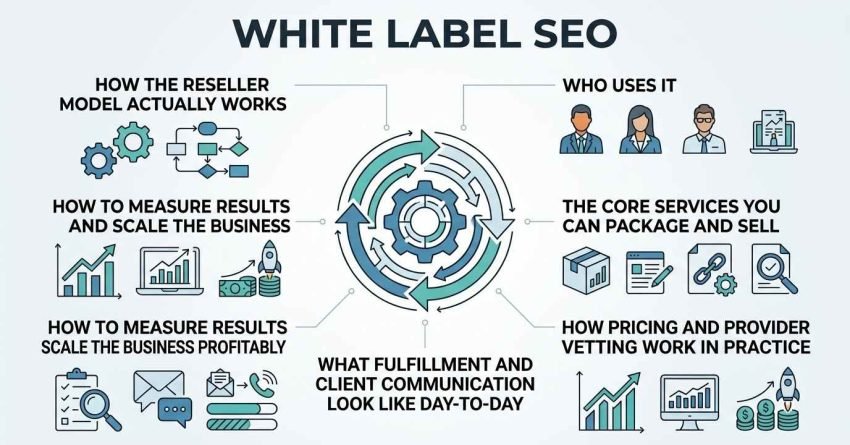
This guide covers how the reseller model actually works and who uses it, the core services you can package and sell, how pricing and provider vetting work in practice, what fulfillment and client communication look like day-to-day, and how to measure results and scale the business profitably.
What Is White Label SEO?
White label SEO is a business arrangement where one company performs search engine optimization work that another company sells and presents as its own. The reseller owns the client relationship; the fulfillment partner owns the technical execution.
I think of it less as outsourcing and more as a brand-invisible partnership. The end client typically never learns that a third party is involved; every report, every email, every strategy call happens under the reseller’s name.
This distinguishes white label SEO from subcontracting in the traditional sense. A subcontractor might be disclosed to the client. A white label SEO provider operates entirely behind the scenes, and that invisibility is the entire point of the arrangement.
How the White Label SEO Model Works
The white label SEO model runs on a three-party structure: the end client, the reseller, and the fulfillment provider working invisibly behind the reseller’s brand. I’ve found most confusion about this model disappears once people see the actual workflow instead of the concept.
The end client hires the reseller, an agency, freelancer, or consultant for SEO services. The reseller then hands the technical work to a white label partner, who performs the audit, strategy, and execution while the reseller manages communication.
Reporting flows back through the reseller, rebranded with their logo and voice, before reaching the client. A typical cycle moves through onboarding, audit, strategy handoff, monthly execution, and reporting on a repeating loop, and I’ll walk through that fulfillment process in more detail further down.
Why Agencies and Businesses Resell SEO Instead of Building In-House
Agencies resell SEO because building an in-house team costs far more than most client contracts can support, especially before an agency reaches significant scale. A single senior SEO specialist commands $75,000–$110,000 annually according to Glassdoor’s 2024 salary data, before tools, training, or management overhead.
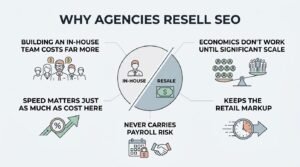
I’ve seen agencies try to hire their way into an SEO offering and stall out within six months. The economics simply don’t work until you have enough SEO clients to justify a full team’s salary load.
Reselling flips this math entirely. An agency pays wholesale rates only for the clients it actually has, keeps the retail markup, and never carries payroll risk during slow months.
Speed matters just as much as cost here. A reseller can say yes to an SEO opportunity today and have a white label team auditing the client’s site within 48 hours, while hiring a qualified specialist internally often takes 60–90 days.
Who Uses White Label SEO? (Reseller Types)
Four business types make up most of the white label SEO reseller market: digital marketing agencies, web design and development shops, freelance consultants, and PR or social media firms expanding their service lines.
Digital marketing agencies are the largest group. They already run paid media, social, or branding services and add SEO to increase average client value without adding a specialist headcount.
Web design and development shops resell SEO because clients ask for it immediately after launch. A freelancer or solo consultant resells SEO to offer enterprise-level service without ever hiring, while PR and social firms add it as a natural extension of their existing visibility work.
Core White Label SEO Services You Can Offer
A white label SEO reseller can package six core service categories: technical audits, on-page optimization, content strategy, link building, local SEO, and performance reporting. Each maps to a distinct part of how search engines evaluate a website.
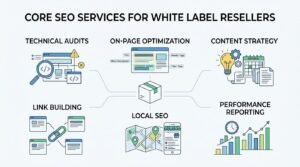
Technical SEO audits identify crawlability, indexing, site speed, and structural issues that block search engines from properly reading a site. This work forms the foundation everything else depends on.
On-page optimization covers title tags, meta descriptions, header structure, and internal content signals on individual pages. Content strategy and creation address the content creation engines need to rank for target keywords, built around real search intent rather than guesswork.
Link building and authority development earn external signals that tell search engines a site deserves trust, and I treat this as the slowest-moving but highest-leverage lever in the entire stack. Local SEO and Google Business Profile management serve location-based businesses, while reporting and analytics tie every deliverable back to measurable traffic, ranking, and lead outcomes.
White Label SEO Pricing Models & Packaging
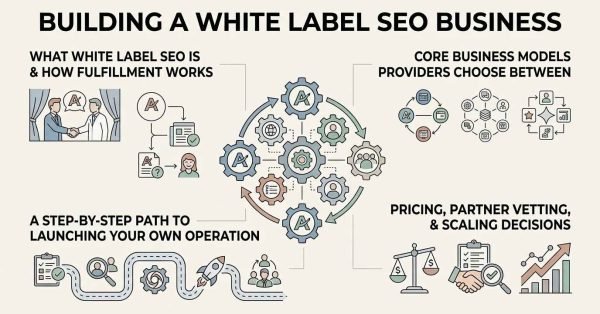
White label SEO pricing typically follows one of three structures: flat-rate packages, tiered service levels, or fully custom scopes built around a specific client’s needs. Most providers publish flat or tiered rates and reserve custom pricing for enterprise accounts.
Flat-rate packages simplify reseller math: a provider charges a fixed monthly wholesale rate, and the reseller marks it up to whatever retail price the market supports. Tiered pricing scales with deliverables, adding more content volume, links, or reporting depth at each level.
Markup strategy determines actual profit. I generally see resellers apply a 40–70% markup over wholesale cost, though this varies heavily depending on the reseller’s own sales positioning and client relationship strength.
How to Choose a White Label SEO Provider
Choosing a white label SEO provider comes down to three vetting criteria: reporting transparency, white-label guarantees in writing, and demonstrated fulfillment quality on past client work. I never recommend signing with a provider before requesting a sample audit and sample report.
Transparency means the provider shows you exactly what work gets done, not just a summary metric at month’s end. A written white-label guarantee confirming the client will never see the provider’s branding, emails, or invoices protects the reseller relationship at its most vulnerable point.
Red flags include vague reporting, reluctance to share sample deliverables, and providers who can’t explain their link building methodology in plain language. Any provider promising guaranteed rankings within a fixed short timeframe is one to avoid entirely, since no ethical SEO provider can make that promise.
The White Label SEO Fulfillment Process, Step by Step
White label SEO fulfillment moves through four repeating stages: onboarding and audit, strategy handoff, ongoing execution, and white-labeled reporting delivery. I map this cycle out for every new reseller partnership before any work begins.
Onboarding starts with access to the client’s website, analytics, and search console, followed by a full technical and competitive audit. The provider then hands the reseller a strategy document written to match the reseller’s own client-facing language and branding.
Execution runs monthly: content gets published, links get built, technical fixes get implemented on a cadence the reseller and provider agree to upfront. Reporting closes each cycle, arriving rebranded and ready for the reseller to forward, or present, directly to the end client.
How to Present White Label SEO to Your Clients
Presenting white label SEO to clients requires rebranding every report, email, and call script so the fulfillment partner stays completely invisible. I coach resellers to treat this like any other agency deliverable because to the client, that’s exactly what it is.

Branded reporting means removing every trace of the fulfillment provider’s name, logo, and contact details before anything reaches the client’s inbox. Most white label providers supply report templates specifically built for this rebranding step.
Managing timeline expectations matters just as much as branding. Clients who hear “SEO takes time” without specifics get anxious by month two, so I recommend resellers set explicit 3, 6, and 12-month milestones before the first invoice goes out.
Realistic SEO Timelines and Results for Resold Campaigns
Realistic SEO timelines for resold campaigns run on the same schedule as any SEO engagement: early technical gains by month three, meaningful ranking movement by month six, and compounding traffic growth by month twelve. Ahrefs’ study of over 2 million keywords found that only 5.7% of pages reach the top 10 within a year of publishing.
Factors that speed up or slow down results include domain age, existing content quality, competitive density in the client’s niche, and how quickly the reseller approves and forwards strategy recommendations. A client in a low-competition local market often sees movement faster than one competing nationally in a crowded vertical.
I always tell resellers to under-promise here. Setting a 12-month expectation and delivering results in month eight builds more trust than promising month three and delivering month seven.
How to Measure and Report White Label SEO Performance
Measuring white label SEO performance requires tracking four core metrics: keyword rankings, organic traffic, lead or conversion volume, and return on investment relative to the client’s monthly spend. These four numbers tell the entire performance story a client actually cares about.
Google Search Console shows impressions, clicks, and average ranking position for every query a site appears for. Google Analytics (GA4) connects that traffic to actual on-site behavior: time on page, conversion events, and goal completions.
Rank tracking tools layer in competitive positioning over time, showing whether a client’s visibility is climbing relative to named competitors. I recommend building one simple monthly dashboard that pulls all three sources together, since scattered reporting is the fastest way to lose a client’s confidence.
Common Risks and Mistakes When Reselling SEO
The three most common mistakes resellers make are overpromising results, skipping proper vendor vetting, and letting communication gaps form between the client, the reseller, and the fulfillment partner. Any one of these can unwind an otherwise profitable reseller relationship.
Overpromising happens when sales teams quote timelines the fulfillment side never agreed to. I’ve seen this single issue cause more reseller-client breakups than poor SEO work itself.
Poor vendor vetting shows up months later as thin content, spammy link building tactics, or reports that don’t match actual ranking movement, by which point the reseller’s reputation is already on the line. Weak communication loops, where the reseller doesn’t relay client feedback to the provider or vice versa, quietly erode strategy quality over time even when both parties are individually competent.
Profit Margins and Scalability of a White Label SEO Business
Profit margins on resold SEO typically run 40–70% once a reseller establishes a stable wholesale rate and retail pricing structure. A reseller paying $800 wholesale and charging $1,400 retail nets $600 in monthly margin per client with zero fulfillment labor of their own.
Scalability is where this model outperforms in-house hiring. Adding ten new SEO clients under a white label arrangement requires zero additional headcount, while the same ten clients under an in-house model might require hiring a second or third specialist.
I consider this the real advantage of the reseller model: revenue scales roughly linearly with client count, while cost stays flat until volume justifies bringing fulfillment in-house.
White Label SEO vs. Building an In-House SEO Team
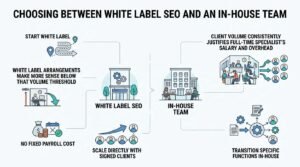
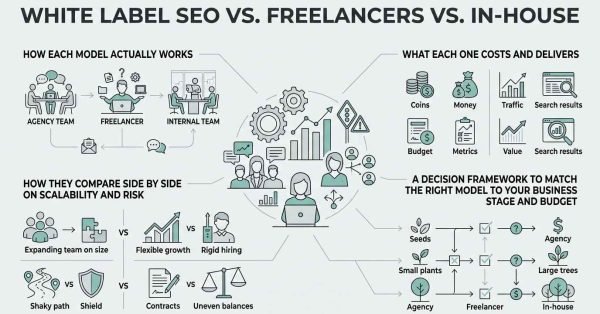
Choosing between white label SEO and an in-house team comes down to volume, capital, and how fast an agency needs to launch its SEO offering. In-house teams make sense once client volume consistently justifies a full-time specialist’s salary and overhead.
White label arrangements make more sense below that volume threshold, since they carry no fixed payroll cost and scale directly with signed clients. Many agencies start white label and transition specific functions in-house only once volume in that specific service, like content strategy, justifies a dedicated hire.
White Label SEO Contracts, White-Labeling Agreements & Legal Considerations
A proper white label SEO agreement should specify confidentiality terms, ownership of deliverables, service level expectations, and explicit non-disclosure language preventing the provider from contacting the end client directly. This document protects both the reseller’s client relationship and the provider’s operational terms.
Ownership clauses matter more than most resellers realize upfront; confirm in writing that content, links, and reports become the reseller’s property to present as their own. Non-disclosure and non-circumvention clauses prevent a provider from ever reaching out to the end client independently, which would immediately expose the entire arrangement.
Conclusion
White label SEO connects reseller branding with specialized fulfillment across audits, content, links, and reporting. The model scales profitably without in-house hiring, provided resellers vet partners carefully and set honest timelines.
Every agency exploring this space benefits from understanding the full cluster of pricing, fulfillment, and reporting mechanics involved. The reseller model keeps rewarding those who choose partners wisely.
We built our reseller programs around exactly this transparency and reliability. Partner with White Label SEO Service to launch or scale your offering today.
Frequently Asked Questions
What does “white label SEO” mean exactly?
White label SEO means a provider performs SEO work that a reseller sells under its own brand name. The end client never learns a third party is involved.
Is white label SEO legal and ethical?
Yes, white label SEO is a legal and widely used business model across the marketing industry. Ethics depend on transparency about results and honest timeline expectations, not the arrangement itself.
How much does white label SEO cost?
Wholesale white label SEO packages typically range from $500 to $3,000 monthly depending on scope. Resellers then apply a markup, commonly 40–70%, to set client-facing retail pricing.
Can I resell SEO without any technical knowledge?
Yes, many successful resellers have no technical SEO background at all. The fulfillment partner handles execution while the reseller focuses on sales and client communication.
How do white label SEO reports stay branded as mine?
Providers supply report templates stripped of their own branding, ready for the reseller’s logo and contact details. Most also allow custom domains for client-facing dashboards.
What’s a realistic profit margin on resold SEO?
Most resellers earn a 40–70% margin once wholesale pricing and retail rates are set. Margin grows further as client volume increases without added fulfillment cost.
How long before my clients see ranking improvements?
Early technical improvements typically appear within three months, with meaningful ranking movement by month six. Full compounding traffic growth generally builds by month twelve.