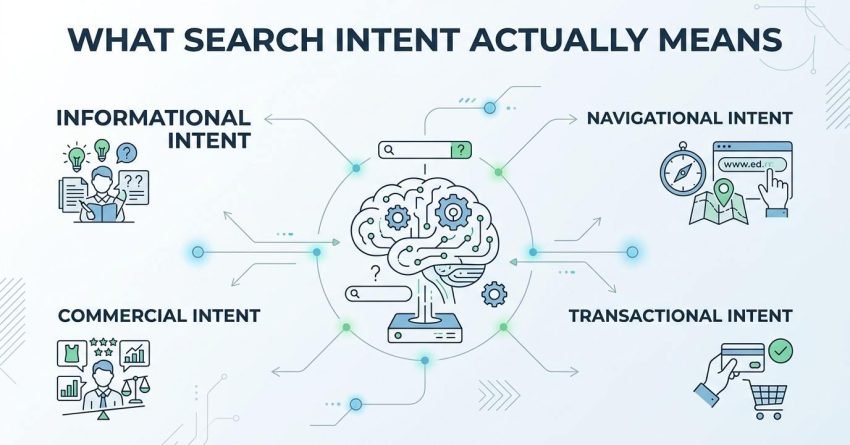
Search intent is the underlying goal a person has when typing a query into a search engine. Google’s entire ranking system exists to match results to that goal, which makes intent the single filter every page must pass before rankings, traffic, or conversions become possible.
I have watched well-written pages with strong backlinks sit on page four for months. The cause was almost always the same: wrong intent match.
This guide covers what intent means and how Google assigns it, the four intent types and the signals that reveal them, how to read a SERP to diagnose intent, how intent shapes keyword research and content format, what mismatch costs in traffic and revenue, how intent behaves in AI search and local results, and how to build and measure an intent-led strategy.
What Search Intent Actually Means
Search intent is the specific outcome a searcher wants from their query, whether that is an answer, a website, a comparison, or a purchase. Every query carries one, even when the wording is vague.
I think about it as the gap between what someone typed and what they actually wanted. Nobody searches “best running shoes” because they want to read about running shoes. They want to narrow a decision down to two or three options and move on.
That gap is where most SEO fails.
The Query Behind the Keyword
Keywords are strings of text. Queries are requests with a purpose attached. A keyword research tool shows me “protein powder” has 200,000 monthly searches, but it tells me nothing about whether those searchers want to buy, compare, or learn what protein powder does.
When I look at a keyword, I am really looking for the unspoken question sitting behind it. That unspoken question determines what the page has to deliver.
Two businesses can target the identical keyword and one ranks while the other does not. The difference is rarely authority. It is usually that one built the page around the query and the other built it around the keyword.
Why Google Treats Intent as a Ranking Signal
Google’s core job is answering queries correctly, and intent matching is how it decides what “correctly” means. The Google Search Quality Rater Guidelines instruct human raters to assess “Needs Met” before anything else, which tells you exactly how much weight intent carries.
Raters do not score a page on word count or keyword density. They score whether it satisfies what the searcher wanted.
Those ratings feed back into algorithm training. So intent alignment is not a soft best practice sitting alongside technical SEO and link building. It is the gate those other factors operate behind.
The Four Types of Search Intent

There are four types of search intent: informational, navigational, commercial investigation, and transactional. Each type demands a different page format, and mixing them on a single page usually weakens both.
This table shows how the four intent types differ across query signals, expected page format, and business value.
| Intent Type | What the Searcher Wants | Typical Query Shape | Expected Page Format | Conversion Proximity |
| Informational | Knowledge or an answer | “what is,” “how to,” “why does” | Guide, explainer, tutorial | Low |
| Navigational | A specific site or page | Brand names, “login,” “pricing page” | Homepage, login, branded landing page | Variable |
| Commercial Investigation | To compare before deciding | “best,” “vs,” “review,” “alternatives” | Comparison, review, roundup | Medium to high |
| Transactional | To act or buy now | “buy,” “order,” “near me,” “free trial” | Product page, checkout, booking form | Highest |
Informational Intent
Informational intent is the goal of learning something, and it accounts for the largest share of all search volume. These searchers are not ready to buy, and treating them like they are kills the page.
I write these pages to teach, not to sell. A soft mention of what we do at the end is fine. A sales pitch in paragraph two sends people back to the SERP.
The business value is real but indirect. You earn the relationship first.
Navigational Intent
Navigational intent is the goal of reaching a specific website or page the searcher already has in mind. Someone typing “Ahrefs login” is not shopping for SEO tools.
You cannot win these queries for someone else’s brand, and you should not try. What you can do is make sure your own branded queries resolve cleanly to your pages rather than to a review site or a competitor’s comparison page.
I check branded SERPs for every client in month one. It is a surprisingly common leak.
Commercial Investigation Intent
Commercial investigation intent sits between learning and buying, where the searcher has decided to act but not decided with whom. These are the highest-leverage queries in most SEO programs.
The searcher wants a shortlist, honest tradeoffs, and a reason to eliminate options. They do not want a brochure.
I have seen a single well-built comparison page outperform thirty informational posts on revenue. The traffic is smaller, and the money is closer.
Transactional Intent
Transactional intent is the goal of completing an action immediately, such as buying, booking, downloading, or signing up. The searcher has made the decision and wants the shortest path to completion.
Friction is the enemy here. Long explainers, gated forms, and unnecessary steps all push people back to the results page.
Transactional pages need speed, clarity, and a visible next action above the fold.
How Google Interprets and Assigns Intent
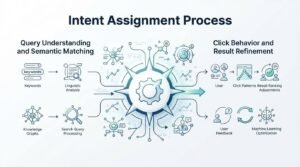
Google assigns intent by combining language understanding with observed searcher behavior, then reshapes the results page to match what most people want from that query. It is not reading minds. It is reading patterns.
Here is how that process works in sequence.
- The query is parsed for entities, modifiers, and syntax to establish literal meaning
- Semantic models map the query to related concepts and synonyms
- Historical click and engagement patterns for similar queries are applied
- Result types and SERP features are selected to match the dominant intent
- Ranking candidates are filtered against that intent before scoring on quality and authority
Query Understanding and Semantic Matching
Google’s language models interpret queries as meaning rather than as keyword strings, which is why “how much does a plumber cost” and “plumber rates” surface overlapping results. Systems like BERT were built specifically to read prepositions and context that change a query’s meaning.
This is also why exact-match keyword targeting stopped working. The model is matching concepts, not characters.
I plan pages around a concept cluster now rather than a keyword list. The results hold far better through algorithm updates.
Click Behavior and Result Refinement
Google observes which results satisfy searchers and uses that signal to refine what it shows for a query over time. When people consistently skip the top result and click the fourth, that pattern registers.
The practical version for me is simple. If a page ranks and holds its position for six months, the intent match is probably right. If it ranks then slides without any technical change, the match was probably wrong.
How to Identify Search Intent From the SERP
The fastest way to identify search intent is to read the results page, because Google has already done the analysis for you. The page types that rank are the page types that satisfy that query.
Follow this sequence for any keyword you are considering.
- Search the query in an incognito window with location set to your target market
- List the page type of the top ten results: guide, product, comparison, category, tool, or brand page
- Note which SERP features appear and what format they use
- Read the top three titles for the framing they share
- Check whether the top results sell, teach, compare, or transact
- Match your planned page format to the dominant pattern
Reading Result Types and Page Formats
The dominant page format in the top ten tells you the required format for your page. If eight of ten results are comparison articles, a product page will not break in regardless of quality.
I count formats before I write a brief. Blog posts, product pages, category pages, tools, and forum threads each signal something different.
Forum results are the most useful signal people ignore. Reddit or Quora ranking high usually means the query wants lived experience rather than a polished guide.
Reading SERP Features as Intent Signals
SERP features are direct declarations of intent from Google itself. Each one maps to a specific searcher goal.
This table shows what each common SERP feature reveals about the dominant intent behind a query.
| SERP Feature | Intent Signal |
| Featured snippet | Informational – a direct answer is expected |
| People Also Ask | Informational – the topic has open sub-questions |
| Shopping ads/product carousel | Transactional – purchase is imminent |
| Local pack/map | Local transactional – proximity matters |
| Video carousel | Informational or demonstrative – process needs showing |
| Sitelinks under one result | Navigational – a specific brand is being sought |
| Image pack | Visual – appearance or identification matters |
Keyword Modifiers and Intent Signals
Keyword modifiers are the words attached to a core term that reveal the searcher’s goal, and they are the fastest intent shortcut available in keyword research. The root keyword rarely carries intent on its own. The modifier almost always does.
This table maps common modifiers to the intent they signal.
| Modifier | Signals | Example |
| what, why, how, guide, meaning | Informational | “what is technical SEO” |
| best, top, review, comparison, vs | Commercial investigation | “best SEO agency” |
| alternatives, competitors, like | Commercial investigation | “Ahrefs alternatives” |
| cheap, affordable, pricing, cost | Commercial or transactional | “SEO audit cost” |
| buy, order, hire, book, download | Transactional | “hire SEO consultant” |
| near me, in [city], local | Local transactional | “SEO agency near me” |
| login, dashboard, account | Navigational | “Search Console login” |
| template, checklist, tool, calculator | Informational with utility | “SEO audit checklist” |
Modifiers get you to a working hypothesis in seconds. They do not replace checking the SERP, because Google sometimes reads a query differently than the modifier suggests.
I use modifiers to sort a keyword list fast, then verify the high-value ones manually.
Mixed and Ambiguous Intent Queries
Mixed intent is a query where the results page serves two or more intent types simultaneously because searchers using those words want genuinely different things. These queries are common, and they are where most content strategy goes sideways.
Search “CRM”, and you get definitions, product pages, comparison roundups, and vendor homepages on one page. Google is hedging because it cannot tell which searcher sent the query.
My rule is to check the split before committing. If seven of ten results share one format, that is dominant intent, and I build for it. If it splits four-three-three, I either build a hybrid page that leads with the dominant format, or I skip the head term and target the clearer long-tail variations underneath it.
The mistake I see most is building one page that half-satisfies three intents. It satisfies none of them well enough to rank.
Matching Content Format to Intent
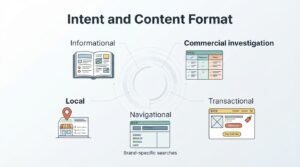
Content format is the delivery mechanism for intent, and choosing the wrong one wastes even excellent writing. The format decision comes before the outline, not after.
This table shows the format that typically satisfies each intent type.
| Intent | Required Format | Primary Success Metric |
| Informational | Long-form guide, tutorial, definition page | Time on page, snippet capture |
| Commercial investigation | Comparison table, review, ranked roundup | Click-through to product, assisted conversions |
| Transactional | Product, pricing, booking, or signup page | Conversion rate |
| Navigational | Clean branded landing or login page | Bounce to intended destination |
| Local | Location page with NAP, hours, and map | Calls, directions, form fills |
Format failure looks like a 4,000-word guide ranking for a transactional query while a 300-word product page outranks it. The short page wins because it matches.
I decide the format from the SERP audit, then brief the writer. Reversing that order produces beautiful pages that never rank.
Search Intent and Keyword Research
Search intent belongs at the front of keyword research, not the end, because volume and difficulty are meaningless without knowing what the query demands. A 10,000-volume keyword you cannot satisfy is worth less than a 200-volume keyword you can own.
Here is the sequence I run.
- Pull the raw keyword set from your seed terms and competitor gaps
- Tag every keyword with a hypothesised intent using modifiers
- Verify intent on the SERP for anything above your volume threshold
- Group keywords by shared intent and shared SERP, not by string similarity
- Assign one page per intent group rather than one page per keyword
- Prioritise groups by commercial proximity before raw volume
Step four matters most. Two keywords belong on the same page only when their results pages substantially overlap, because overlapping SERPs mean Google considers them the same query.
That single check prevents most keyword cannibalisation before it starts.
Search Intent Across the Customer Journey
Search intent maps directly onto the buying journey, with informational queries clustering at awareness and transactional queries at decision. Understanding that mapping is how you stop judging every page by conversion rate.
This table shows the relationship between journey stage, dominant intent, and appropriate measurement.
| Journey Stage | Dominant Intent | Page Type | How to Measure |
| Awareness | Informational | Guide, explainer | Traffic, engagement, email capture |
| Consideration | Commercial investigation | Comparison, review | Assisted conversions, product clicks |
| Decision | Transactional | Product, pricing, booking | Direct conversions, revenue |
| Retention | Navigational or informational | Support docs, login | Ticket deflection, repeat visits |
We lose clients’ money every time someone insists an awareness page should convert at 3%. It will not, and forcing it to try destroys its rankings.
Each stage has a job. Judge the page on its own job.
What Intent Mismatch Costs You
Intent mismatch means the page cannot rank regardless of how strong its content, links, or technical setup are, because it fails Google’s first filter. That makes it the most expensive error in SEO.
Ahrefs research on 2 million keywords found only 5.7% of pages reach the top ten within a year, and mismatch is a frequent cause of pages that never arrive at all.
The costs stack up in specific ways.
- Content budget spent on pages that cannot compete for their target query
- Backlinks earned by pages that will never rank, wasting authority
- Months of waiting before the problem is diagnosed
- Traffic that arrives but bounces because the page answers the wrong question
- Internal links pointing at pages that do not deserve them
I now audit intent before a single brief gets written. The fix is cheap at the planning stage and brutal at the republishing stage.
Auditing Existing Pages for Intent Alignment
An intent audit compares what each existing page delivers against what its target SERP demands, and it is usually the highest-ROI work available on an established site. Most sites have pages one format change away from ranking.
Run it in this order.
- Export every page with impressions but poor average position from Search Console
- Identify the primary query each page actually receives impressions for
- Search that query and record the dominant format in the top ten
- Compare that format against the page’s current format
- Tag each page as aligned, partially aligned, or mismatched
- Rewrite mismatched pages to the required format rather than adding word count
Step two catches the most common surprise. Pages frequently earn impressions for a query nobody intended to target, which means the page and its actual demand have drifted apart.
Partially aligned pages are usually the fastest wins. They need a restructure, not a rewrite.
Search Intent in AI Overviews and AI Search

AI Overviews and AI assistants apply intent matching at the sentence level rather than the page level, selecting individual claims that answer the query directly. A page can rank well and still be invisible to AI answers if its sentences are not self-contained.
The intent logic is the same, and the extraction unit is smaller.
What this changes in practice is structure. Each section needs to answer its heading in its first sentence, name its own subject rather than relying on “it” or “this,” and attribute any statistic inside the same sentence as the number.
I write definition sentences in plain third person for exactly this reason. A definition framed as personal opinion cannot be lifted and cited.
Informational and commercial investigation queries trigger AI answers most often, so those pages need the tightest extractable structure.
Local and Geographic Intent

Local intent is a query where proximity changes the correct answer, and it can be present without any location word in the query itself. Google infers it from query category and user location.
Someone searching “emergency plumber” at 11 pm has local intent even without typing a city. The SERP responds with a map pack, not a national guide.
The tell is the local pack. If it appears, the query is local, and your ranking work shifts toward Google Business Profile, local citations, and location-specific pages rather than general content depth.
Service businesses get this wrong by building one national page for a query that resolves to twenty separate local SERPs.
Intent Drift: When Search Intent Changes
Intent drift is when the dominant intent behind a query shifts over time, causing pages that once ranked to decline without any change on the page itself. It happens more often than most teams check for.
Common triggers look like this.
- A product category matures, and searchers move from learning to comparing
- A news event temporarily converts an informational query into a fresh-results query
- A new product launch converts a generic term into a navigational brand query
- Seasonality shifts a query between research and purchase modes
- Google reinterprets a query after a core update
The symptom is a page that loses position while its content, links, and technical health stay stable. That pattern points at the SERP, not the page.
I recheck the SERP for every priority keyword quarterly. It takes an hour and catches drift before it costs a full quarter of traffic.
Building an Intent-Led Content Strategy
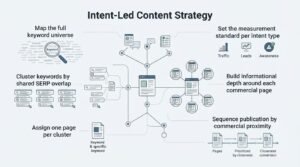
An intent-led content strategy assigns every planned page a single intent type and a single SERP to compete in, before any writing begins. It replaces keyword-count planning with demand-shape planning.
Here is how I build one.
- Map the full keyword universe for the topic and tag every term by intent
- Cluster keywords by shared SERP overlap into page-level groups
- Assign one page per cluster with one intent and one format
- Sequence publication by commercial proximity, not by ease
- Build informational depth around each commercial page to support it
- Set the measurement standard per intent type before launch
Point five is the part teams skip. Commercial pages rarely rank on their own because Google wants topical evidence around them.
The informational cluster is what makes the money page credible.
Measuring Whether Your Content Satisfies Intent
You measure intent satisfaction by pairing ranking data with behavioral data, because position alone cannot tell you whether searchers got what they came for. A page at position three with a 90% bounce back to the SERP is failing.
This table shows which signal to read for each intent type.
| Intent | Primary Signal | Failure Indicator |
| Informational | Impressions, average position, snippet capture | High impressions with low CTR |
| Commercial investigation | Clicks to product or pricing pages | Traffic with zero downstream clicks |
| Transactional | Conversion rate, revenue per session | Traffic with no form or cart activity |
| Local | Calls, direction requests, form fills | Impressions without Business Profile actions |
The fastest diagnostic is the gap between impressions and clicks in Search Console. Strong impressions with weak clicks usually mean your title and format do not match what the searcher expected to see.
I check that gap monthly. It surfaces mismatch faster than any ranking report.
Conclusion
Search intent determines whether a page can rank at all, sitting ahead of content quality, backlinks, and technical health as the first filter.
Every concept here connects to deeper work: SERP analysis, keyword clustering, content auditing, and local optimization each deserve their own attention.
We build intent-aligned organic growth programs at White Label SEO Service, from audit through execution and reporting.
Frequently Asked Questions
What is search intent in simple terms?
Search intent is what a person actually wants when they type a query. It is the goal behind the words, not the words themselves.
How many types of search intent are there?
There are four types: informational, navigational, commercial investigation, and transactional. Some queries blend two, which Google handles by mixing result formats.
How do I find the search intent of a keyword?
Search the keyword and read the top ten results. The page formats that rank reveal what Google has decided searchers want.
Can one keyword have more than one intent?
Yes, and it is common. Google shows mixed result formats when searchers using the same words want genuinely different outcomes.
Does search intent affect rankings directly?
Yes. Google filters ranking candidates against intent before scoring quality, so a mismatched page cannot compete regardless of its strengths.
How often does search intent change?
Intent drifts gradually for most queries and suddenly after product launches or news events. I recheck priority keyword SERPs quarterly.
Should every page target a different intent?
Each page should target one intent and one SERP. Splitting intents across a single page usually means it satisfies neither well.