White label SEO audits are pre-built or customizable site analysis reports that agencies purchase from a third-party provider and rebrand as their own to present to prospective clients. I’ve watched agencies go from a 15% pitch close rate to over 40% simply by walking into a meeting with a professional, data-backed audit instead of a generic pitch deck.
Agencies that skip this step often lose deals to competitors who show up prepared. We built this guide because too many agency owners treat audits as an afterthought rather than a sales weapon.
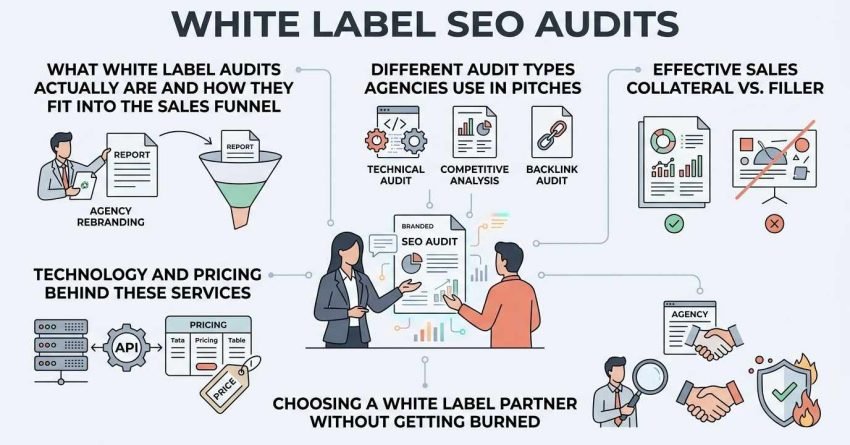
This guide covers what white label audits actually are and how they fit into the sales funnel, the different audit types agencies use in pitches, what separates effective sales collateral from filler, the technology and pricing behind these services, and how to choose a white label partner without getting burned.
What White Label SEO Audits Are and Why Agencies Use Them
A white label SEO audit is a technical and strategic site analysis produced by a third-party provider and rebranded under the agency’s own name for client presentation. Agencies use these audits because building an in-house audit team is slow, expensive, and hard to scale during a sales cycle where speed often wins the deal.
The core value isn’t the audit itself. It’s the credibility it buys in the first fifteen minutes of a sales call, when a prospect is deciding whether the agency on the other end of the call actually understands their website.
The Core Components of a White Label Audit
Every solid audit report walks through crawlability, site speed, on-page structure, backlink profile, and content gaps relative to competitors. A Semrush 2024 industry study found that 58% of top-performing agency proposals included a technical audit component as the centerpiece of the pitch.
Findings are typically ranked by impact, with the highest-impact fixes surfaced first so a prospect can visually grasp the scale of opportunity within minutes.
Who Actually Uses White Label Audit Reports
Small agencies without dedicated SEO analysts use these reports most heavily, but even mid-sized agencies lean on white label production during high-volume pitch periods. In-house marketing teams occasionally commission them too, using the audit as ammunition to justify a bigger SEO budget internally.
How White Label SEO Audits Fit Into the Client Acquisition Process
The audit typically enters the sales process right after initial contact and before the proposal is drafted, functioning as the evidence layer that turns a cold conversation into a data-backed conversation. Without it, most pitches rely on generic promises that prospects have heard a dozen times before.
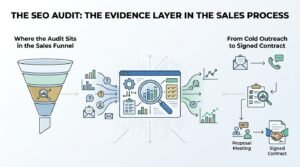
I treat the audit stage as the pivot point of the entire funnel. It’s where a prospect either leans in because the findings feel personal and specific, or checks out because the pitch feels templated.
Where the Audit Sits in the Sales Funnel
The audit sits between discovery and proposal, converting a vague conversation about “improving rankings” into a specific list of prioritized fixes tied to the prospect’s actual domain. This is also where audit prioritization frameworks separate agencies that look competent from agencies that look like they’re guessing.
From Cold Outreach to Signed Contract
A cold email references one specific finding from a lightweight audit, the discovery call expands on the top three issues, and the full audit becomes the centerpiece of the proposal meeting. Each stage narrows the gap between “interested” and “signed,” and the audit is the thread connecting all three.
Types of SEO Audits Used in Client Pitches
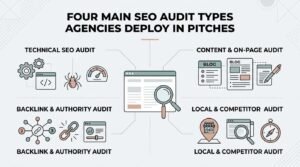
There are four main audit types agencies deploy in pitches: technical, content and on-page, backlink and authority, and local or competitor-focused audits. The table below shows how they compare on typical turnaround, complexity, and pitch usage.
| Audit Type | Typical Turnaround | Complexity | Best Used For |
| Technical SEO Audit | 1–3 days | High | Prospects with crawl or speed issues |
| Content & On-Page Audit | 1–2 days | Medium | Content-heavy sites, blogs, publishers |
| Backlink & Authority Audit | 2–4 days | Medium-High | Sites with toxic link profiles |
| Local & Competitor Audit | 1 day | Low-Medium | Local service businesses, multi-location brands |
Technical SEO Audits
A technical SEO audit is a diagnostic report that examines crawlability, indexation, site speed, and structural errors that block search engines from properly ranking a site. These audits carry the most weight in pitches because technical issues are objective and easy for prospects to verify themselves once pointed out.
Content and On-Page Audits
Content and on-page audits look at keyword targeting, content depth, internal linking, and metadata quality across a site’s existing pages. I find these resonate strongest with prospects who already publish content regularly but haven’t seen the traffic to match the effort.
Backlink and Authority Audits
A backlink audit reviews the quality, relevance, and risk profile of every domain linking to a prospect’s site, flagging toxic or spammy links that could be suppressing rankings. Ahrefs’ 2024 backlink data](https://ahrefs.com/blog/link-building-statistics/) shows that 66.5% of pages get zero organic traffic largely due to a lack of quality backlinks, a stat that lands hard in a pitch meeting.
Local SEO and Competitor Audits
Local and competitor audits focus on Google Business Profile optimization, local pack rankings, and a side-by-side comparison against nearby competitors. These are the fastest audits to produce and often the easiest for a prospect to understand at a glance.
What Makes Sales Collateral Effective for SEO Pitches
Effective SEO sales collateral combines a clear diagnosis, a credible track record, and a specific plan the prospect can visualize acting on. Weak collateral leans on generic stock claims like “we boost rankings,” while strong collateral shows exact numbers, exact timelines, and exact next steps.
We’ve seen agencies double their close rate just by replacing a generic slide deck with collateral built around the specific prospect’s audit findings.
Proposal Templates and Pricing Sheets
A proposal template lays out scope, deliverables, and pricing in a format a prospect can forward internally to a decision-maker without needing a follow-up call to explain it. Pricing sheets that break costs into tiers tend to convert better than single flat-rate quotes because they give the prospect a sense of control.
Case Studies and Performance Reports
Case studies translate past results into a story a prospect can see themselves in, ideally matched by industry or business size. A performance report format that shows month-over-month organic traffic growth, tied to specific ranking improvements, gives the pitch a concrete before-and-after narrative.
Branded Decks and One-Pagers
A branded one-pager condenses the entire pitch into a single visual summary a prospect can glance at during an internal budget meeting where the agency isn’t in the room. This document often decides the deal more than the full presentation does, since it’s what actually gets shared with the person holding the budget.
White Label vs In-House Audit Production
White label audit production means outsourcing report creation to a third-party specialist, while in-house production means building and maintaining that capability internally with dedicated staff. The choice usually comes down to deal volume: agencies pitching fewer than five prospects a month can often justify in-house work, while higher volume almost always favors white label.
Cost, Speed, and Quality Tradeoffs
In-house audits offer more customization but take longer and cost more per report once salary and tooling are factored in. White label production trades some customization for speed and consistency, which matters most when a sales team is pitching several prospects in the same week.
How White Label SEO Reports Are Branded for Reseller Agencies
White label reports are rebranded with the reselling agency’s logo, colors, and domain so the client never sees the original production source. This branding layer is what allows a small agency to present itself as having full in-house analytical capability.
Logo, Domain, and Client-Facing Customization
Most white label platforms let agencies swap in their own logo, adjust color schemes, and host the final report under a branded subdomain or PDF cover page. The best providers also allow custom section ordering, so the report reads as if it were built specifically for that agency’s methodology rather than a generic template.
The Technology Behind Automated White Label Audits
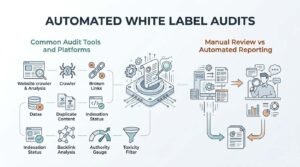
Automated white label audits rely on crawler-based software that scans a site’s technical structure, content, and backlink profile, then compiles the findings into a formatted report. These platforms have replaced most manual audit work over the past several years because they cut turnaround time from days to hours.
Common Audit Tools and Platforms
Crawler-based tools scan thousands of URLs to flag broken links, duplicate content, and indexation errors within minutes, forming the technical backbone of most white label services. Backlink analysis tools run in parallel, pulling in referring domain data to assess authority and toxicity.
Manual Review vs Automated Reporting
Automated tools handle the data collection, but manual review still matters for interpreting findings in the context of a specific prospect’s industry and goals. The strongest white label providers combine automated scanning with a human analyst pass before the report ships.
How to Use an SEO Audit to Win a Client Pitch
The most effective way to use an SEO audit in a pitch is to lead with the three highest-impact findings, tie each one to a business outcome, and end with a specific first-30-days action plan. Prospects rarely care about a full technical breakdown; they care about what’s broken and what happens once it’s fixed.
Structuring the Pitch Around Audit Findings
- Open with a two-sentence summary of overall site health and opportunity size.
- Present the top three findings, ranked by potential traffic or revenue impact.
- Tie each finding to a specific business consequence, like lost leads or wasted ad spend.
- Show a competitor comparison to create urgency.
- Close with a 30-60-90 day action plan tied directly to the audit findings.
Common Objections and How Audits Address Them
Prospects often push back with “we already tried SEO, and it didn’t work,” and a detailed audit gives a concrete, verifiable reason why previous efforts underperformed. This shifts the conversation from a subjective disagreement to an objective diagnosis the prospect can see for themselves.
Pricing Models for White Label SEO Audits and Collateral
White label SEO audits are typically priced per report, through a monthly subscription, or as part of a bundled package that includes sales collateral. Per-report pricing works best for agencies with unpredictable pitch volume, while subscriptions suit agencies pitching consistently every month.
| Pricing Model | Typical Range | Best For |
| Per-Report | $50–$300 per audit | Low, unpredictable volume |
| Monthly Subscription | $200–$1,000/month | Consistent pitch volume |
| Bundled Package | $500–$2,500/month | Agencies needing audits + collateral + ongoing reports |
Per-Report, Subscription, and Bundled Pricing
Bundled pricing usually includes not just the audit but proposal templates, case study formatting, and revision rounds, which reduces the total tools an agency needs to manage separately. Agencies scaling past ten pitches a month tend to see the bundled model pay for itself through time saved alone.
Choosing a White Label SEO Partner for Audits and Sales Materials
The right white label partner delivers accurate, well-formatted reports on a reliable turnaround schedule without ever appearing in client-facing communication. Vetting this properly before signing a contract prevents the embarrassment of a client-facing error traced back to a subcontractor.
Red Flags to Watch For
Vague turnaround promises, no sample reports available for review, and reluctance to disclose the tools behind their audit process are all signs worth taking seriously. A provider unwilling to show a redacted sample report is usually hiding weak output quality.
Questions to Ask Before Signing
Agencies should ask about average turnaround time, revision policy, whether reports are automated or manually reviewed, and how white labeling and rebranding actually work on their end. The answers to these questions reveal more about reliability than any sales pitch the provider gives.
Common Mistakes Agencies Make With White Label Audits
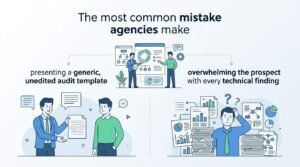
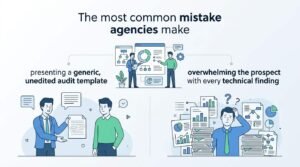
The most common mistake agencies make is presenting a generic, unedited audit template without tailoring the findings to the prospect’s specific industry or business goals. A prospect can tell within seconds when a report feels copy-pasted rather than built for them.
Another frequent error is overwhelming the prospect with every technical finding instead of prioritizing the three or four that actually matter to their bottom line. Volume without prioritization reads as noise, not expertise.
How White Label Audits Support Long-Term Client Retention
White label audits aren’t just a sales tool; they double as a recurring performance benchmark that keeps clients engaged well past the signing stage. Running a fresh audit every quarter gives an agency a built-in reason to check in and show measurable progress.
This ongoing use turns what started as a pitch document into a retention mechanism, giving clients visible proof that the relationship is still delivering value months into the contract.
Conclusion
White label SEO audits and sales collateral turn cold pitches into data-backed conversations prospects can act on. They connect technical findings, sales strategy, and long-term client retention into one system.
The broader SEO landscape keeps shifting, and agencies that pair strong audits with clear proposals stay ahead of competitors relying on generic pitches.
We built White Label SEO Service to help agencies win more pitches with sharper audits and collateral that actually closes deals.
Frequently Asked Questions
What is a white label SEO audit?
A white label SEO audit is a site analysis report produced by a third-party provider and rebranded under an agency’s own name. Agencies use it to present professional findings to prospects without building an in-house audit team.
How much does a white label SEO audit cost?
White label SEO audits typically cost between $50 and $300 per report, depending on depth and turnaround speed. Subscription and bundled pricing models can lower the per-report cost for agencies pitching frequently.
How long does a white label audit take to produce?
Most white label audits take between one and four days depending on complexity and audit type. Technical audits generally take longer than local or competitor-focused audits.
Can white label reports be fully branded with my agency’s logo?
Yes, most white label providers allow full branding with an agency’s logo, colors, and domain. This ensures the client never sees the original production source.
Do white label audits use automated tools or manual review?
Most white label audits combine automated crawler-based tools with a manual analyst review before the final report ships. Automation handles data collection while manual review adds industry-specific interpretation.
What should I look for when choosing a white label SEO provider?
Look for fast, reliable turnaround, sample reports available for review, and clear answers about whether audits are automated or manually reviewed. Avoid providers who won’t disclose their process or show past work.
Can white label audits help with client retention, not just new sales?
Yes, running quarterly white label audits gives agencies a built-in reason to check in with existing clients and show measurable progress. This turns a sales tool into an ongoing retention mechanism.