I’ve watched dozens of businesses struggle with the same decision: hiring a Google Business Profile specialist means finding someone who can manage listing optimization, review strategy, local pack rankings, and Google’s frequent algorithm shifts, all while proving measurable results tied to calls, direction requests, and foot traffic. Getting this hire wrong wastes months and budget.
I’ve seen business owners lose six months of visibility because they picked the wrong person. That mistake compounds fast in competitive local markets.
This guide covers what a GBP specialist actually does and why you need one, the different hiring paths available (freelancer, agency, in-house), what to look for in skills and credentials, realistic costs and timelines, and the mistakes and red flags that derail most hiring decisions.
What a Google Business Profile Specialist Actually Does
A Google Business Profile specialist is a local SEO professional who manages, optimizes, and monitors a business’s Google Business Profile to improve visibility in local search and map pack results. I think of this role as part technician, part strategist. They’re not just filling out a profile once and walking away.
The job includes keyword-optimized business descriptions, photo and post management, review response strategy, and category selection. It also includes fixing suspensions, merging duplicate listings, and tracking local pack ranking movement over time.
Core Responsibilities and Deliverables
I expect a specialist to handle profile optimization, ongoing content posting, review monitoring, citation consistency across directories, and monthly performance reporting. These aren’t optional extras. They’re the baseline of the job.
Good specialists also track call tracking data and direction requests as proof of ROI, not just ranking position. Rankings alone don’t pay bills.
How GBP Specialists Differ From General SEOs
General SEOs focus on organic website rankings across broad keyword sets. A GBP specialist narrows in on the map pack, local citations, and profile-specific ranking signals that don’t always overlap with traditional SEO tactics.
I’ve worked with generalist SEOs who barely touch Google Business Profile because it requires its own specialized knowledge of local pack algorithms and category structures.
Why Businesses Hire a GBP Specialist in 2026
Businesses hire a Google Business Profile specialist in 2026 because local pack competition has intensified and Google now weighs review velocity, photo freshness, and Q&A activity more heavily than in past years. Standing out takes deliberate, ongoing management.
I’ve noticed local pack results shifting weekly in competitive niches like home services and healthcare. A Whitespark local search ranking study found that Google Business Profile signals now account for roughly 32% of local pack ranking weight. That’s a massive share of your visibility.
Local Pack Ranking Pressure
Local pack spots are limited to three visible results per search. That scarcity means small optimization gaps between competitors can determine who gets the call and who gets scrolled past.
I track this constantly for clients. Businesses that update their profile weekly consistently outperform those that touch it once a quarter.
Multi-Location and Franchise Complexity
Multi-location businesses face duplicate listing risks, inconsistent NAP data, and franchise-specific suspension issues that single-location businesses rarely encounter. Managing ten locations manually becomes unmanageable fast.
I’ve cleaned up franchise accounts where three different people had created competing listings for the same address. That kind of chaos tanks visibility across an entire brand.
Signs You Need to Hire a GBP Specialist
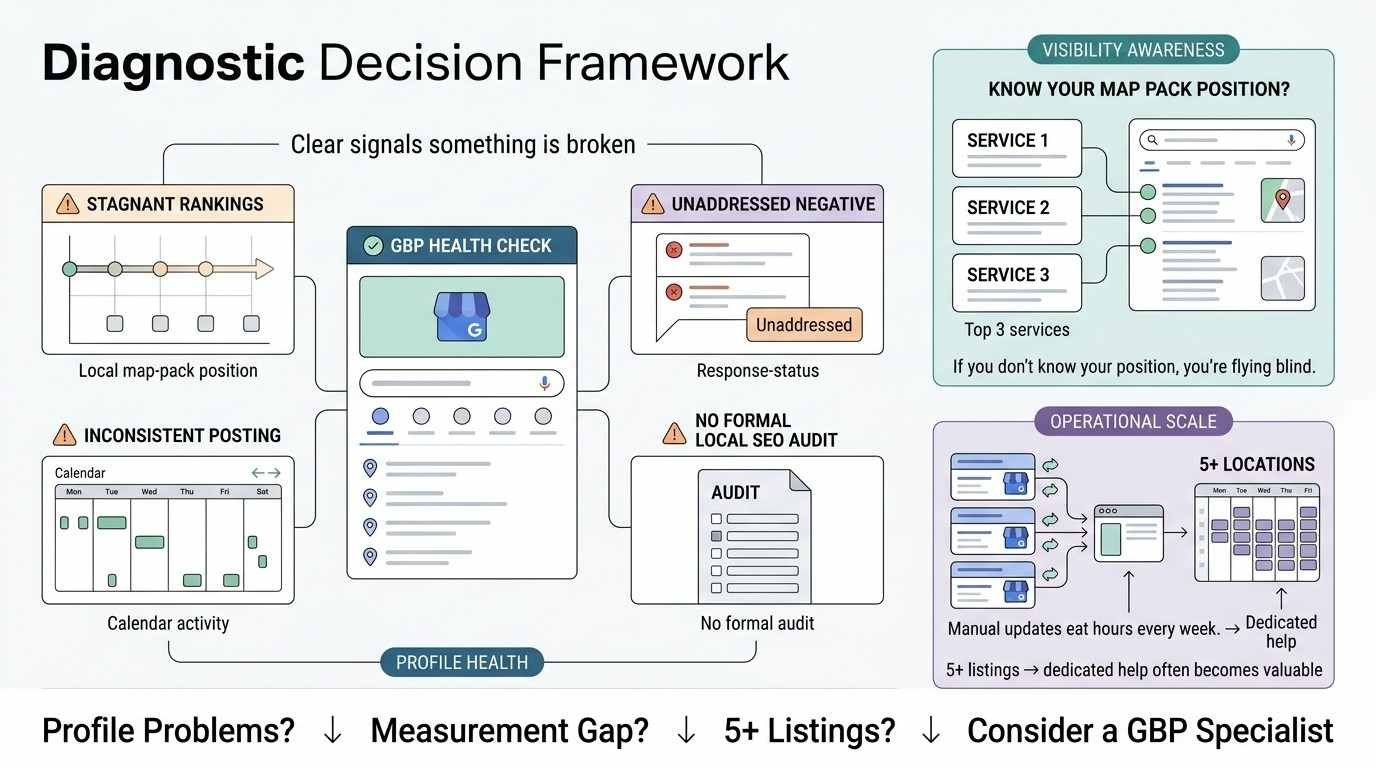
You need a Google Business Profile specialist when your listing has stagnant rankings, unaddressed negative reviews, inconsistent posting, or you’ve never run a formal local SEO audit. These are the clearest signals something’s broken.
I also flag businesses that don’t know their current map pack position for their top three services. If you can’t answer that question, you’re flying blind.
Multi-location brands managing five or more listings almost always benefit from dedicated help, since manual updates across locations eat hours every week.
Types of Google Business Profile Specialists
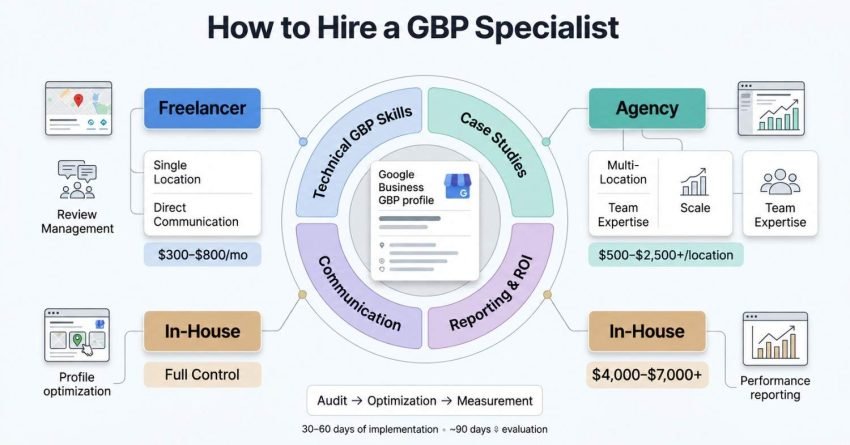
There are three primary paths to hiring GBP expertise: freelance specialists, local SEO agencies, and in-house hires, each suited to different business sizes and budgets. Picking the wrong type for your situation wastes money either way.
I generally steer small single-location businesses toward freelancers, mid-size and multi-location brands toward agencies, and large enterprises with complex needs toward in-house roles.
Freelance GBP Specialists
Freelancers typically charge less than agencies and offer direct, one-on-one communication without account managers in between. That directness appeals to small business owners who want a personal relationship with whoever’s touching their listing.
The tradeoff is capacity. A freelancer juggling fifteen clients can’t always respond same-day, and if they get sick or busy, your account stalls.
Local SEO Agencies
Agencies bring teams, established processes, and reporting dashboards that scale better across multiple locations. You’re paying for redundancy and structure, not just one person’s time.
I’ve seen agencies deliver stronger results for multi-location brands specifically because they’ve built repeatable systems for citation cleanup and review management at scale.
In-House Hires
In-house hires make sense once a business has enough locations or marketing complexity to justify a full-time salary. This path gives you full control over priorities and daily execution.
The downside is training time and the narrower skill set of one person versus an agency’s collective expertise across dozens of accounts.
Core Skills to Look for When Hiring
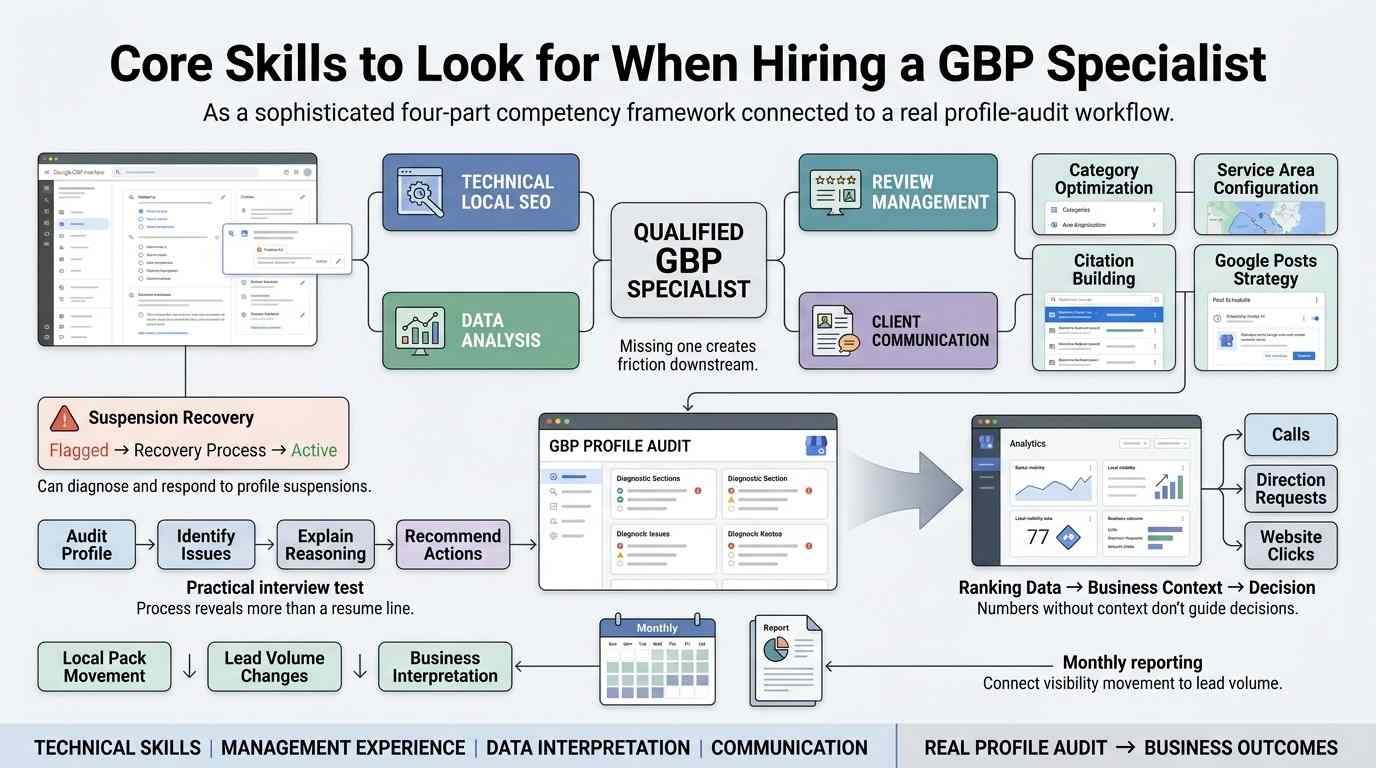
A qualified Google Business Profile specialist needs technical local SEO knowledge, review management experience, data analysis skills, and clear client communication habits. Missing any one of these creates friction down the line.
I always ask candidates to walk through a real profile audit during the interview. Their process reveals more than any resume line.
Technical GBP and Local SEO Skills
Look for hands-on experience with category optimization, service area configuration, citation building, and Google Posts strategy. These are the mechanical skills that move rankings.
I also test whether candidates understand suspension recovery, since even well-managed profiles get flagged occasionally and someone needs to know how to fix it fast.
Reporting and Communication Skills
A specialist should translate ranking data into business outcomes like calls, direction requests, and website clicks, not just present ranking screenshots. Numbers without context don’t help you make decisions.
I expect monthly reports that connect movement in local pack visibility directly to lead volume changes. That connection is what justifies the spend.
Certifications and Credentials That Matter
Google doesn’t offer an official “Google Business Profile specialist” certification, so credibility comes from demonstrated case studies, client retention, and platform-specific training instead. Don’t be fooled by vague certificate claims.
I weigh a candidate’s portfolio of before-and-after ranking screenshots and client testimonials far more heavily than any badge on their LinkedIn profile.
Membership in recognized local SEO communities and completion of platforms like Moz Academy’s local SEO courses signals genuine ongoing education in a field that changes constantly.
Where to Find Qualified GBP Specialists
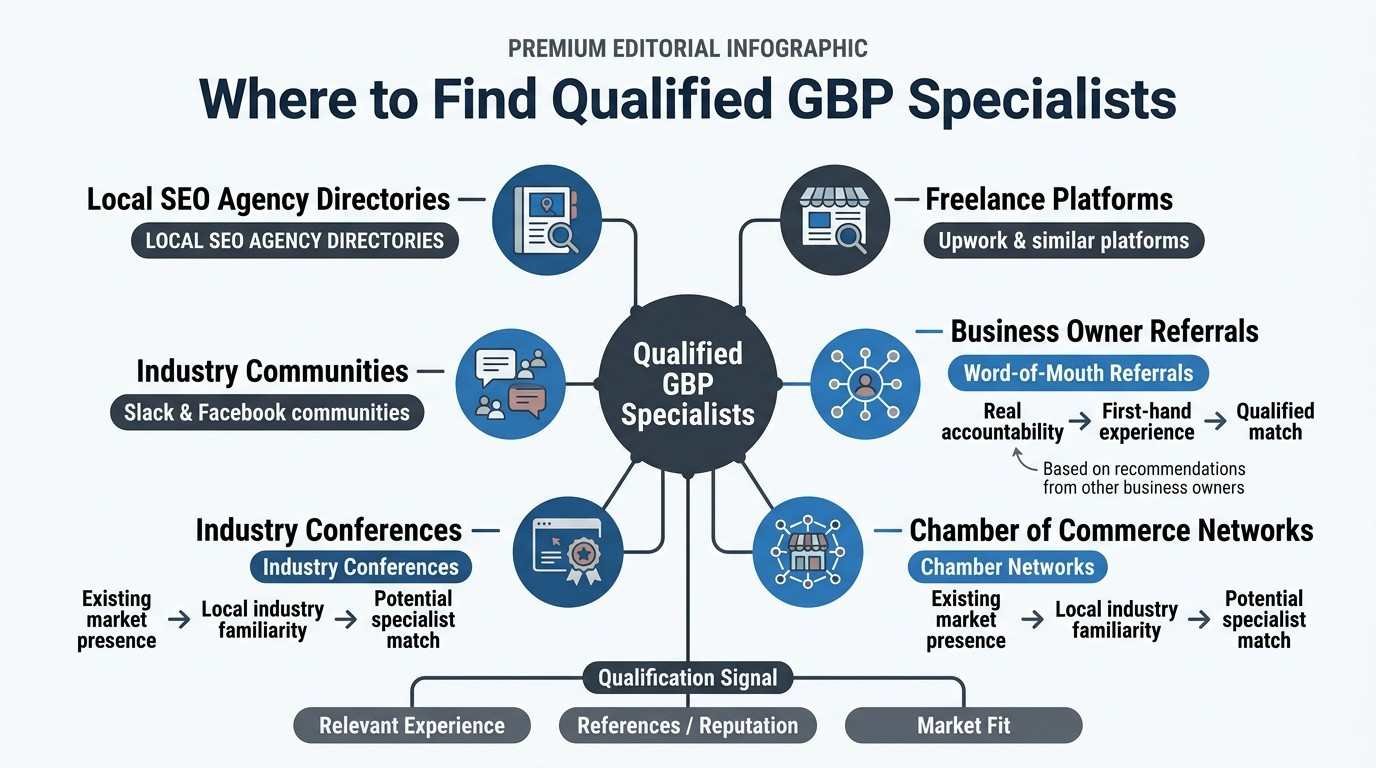
Qualified Google Business Profile specialists can be found through local SEO agency directories, freelance platforms like Upwork, industry-specific Slack and Facebook communities, and referrals from other business owners. Referrals tend to produce the highest-quality matches.
I trust word-of-mouth recommendations from other business owners more than cold platform searches, since those referrals come with real accountability built in.
Industry conferences and local chamber of commerce networks also surface specialists who’ve already proven themselves in your specific market.
Questions to Ask Before Hiring
Before hiring, ask candidates about their reporting cadence, past suspension recovery experience, review response process, and how they measure ROI beyond ranking position. Their answers reveal whether they think strategically or just execute tasks.
I always ask for two or three case studies with specific before-and-after metrics. Vague answers here are an immediate red flag.
Ask how they’d handle a sudden ranking drop, since that scenario tests both their technical knowledge and how they communicate under pressure.
Ask what tools they use for local rank tracking and whether they’ll grant you direct dashboard access instead of gatekeeping the data.
Red Flags and Warning Signs of a Bad Hire
Red flags when hiring a GBP specialist include guaranteed rankings, refusal to share past client results, vague reporting, and pressure to sign long-term contracts before any trial period. Any one of these should give you pause.
I walk away immediately from anyone who guarantees a specific ranking position. Nobody controls Google’s algorithm that precisely, and that promise signals either inexperience or dishonesty.
Watch for specialists who won’t explain their process in plain language. If they can’t describe what they’re doing and why, you can’t evaluate whether it’s working.
How Much It Costs to Hire a GBP Specialist in 2026
Hiring a Google Business Profile specialist in 2026 typically costs between $300 and $2,500 per month, depending on whether you choose a freelancer, agency retainer, or in-house salary. Location count and market competitiveness push costs toward the higher end.
A Clutch survey of small business marketing spend found that local businesses budget an average of $1,200 monthly for combined local SEO and GBP management services.
Freelancer Pricing Models
Freelancers commonly charge $300 to $800 monthly for single-location profile management, or hourly rates between $50 and $150 for project-based work. Hourly arrangements work well for one-time audits or cleanup projects.
I’ve seen freelancer pricing vary widely based on market competitiveness. A freelancer serving a dense urban market charges more than one serving a smaller regional area.
Agency Retainer Pricing Models
Agencies typically charge $500 to $2,500 monthly per location, with multi-location discounts common for brands managing five or more profiles. That per-location cost usually drops as location count scales up.
I’ve negotiated bulk pricing for franchise clients that cut per-location costs by nearly 30% once they crossed ten managed profiles.
Freelancer vs. Agency vs. In-House: Which Is Right for You
The right hiring path depends on location count, budget, and how much hands-on control you want over daily execution. Single-location businesses with tight budgets usually do best with freelancers.
| Factor | Freelancer | Agency | In-House |
| Best for | Single location, tight budget | Multi-location, need scale | Large enterprise, complex needs |
| Monthly cost | $300-$800 | $500-$2,500+/location | $4,000-$7,000+ salary |
| Response time | Variable | Fast, structured | Immediate |
| Expertise depth | Individual skill level | Team-based, broader | Depends on hire |
Multi-location brands generally outgrow freelancer capacity once they pass three or four managed profiles, since consistency across locations becomes harder to maintain manually.
What Deliverables and Timelines to Expect
Expect an initial profile audit within the first two weeks, followed by optimization implementation over 30 to 60 days, and ranking movement typically visible within 90 days. Faster results happen occasionally, but 90 days is the realistic baseline.
I set this expectation with every new client because Google’s algorithm needs time to recognize consistent, sustained profile activity before it shifts rankings meaningfully.
Monthly deliverables should include a performance report, updated post content, and a review response log showing every interaction handled that period.
How to Evaluate Results After Hiring
Evaluate a GBP specialist’s performance using call volume, direction requests, website clicks from the profile, and local pack position for your top three target keywords. Ranking alone tells an incomplete story.
I recommend checking Google Business Profile Insights data monthly against baseline numbers recorded before the specialist started.
A specialist who can’t show measurable movement across at least two of these four metrics within 90 days probably isn’t the right long-term fit.
Google Business Profile Algorithm Changes to Watch in 2026
Google’s Business Profile algorithm in 2026 continues weighting review recency, response rate, and photo activity more heavily than static profile completeness alone. Businesses that treat their profile as a living asset outperform those that set it up once and forget it.
I’ve noticed proximity signals softening slightly in favor of relevance and engagement metrics, meaning well-optimized profiles further from a searcher can still outrank closer, neglected ones.
Staying current on these shifts matters because a specialist trained on outdated tactics can actually hurt your visibility instead of helping it.
Common Mistakes Businesses Make When Hiring
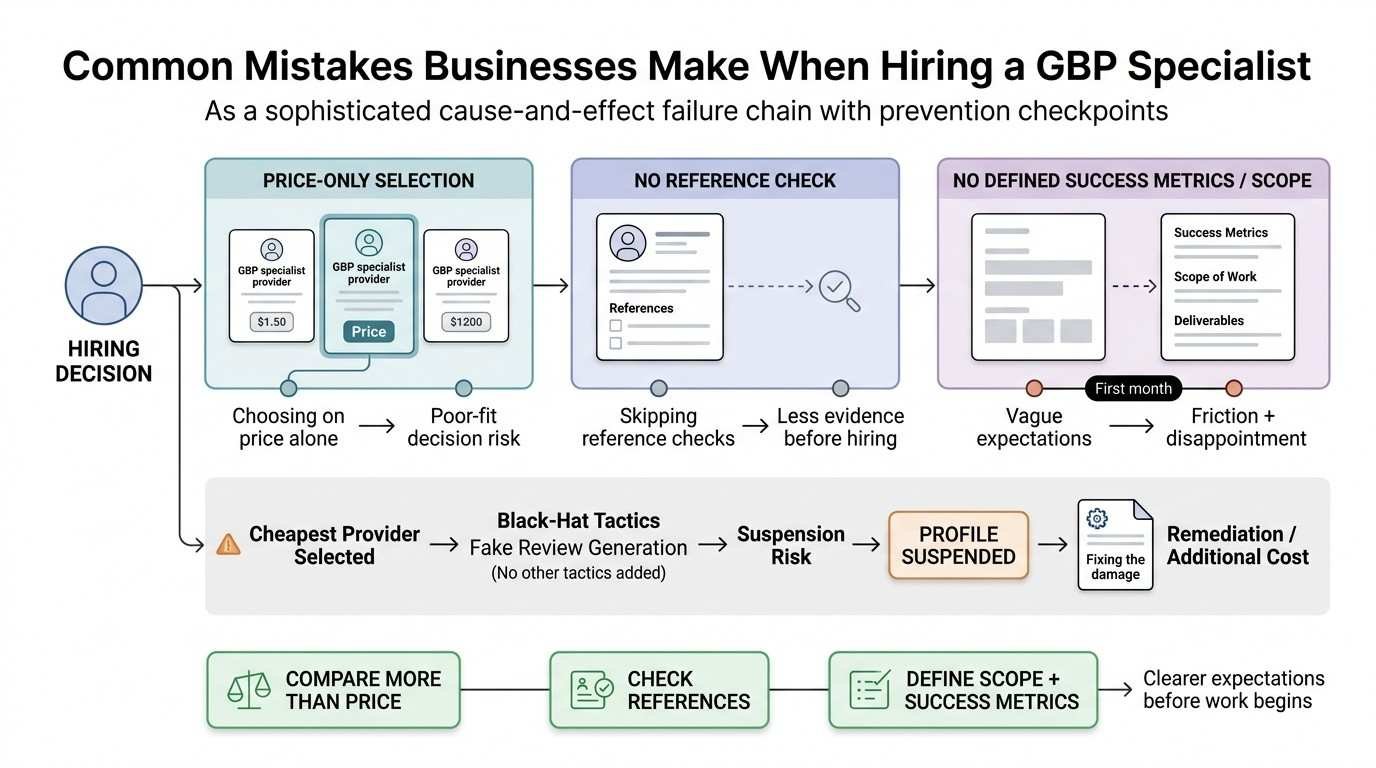
The most common hiring mistakes include choosing based on price alone, skipping reference checks, and failing to define success metrics before the engagement starts. Each of these sets the relationship up to fail from day one.
I’ve watched businesses hire the cheapest freelancer available, only to spend more later fixing suspensions caused by black-hat tactics like fake review generation.
Skipping a clear scope-of-work agreement also causes friction, since vague expectations lead to disappointment on both sides within the first month.
Conclusion
Hiring the right Google Business Profile specialist means matching your location count, budget, and growth goals to the correct hiring path. Skills, transparency, and measurable reporting matter more than price alone.
Local search keeps evolving, and Google Business Profile management now sits at the center of local visibility strategy. Ongoing specialist support keeps your listing competitive.
We help businesses navigate exactly this decision every day. Reach out to White Label SEO Service to build a local visibility strategy that delivers real, measurable growth.
Frequently Asked Questions
What does a Google Business Profile specialist cost per month?
A Google Business Profile specialist typically costs between $300 and $2,500 per month. Freelancers charge less, while agencies and multi-location retainers push costs toward the higher end.
Can I manage my Google Business Profile myself instead of hiring someone?
Yes, small single-location businesses can manage their own profile with consistent effort. Time constraints and competitive markets are usually what push owners toward hiring outside help.
How long does it take to see results after hiring a GBP specialist?
Most businesses see ranking movement within 90 days of hiring a specialist. Initial audits and optimization work typically take the first 30 to 60 days.
What certifications should a Google Business Profile specialist have?
No official Google certification exists for this role. Look instead for demonstrated case studies, client testimonials, and ongoing local SEO education.
Is it better to hire a freelancer or an agency for GBP management?
Freelancers suit single-location businesses with tighter budgets. Agencies suit multi-location brands needing scale, structured reporting, and faster response times.
What questions should I ask before hiring a GBP specialist?
Ask about their reporting cadence, past suspension recovery experience, and how they measure ROI beyond rankings. Request case studies with specific before-and-after metrics.
How do I know if my GBP specialist is underperforming?
Underperformance shows up as flat call volume, no direction request growth, and no local pack movement after 90 days. Vague or infrequent reporting is also a warning sign.