Local SEO services include Google Business Profile management, citation building, on-page optimization, review generation, local content, and performance reporting designed to improve visibility in map packs and local organic results. I put this list together because most business owners sign a contract without knowing what’s actually being done for their money. Local SEO isn’t one task. It’s a bundle of technical, content, and reputation work that compounds over months.
Getting this wrong costs real money and wastes a year of visibility. Understanding the full deliverable list protects your budget and your expectations.
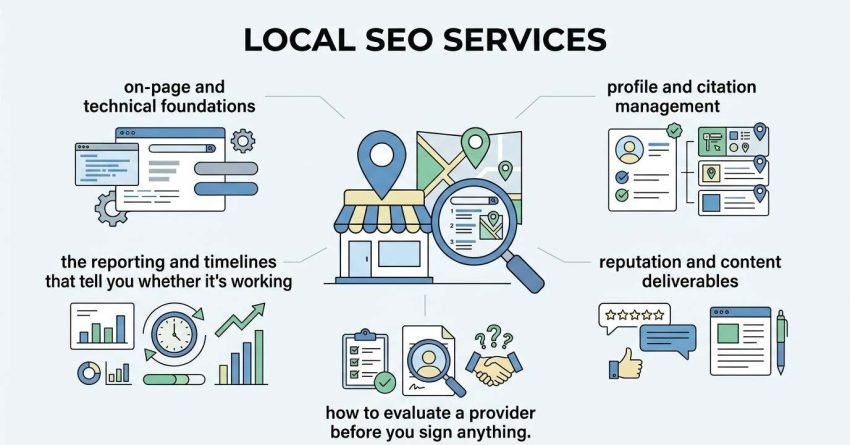
This guide covers the core visibility work profile and citation management, on-page and technical foundations, reputation and content deliverables, and the reporting and timelines that tell you whether it’s working. I’ll also walk through how to evaluate a provider before you sign anything.
What Counts as a Local SEO Service?
A local SEO service is any deliverable aimed at improving a business’s visibility for geographically-specific searches, such as “plumber near me” or “dentist in Austin.” I draw this line early because local SEO and national SEO use overlapping tactics but different priorities.
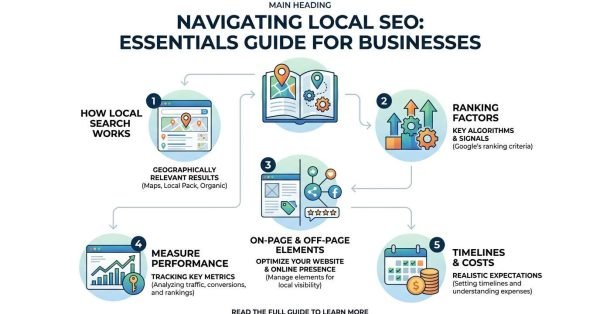
Local search ranks businesses based on proximity, relevance, and prominence three factors that don’t carry the same weight in broader organic SEO. Local SEO leans heavily on Google Business Profile signals, citations, and reviews, while national SEO leans on content depth and backlink authority.
A service qualifies as “local SEO” when its output changes map pack rankings, local organic rankings, or visibility for near-me queries. Website copywriting only counts as local SEO if it targets a specific service area rather than a broad national audience.
Google Business Profile Management
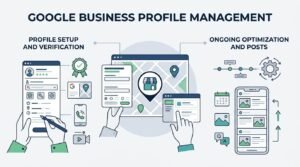
Google Business Profile management is the deliverable that controls how a business appears in the map pack, and it’s usually the single highest-impact item on a local SEO checklist. I’ve seen businesses jump into the top three results just from cleaning up a neglected profile. This is the deliverable clients notice fastest because it’s visible immediately in search results.
Profile Setup and Verification
Profile setup means claiming the listing, verifying ownership through Google’s confirmation process, and filling out every available field: categories, services, attributes, hours, and service areas. Missing categories are one of the most common reasons a profile underperforms.
Verification can take anywhere from a few days to several weeks depending on the method Google assigns, whether that’s a postcard, phone call, or video verification.
Ongoing Optimization and Posts
Ongoing optimization covers weekly or biweekly posts, photo uploads, Q&A monitoring, and updates to services or products listed on the profile. Profiles that get updated regularly signal activity to Google, and inactive profiles tend to lose visibility over time even without a technical error.
A well-run Google Business Profile management program also monitors for unauthorized edits, since anyone can suggest changes to a public listing.
Local Keyword Research and Mapping
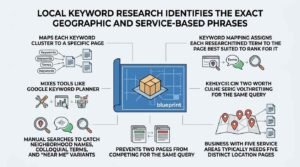
Local keyword research identifies the exact geographic and service-based phrases a business’s customers use, then maps each keyword cluster to a specific page. I treat this as the blueprint the rest of the local strategy gets built on; skip it, and content gets created for guesses instead of demand.
This process usually mixes tools like Google Keyword Planner with manual searches to catch neighborhood names, colloquial terms, and “near me” variants that formal tools sometimes miss.
Keyword mapping assigns each researched term to the page best suited to rank for it, which prevents two pages from competing for the same query. A business with five service areas typically needs five distinct location pages, not one page stuffed with five city names.
On-Page Local SEO Optimization
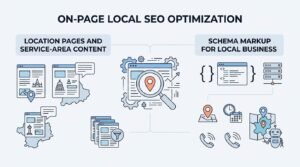
On-page local SEO optimization means editing the actual content, titles, and code of a website’s pages to target local search terms and satisfy local user intent. This is where the keyword research from the previous step actually gets implemented.
Location Pages and Service-Area Content
Location pages are individual pages built for each city, neighborhood, or service area a business operates in, each with unique content describing local service details rather than duplicated boilerplate text. Duplicate location pages with only the city name swapped tend to get filtered out of search results entirely.
Good location pages mention local landmarks, service-area-specific pricing notes, and testimonials from customers in that area.
Schema Markup for Local Business
Schema markup is structured code added to a webpage that tells search engines specific facts about a business, its address, hours, phone number, and service area in a machine-readable format. Google’s structured data guidelines confirm that LocalBusiness schema helps search engines match a listing to relevant local queries more precisely.
NAP Consistency and Citation Building
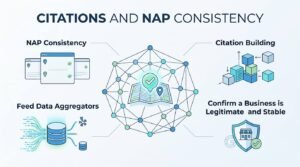
NAP consistency means a business’s name, address, and phone number appear identically across every directory, website, and platform where it’s listed. Inconsistent NAP data is one of the more common technical trust issues I catch during local SEO audits.
Citation building is the process of creating and correcting these listings across relevant directories- think Yelp, Apple Maps, industry-specific directories, and data aggregators like Data Axle. A BrightLocal survey found that inconsistent business information erodes consumer trust as much as negative reviews do.
Citations don’t just help rankings directly. They also feed data aggregators that Google cross-references to confirm a business is legitimate and stable.
Local Link Building and Digital PR
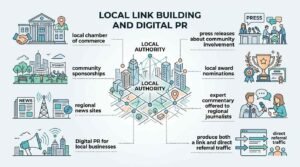
Local link building earns backlinks from other websites in the same geographic area or industry, signaling to search engines that a business is a recognized, trusted part of its local business community. This differs from national link building mainly in source selection — local chambers of commerce, community sponsorships, and regional news sites carry more local relevance weight than a generic high-authority blog.
Digital PR for local businesses often involves press releases about community involvement, local award nominations, or expert commentary offered to regional journalists. These placements tend to produce both a link and direct referral traffic, which is a combination most link-building tactics don’t offer.
Online Review Management and Generation
Online review management is the ongoing process of monitoring, responding to, and actively generating customer reviews across Google, Yelp, and industry-specific platforms. Reviews function as both a ranking factor and a conversion factor, which makes this deliverable dual-purpose in a way most others aren’t.
A structured review generation process typically includes automated request emails or texts sent after service completion, a system for responding to both positive and negative feedback within a set timeframe, and monitoring for fake or policy-violating reviews. Moz’s Local Search Ranking Factors study lists review signals among the top-weighted local ranking factors year over year.
Responding to negative reviews professionally and quickly often matters more to prospective customers than the negative review itself.
Local Content Strategy
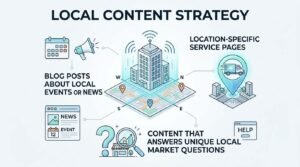
A local content strategy plans and produces content specifically designed to serve local search intent, such as neighborhood guides, local event coverage, or city-specific FAQs. I separate this from general on-page optimization because content strategy is ongoing production, not a one-time edit.
This typically includes blog posts about local events or news tied to the business’s industry, location-specific service pages, and content that answers questions unique to operating in that particular market. Content built around local relevance tends to earn natural local backlinks more easily than generic service content.
Technical SEO for Local Businesses
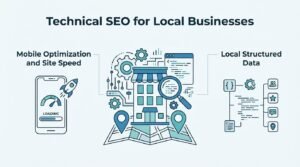
Technical SEO for local businesses covers the site infrastructure work that ensures search engines can properly crawl, index, and understand location-specific pages. Technical problems here quietly cap how well the content and citation work above can ever perform.
Mobile Optimization and Site Speed
Mobile optimization ensures a website functions correctly on smartphones, which matters disproportionately for local search since most “near me” searches happen on mobile devices while someone is out and about. Google’s research found that 53% of mobile visitors abandon a page that takes longer than three seconds to load.
Local Structured Data
Local structured data extends beyond basic schema to include markup for services, service areas, and location-specific reviews, giving search engines granular detail about exactly what a business offers in each market it serves.
Multi-Location SEO Management
Multi-location SEO management coordinates rankings and content across several business locations without those locations competing against each other in search results. Franchises and multi-branch service businesses run into this problem constantly once they expand past a single city.
This deliverable typically includes a distinct Google Business Profile for each verified location, unique location pages with non-duplicated content, and a hub page structure that connects all locations under one parent brand page.
Local SEO Reporting and Performance Tracking
Local SEO reporting and performance tracking measures whether all the deliverables above are actually producing visibility and business results. This is the deliverable that determines whether continued investment is justified, so I treat it as non-negotiable in any legitimate local SEO engagement.
Key Metrics and KPIs
| Metric | What It Measures | Typical Tool |
| Map pack rankings | Position for target local keywords | Local Falcon, BrightLocal |
| Organic local traffic | Visitors from local search queries | Google Analytics |
| GBP actions | Calls, direction requests, website clicks | Google Business Profile Insights |
| Conversion rate | Leads or bookings from organic traffic | CRM + Analytics integration |
| Citation accuracy | Consistency across directory listings | Moz Local, Whitespark |
Google Search Console and Google Analytics together form the baseline reporting stack for tracking impressions, clicks, and on-site behavior tied to local queries.
Typical Local SEO Deliverable Timelines
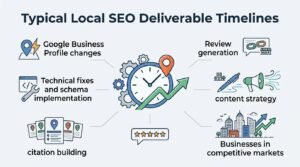
Most local SEO deliverables show measurable movement in three to six months, with fuller results typically taking six to twelve months. Google Business Profile changes tend to move fastest, sometimes within days, while citation building and content strategy compound more slowly.
Technical fixes and schema implementation usually show impact within four to eight weeks once search engines recrawl the affected pages. Review generation and local link building take longer to show ranking impact because they depend on accumulated volume and third-party timing rather than a single edit.
Businesses in competitive markets, like dental or legal services in major metros, generally need the longer end of that range before rankings stabilize.
How to Evaluate a Local SEO Service Provider
Evaluating a local SEO service provider means checking whether their proposed deliverables match the checklist above, rather than a vague promise of “better rankings.” I always tell prospective clients to ask for a specific list of monthly deliverables before signing anything.
A provider worth hiring should be able to explain their citation sources, show sample reporting dashboards, and describe their review generation process in concrete terms. Vague answers about “proprietary strategies” without specifics are a signal to keep looking.
Conclusion
Local SEO combines Google Business Profile management, citations, on-page work, reviews, content, and reporting into one coordinated system. Each deliverable reinforces the others, and skipping one weakens the rest.
Understanding this checklist protects your budget and sets realistic timelines for the results you’re paying for. Sustainable local visibility takes coordinated execution, not shortcuts.
We built White Label SEO Service to deliver every piece of this checklist with transparent reporting. Reach out, and we’ll show you exactly what’s included.
Frequently Asked Questions
What is included in a local SEO service package?
A local SEO package typically includes Google Business Profile management, citation building, on-page optimization, review management, local content, and monthly performance reporting.
How long does local SEO take to show results?
Most businesses see measurable movement within three to six months. Full results, including stable map pack rankings, usually take six to twelve months to materialize.
How much do local SEO services typically cost?
Local SEO services generally range from $300 to $2,000 per month depending on market competitiveness and the number of locations served. Multi-location campaigns cost more due to added citation and content work.
Do I need local SEO if I have multiple locations?
Yes, multiple locations need coordinated local SEO to avoid competing against each other in search results. Each location typically requires its own profile and unique page content.
What is the difference between local SEO and national SEO?
Local SEO targets geographically-specific searches using profile, citation, and review signals. National SEO focuses on broader keyword rankings driven mainly by content depth and domain authority.
How often should local SEO deliverables be updated?
Google Business Profile posts and photos should be updated weekly or biweekly. Citations, content, and technical audits are typically reviewed monthly or quarterly.
What metrics prove local SEO is working?
Map pack rankings, local organic traffic, Google Business Profile actions, and conversion rates together confirm whether local SEO is producing real business results.