Local SEO targets searches tied to a specific geographic area, while traditional SEO targets broader, often national or global, non-location-based search queries. I have watched business owners waste budget on the wrong one simply because nobody explained the distinction clearly. Understanding which strategy fits your business changes how you spend, what you measure, and how fast you see results.
Picking the wrong approach wastes months of effort and budget on invisible rankings. Getting it right compounds visibility, leads, and revenue for years. This guide separates fact from guesswork so you invest with confidence.
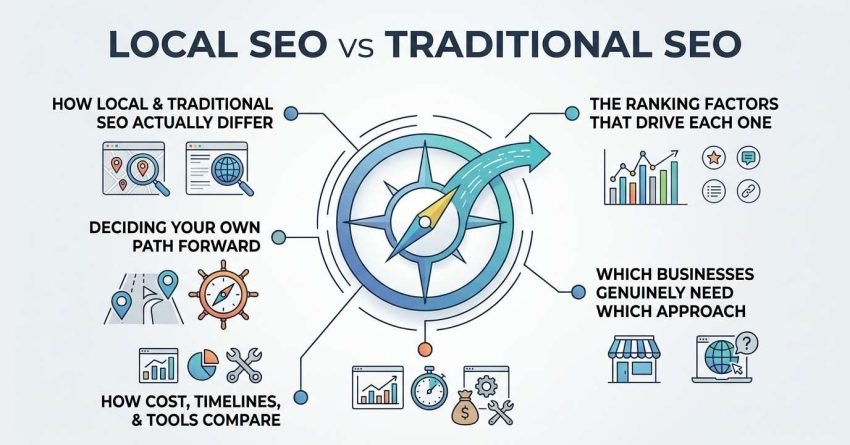
This guide covers how local and traditional SEO actually differ, the ranking factors that drive each one, which businesses genuinely need which approach, and how cost, timelines, and tools compare. I close with a practical framework for deciding your own path forward.
What Is Local SEO?
Local SEO is the practice of optimizing a business’s online presence to rank in geographically targeted searches, such as “plumber near me” or “coffee shop in Austin.” I treat it as its own discipline because Google treats it as its own ranking system, complete with a separate results block called the local pack.
Local SEO is a search optimization discipline that helps businesses appear in map-based and location-qualified search results. It relies heavily on a verified Google Business Profile, consistent business citations, and proximity to the searcher. A dentist, HVAC contractor, or restaurant depends on this system because their customers search with location intent baked into the query.
Core Ranking Signals in Local SEO
Google’s Local Search Ranking Factors report identifies Google Business Profile signals as the single largest ranking factor group for local pack visibility. Proximity to the searcher, category selection, and keyword presence in the business name all carry measurable weight.
Review signals matter almost as much. Businesses with higher review volume and recency tend to outrank competitors with stronger websites but weaker reputation signals.
What Is Traditional SEO?
Traditional SEO is the practice of optimizing a website to rank in standard, non-map organic search results regardless of the searcher’s physical location. I use this term to separate it clearly from local SEO, since most people just say “SEO” and mean this broader discipline.
Traditional SEO is an organic search optimization approach that focuses on content relevance, technical site health, and backlink authority rather than geography. An ecommerce brand, a SaaS company, or a national publisher depends on this approach because their customers don’t search with a city name attached to their query.
Core Ranking Signals in Traditional (Organic) SEO
Content depth, topical authority, and backlink quality drive most organic ranking outcomes. Google’s own Search Central documentation confirms that content built to genuinely satisfy search intent outperforms content built primarily for algorithms.
Site architecture and technical crawlability round out the foundation. A technically broken site rarely ranks well regardless of content quality.
Local SEO vs Traditional SEO: The Core Differences
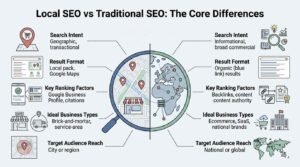
The core difference between local SEO and traditional SEO is geographic intent: local SEO targets location-specific searches while traditional SEO targets searches without geographic qualifiers. I explain this distinction to every new client because it determines almost every downstream decision about strategy and budget.
The table below breaks down the practical differences that matter most when choosing a strategy.
| Factor | Local SEO | Traditional SEO |
| Search intent | Geographic, transactional | Informational, broad commercial |
| Primary ranking surface | Local pack, Google Maps | Organic (blue link) results |
| Key signal | Google Business Profile, citations | Backlinks, content authority |
| Ideal business type | Brick-and-mortar, service-area | Ecommerce, SaaS, national brands |
| Competitive scope | City or region | National or global |
Search Intent Differences
Search intent separates these two disciplines at the root. Someone typing “roofing contractor Dallas” wants a business they can call today, while someone typing “how long do roofs last” wants information first.
I map every keyword to intent before deciding whether it belongs in a local or traditional strategy. Mixing the two without this step leads to wasted content investment.
Geographic Scope Differences
Geographic scope defines how wide the competitive playing field is. Local SEO competition is bounded by a city, region, or service radius, while traditional SEO competes against every relevant site globally.
A single-location bakery competes with three other bakeries in town. A national ecommerce brand competes with thousands of sites worldwide.
How Google Decides Between Local and Organic Results
Google decides whether to show local pack results or traditional organic results by analyzing the query’s implied geographic intent. Queries containing city names, “near me,” or location-dependent service categories trigger the local pack automatically.
Google’s Search Quality Rater Guidelines confirm that locally-intended queries are evaluated against different relevance standards than broad informational queries. This is why a business can rank well organically but still miss the local pack entirely, or vice versa.
Key Ranking Factors: Local SEO
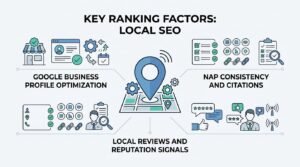
Local SEO ranking depends primarily on Google Business Profile optimization, NAP consistency, and review signals. I prioritize these three areas before touching anything else when auditing a local campaign.
Google Business Profile Optimization
A complete, verified, and actively managed Google Business Profile is the foundation of any local SEO campaign. Category accuracy, photo uploads, and regular posts all contribute to visibility in the local pack.
Businesses that update their profile weekly tend to outperform those that set it up once and abandon it.
NAP Consistency and Citations
NAP consistency means a business’s name, address, and phone number appear identically across every online directory and citation source. Inconsistent NAP data confuses Google’s local index and suppresses ranking potential.
I run a citation audit on every new local client before building anything new.
Local Reviews and Reputation Signals
Review volume, average rating, and response rate all feed into local pack ranking calculations. BrightLocal’s Local Consumer Review Survey found that 98% of consumers read online reviews for local businesses in 2024.
Responding to reviews, both positive and negative, signals active business management to both customers and Google.
Key Ranking Factors: Traditional SEO
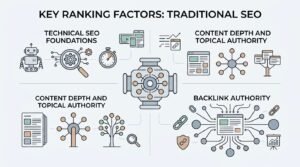
Traditional SEO ranking depends primarily on technical site health, content depth, and backlink authority. These three pillars have remained consistent through most major algorithm updates.
Technical SEO Foundations
Crawlability, site speed, mobile usability, and proper indexation form the technical base every organic ranking strategy sits on. A site Google cannot crawl efficiently cannot rank, regardless of content quality.
Core Web Vitals scores also factor into how Google evaluates overall page experience.
Content Depth and Topical Authority
Comprehensive content that covers a topic domain thoroughly signals topical authority to search engines. This is the same hub-and-spoke principle behind pillar and cluster content architecture.
Shallow, thin content rarely competes against comprehensive resources built around genuine search intent.
Backlink Authority
Backlinks from relevant, authoritative domains remain one of the strongest ranking correlations in organic search. Ahrefs’ study of two million keywords found that pages ranking in the top 10 typically have significantly more referring domains than lower-ranked pages.
Quality and relevance of linking domains matter more than raw link volume.
Which Businesses Need Local SEO?
Businesses with a physical location or a defined service area need local SEO to appear in geographically qualified searches. Restaurants, medical practices, home service contractors, and law firms all fall into this category.
Any business where customers search with a city name, neighborhood, or “near me” attached to the query depends heavily on local pack visibility to generate leads.
Which Businesses Need Traditional SEO?
Businesses that sell products or services without geographic restriction need traditional SEO to compete in broad organic search results. Ecommerce stores, SaaS platforms, media publishers, and national service brands fall into this category.
Any business where customers search by product, topic, or brand name rather than location depends primarily on organic content and backlink strategy.
Can You Combine Local SEO and Traditional SEO?
Yes, a business can and often should combine local SEO and traditional SEO when it operates in multiple locations while also serving a broader online audience. A regional retailer with both physical stores and an ecommerce site is the clearest example.
I build combined strategies constantly for multi-location businesses that also compete nationally online. The two disciplines share technical foundations but require separate content and citation strategies layered on top.
Cost and Timeline Differences Between Local and Traditional SEO
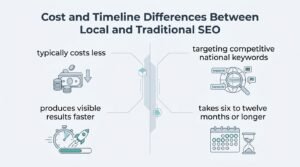
Local SEO typically costs less and produces visible results faster than traditional SEO because the competitive field is smaller. Local campaigns often show local pack movement within three to six months.
Traditional SEO campaigns targeting competitive national keywords frequently take six to twelve months or longer to produce meaningful ranking movement, given the larger competitive pool and higher backlink requirements.
Tools Used to Measure Local vs Traditional SEO Performance
Local SEO performance is measured primarily through Google Business Profile insights, local rank trackers, and citation monitoring tools, while traditional SEO relies on Google Search Console, Google Analytics, and backlink analysis platforms. Both disciplines depend on consistent tracking to prove ROI.
Google Search Console remains the baseline tool for monitoring organic query performance regardless of which strategy a business runs. Rank tracking software layered on top adds competitive visibility.
Common Mistakes Businesses Make Choosing Between Local and Traditional SEO
The most common mistake businesses make is applying a traditional SEO strategy to a local business, or vice versa, without adjusting for search intent. A single-location dentist investing entirely in national backlink campaigns wastes budget that should go toward Google Business Profile optimization.
Ignoring NAP consistency while chasing organic content volume is another frequent error I see in local campaigns. Neglecting technical site health while chasing local citations is the equivalent mistake on the traditional side.
How to Decide Which SEO Strategy Fits Your Business
Deciding between local and traditional SEO comes down to whether your customers search with location intent or topic intent. I walk clients through their own search query data before recommending a direction.
Reviewing actual keyword search volume by intent type, checking whether competitors show up in the local pack or organic results, and mapping customer geography all inform this decision. Most businesses land clearly on one side once the data is reviewed honestly.
Conclusion
Local SEO and traditional SEO solve different problems, built on different ranking signals and competitive scopes. Understanding both helps you invest where your customers actually search.
Search behavior keeps evolving, and many businesses eventually need elements of both strategies working together. Staying informed keeps your visibility compounding rather than stalling.
We help businesses build the right strategy from day one. Reach out to White Label SEO Service to map your growth path today.
Frequently Asked Questions
Is local SEO better than traditional SEO?
Neither is universally better; the right choice depends on whether your customers search with location intent. A brick-and-mortar business needs local SEO, while an ecommerce brand needs traditional SEO.
Does local SEO cost less than traditional SEO?
Local SEO typically costs less because it targets a smaller, less competitive geographic market. Traditional SEO often requires larger content and backlink investments to compete nationally.
Can a business rank locally without a physical address?
Yes, service-area businesses without a public address can still rank locally using a verified Google Business Profile with a defined service area. Physical storefronts are not strictly required for local pack eligibility.
How long does local SEO take to show results?
Local SEO typically shows measurable local pack movement within three to six months. Highly competitive metro areas can take longer depending on existing competition.
Do I need a Google Business Profile for traditional SEO?
A Google Business Profile is not required for traditional SEO since it targets non-geographic organic results. It becomes necessary only if the business also pursues local visibility.
What is the difference between local pack and organic results?
The local pack is the map-based block showing three local businesses, while organic results are the standard blue-link listings below it. They are ranked using different, though overlapping, signals.
Should ecommerce businesses focus on traditional SEO only?
Ecommerce businesses should focus primarily on traditional SEO since most shoppers search by product rather than location. Multi-location retailers with physical stores may still benefit from a layered local strategy.