Google Business Profile is a free Google tool that controls how a business appears in local search results, and it directly determines whether a business shows up in the local pack or on Google Maps. I have watched businesses jump from page two to the top three map results just by fixing a handful of profile signals. Nothing else in local SEO moves rankings as fast or as visibly.
Ignoring this profile costs real customers every single day it stays incomplete. Competitors with sharper categories, more reviews, and tighter consistency simply take the visibility instead. Search behavior has shifted toward “near me” and map-based decisions faster than most business owners realize.
We built this guide to cover the full picture: what the profile is and how it feeds Google’s local algorithm, the relevance, distance, and prominence factors behind rankings, the practical elements you control (categories, reviews, photos, posts, attributes), and how to track performance and avoid the mistakes that quietly suppress visibility.
What Is Google Business Profile and Why It Matters for Local Rankings
Google Business Profile is a free business listing tool that feeds the information Google uses to populate the local pack, Google Maps, and the local knowledge panel. I think of it as the primary data source Google trusts most, because the business itself submits and verifies it directly.
This matters because the local pack pulls almost entirely from profile data rather than from a website’s on-page content. A business with a thin website but a fully optimized, active Google Business Profile regularly outranks a business with a polished site and a neglected profile.
How GBP Differs From a Website for Ranking Purposes
A website ranks through content, backlinks, and technical signals evaluated across the broader organic algorithm. Google Business Profile ranks through an entirely separate local algorithm that weighs proximity, category match, and engagement signals like calls and direction requests.
I treat these as two different ranking systems that happen to share a search results page. Optimizing one does not automatically move the other, which is why local pack visibility often needs its own dedicated tracking.
The Connection Between GBP and Google’s Local Algorithm
Google’s local algorithm cross-references profile data against the searcher’s location and query intent in real time. Every field filled out on the profile, from category to services to attributes, becomes a signal that algorithm reads at the moment someone searches.
I have seen incomplete profiles get skipped entirely in favor of a fully filled-out competitor sitting several miles further away. Completeness competes directly with proximity in ways most owners underestimate.
How the Local Pack and Google Maps Rankings Actually Work
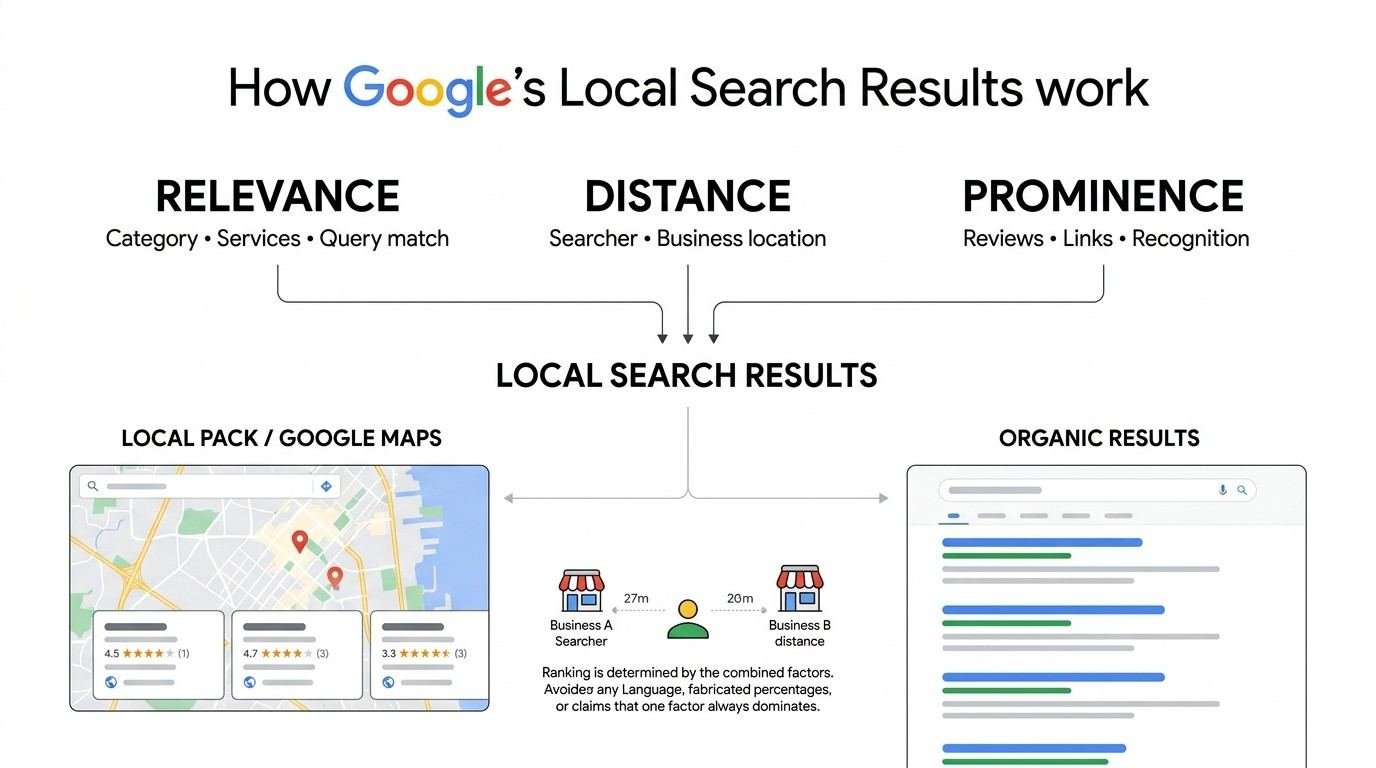
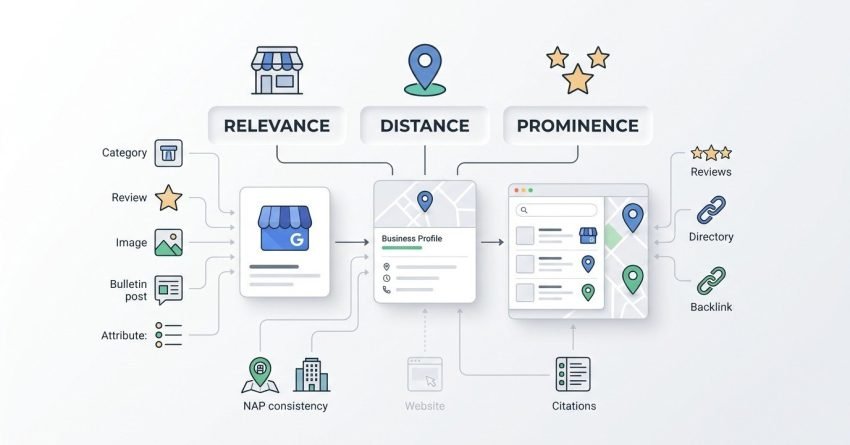
The local pack and Google Maps rankings are determined by three core factors: relevance, distance, and prominence, weighted together for each individual search. These three factors form the backbone of local search, and Google has confirmed this framework directly in its own guidance.
I explain this to clients the same way every time: no single factor wins alone. A business close to the searcher but poorly categorized will still lose to a slightly farther business with a perfect category match and stronger prominence signals.
Relevance, Distance, and Prominence Explained
Relevance measures how well a business profile matches what the searcher is looking for, based on category, keywords, and services listed. Distance measures the physical proximity between the searcher (or the location specified) and the business address.
Prominence measures how well-known and trusted the business is, based on review volume, review scores, and backlink signals, according to Google’s own local ranking documentation. I watch prominence carry the most weight for competitive, high-search-volume categories in dense metro areas.
Local Pack vs. Organic Results vs. Map Pack
The local pack is the three-listing block with a map that appears above organic results for local-intent searches. The map pack refers to the same result set displayed when a searcher taps into the full Google Maps interface, and it typically shows more listings ranked using the same three factors.
Organic results are the traditional blue-link listings below the pack, ranked by the separate algorithm covered earlier. A business can rank well in one and poorly in the other, which is a distinction I bring up with almost every new client.
Google Business Profile Categories and Their Ranking Impact
Category selection is one of the strongest relevance signals Google uses to decide which businesses appear for a given search query. I rank category accuracy above almost every other on-profile factor because it directly filters which searches a business is even eligible to appear in.
Choosing a category that is too broad dilutes relevance, while choosing one that is too narrow can exclude a business from searches it should be winning. Getting this wrong quietly caps visibility long before reviews or photos ever come into play.
Primary vs. Secondary Category Selection
The primary category carries the most ranking weight and should match the single service or product that defines the business most precisely. Secondary categories add supporting relevance for adjacent services without diluting the primary signal, and Google allows up to ten total categories per profile.
I audit primary category choice first on every new account because business owners frequently pick a category that describes their industry generally rather than their core offering specifically.
Business Name, Address, and Phone (NAP) Consistency
NAP consistency means a business’s name, address, and phone number match exactly across the Google Business Profile, website, and every online directory listing it appears on. Inconsistent NAP data confuses Google’s local algorithm and weakens the trust signals tied to prominence.
I have traced ranking stagnation directly back to a single old address still listed on a forgotten directory. Small mismatches, like “St.” versus “Street,” rarely tank rankings alone but compound quickly across dozens of citation sources.
The Role of Reviews and Ratings in Local Pack Rankings
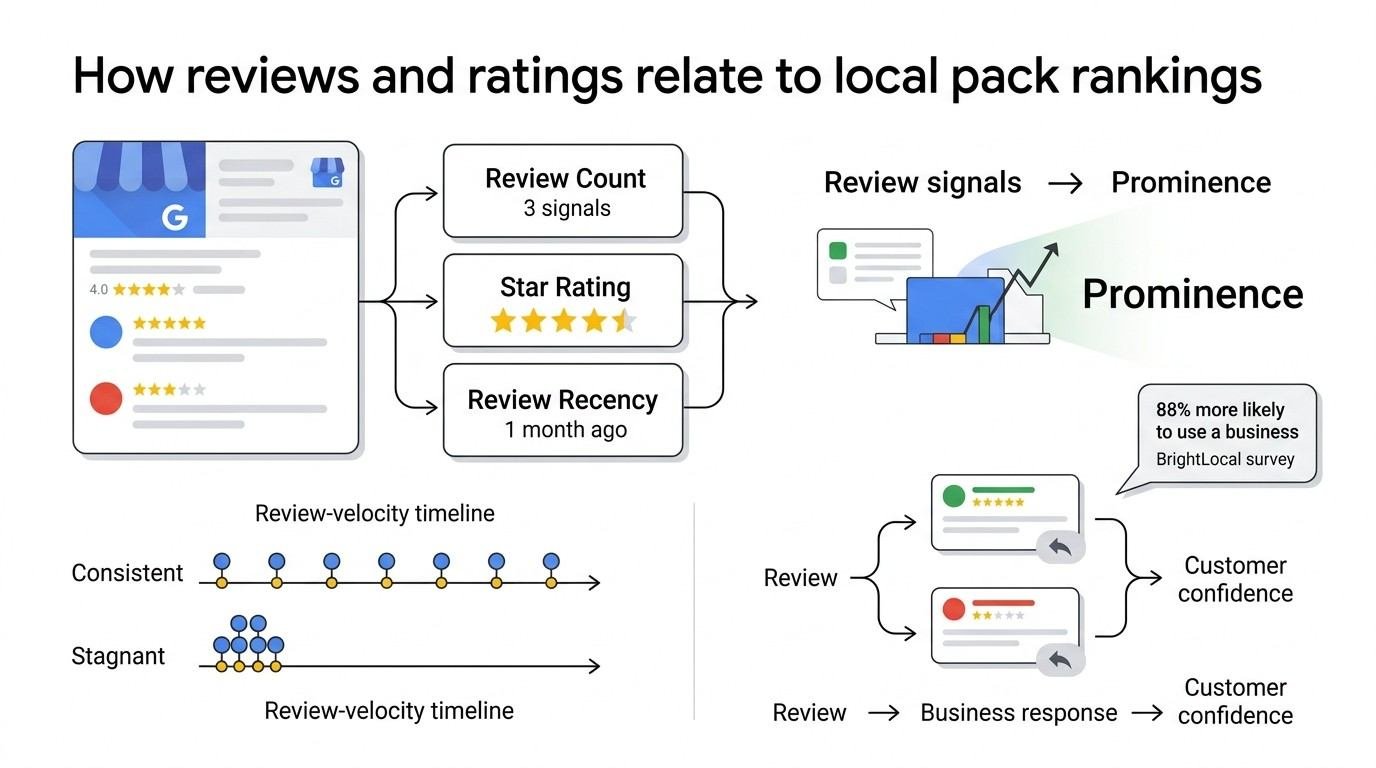
Reviews influence local pack rankings through three measurable factors: total review count, average star rating, and the frequency of new reviews coming in over time. Google has stated publicly that review signals factor into the prominence portion of local ranking.
I push review generation harder than almost any other tactic because it compounds. More reviews build prominence, prominence builds trust, and trust builds the click-through behavior that reinforces rankings further.
Review Velocity and Recency
Review velocity refers to how consistently new reviews arrive rather than a single burst followed by silence. A steady stream of new reviews signals an active, trustworthy business, while a stagnant review profile can read as a business that has slowed down or closed.
I recommend building review requests into a repeatable process rather than an occasional push, since consistency matters more than any single spike in volume.
Responding to Reviews as a Ranking Signal
Responding to reviews, both positive and negative, demonstrates active profile management and customer engagement to Google’s local algorithm. A BrightLocal survey found that 88% of consumers are more likely to use a business that responds to all its reviews.
I treat unanswered negative reviews as a bigger risk than the negative review itself, since the lack of response is what most potential customers notice first.
Photos, Videos, and Visual Content on Google Business Profile
Visual content on a Google Business Profile directly affects both click-through rate and the engagement signals Google factors into prominence. Profiles with recent, high-quality photos consistently attract more direction requests and website clicks than sparse profiles with outdated imagery.
I ask clients to upload new photos monthly at minimum, because a stagnant photo gallery signals inactivity in the same way a stagnant review profile does.
Google Posts and Product/Service Listings Within GBP
Google Posts function like mini social updates published directly to a business’s profile, appearing in search results for a limited window after publishing. Product and service listings give Google structured data about exactly what a business offers, strengthening the relevance signal covered earlier.
I use posts to highlight promotions, events, and new services, since active posting correlates with the same activity signals that influence prominence.
Proximity and Distance Signals in Map Pack Rankings
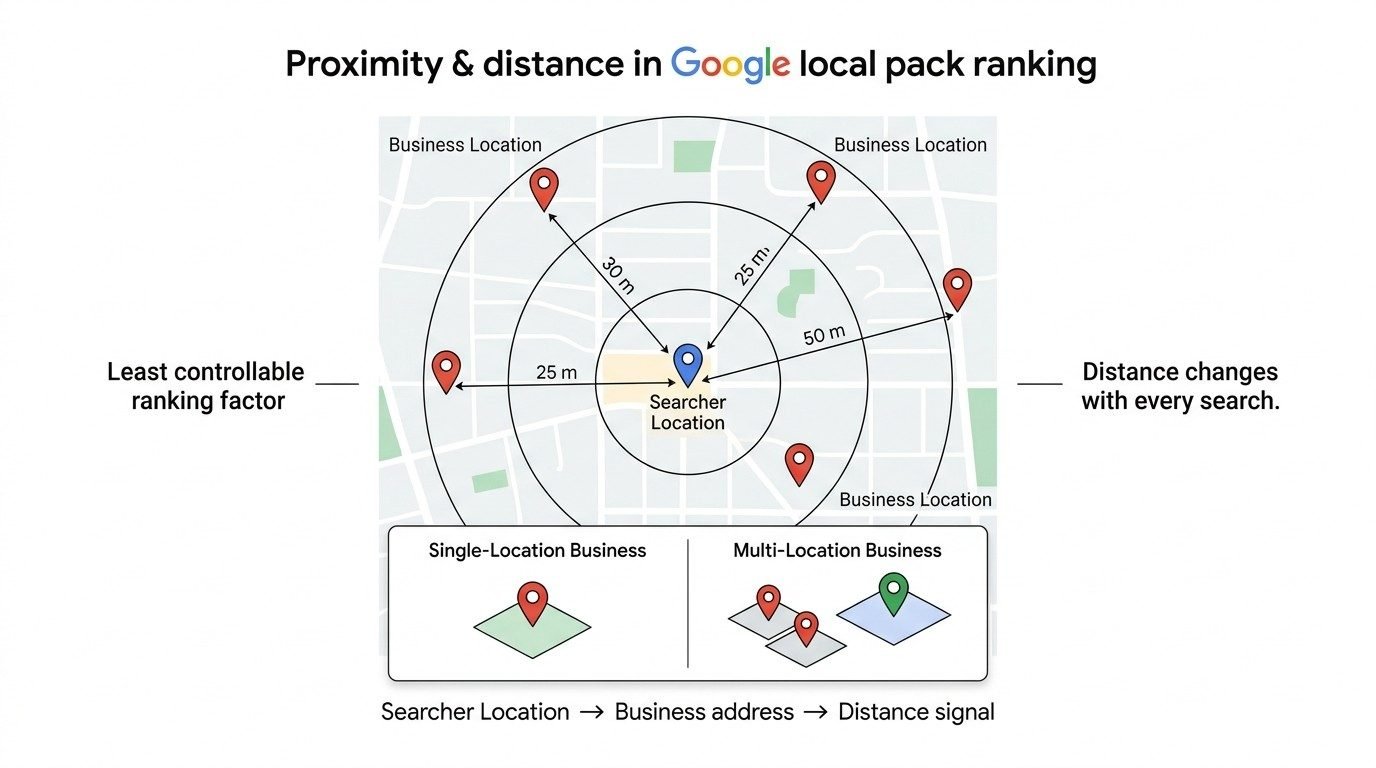
Distance is calculated between the searcher’s actual or implied location and the business address listed on the profile, and it cannot be manipulated the way other factors can. A business physically closer to a high volume of searchers has a structural advantage that no amount of optimization fully overcomes.
I explain to multi-location clients that this is exactly why individual location pages matter more in local SEO than in traditional organic SEO. Distance resets with every single search, which makes it the least controllable of the three ranking factors.
Prominence Signals: Citations, Backlinks, and Brand Authority
Prominence reflects how well-known a business is across the web, measured through local citations, backlinks, and general online mentions. A citation is any online mention of a business’s name, address, and phone number, even without a direct link back to the website.
I treat citation building as foundational rather than optional, since inconsistent or missing citations undercut every other ranking effort a business makes.
How Local Citations Reinforce Google Business Profile Trust
Citations on major directories like Yelp, Apple Maps, and industry-specific platforms act as third-party confirmation of the business details listed on Google Business Profile. Moz’s Local Search Ranking Factors study lists citation signals among the top factors influencing local pack visibility.
I prioritize the handful of high-authority directories relevant to each industry rather than mass-submitting to hundreds of low-quality sites.
Google Business Profile Attributes and Q&A Sections
Attributes are specific tags a business can add to its profile, such as “wheelchair accessible,” “women-led,” or “outdoor seating,” that help match searches with specific intent. The Q&A section allows searchers to ask questions publicly, and any business owner can respond directly on the listing.
I monitor Q&A sections closely because unanswered or inaccurate public answers can misinform potential customers before they ever reach the website.
Website and Landing Page Alignment With Google Business Profile
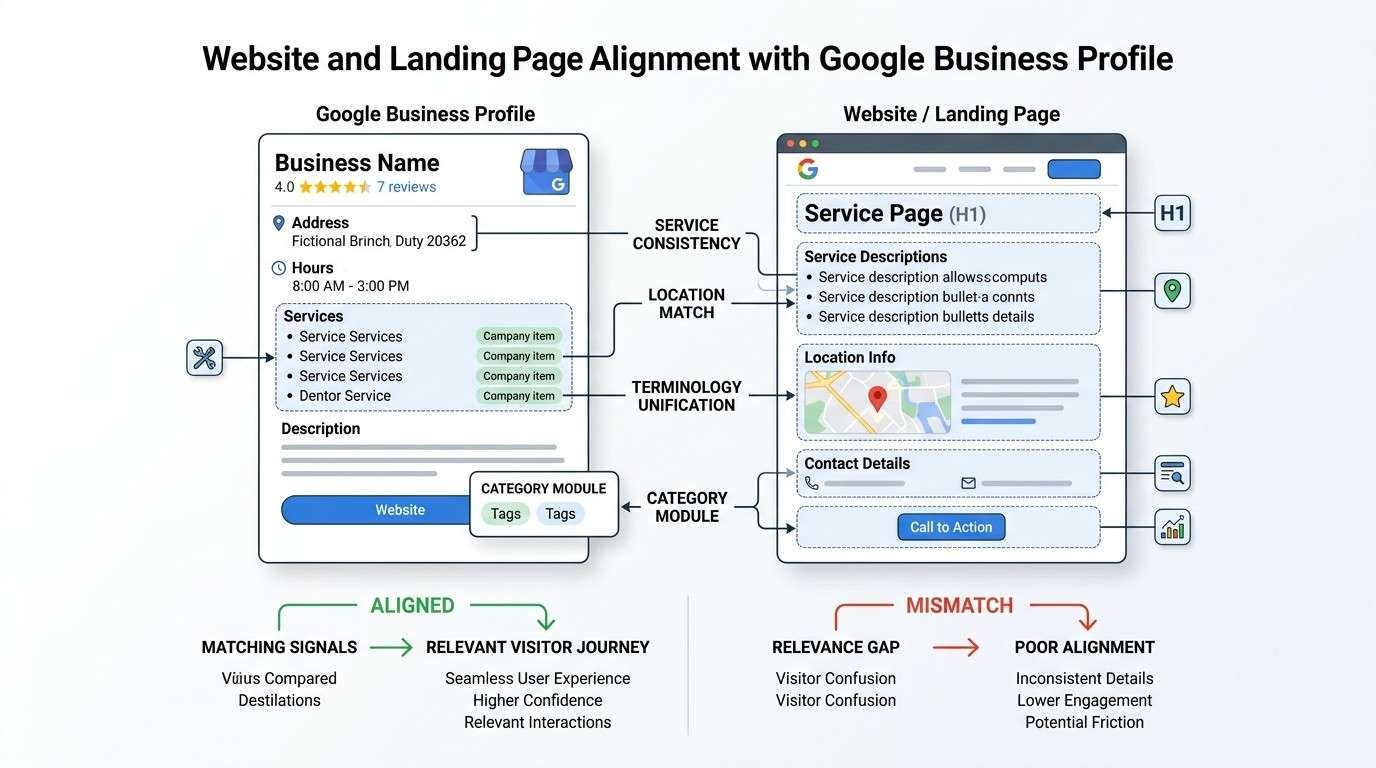
The website linked from a Google Business Profile should match the services, location, and terminology used on the profile itself. Misalignment between the profile’s category and the website’s actual content can create a relevance gap that suppresses rankings on both sides.
I check this alignment on every audit, since a mismatch here often explains why a profile ranks but the website traffic never converts as expected.
Common Google Business Profile Mistakes That Hurt Rankings
The most damaging Google Business Profile mistakes are keyword stuffing the business name, choosing an inaccurate primary category, and leaving the profile inactive for months at a time. Each of these triggers either a ranking suppression or, in more severe keyword-stuffing cases, a suspension.
I see keyword stuffing most often, where businesses add extra descriptive terms to their listed name to chase rankings. Google actively penalizes this practice and can suspend profiles that violate its guidelines outright.
How to Track and Measure Google Business Profile Performance
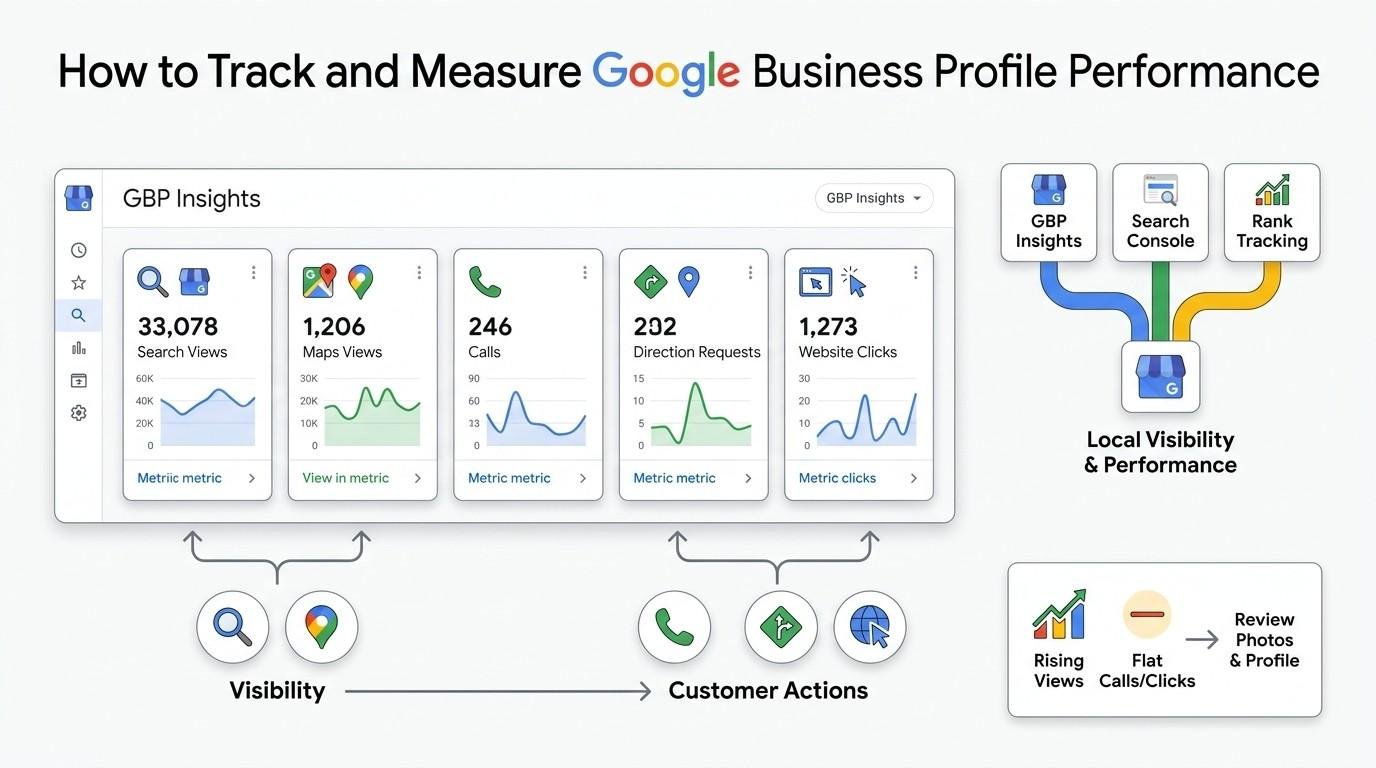
Google Business Profile Insights is the built-in analytics dashboard that shows how customers find, view, and interact with a business listing. It reports search queries, customer actions, and photo view counts directly inside the profile dashboard.
I pair this data with Google Search Console and rank tracking tools to get a complete picture of local visibility rather than relying on any single source.
Key Metrics in Google Business Profile Insights
The core metrics inside Insights include search views, map views, calls, direction requests, and website clicks generated directly from the profile. Tracking these monthly reveals whether optimization efforts are translating into real customer actions rather than just impressions.
I flag a rising view count paired with flat calls or clicks as a sign the profile is visible but not converting, which usually points back to reviews or photos needing attention.
Multi-Location and Service-Area Business Considerations
Multi-location businesses need a separate, fully optimized profile for each physical location rather than a single combined listing. Service-area businesses without a public storefront can hide their address and instead define a service radius, which changes how Google evaluates the distance factor.
I set up bulk location management through Google’s business group tools for any client managing five or more locations, since manual updates at that scale become unreliable fast.
Conclusion
Google Business Profile drives local pack and map visibility through relevance, distance, and prominence working together. Categories, reviews, photos, and citations all feed this system directly.
Mastering the profile is only one piece of a broader local SEO strategy that includes website alignment and ongoing tracking. The businesses that treat it as active, not static, win the most visibility.
We help businesses build and maintain profiles that convert visibility into real customers. Partner with White Label SEO Service to turn your local presence into consistent, measurable growth.
Frequently Asked Questions
Does Google Business Profile affect organic rankings too?
Google Business Profile primarily affects local pack and map rankings, not standard organic rankings. It can indirectly support organic visibility through branded searches and website clicks generated from the profile.
How long does it take for GBP changes to affect rankings?
Most Google Business Profile changes show ranking effects within one to four weeks. Category or name changes sometimes take longer as Google re-evaluates relevance signals across the profile.
Can I rank in the local pack without a physical address?
Yes, service-area businesses can rank in the local pack by hiding their address and setting a defined service radius. Google evaluates distance differently for these listings compared to storefront businesses.
How many reviews do I need to rank in the map pack?
There is no fixed review count required to rank in the map pack. Consistent review growth and strong ratings matter more than hitting a specific number.
Does responding to reviews improve local rankings?
Responding to reviews does not directly boost rankings but strengthens engagement and trust signals. Businesses that respond consistently often see stronger customer conversion from their listings.
What is the difference between local pack and Google Maps rankings?
The local pack is the three-result block shown on the main search results page for local queries. Google Maps rankings display a longer list of results using the same three ranking factors within the Maps interface itself.
Can a suspended Google Business Profile be recovered?
Yes, suspended profiles can often be recovered by correcting the guideline violation and submitting a reinstatement request. Recovery timelines vary from a few days to several weeks depending on the suspension type.