AI search engines now answer questions directly instead of just listing links, and the content that gets cited follows specific structural rules. Search has shifted from ranking pages to extracting sentences, and I’ve watched this shift change what “good SEO content” actually means. Business owners who ignore this shift lose visibility to competitors who don’t.
This guide covers how AI search engines read and rank content, the exact writing patterns that make sentences extractable, and how headings, schema, and topical authority combine to earn citations.
This guide covers how AI systems interpret content differently from traditional crawlers, how to structure sentences and headings so they get lifted into AI answers, the technical and authority signals AI engines weigh, and how to measure whether any of it is working.
What Are AI Search Engines and How Do They Differ From Traditional Search?
AI search engines are systems that generate synthesized answers by retrieving, ranking, and summarizing content from multiple sources rather than simply listing ranked links. Google AI Overviews, ChatGPT search, and Perplexity all work this way now. I treat them as a separate ranking surface from traditional blue-link SEO, because the mechanics of what gets shown are genuinely different.
AI Overviews vs. Traditional SERPs
A traditional SERP ranks whole pages against a query and lets the user pick. An AI Overview instead pulls specific sentences or passages from several pages and blends them into one answer. This means a page can rank on page one and still never get cited, because its best sentence isn’t extractable on its own. We’ve seen this happen with clients who had strong rankings but weak citation rates.
How AI Assistants Retrieve and Synthesize Content
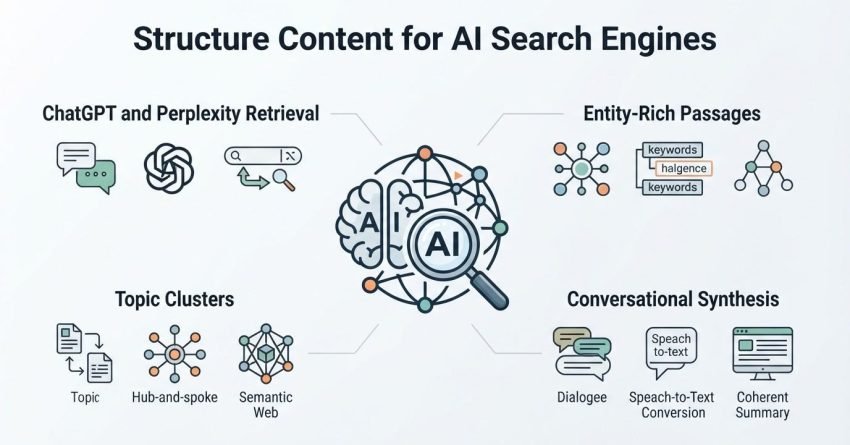
AI assistants like ChatGPT and Perplexity retrieve content through a mix of live web search and pre-trained knowledge, then synthesize it into a conversational answer. The retrieval step favors clearly structured, entity-rich passages over long narrative prose. I’ve found that pages built around topic clusters tend to surface more often in these tools, since the assistant can pull one clean answer without needing surrounding context.
How Do AI Search Engines Read and Interpret Content?
AI search engines read content by breaking pages into smaller units called chunks, then evaluating each chunk independently for relevance to a query. This is fundamentally different from how a human reads a page top to bottom. A chunk might be a paragraph, a table row, or a single sentence, and each one is scored on its own merit.
Natural Language Processing and Entity Recognition
Natural language processing lets AI systems identify entities, attributes, and relationships inside a sentence rather than just matching keywords. Entity recognition is the process by which a system identifies a proper noun, concept, or thing and links it to what it already knows about that entity. I write with this in mind by naming entities explicitly instead of relying on pronouns, since a system parsing “it” three sentences later loses the thread.
Google’s own documentation on how Search works confirms that entity understanding sits at the core of modern ranking systems, not just keyword matching.
Chunking and Passage-Level Retrieval
Passage-level retrieval means a search system can rank and display one paragraph from a page without regard to the rest of the content around it. This matters because a weak sentence sitting next to a strong one can drag down extraction eligibility for the whole passage. I structure every section so each paragraph could theoretically stand alone and still make sense.
What Is Answer-First Content Structure?
Answer-first content structure means placing the direct, complete answer to a heading’s implied question in the very first sentence beneath it, before any supporting context or background. This single habit affects extraction more than almost anything else I’ve tested. AI systems and featured snippets both favor the sentence that answers first and explains second.
Writing the Direct Answer Before Context
I open every section with the answer, not a lead-in. A sentence like “SEO timelines vary depending on competition” fails this test because it hedges instead of answering. A sentence like “Most SEO campaigns show measurable ranking movement within four to six months” passes, because it states a fact a reader or a machine can lift and quote. Context, caveats, and nuance come after, never before.
How Should Headings Be Structured for AI Extraction?
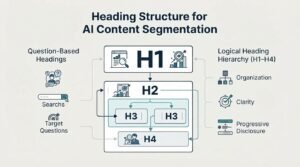
Headings should be structured as clear, literal statements or questions that match how real users phrase their queries, since AI systems use headings to segment and label content chunks. A heading like “Considerations” tells a machine nothing. A heading like “How Long Does SEO Take to Show Results” tells it exactly what the section answers.
Question-Based Headings
Question-based headings work especially well for sections targeting People Also Ask boxes, because the heading itself mirrors the query format Google already recognizes. I reserve this format for sections with clear, single-answer intent rather than forcing every heading into a question shape.
Logical Heading Hierarchy (H1–H3)
A logical heading hierarchy uses H1 for the page title, H2 for major topic shifts, and H3 for subpoints nested inside those topics, without skipping levels. Search engines and AI crawlers use this nesting to understand which ideas are subordinate to which, and a broken hierarchy makes that relationship harder to parse correctly.
What Makes a Sentence Extractable by AI Engines?
An extractable sentence is one that states a complete claim, names its own subject, and makes sense when quoted entirely on its own with no surrounding text. Extractability has become a writing requirement rather than a formatting choice, because AI Overviews and assistants now lift individual sentences out of pages constantly.
Self-Contained Claims
A self-contained claim never relies on “it,” “this,” or “the above” to carry its meaning across a sentence boundary. I check every key claim by deleting the sentence before it and reading it alone. If the subject disappears, the claim isn’t extractable, and I rewrite it to name the subject directly.
Entity-Shaped Definitions
An entity-shaped definition follows the pattern “[Entity] is a [type] that [defining attribute],” placed at the entity’s first meaningful mention in the content. Crawl budget is the number of pages a search engine bot requests from a site within a given timeframe. I place this exact sentence shape once per major entity, right where the term first does real work in the article.
How Do Schema Markup and Structured Data Support AI Visibility?
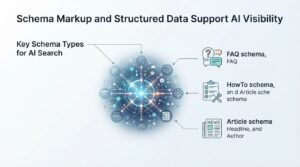
Schema markup is code added to a page that explicitly labels its content type, entities, and relationships for search engines, making machine interpretation faster and more accurate. Google’s structured data guidelines confirm that properly implemented schema increases eligibility for enhanced search features, including AI-generated summaries.
Key Schema Types for AI Search
FAQ schema, HowTo schema, and Article schema each label a distinct content shape that AI systems can parse without guessing at structure. I prioritize FAQ and Article schema on most pillar and cluster content, since those two formats cover the majority of informational search intent.
What Role Do Tables, Lists, and Numbered Steps Play in AI Search?
Tables, lists, and numbered steps give AI systems a pre-structured format they can lift directly into an answer without needing to parse loose prose into that shape themselves. A comparison table showing SEO timeline benchmarks by industry is far more likely to get pulled into an AI Overview than the same data buried in a paragraph.
| Content Format | Best Query Type | Extraction Likelihood |
| Definition paragraph | “What is X” | High |
| Comparison table | “X vs Y” | High |
| Numbered list | “How does X work” | High |
| Bulleted list | “Types of X” | Medium |
| Narrative paragraph | General context | Low |
Every table and list needs one sentence stating what it shows before it appears, since an extracted table without that lead-in loses its meaning once pulled out of context.
How Important Is Source Attribution and E-E-A-T for AI Citations?
Source attribution and E-E-A-T signals directly influence whether AI systems treat a page as trustworthy enough to cite, since these systems weigh credibility alongside relevance. Google’s Search Quality Rater Guidelines explicitly define E-E-A-T as experience, expertise, authoritativeness, and trust.
In-Sentence Citations and Data Attribution
An in-sentence citation names the source of a statistic within the same sentence as the number itself, rather than in a separate reference elsewhere. An Ahrefs study of over 1 billion pages found that 90.63% of content gets zero organic search traffic, largely due to poor structure and weak topical relevance. I follow this pattern for every statistic, since a number without its source becomes unusable once extracted.
Author Expertise and Trust Signals
Author bylines, credentials, and clear publication dates all function as trust signals that AI crawlers and human readers use to judge content reliability. I make sure every pillar page carries a visible author with relevant expertise, since anonymous or unattributed content struggles to earn citations in competitive topics.
How Does Topical Authority Influence AI Search Rankings?
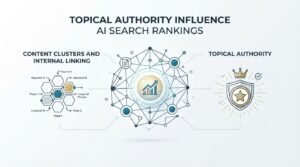
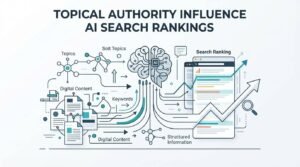
Topical authority is the degree to which a website demonstrates comprehensive, interconnected coverage of a subject area, and it strongly influences whether AI systems treat that site as a reliable source. A single strong page rarely earns consistent citations. A cluster of interlinked pages covering every angle of a topic does.
Content Clusters and Internal Linking
A content cluster is a group of pages built around one pillar topic, connected through internal links that signal topical relationships to search engines. I build every pillar page as a hub that orients readers toward deeper cluster pages, since this structure mirrors exactly how AI systems map topical relationships across a site.
What Technical SEO Factors Affect AI Crawlability?
Technical SEO factors like site speed, clean HTML structure, and proper indexation directly affect whether AI crawlers can access and parse a page’s content at all. A page an AI bot can’t crawl efficiently never gets the chance to be evaluated for extraction, regardless of how well it’s written.
Site Speed and Core Web Vitals
Google’s Core Web Vitals measure loading performance, interactivity, and visual stability, and slow pages risk incomplete crawling by resource-constrained bots. I treat Core Web Vitals as a baseline requirement, not an advanced tactic, on every technical audit.
Crawlability and Indexation for AI Bots
Crawlability determines whether a bot can access a page’s content, while indexation determines whether that content gets stored and made eligible for retrieval. Blocking AI-specific crawlers in a robots.txt file, even unintentionally, removes a page from that engine’s citation pool entirely.
How Should FAQ Content Be Structured for AI Search?
FAQ content should be structured as literal questions paired with direct, complete answers in the first sentence, since this format maps almost exactly to how AI systems generate conversational responses. Each question should stand alone as a complete thought, without depending on the question above or below it for context.
What Content Formats Perform Best in AI Overviews and AI Assistants?
Definition paragraphs, comparison tables, numbered processes, and short criteria-based lists consistently perform best in AI Overviews and AI assistant answers, because each format matches a specific query shape the system is trying to fill. Long narrative sections without clear structural breaks rarely get cited, even when the information itself is accurate and useful.
How Do You Measure AI Search Visibility and Performance?
AI search visibility is measured by tracking citation frequency in AI Overviews, referral traffic from AI assistants, and branded search lift following content publication. This is a newer discipline than traditional rank tracking, and the tooling is still catching up to the need.
Tracking AI Citations and Referral Traffic
Google Search Console now surfaces some AI Overview impression data, and server log analysis can reveal crawl activity from AI-specific bots. I cross-reference referral traffic segments in Google Analytics against known AI assistant domains to catch traffic that traditional attribution models miss entirely.
What Are Common Mistakes That Prevent AI Search Visibility?
The most common mistake is writing long, hedge-filled introductions before answering the actual question, which buries the extractable sentence too deep for AI systems to reliably find. Other frequent mistakes include vague pronoun-heavy claims, missing schema markup, and statistics cited without a named source in the same sentence.
Conclusion
We’ve built this exact structural discipline into every page we produce for clients. A page that answers clearly, cites properly, and connects to a genuine topic cluster earns visibility across both traditional and AI-driven search. Partner with White Label SEO Service to structure your content for how search actually works now.
Frequently Asked Questions
Do I need to rewrite all my old content for AI search engines?
No, prioritize your highest-traffic and highest-intent pages first. Restructure those with answer-first openings and clear headings before addressing lower-priority content.
Does schema markup guarantee an AI Overview citation?
No, schema markup improves eligibility but doesn’t guarantee citation. Content quality, extractability, and topical authority all factor into whether AI systems select a page.
How is writing for AI search different from writing for featured snippets?
They overlap significantly, since both reward answer-first, self-contained sentences. AI search adds emphasis on entity clarity and in-sentence source attribution beyond typical snippet formatting.
Can small businesses compete with large sites in AI search results?
Yes, AI systems weigh content clarity and topical depth over domain size alone. A well-structured, focused site can out-cite a larger competitor with weaker content structure.
Do AI search engines penalize duplicate or thin content?
Yes, thin or duplicate content rarely gets selected for extraction since AI systems favor unique, complete answers. Weak content also risks standard SEO quality penalties.
How often should I update content for AI search visibility?
Update pillar content whenever core facts, statistics, or industry standards change. Stale statistics without current sourcing lose credibility with both AI systems and readers.
Will AI search reduce organic website traffic over time?
It changes traffic patterns rather than eliminating them, shifting some clicks toward zero-click AI answers. Sites that earn citations still gain visibility, brand exposure, and some referral traffic.