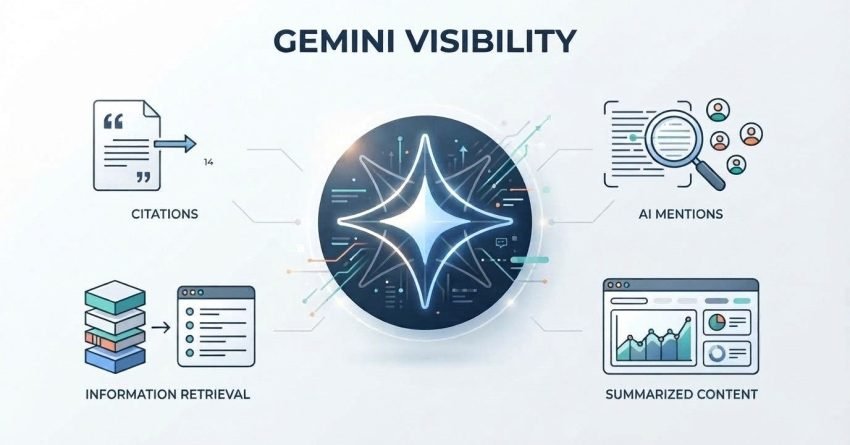
Gemini visibility measures how often and how accurately Google’s Gemini AI surfaces a brand, product, or piece of content inside its generated answers. I look at it as the AI-era equivalent of a ranking position, except the “result” is a sentence inside a conversational response rather than a blue link. For businesses trying to stay found, this matters because a growing share of research now happens inside AI chat interfaces instead of traditional search result pages.
I’ve watched clients ask the same question repeatedly this year: does showing up in Gemini actually move the needle? It does, and ignoring it risks invisibility in a channel that’s expanding fast.
This guide covers what Gemini visibility actually is and why it matters, the metrics and tools used to track it, how Gemini pulls and ranks information differently from ChatGPT or Perplexity, and how to structure content and technical foundations so Gemini can find and cite you. We’ll close with how this fits into a broader SEO and GEO strategy.
What Is Gemini Visibility?
Gemini visibility is the measurable presence a brand or webpage achieves within Google Gemini’s AI-generated responses, including citations, mentions, and summarized information pulled from that source. I think of it as a parallel metric to organic rankings, but instead of position 1 through 10, the outcome is either “cited” or “not cited.”
Unlike traditional SEO, there’s no single URL competing for one slot. Gemini can pull from multiple sources simultaneously and blend them into a single answer.
Why Gemini Visibility Differs From Traditional SEO Rankings
Traditional rankings reward the page that best matches a query’s intent and authority signals, then display it as one link among ten. Gemini visibility instead rewards content that can be extracted, summarized, and attributed cleanly, regardless of where it sits on a results page. A page can rank on page two of Google and still get cited inside a Gemini answer if its content is structured well enough to be lifted.
Why Gemini Visibility Matters for Businesses in 2026
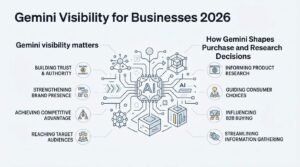
Gemini visibility matters in 2025 because a growing share of product research, comparison shopping, and informational queries now happen directly inside AI chat interfaces rather than traditional search results pages. I’ve seen this shift accelerate as Gemini gets built directly into Google Search, Android devices, and Workspace tools. Every one of those touchpoints is a chance for a brand to be mentioned, or skipped entirely.
Businesses that ignore this risk a growing invisibility gap. Competitors who structure content for AI extraction get cited; those who don’t disappear from an entire layer of discovery.
How Gemini Shapes Purchase and Research Decisions
Readers increasingly ask Gemini for direct comparisons, recommendations, and summaries before ever visiting a website. A 2024 Search Engine Land analysis found that AI-assisted search sessions are growing faster than traditional query volume across most commercial categories. When Gemini names a specific brand as an answer, that brand effectively skips several steps in the traditional consideration funnel.
How Gemini Retrieves and Ranks Brand Information
Gemini retrieves brand information by combining Google’s search index, structured data signals, and real-time grounding to select which sources it cites in a generated response. It doesn’t rank pages the way classic search does. Instead, it evaluates which passages most directly and clearly answer the user’s specific prompt.
Grounding is the mechanism that connects Gemini’s language model to live, indexed web content rather than relying purely on its training data.
The Role of Grounding and Google Search Integration
Grounding lets Gemini pull current facts from the web instead of guessing from static training data, which is why Google’s search index quality directly affects what Gemini can cite. A page that’s well-indexed, fast, and clearly structured has a far better chance of being pulled into a grounded response than one buried under crawl or indexation issues.
Key Metrics for Tracking Gemini Visibility
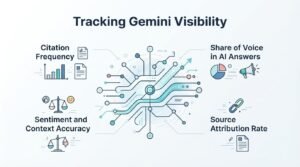
Tracking Gemini visibility requires a different metric set than classic rank tracking, built around citation behavior rather than position. The table below shows the four metrics that matter most for a working AI visibility program.
| Metric | What It Measures | Why It Matters |
| Citation Frequency | How often a source is cited across a set of test prompts | Core measure of AI presence |
| Share of Voice | Percentage of AI answers mentioning a brand vs. competitors | Competitive benchmarking |
| Sentiment & Context Accuracy | Whether mentions are accurate and favorable | Reputation and trust signal |
| Source Attribution Rate | How often Gemini names the source explicitly | Determines traceable traffic value |
Citation Frequency
Citation frequency counts how many times a brand or page gets referenced across a defined set of test prompts run on a regular cadence. I track this the same way I’d track keyword rankings, just against prompts instead of search queries.
Share of Voice in AI Answers
Share of voice compares how often a brand appears in Gemini responses relative to its direct competitors across the same prompt set. A brand showing up in 3 out of 20 tracked prompts, while a competitor appears in 12, has a share-of-voice gap worth addressing.
Sentiment and Context Accuracy
Sentiment and context accuracy evaluates whether Gemini’s mention of a brand is factually correct and framed in a positive or neutral light. Inaccurate citations can misrepresent pricing, services, or positioning, which creates a trust problem separate from visibility itself.
Source Attribution Rate
Source attribution rate tracks how frequently Gemini explicitly names or links the originating source rather than paraphrasing without credit. Higher attribution rates correlate with clearer, more extractable content structure on the source page.
Prompt and Query Coverage Tracking
Prompt and query coverage tracking involves building a representative set of real user prompts and monitoring how consistently a brand appears across all of them. Rather than one keyword, I build a bank of 20 to 50 prompts that mirror how actual buyers phrase questions at each stage of their research.
Coverage gaps usually show up at the comparison and decision stages first, before they show up at the awareness stage.
Mapping Prompts to Buyer Journey Stages
Grouping prompts into awareness, consideration, and decision stages shows exactly where visibility breaks down across the funnel. A brand might dominate broad “what is X” prompts but disappear entirely once prompts get specific, like direct comparisons against named competitors.
Top Tools for Tracking Gemini Visibility
The top tools for tracking Gemini visibility fall into three categories: dedicated AI monitoring platforms, manual prompt testing, and search console signal analysis. No single tool covers everything yet, since AI visibility tracking is still a maturing category compared to established rank trackers.
AI Visibility Monitoring Platforms
Dedicated AI visibility platforms automate prompt testing across Gemini, ChatGPT, and Perplexity, then report citation frequency and share of voice over time. These tools save the manual effort of running dozens of prompts by hand every week and typically include historical trend data.
Manual Prompt Testing Methods
Manual testing means running a fixed prompt set directly inside Gemini on a schedule and logging which sources get cited each time. This method costs nothing beyond time and works well for smaller brands not ready to invest in a dedicated platform yet.
Google Search Console Signals Relevant to AI Overviews
Google Search Console doesn’t isolate Gemini citations directly, but impression and click anomalies on informational queries often correlate with AI Overview exposure. A sudden impression increase paired with a flat or declining click-through rate is a common signal that a page is being surfaced in an AI summary rather than a traditional listing.
How Gemini Visibility Differs From ChatGPT and Perplexity Visibility
Gemini visibility differs from ChatGPT and Perplexity visibility primarily in its data source, since Gemini draws heavily on Google’s live search index while the others rely on different retrieval and training combinations. Perplexity leans on its own real-time web crawling and shows citations more consistently by design. ChatGPT’s browsing and citation behavior depends on which mode or plugin a user has active.
Content that performs well in one AI engine doesn’t automatically perform the same way in another, since each has different weighting for freshness, structure, and source authority.
Cross-Platform Tracking Considerations
Tracking visibility across all three engines separately reveals platform-specific gaps a single-engine view would miss entirely. A brand might dominate Perplexity citations due to strong original research content while remaining nearly invisible in Gemini due to structured data gaps.
Content Structuring for Gemini Extractability
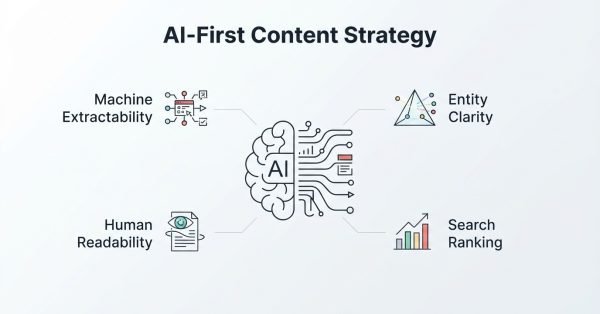
Content structuring for Gemini extractability means writing in self-contained sentences, clear definitions, and well-labeled sections so AI systems can lift accurate information without additional context. I treat every heading as if it needs to answer its own question in the very first sentence beneath it, because that’s exactly the shape Gemini looks for when selecting a passage to cite.
Long, meandering paragraphs without a clear topic sentence rarely get pulled into AI answers, no matter how accurate the underlying information is.
Entity Clarity and Structured Data Signals
Naming entities explicitly, rather than relying on pronouns like “it” or “this,” gives Gemini a clean subject to extract and attribute correctly. Structured data markup reinforces this by explicitly labeling what an entity is, what type it belongs to, and how it relates to other entities on the page.
Technical Foundations That Influence Gemini Visibility
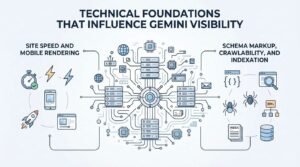
Technical SEO foundations influence Gemini visibility because a page must be crawled, indexed, and rendered correctly before it can ever be considered for citation. No amount of well-written content matters if Googlebot can’t access or properly parse the page in the first place.
Site speed and mobile rendering issues that suppress traditional rankings suppress AI citation eligibility for the same underlying reason.
Schema Markup, Crawlability, and Indexation
Schema markup, clean crawl paths, and confirmed indexation form the technical baseline a page needs before content quality even becomes a factor. A Google Search Central documentation page confirms that structured data helps automated systems understand page content more reliably than unstructured text alone.
Building a Gemini Visibility Tracking Cadence
A working Gemini visibility tracking cadence runs a fixed prompt set weekly for volatility, monthly for trend analysis, and quarterly for full competitive benchmarking. I’ve found that testing too infrequently hides short-term volatility, while testing too often just adds noise without adding insight.
Quarterly reviews are also the right time to refresh the prompt set itself, since buyer language and AI response patterns shift over time.
Weekly, Monthly, and Quarterly Checkpoints
Weekly checks catch sudden citation drops tied to algorithm or model updates, monthly checks reveal directional trends, and quarterly checks support full competitive share-of-voice comparisons. Skipping the weekly layer means missing the early warning signs that usually precede a larger visibility shift.
Common Gemini Visibility Measurement Mistakes
The most common Gemini visibility measurement mistake is treating impressions or general brand mentions as equivalent to actual AI citations. I see teams celebrate a spike in branded search volume without confirming whether that spike actually originated from a Gemini citation or something unrelated.
Another frequent error is testing prompts inconsistently, which makes it impossible to compare results across time periods.
Confusing Impressions With Citations
An impression simply means a page was eligible to be shown, while a citation means Gemini actually referenced it by name or content in a generated answer. Conflating the two inflates perceived visibility and leads to misallocated effort on tactics that aren’t actually driving AI presence.
How Gemini Visibility Connects to Overall SEO and GEO Strategy
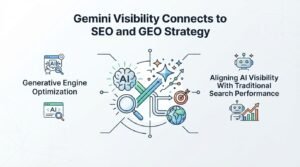
Gemini visibility connects to overall SEO and GEO strategy because both disciplines depend on the same underlying foundation: authoritative, well-structured, technically sound content. I don’t treat AI visibility as a separate department from SEO anymore, since the two increasingly draw from the same signals and the same indexed content.
Generative Engine Optimization builds on traditional SEO rather than replacing it, adding extraction and citation eligibility on top of ranking fundamentals.
Aligning AI Visibility With Traditional Search Performance
A page optimized for both traditional rankings and AI extraction typically outperforms one optimized for only one or the other. Consistent entity naming, clean technical performance, and answer-first content structure serve both goals simultaneously rather than requiring separate strategies.
Conclusion
Gemini visibility ties together citation frequency, share of voice, and content structured for extraction rather than just ranking position. It sits alongside traditional SEO and GEO as one connected discipline, not a separate silo demanding its own strategy.
We help brands build the technical and content foundations that earn visibility across both traditional search and AI answers. Talk to White Label SEO Service to start tracking and improving your AI visibility today.
Frequently Asked Questions
What is Gemini visibility?
Gemini visibility is how often and how accurately a brand or webpage appears in Google Gemini’s AI-generated answers. It’s measured through citation frequency, share of voice, and attribution accuracy rather than a single ranking position.
How is Gemini visibility different from Google ranking?
Gemini visibility measures whether content gets cited inside an AI-generated answer, not where a page ranks on a results page. A page can rank lower traditionally yet still be cited if it’s structured clearly enough for extraction.
What tools track Gemini visibility?
Dedicated AI visibility monitoring platforms, manual prompt testing, and Google Search Console signal analysis are the main tools available today. Most brands combine at least two of these methods for reliable coverage.
How often should Gemini visibility be measured?
Gemini visibility should be measured weekly for volatility, monthly for trends, and quarterly for full competitive benchmarking. This cadence catches both sudden shifts and longer-term directional changes.
Does Gemini visibility affect website traffic?
Gemini visibility can affect website traffic when citations include a clickable source link that users follow. Even without a click, citation exposure still builds brand awareness during the research phase.
Can small businesses improve their Gemini visibility?
Small businesses can improve Gemini visibility by structuring content around clear definitions, named entities, and answer-first sections. Technical fundamentals like crawlability and structured data matter more than company size.
How does structured data affect Gemini visibility?
Structured data helps Gemini and Google’s indexing systems understand what an entity is and how it relates to other content on a page. Pages with clear schema markup tend to have higher attribution and citation accuracy.