I’ve watched search behavior shift faster in the last two years than in the previous decade combined. Claude visibility is the measurable presence a brand or website has within Anthropic’s Claude AI responses, including citations, mentions, and the accuracy of information Claude surfaces about that brand. It matters because millions of professionals now ask Claude questions they used to type into Google.
We’re seeing budgets move toward AI visibility work right now. Brands that ignore this shift risk losing relevance in a search landscape that no longer runs through ten blue links.
This guide covers what Claude visibility actually means and why it’s distinct from traditional rankings, the key metrics worth tracking, the technical and content foundations that influence citations, and the tools available to monitor your presence. I’ll also walk through ROI measurement and where this fits into a broader AI search strategy.
What Is Claude Visibility and Why It Matters for SEO
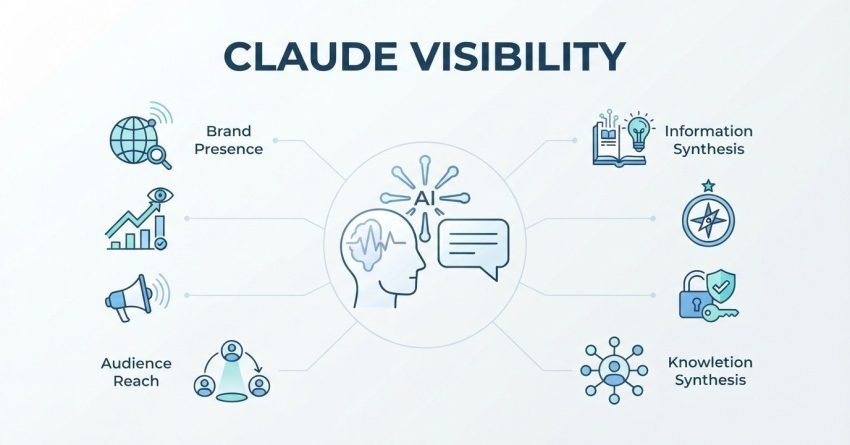
Claude visibility refers to how often, how accurately, and how favorably a brand, product, or piece of content appears in responses generated by Anthropic’s Claude AI models. I think of it as the AI-era equivalent of organic rankings, except the “result” is a sentence inside a conversation instead of a link on a page.
This matters because search behavior has fragmented. People still use Google, but a growing share of research, comparison, and decision-making questions now happen inside AI assistants like Claude, ChatGPT, and Perplexity.
How Claude Differs From Traditional Search Engines
Claude doesn’t return a ranked list of pages. It synthesizes an answer from patterns it learned during training and, in some product integrations, from live web retrieval. That distinction changes what “visibility” even means.
A page can rank on page one of Google and never get mentioned by Claude, and the reverse happens too. I’ve seen niche sites with strong topical authority get cited by Claude more often than sites with higher domain ratings.
Why Brands Are Prioritizing AI Visibility in 2025–2026
Enterprise buyers are treating AI assistants as first-touch research tools. An Ahrefs study on AI search behavior found that a growing share of B2B researchers now start product research inside an AI chat interface rather than a search engine.
We help clients recognize that this isn’t a future trend anymore. It’s already reshaping how prospects find and evaluate vendors today.
How Claude Discovers, Crawls, and Cites Web Content
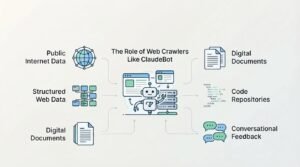
Claude builds its understanding of the web through a combination of pretraining data and, in tool-enabled contexts, live retrieval from search and browsing integrations. The exact sourcing mix depends on which Claude product surface a person is using.
Anthropic trains its models on large text corpora that include web pages, books, and licensed datasets, but the company doesn’t publish a full list of sources. This makes attribution harder to reverse-engineer compared to a traditional search index.
Claude’s Data Sources and Training Signals
Training data has a cutoff date, which means anything published after that point relies on retrieval tools rather than the base model’s memory. Claude’s web-search-enabled modes pull fresher information dynamically, closing part of that gap.
Content that’s well-structured, factually consistent across the web, and frequently cited by other authoritative sources has a better chance of surfacing in both training-derived and retrieval-based answers.
The Role of Web Crawlers Like ClaudeBot
Anthropic operates a crawler called ClaudeBot that collects publicly available web content for research and training purposes. Sites that block ClaudeBot in their robots.txt file are opting out of being represented in future model updates.
I recommend checking server logs periodically to confirm crawler activity, since a blocked or misconfigured robots.txt file can silently remove a site from consideration.
Key Metrics for Measuring Claude Visibility
The core metrics for Claude visibility are citation frequency, share of voice against competitors, answer accuracy, sentiment, and referral traffic generated from AI-driven sessions. These five numbers together paint a full picture of how a brand shows up in AI answers.
Citation frequency tracks how often a brand or domain gets mentioned across a defined set of test prompts. Share of voice compares that frequency against named competitors answering the same query set.
Citation Frequency and Share of Voice
Citation frequency is the percentage of relevant prompts where a brand appears in Claude’s response at all. I run this test monthly for clients using a fixed prompt library tied to their core topics.
Share of voice takes that a step further by comparing citation counts across a competitive set, which shows whether a brand is gaining or losing ground relative to rivals.
Answer Accuracy and Brand Sentiment in Responses
Answer accuracy measures whether Claude describes a brand’s products, pricing, or positioning correctly when it does mention them. Sentiment analysis then classifies whether that mention reads as neutral, favorable, or unfavorable.
Outdated or incorrect information in Claude’s responses often traces back to stale web content or conflicting data across a brand’s own pages.
Referral Traffic From AI Platforms
Referral traffic from AI platforms shows up in analytics tools as sessions originating from claude.ai or related domains once a user clicks through from a cited source. This number is still small industry-wide but growing quarter over quarter.
I treat this metric as a leading indicator rather than a primary KPI, since most AI-assistant interactions never generate a click at all.
How Claude Visibility Differs From Traditional SEO Metrics
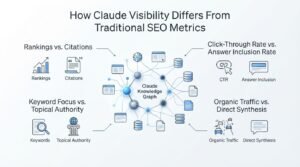
Claude visibility measures inclusion inside a generated answer, while traditional SEO measures ranking position on a search results page, and the two require different optimization approaches. Confusing the two leads to wasted effort.
A page ranking first for a keyword tells you almost nothing about whether Claude will cite it, because Claude isn’t running the same relevance algorithm a search engine uses.
Rankings vs. Citations
Rankings are positional and competitive by nature. Citations are inclusion-based, meaning multiple sources can get cited within the same answer without competing for a single top spot.
This changes the optimization mindset from “beat the competition for position one” to “become one of the sources worth referencing.”
Click-Through Rate vs. Answer Inclusion Rate
Click-through rate assumes a user sees a list of options and picks one. Answer inclusion rate assumes the user gets a synthesized response and may never click anything at all.
I’ve had to reset client expectations here, since a strong answer inclusion rate can coexist with very low direct traffic.
Content Optimization Strategies for Claude Visibility
Content earns Claude citations by being clearly structured, factually precise, and easy to extract as a standalone answer. Four practices consistently move the needle for the clients we work with.
First, answer the core question in the opening sentence of every section. Second, use consistent terminology across all owned properties. Third, back claims with cited data. Fourth, keep information current with visible update dates.
Structuring Content for Extractability
- Open every section with a direct, complete answer to its heading.
- Keep key claims self-contained, naming the subject rather than relying on “it” or “this.”
- Use tables for comparisons and numbered lists for processes.
- Attribute every statistic to its source inside the same sentence.
This structure mirrors how featured snippets get selected, which isn’t a coincidence, since both systems favor extractable, well-bounded text.
E-E-A-T Signals Claude Prioritizes
Experience, expertise, authoritativeness, and trust signals matter as much for AI visibility as they do for classic SEO. Author credentials, cited sources, and consistent factual accuracy across a domain all build the kind of trust that keeps content in circulation.
A Backlinko analysis of AI-cited content found that pages with clear authorship and original data were disproportionately represented in AI-generated answers compared to unattributed content.
Technical Foundations That Support AI Visibility
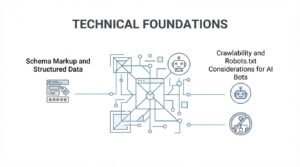
Technical SEO fundamentals like crawlability, structured data, and site speed remain prerequisites for AI visibility, since a page Claude can’t access or parse cleanly can’t be cited at all. None of the content strategy above matters if the underlying page is unreachable.
Schema markup gives machines an explicit, unambiguous description of what a page contains, which reduces the guesswork involved in extracting facts.
Schema Markup and Structured Data
FAQ schema, Article schema, and Organization schema all help clarify page content for both traditional search engines and AI systems parsing the page. I add schema markup as a standard step on every technical audit now, not an optional extra.
Structured data doesn’t guarantee a citation, but it removes ambiguity that could otherwise cause a model to misinterpret or skip content entirely.
Crawlability and Robots.txt Considerations for AI Bots
A site’s robots.txt file determines whether crawlers like ClaudeBot, GPTBot, and others can access its pages at all. Blocking these crawlers is a legitimate business decision for some sites, but it comes with a visibility tradeoff worth weighing deliberately.
I check robots.txt configuration as one of the first steps in any AI visibility audit, since a blanket disallow rule silently erases a domain from consideration.
Top Tools for Tracking AI Visibility in Claude
Dedicated AI visibility platforms, prompt-testing scripts, and manual query logs are the three practical ways businesses currently track their presence inside Claude’s responses. No single tool covers every angle yet, so most teams combine methods.
Purpose-built AI visibility platforms have emerged over the past two years specifically to fill the gap left by traditional rank trackers, which were never designed to measure conversational answers.
Dedicated AI Visibility Platforms
These platforms run standardized prompt sets against multiple AI models, including Claude, and report citation frequency, sentiment, and competitive share of voice in a dashboard format. Most support scheduled tracking so visibility trends are visible over time rather than as one-off snapshots.
Pricing and feature depth vary widely, which is why comparing platforms side by side matters before committing budget to one.
Manual Prompt Testing Methods
Manual testing means running a fixed list of relevant prompts directly in Claude on a recurring schedule and logging the results in a spreadsheet. It’s slower than automated tools but costs nothing beyond time.
I recommend this approach for smaller teams just starting to measure AI visibility, since it builds intuition for how Claude responds before investing in paid tooling.
How to Track Claude Citations and Brand Mentions
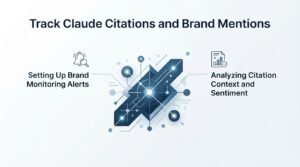
Tracking Claude citations involves running consistent test prompts, logging every mention with its context, and monitoring changes over time to spot trends. This process works whether it’s done manually or through a dedicated platform.
- Build a prompt library covering core topics, branded queries, and competitor comparisons.
- Run the same prompts on a fixed schedule, weekly or monthly.
- Log every citation, including exact wording and surrounding context.
- Score each mention for accuracy and sentiment.
- Compare results over time to identify gains or losses.
Setting Up Brand Monitoring Alerts
Some AI visibility platforms offer alert systems that flag new citations or sentiment shifts automatically. Setting a baseline first makes these alerts meaningful rather than just noise.
I set alerts around branded terms and core product categories, since those two query types tend to carry the highest business impact.
Analyzing Citation Context and Sentiment
Context matters as much as the citation itself. A brand mentioned as a cautionary example reads very differently from a brand mentioned as a recommended solution, even though both count as a “citation” in raw frequency terms.
I score sentiment on a simple three-point scale: favorable, neutral, unfavorable, and track how that distribution shifts month over month.
Comparing Claude Visibility Tools by Feature Set
The table below compares AI visibility tools by the platforms they track, their reporting depth, and their pricing tier, since these three factors typically decide which tool fits a given team’s needs.
| Feature | Prompt Frequency Tracking | Multi-Model Coverage | Sentiment Analysis | Typical Pricing Tier |
| Enterprise AI visibility suites | Automated, scheduled | Claude, ChatGPT, Gemini, Perplexity | Included | High |
| Mid-market AI monitoring tools | Automated, scheduled | Claude, ChatGPT | Basic | Medium |
| Manual spreadsheet tracking | Manual | Whichever tools tested | Manual scoring | Free |
Smaller teams often start with manual tracking and graduate to a paid platform once they need multi-model coverage or historical trend reporting.
Measuring ROI From AI Visibility Efforts
ROI from AI visibility work is measured by connecting citation growth and AI-referred traffic to downstream leads and revenue, though attribution remains harder than in traditional SEO. This is the honest limitation every team measuring this channel runs into.
Analytics platforms can now segment traffic originating from AI assistant referrals, giving a partial view of the funnel from citation to session.
Connecting AI Citations to Traffic and Leads
I connect AI-referred sessions to conversion events the same way I would any other channel, using UTM-style segmentation where the referral data allows it. This shows whether AI-sourced visitors convert at comparable rates to organic search visitors.
Early data across client accounts suggests AI-referred sessions convert at rates close to organic search, though sample sizes remain small industry-wide.
Attribution Challenges With AI-Driven Referrals
Many AI interactions never produce a click at all, meaning the influence on a buyer’s decision happens without leaving any trace in analytics. This “dark funnel” effect makes pure last-click attribution understate AI’s real impact.
We address this by pairing quantitative referral data with qualitative buyer surveys asking how prospects first heard about a brand.
Common Mistakes That Hurt Claude Visibility
The most common mistakes hurting Claude visibility are blocking AI crawlers, publishing inconsistent facts across owned pages, and neglecting content freshness. Each of these is fixable with a straightforward technical or editorial change.
Inconsistent facts, like different pricing or specifications listed on different pages, create confusion that models sometimes resolve by citing a competitor’s cleaner data instead.
Ignoring Structured Data and Content Freshness
Pages left unchanged for years lose relevance in retrieval-based answers, since fresher content generally wins when multiple sources cover the same topic. Visible last-updated dates and periodic content refreshes both help here.
I audit content freshness quarterly for clients pursuing AI visibility, since this is one of the easiest levers to pull for measurable improvement.
How Claude Visibility Fits Into a Broader AI Search Strategy
Claude visibility is one piece of a larger AI search optimization strategy that also includes ChatGPT, Perplexity, and Google’s AI Overviews, since buyers research across multiple AI surfaces rather than just one. Treating Claude in isolation misses most of the opportunity.
Each platform weighs sourcing and retrieval differently, so a strategy built only around one model tends to leave visibility gaps on the others.
Claude vs. ChatGPT vs. Perplexity Visibility Considerations
Perplexity leans heavily on live web retrieval and shows sources directly, making it closer to a traditional search engine in behavior. ChatGPT’s behavior depends heavily on whether browsing or retrieval plugins are active for a given session.
Claude sits somewhere between the two, blending trained knowledge with retrieval in its tool-enabled modes, which is why testing prompts across all three surfaces matters.
Building a Unified GEO/AEO Strategy
Generative engine optimization and answer engine optimization share the same foundation: clear structure, factual consistency, and credible sourcing. Building content once with these principles in mind pays off across every AI surface simultaneously.
We build client content strategies around this shared foundation rather than optimizing separately for each individual AI platform.
Future Trends in AI Visibility and Claude’s Evolving Role
AI visibility is expected to grow in importance as Claude and competing models expand their web retrieval capabilities and get embedded into more everyday business tools. Anthropic has steadily increased Claude’s browsing and tool-use capabilities since its early releases.
I expect measurement tools to mature quickly over the next year, closing some of today’s attribution gaps as more standardized reporting emerges across the industry.
Conclusion
Claude visibility now sits alongside traditional rankings as a measure of real search presence. Citation frequency, sentiment, and technical crawlability all determine whether a brand gets represented accurately in AI answers.
This space will keep evolving as AI assistants expand their web retrieval. Pairing strong technical SEO with clear, factual content builds a foundation that works across every AI surface.
We help brands build that foundation and track results consistently. Reach out to White Label SEO Service to start measuring and improving your AI visibility today.
Frequently Asked Questions
What is Claude visibility?
Claude visibility is how often and how accurately a brand appears in responses generated by Anthropic’s Claude AI. It includes citation frequency, sentiment, and factual accuracy of those mentions.
How is Claude visibility different from Google rankings?
Claude visibility measures inclusion inside a generated answer rather than position on a results page. Multiple sources can get cited in one answer without competing for a single top spot.
What tools can track brand mentions in Claude?
Dedicated AI visibility platforms and manual prompt-testing spreadsheets both track brand mentions in Claude. Platforms automate scheduling and sentiment scoring, while manual methods rely on consistent logging.
Does structured data improve Claude citations?
Structured data doesn’t guarantee a citation, but it clarifies page content for AI systems parsing it. This reduces the chance a model misinterprets or skips important information.
How long does it take to improve AI visibility?
Meaningful AI visibility improvements typically take three to six months of consistent content and technical work. Results depend on current site authority, content quality, and crawler accessibility.
Can small businesses compete for Claude visibility?
Small businesses can compete for Claude visibility since citation inclusion isn’t purely competitive like ranking position. Well-structured, authoritative content on a narrow topic can earn citations regardless of company size.
How do you measure ROI from AI visibility efforts?
ROI is measured by connecting citation growth and AI-referred traffic to leads and revenue, though attribution remains imperfect. Combining analytics data with buyer surveys gives a fuller picture.