Copilot visibility is the degree to which a brand, product, or piece of content appears, gets cited, or gets referenced inside Microsoft Copilot’s AI-generated answers. It matters because Copilot pulls from Bing’s index and increasingly shapes how people discover businesses without ever clicking through to a website.
I’ve watched this shift accelerate fast, and most teams still aren’t measuring it. Ignoring Copilot visibility now means losing ground you won’t easily win back later.
This guide covers what Copilot visibility actually means and how it differs from search rankings, the metrics worth tracking, how Copilot stacks up against ChatGPT and Google AI Overviews, the tools available for measuring your presence, and how to build content that earns citations consistently.
What Is Copilot Visibility?
Copilot visibility measures how often and how prominently a brand’s content shows up when users ask Microsoft Copilot questions related to that brand’s industry, products, or expertise. It’s a distinct discipline from traditional keyword rankings because there’s no blue link to track, only the presence or absence of a citation.
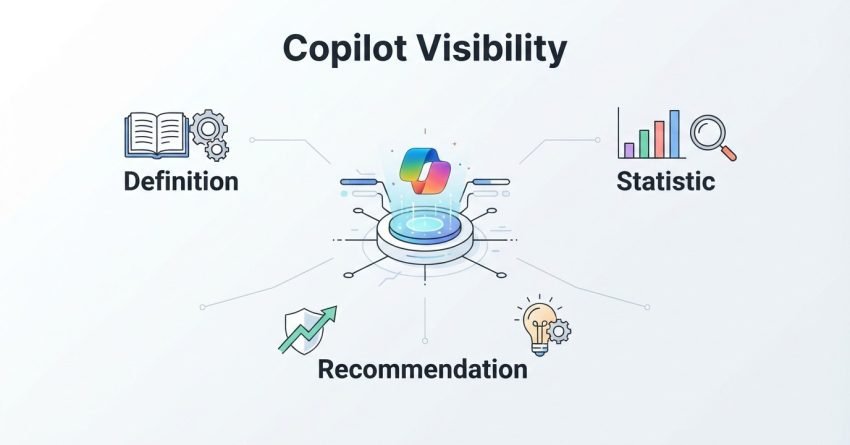
I think about it as a mirror image of featured snippet tracking, except the “snippet” is now a full conversational answer. When Copilot pulls a definition, statistic, or recommendation from a page, that page’s owner gains visibility even if the searcher never visits the site.
Why Copilot Visibility Differs From Traditional SEO Visibility
Traditional SEO visibility is measured by rank position, click-through rate, and organic sessions. Copilot visibility strips out the click entirely and measures whether your content gets selected, quoted, or summarized inside the answer itself.
This distinction changes how I evaluate success for clients. A page can have zero new sessions from Copilot and still be delivering enormous brand exposure, because the citation itself builds awareness and trust before a purchase decision is even made.
How Microsoft Copilot Sources and Cites Content
Microsoft Copilot pulls most of its web-grounded answers from the Bing index, layering its language model on top of Bing’s crawled and ranked pages. This means a page’s visibility in Copilot is tightly connected to how well that same page already performs in Bing search results.
I’ve found that pages with strong Bing Webmaster Tools signals, clean crawl status, structured data, and clear entity markup get pulled into Copilot answers more consistently than pages optimized purely for Google. Copilot also draws on Microsoft’s own knowledge graph and partner data feeds for certain queries, particularly around products, local businesses, and news.
The Role of Bing’s Index in Copilot Answers
Bing’s index acts as the retrieval layer underneath Copilot’s generative responses, supplying the raw pages the model selects from and summarizes. A site with poor Bing indexation has almost no chance of appearing in Copilot answers, regardless of its Google performance.
I always check Bing Webmaster Tools first when a client asks why they’re invisible in Copilot. Nine times out of ten, the answer traces back to indexation gaps rather than content quality.
Why Copilot Visibility Matters for Businesses in 2025-2026
Copilot visibility matters now because Microsoft has embedded Copilot directly into Windows, Edge, Bing, and the entire Microsoft 365 suite, putting it in front of hundreds of millions of daily users. Businesses that ignore this channel are ceding ground in a rapidly growing discovery surface.
I’m seeing more B2B decision-makers use Copilot inside Edge and Word to research vendors before they ever open a traditional search tab. That behavior shift means brand mentions inside AI answers increasingly happen upstream of the traditional funnel, shaping consideration before a prospect fills out a form.
The Shift From Clicks to Citations
The shift from clicks to citations describes the move away from measuring success by traffic volume and toward measuring success by how often a brand is referenced inside AI-generated answers. Marketers who only track sessions are missing an entire layer of influence happening inside the answer itself.
I tell clients to treat citation frequency the way they used to treat impression share. It’s an upper-funnel signal, not a bottom-funnel one, and it needs its own reporting line.
Key Metrics for Tracking Copilot Visibility
The key metrics for tracking Copilot visibility are citation frequency, share of voice, prompt coverage, and sentiment accuracy, each measuring a different dimension of how a brand appears inside AI answers. Tracking all four together gives a far more complete picture than watching any single number in isolation.
| Metric | What It Measures | Why It Matters |
| Citation Frequency | How often your domain is cited across a set of tracked prompts | Shows raw visibility volume |
| Share of Voice | Your citation count relative to competitors on the same prompts | Shows competitive standing |
| Prompt Coverage | The percentage of relevant industry prompts where you appear at all | Shows topical breadth |
| Sentiment and Context Accuracy | Whether the citation frames your brand accurately and favorably | Shows reputational risk |
Citation Frequency
Citation frequency is the raw count of how many times a domain gets referenced across a defined set of Copilot prompts over a given period. I run this weekly for active clients because Copilot’s underlying model and Bing index both update frequently enough to shift results.
A single spike or drop rarely means much on its own. I look for sustained three- to four-week trends before drawing conclusions.
Share of Voice in AI Answers
Share of voice in AI answers compares how often your domain is cited against how often your direct competitors are cited on the same set of prompts. This metric matters more than raw citation counts because it contextualizes your performance against the market you’re actually competing in.
I’ve had clients with high citation frequency in absolute terms who were still losing share of voice because competitors were growing faster. The relative number tells the real story.
Prompt Coverage
Prompt coverage is the percentage of a brand’s relevant industry prompts where the brand appears in Copilot’s answer at all, cited or not. Low prompt coverage signals topical gaps in content rather than a ranking problem specifically.
I build prompt coverage lists the same way I’d build a keyword list, mapping every question a buyer might realistically ask across the awareness, consideration, and decision stages.
Sentiment and Context Accuracy
Sentiment and context accuracy measures whether Copilot’s summary of your brand is factually correct and favorably framed rather than outdated or misrepresentative. A citation isn’t automatically a win if the model is quoting stale pricing or an outdated product description.
I flag this constantly with e-commerce clients whose product pages change often. Copilot can lag behind a price change by weeks depending on Bing’s recrawl schedule.
How Copilot Visibility Differs From ChatGPT and Google AI Overviews Visibility
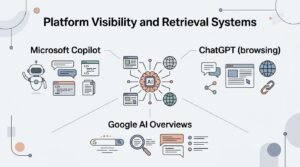
Copilot visibility, ChatGPT visibility, and Google AI Overviews visibility each depend on different underlying retrieval systems, which means optimizing for one doesn’t guarantee visibility in the others. Copilot leans on Bing’s index, ChatGPT’s browsing feature draws on Bing as well but applies its own retrieval and ranking layer, and Google AI Overviews pulls from Google’s own index and knowledge graph.
| Platform | Underlying Index | Primary Optimization Lever |
| Microsoft Copilot | Bing | Bing Webmaster Tools, structured data |
| ChatGPT (browsing) | Bing + OpenAI retrieval layer | Content clarity, entity structure |
| Google AI Overviews | Google index | Traditional Google SEO signals |
I treat these as three separate tracking workstreams even though there’s real overlap in the underlying tactics. A page that’s invisible in Google’s index can still perform in Copilot if Bing has crawled and understood it well.
Top Tools for Tracking AI Visibility in Copilot
The top tools for tracking Copilot visibility fall into three categories: enterprise AI visibility platforms, mid-market tracking tools, and free manual testing methods. Choosing the right tier depends on prompt volume, budget, and how frequently you need fresh data.
Enterprise AI Visibility Platforms
Enterprise AI visibility platforms run automated, large-scale prompt testing across Copilot, ChatGPT, and other assistants, then aggregate citation and sentiment data into dashboards. These tools suit larger brands tracking hundreds or thousands of prompts across multiple markets and languages.
I recommend this tier once a brand has enough prompt volume that manual testing becomes unmanageable, typically past 50 to 100 tracked queries.
Mid-Market and SME Tracking Tools
Mid-market and SME tracking tools offer scaled-down versions of enterprise AI visibility monitoring, usually covering a smaller prompt set at a lower price point. These fit businesses that want consistent tracking without the cost of an enterprise contract.
I steer most of my SME clients here first, since it gives real trend data without requiring a six-figure commitment before the value is proven.
Free and Manual Tracking Methods
Free and manual tracking methods involve running a fixed list of prompts through Copilot by hand on a regular schedule and logging the results in a spreadsheet. This approach costs nothing but time and works well for brands just starting to monitor their AI visibility.
I still do this for smaller clients testing the waters. A simple spreadsheet with prompt, date, cited domain, and citation snippet columns gets the job done for months before a paid tool becomes necessary.
How to Set Up a Copilot Visibility Tracking Process
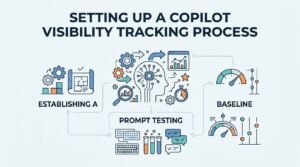
Setting up a Copilot visibility tracking process starts with building a prompt list, then testing it on a fixed schedule, logging results, and reviewing trends monthly. The process mirrors traditional rank tracking but swaps position numbers for citation presence and framing quality.
- Build a list of 30 to 100 realistic buyer prompts across awareness, consideration, and decision stages
- Run each prompt through Copilot and record whether your domain is cited
- Log the exact citation text and compare it against your actual content
- Note which competitors appear on the same prompts
- Repeat on a consistent weekly or biweekly schedule
- Review trends monthly and adjust content based on gaps
Establishing a Prompt Testing Baseline
A prompt testing baseline is the first full round of results against your prompt list, used as the reference point for measuring future gains or losses. Without a baseline, every future data point lacks context.
I always insist on at least two full testing cycles before drawing strategic conclusions. Copilot’s answers can vary slightly between sessions even for identical prompts.
Content Factors That Influence Copilot Visibility
The content factors that most influence Copilot visibility are structured data implementation, content freshness, E-E-A-T signals, and Bing-specific technical optimization. These factors determine both whether a page gets crawled and understood correctly and whether the model trusts it enough to cite.
Structured Data and Schema Markup
Structured data and schema markup give search engines and AI models explicit, machine-readable signals about what a page contains and how its information is organized. Pages with clear FAQ, Article, and Organization schema tend to get parsed more accurately by Copilot’s retrieval layer.
I add schema as a standard step on every technical audit now, not as an optional extra. It’s one of the lowest-cost, highest-leverage changes available.
Content Freshness and E-E-A-T Signals
Content freshness and E-E-A-T signals experience, expertise, authoritativeness, and trustworthiness influence whether Copilot treats a page as a reliable source worth citing. Stale content with no visible author credentials or update history tends to get passed over in favor of more current, better-attributed pages.
I push clients to add visible publish and update dates plus author bios on every cornerstone page. It’s a small addition that measurably affects how confidently AI systems cite the content.
Bing Webmaster Tools Optimization
Bing Webmaster Tools optimization means actively managing crawl settings, sitemaps, and indexation status inside Bing’s own webmaster platform rather than relying solely on Google Search Console. Since Copilot draws directly from Bing’s index, a page invisible to Bing is invisible to Copilot.
I check Bing Webmaster Tools for every client now as a standard part of onboarding. It’s frequently the single most overlooked platform in a technical SEO stack.
Common Copilot Visibility Tracking Mistakes to Avoid
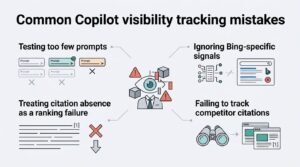
The most common Copilot visibility tracking mistakes are testing too few prompts, ignoring Bing-specific signals, treating citation absence as a ranking failure, and failing to track competitor citations. Each of these mistakes leads to incomplete or misleading conclusions about performance.
Testing only five or ten prompts produces noisy, unreliable data that shifts wildly week to week. I’ve also seen teams pour effort into Google-only technical fixes while their Bing indexation sat neglected, which explains most of the “why aren’t we showing up in Copilot” questions I get.
How Copilot Visibility Impacts Traffic, Leads, and ROI
Copilot visibility impacts traffic, leads, and ROI indirectly, primarily by building brand awareness and trust earlier in the buyer journey rather than by driving direct click-through sessions. A Bain & Company survey found that 80% of consumers now rely on AI-generated answers for at least some portion of their online research, often before ever visiting a brand’s website.
I explain this to skeptical clients using a simple framing: a citation is a warm impression, not a cold click. Buyers who encounter your brand favorably inside Copilot arrive at your site later already primed to trust you, which tends to show up as improved conversion rates rather than raw traffic spikes.
Building a Long-Term AI Visibility Strategy Around Copilot
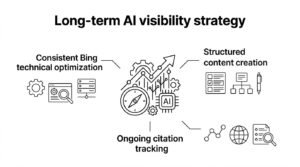
A long-term AI visibility strategy around Copilot combines consistent Bing technical optimization, structured content creation, and ongoing citation tracking rather than a one-time optimization push. This space changes fast, and strategies built for today’s model behavior can go stale within a few months.
I treat this the same way I treat any evolving channel: build the measurement system first, then let the data guide where content investment goes next. Brands that start tracking now will have a meaningful head start once Copilot’s usage curve climbs further.
Conclusion
Copilot visibility now sits alongside traditional rankings as a measurable, manageable discipline. Citation frequency, share of voice, and prompt coverage all define whether your brand gets seen.
This space will keep evolving as Copilot, ChatGPT, and Google AI Overviews each mature. Building the tracking habit now positions you ahead of competitors still ignoring it.
We help brands build and track AI visibility strategies that convert exposure into real growth. Talk to White Label SEO Service about getting started.
Frequently Asked Questions
What is Copilot visibility?
Copilot visibility is how often and how prominently a brand appears or gets cited inside Microsoft Copilot’s AI-generated answers. It’s measured through citation presence rather than traditional click-based metrics.
How is Copilot different from Google for tracking visibility?
Copilot draws primarily from Bing’s index, while Google AI Overviews use Google’s own index and ranking systems. A page can perform well in one and remain invisible in the other.
Can small businesses track Copilot visibility without expensive tools?
Yes, small businesses can track Copilot visibility manually by running a fixed prompt list through Copilot and logging results in a spreadsheet. This free method works well before investing in paid tracking platforms.
Does Copilot visibility drive direct website traffic?
Copilot visibility drives limited direct traffic since citations often satisfy the user’s query without a click. Its main value comes from brand awareness and trust built earlier in the buyer journey.
How often should I test my Copilot visibility prompts?
Testing weekly or biweekly gives the most reliable trend data without excessive manual effort. Monthly reviews of the accumulated results reveal whether visibility is improving or declining.
What role does Bing Webmaster Tools play in Copilot visibility?
Bing Webmaster Tools controls how well Bing crawls and indexes a site, which directly determines whether Copilot can retrieve and cite that content. Poor Bing indexation is one of the most common causes of Copilot invisibility.
Is Copilot visibility replacing traditional SEO?
Copilot visibility is not replacing traditional SEO but adding a new measurement layer alongside it. Strong technical SEO foundations, especially on Bing, remain a prerequisite for AI visibility success.