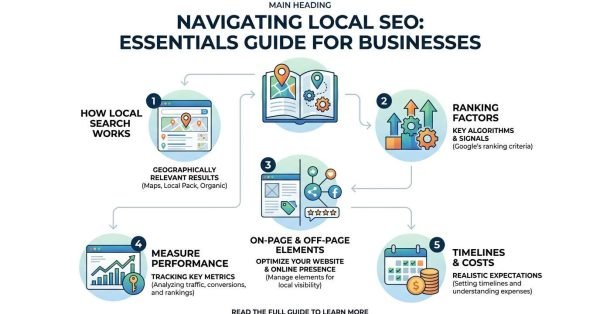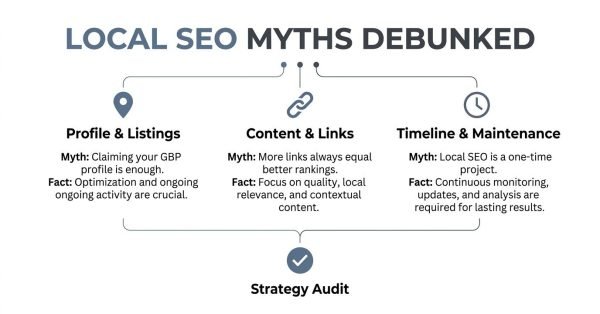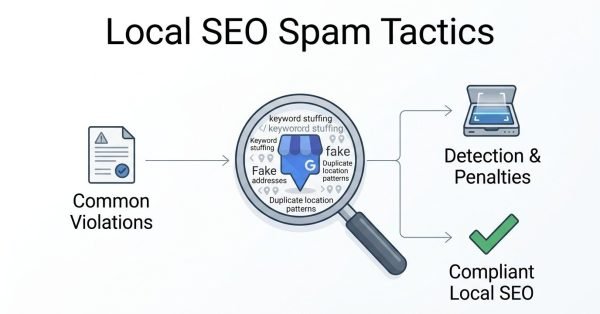
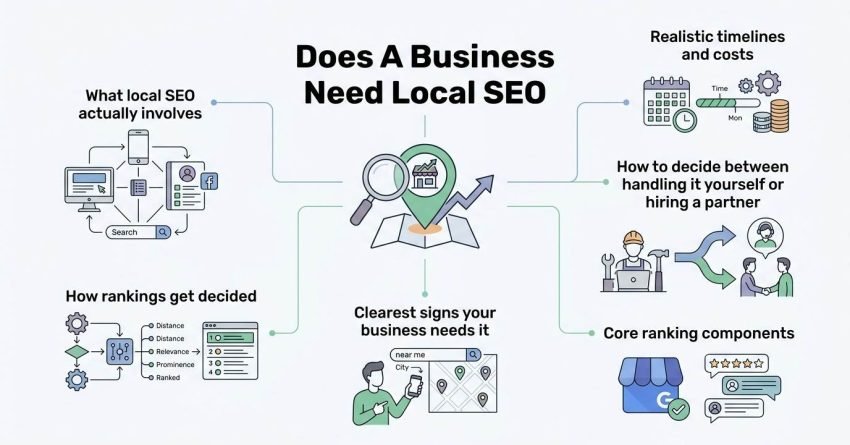
I get asked some version of “do I actually need local SEO” almost every week, and the honest answer depends on how your customers find you. Local SEO is the practice of optimizing a business’s online presence so it appears in location-based searches, and it matters because most customers now choose a business from the first three map results they see. If people search for what you sell “near me” or with a city name attached, this affects you directly.
Ignoring local visibility means competitors capture the customers actively searching for what you offer. We built this guide to walk through the full picture so you can decide with confidence.
This guide covers what local SEO actually involves and how rankings get decided, the clearest signs your business needs it, the core ranking components like Google Business Profile and reviews, realistic timelines and costs, and how to decide between handling it yourself or hiring a partner.
What Local SEO Actually Means
Local SEO is the process of optimizing a business’s digital presence so it appears prominently when people search for products or services tied to a specific location. It differs from traditional SEO because it targets geographically-bound intent rather than broad national visibility.
I think of it as answering one question for search engines: which business is the best, closest, most relevant match for this person right now? That question gets answered using signals most business owners never think about.
Local SEO vs. Traditional SEO
Traditional SEO chases rankings across an entire country or language market. Local SEO narrows that competition to a radius around a searcher, which changes almost every part of the strategy, from keyword research to the platforms involved.
A national SEO campaign for “project management software” competes against thousands of sites globally. A local campaign for “plumber in Austin” competes against maybe thirty real businesses, which is why smaller companies can win locally even when they’d never rank nationally.
How Local Search Rankings Work
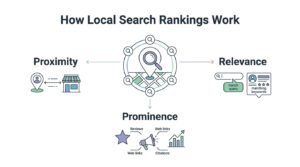
Local rankings are decided by three main factors: proximity, relevance, and prominence, according to Google’s own local ranking documentation. Understanding these three explains almost every local SEO decision that follows.
Proximity measures how close a business is to the searcher or the location implied in the search. Relevance measures how well a business profile matches what was searched. Prominence measures how well-known and well-reviewed a business is across the web.
The Role of Proximity, Relevance, and Prominence
I can’t change how close a customer is to a storefront, but I can influence relevance and prominence heavily through consistent optimization. Prominence in particular responds to citations, backlinks, and review volume over time.
A business with a thin profile and no reviews loses to a mediocre competitor with a hundred reviews almost every time, even if the thin profile is objectively the better business. This is where most owners get frustrated, and it’s usually fixable.
Signs Your Business Needs Local SEO
A business needs local SEO when it depends on nearby customers finding it through search rather than through walk-in traffic or referrals alone. A few patterns show up again and again in businesses that are clearly underinvesting here.
Your competitors consistently outrank you for your own business name plus city. Your Google Business Profile has fewer reviews than three competitors within a mile. Customers mention they “couldn’t find you online” despite you having a website. Your phone stopped ringing from search even though foot traffic held steady.
Any one of these on its own isn’t alarming. Two or more together usually means visibility, not quality, is the problem.
Which Businesses Benefit Most From Local SEO
Local SEO delivers the most value for businesses with a physical location or a defined service area that customers search for by geography. Restaurants, medical practices, home services, legal firms, and retail all fall squarely into this category.
I’ve seen this matter most for businesses competing in dense urban markets, where dozens of nearly identical providers fight for the same three map pack spots. The businesses that win aren’t always the best ones. They’re the ones that took their profile seriously.
Multi-Location and Service-Area Businesses
Multi-location businesses face a unique challenge because each location needs its own optimized presence rather than one shared page representing the whole brand. Service-area businesses without a storefront face the opposite problem: proving legitimacy to Google without a physical address to anchor them.
Both situations require deliberate service area page structuring so each location or region gets fair visibility instead of competing against itself.
Google Business Profile and the Local Map Pack
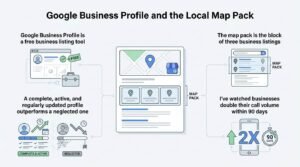
Google Business Profile is a free business listing tool that controls how a business appears in Google Maps and the local map pack, and it is the single most influential asset in local search visibility. The map pack is the block of three business listings shown above organic results for local queries.
A complete, active, and regularly updated profile outperforms a neglected one even when the underlying business is comparable. I’ve watched businesses double their call volume within 90 days simply by completing every profile field Google offers.
Local Citations and NAP Consistency
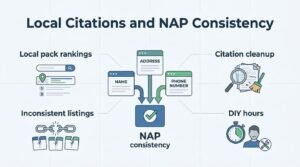
A local citation is any online mention of a business’s name, address, and phone number, commonly abbreviated as NAP, and consistency across these mentions is a trust signal search engines weigh directly. Inconsistent NAP data across directories confuses the algorithm about which details are accurate.
I treat citation cleanup as foundational work rather than an optional extra, because a business with conflicting addresses across ten directories is quietly undermining every other optimization effort it makes.
Customer Reviews and Local Trust Signals
Customer reviews function as both a ranking signal and a conversion signal, since they influence prominence in Google’s algorithm while also shaping whether a searcher trusts a business enough to call. A BrightLocal survey found that 98% of consumers read online reviews for local businesses before making a purchase decision.
Review volume, recency, and response rate all factor into this signal. A business with old reviews and no owner responses reads as inactive, even if it’s thriving offline.
Local Content and On-Page Signals
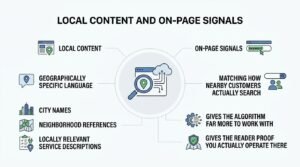
Local content refers to website pages, blog posts, and location pages that use geographically specific language matching how nearby customers actually search. This includes city names, neighborhood references, and locally relevant service descriptions woven naturally into page copy.
A generic services page tells search engines nothing about geography. A page that mentions the neighborhoods served, local landmarks, and city-specific service considerations gives the algorithm far more to work with, and gives the reader proof you actually operate there.
How Long Local SEO Takes to Show Results
Most businesses start seeing measurable movement in local rankings within three to six months, according to patterns Moz has documented across competitive local markets. Full maturity of a local campaign, including sustained map pack presence, typically takes closer to a year.
Timelines shift based on competition density, how neglected the starting profile was, and how aggressively citations and reviews get addressed early. A business starting from zero reviews in a competitive city waits longer than one refining an already-decent presence.
What Local SEO Costs and What Affects Pricing
Local SEO services in the US typically range from $300 to $2,000 per month for small to mid-sized businesses, with pricing driven by market competitiveness, number of locations, and scope of work involved. Multi-location campaigns and highly competitive metro markets sit at the higher end of that range.
I always tell business owners that price should track directly to competition. A single-location bakery in a small town needs far less investment than a med spa competing in a top-20 metro market.
DIY Local SEO vs. Hiring a Professional
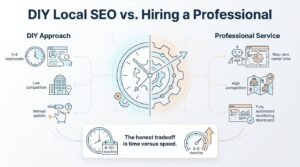
DIY local SEO works reasonably well for single-location businesses in low-competition markets with an owner willing to spend a few hours a month on profile updates and review responses. Hiring a professional makes more sense once competition intensifies or time becomes the limiting factor.
| Factor | DIY Approach | Professional Service |
| Time investment | 3–6 hrs/month | Near zero owner time |
| Best for | Low competition, single location | Competitive or multi-location markets |
| Citation management | Manual, error-prone | Automated and monitored |
| Typical results timeline | 6–12+ months | 3–6 months |
| Cost | Free (time only) | $300–$2,000+/month |
The honest tradeoff is time versus speed. A capable owner can do this themselves. Most just don’t have the hours to do it consistently enough to matter.
When to Hire a Local SEO Agency
Hiring a local SEO agency makes sense once a business has multiple locations, operates in a competitive market, or has tried DIY efforts without meaningful ranking movement after six months. These three triggers cover the majority of businesses that eventually bring in outside help.
Warning Signs You’ve Outgrown DIY
A few clear signals tell me a business owner has hit the ceiling of what they can manage alone. Rankings have stalled despite consistent effort. Competitors are pulling ahead in review count and citation quality. The owner simply has no time left to keep the profile updated weekly.
Once two or more of these show up together, the cost of inaction usually exceeds the cost of hiring help.
How to Choose the Right Local SEO Partner
Choosing the right local SEO partner starts with reviewing case studies in a similar industry or market size, then confirming they offer transparent reporting rather than vague monthly summaries. A partner unwilling to show past ranking data is a red flag worth taking seriously.
Ask how they handle citation building, review generation, and Google Business Profile management specifically, since vague answers here usually mean thin, templated service. Real specialists can walk through their exact process without hesitation.
Conclusion
Local SEO combines proximity, relevance, and prominence into one system search engines use to decide who ranks. Reviews, citations, and profile completeness all feed that system directly.
The businesses that win locally treat this as ongoing work, not a one-time project. Rankings shift as competitors improve theirs too.
We help businesses build this foundation properly from day one. Reach out to White Label SEO Service to see where your local visibility stands today.
Frequently Asked Questions
Is local SEO worth it for small businesses?
Yes, local SEO is worth it for most small businesses that depend on nearby customers finding them through search. It typically costs less than paid ads while delivering longer-lasting visibility.
How is local SEO different from regular SEO?
Local SEO targets geographically-bound searches using signals like proximity and Google Business Profile activity. Traditional SEO targets broader national or global search visibility without a location component.
How long does local SEO take to work?
Most businesses see measurable ranking movement within three to six months. Full campaign maturity, including consistent map pack presence, usually takes closer to a year.
Do I need local SEO if I only serve one city?
Yes, single-city businesses still compete against every nearby provider for the same map pack spots. Local SEO ensures your profile outperforms theirs in that limited pool.
What happens if I ignore local SEO?
Ignoring local SEO means competitors with optimized profiles capture the customers actively searching for what you offer. Your phone and foot traffic decline even if your business quality stays the same.
Can I do local SEO myself without an agency?
Yes, DIY local SEO works for single-location businesses in low-competition markets willing to spend a few hours monthly on updates. Competitive markets usually require professional help to keep pace.
How much does local SEO cost per month?
Local SEO in the US typically costs between $300 and $2,000 per month for small to mid-sized businesses. Price depends on market competition, location count, and scope of work.