Link building is the process of acquiring hyperlinks from other websites to your own, and search engines treat those links as votes of trust and relevance. Sites with more high-quality backlinks tend to rank higher because search engines interpret those links as third-party validation. I’ve watched businesses stall in the search results for years simply because they had great content and zero links pointing to it.
Content alone rarely wins competitive keywords anymore, and ignoring links leaves real traffic and revenue on the table. Every month without a link strategy is a month a competitor closes the gap.
This guide covers what link building actually is and how search engines judge link quality, the main strategy types and tactics that work today, a six-step process for building your own campaign, and the practical realities of timelines, costs, and tool selection.
What Is Link Building and Why Does It Still Matter?
Link building is the ongoing practice of earning backlinks from other websites to increase a site’s authority, visibility, and organic search rankings. I still consider it one of the three pillars of SEO, alongside technical health and content quality. Search engines can’t fully judge quality on content alone, so they use links as external signals of trust.
How Links Function as Ranking Signals
A backlink acts as a signal that tells a search engine another website considers your page valuable enough to reference. Google’s own guidance on how search works confirms that links remain one of the core signals used to understand a page’s relevance and authority. Not every link carries equal weight, and that’s where quality evaluation becomes central to any real strategy.
Link Building vs. Other SEO Disciplines
Link building sits alongside technical SEO and content strategy as one of the three foundational SEO disciplines, but it’s the one most businesses neglect. Technical SEO makes a site crawlable, content answers search intent, and link building tells search engines the content deserves to rank. I treat these three as inseparable rather than competing priorities.
How Search Engines Evaluate Link Quality
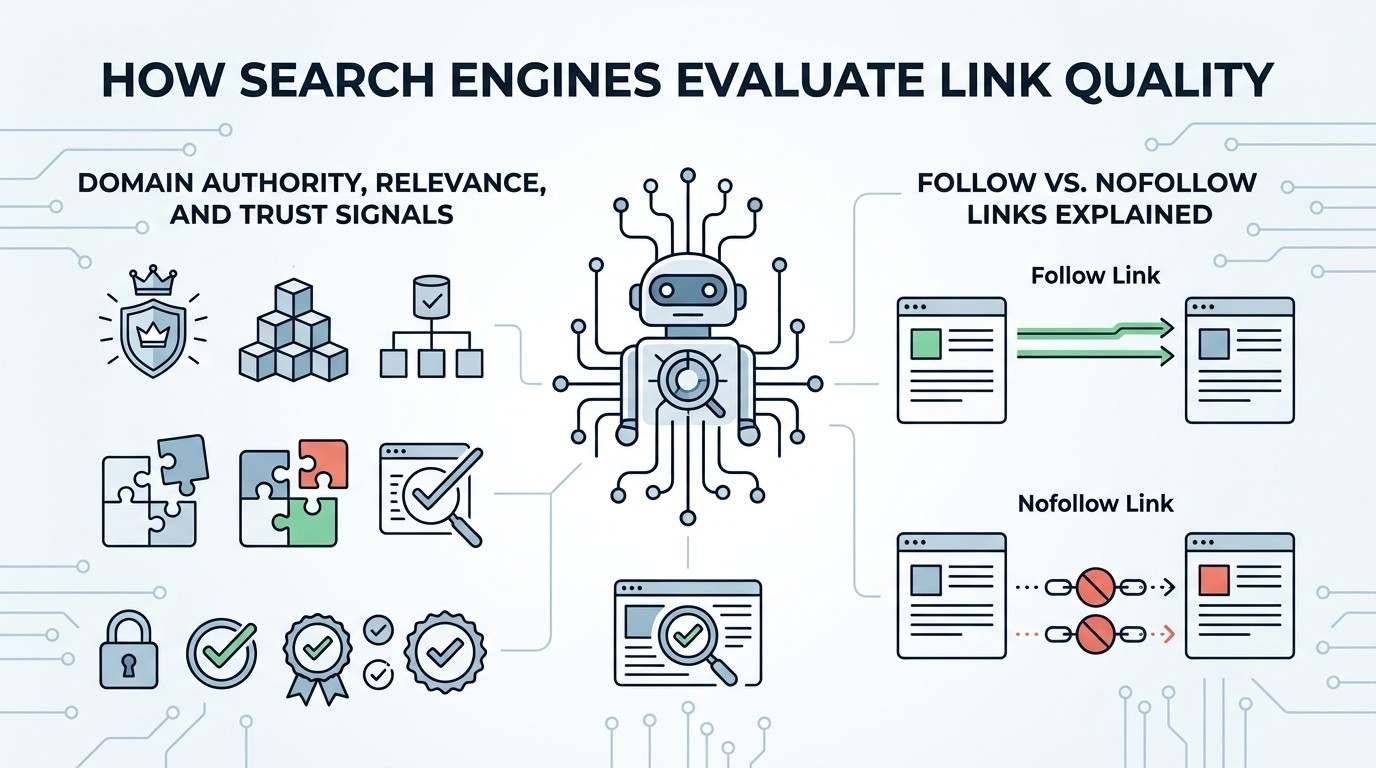
Search engines evaluate link quality by assessing the linking domain’s authority, topical relevance, and the trustworthiness of the site providing the link. Not every backlink helps equally, and some can actively hurt a site if they come from spammy or unrelated domains.
Domain Authority, Relevance, and Trust Signals
Domain authority reflects how much trust and ranking power a website has accumulated over time through its own backlink profile and content history. A study from Ahrefs analyzing over 2 million search results found that pages ranking in the top 10 had significantly higher referring domain counts than lower-ranked pages. Relevance matters just as much as authority, since a link from a topically related site carries more weight than one from an unrelated niche.
Follow vs. Nofollow Links Explained
A follow link passes ranking value between sites, while a nofollow link tells search engines not to pass that authority signal. I still pursue nofollow links from reputable, high-traffic sites because they drive referral clicks and brand exposure even without direct ranking credit. Building a natural backlink profile means having both types rather than only follow links, since an all-follow profile can actually look unnatural to search engines.
Types of Link Building Strategies
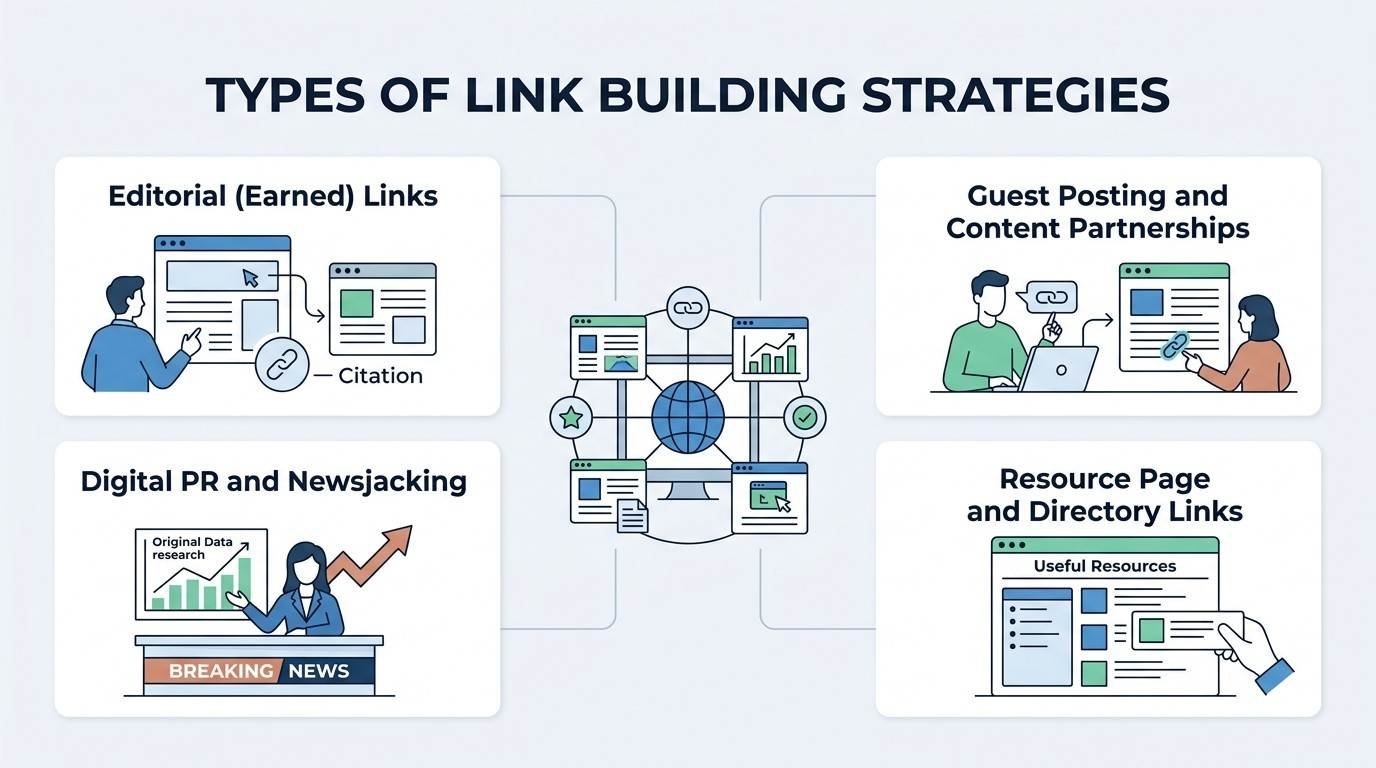
Link building strategies generally fall into four categories: editorial links, guest posting, digital PR, and resource page links. Each type serves a different purpose in a broader campaign, and most successful strategies blend two or three of them.
Editorial (Earned) Links
Editorial links are backlinks that other websites add naturally because they found your content valuable enough to cite. These are the most valuable link type because search engines can’t easily distinguish them from a paid placement, and they typically come from genuinely useful, well-researched linkable assets that other publishers want to reference.
Guest Posting and Content Partnerships
Guest posting involves writing content for another website in exchange for a backlink, usually placed within the body content or an author bio. I’ve found this tactic works best when the target site has genuine topical overlap with your business rather than being chosen purely for its domain metrics.
Digital PR and Newsjacking
Digital PR link building uses data-driven stories, original research, or timely news angles to earn coverage and backlinks from journalists and publishers. Newsjacking specifically means attaching your content to a trending news story to capture media attention while interest is still high.
Resource Page and Directory Links
Resource page link building means getting your page listed on a curated page a website maintains to point readers toward helpful external resources. These pages exist in nearly every niche, and finding them through targeted search queries remains one of the more efficient linkable outreach methods.
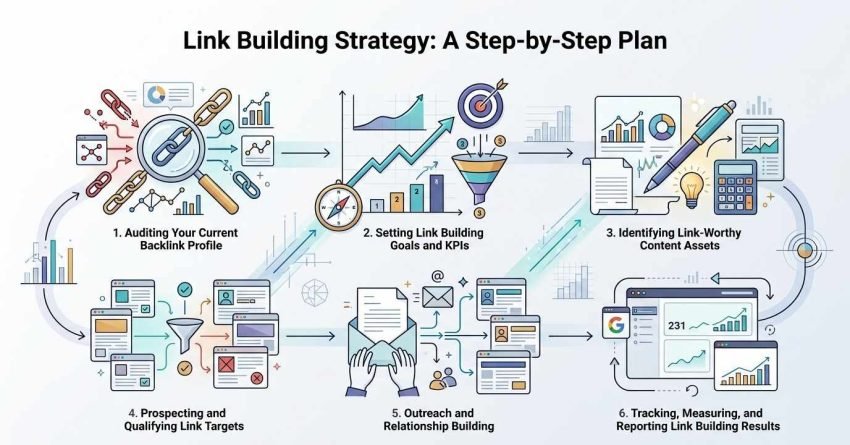
Step 1: Auditing Your Current Backlink Profile
A backlink audit is the process of reviewing every link currently pointing to your site to assess quality, identify toxic links, and find gaps compared to competitors. I never start a new campaign without one, because building on top of a damaged profile wastes budget.
Ahrefs’ backlink checker or Google Search Console are the two tools I rely on most for this stage, since Search Console shows exactly which external links Google itself has indexed. A clean audit tells you which existing links are working, which need disavowing, and which competitor links represent realistic opportunities.
Step 2: Setting Link Building Goals and KPIs
Link building goals should tie directly to business outcomes like organic traffic growth, keyword rankings, and lead generation rather than raw link counts. I push clients away from vanity metrics like “50 links this quarter” toward metrics that reflect actual ranking movement and referral traffic.
Referring domain growth, not total link count, is the KPI that correlates most closely with ranking improvement. A single link from a highly relevant, high-authority domain often outperforms twenty links from weak, unrelated sites.
Step 3: Identifying Link-Worthy Content Assets
A linkable asset is a piece of content specifically created or optimized to attract backlinks, such as original research, data studies, tools, or comprehensive guides. Without something genuinely worth linking to, outreach becomes a much harder sell regardless of how good your pitch is.
Original data studies and free tools tend to attract the most natural links because they give other publishers something unique to cite. I always ask clients what proprietary data or expertise they have sitting unused before recommending new content.
Step 4: Prospecting and Qualifying Link Targets
Link prospecting is the process of finding websites that are realistic, relevant candidates for a backlink based on their authority, audience, and topical fit. This step determines the entire success rate of an outreach campaign, since even a great pitch fails on the wrong target list.
Qualifying a prospect means checking their domain authority, organic traffic, topical relevance, and existing outbound link patterns before reaching out. I filter out sites with thin content, excessive ads, or link-selling patterns early to protect campaign integrity.
Step 5: Outreach and Relationship Building
Link building outreach is the practice of contacting website owners, editors, or journalists to propose a link placement, guest post, or content collaboration. Personalized outreach consistently outperforms templated mass emails, even though it takes considerably more time per prospect.
A 2024 analysis by Backlinko examining outreach response patterns found that personalized subject lines increased open rates by roughly 26% compared to generic ones. I build relationships with a handful of publishers over months rather than treating every contact as a one-time transaction, since repeat placements get easier every time.
Step 6: Tracking, Measuring, and Reporting Link Building Results
Tracking link building results means monitoring referring domain growth, keyword ranking movement, and organic traffic changes tied to specific link campaigns. Attribution isn’t always perfect in SEO, but pairing link acquisition dates with ranking shifts in Google Search Console gives a reasonably clear picture over a 60- to 90-day window.
Monthly reporting should separate vanity metrics, like total links acquired, from performance metrics like keyword position changes and organic sessions. I’ve seen campaigns that looked impressive on link count alone deliver almost no ranking movement because the links came from irrelevant domains.
Common Link Building Tactics That Work in 2025
The tactics producing the most consistent results in 2025 combine original content creation with targeted, relationship-based outreach rather than mass automated tactics. Search engines have gotten considerably better at discounting manipulative link patterns, which has pushed the effective tactics toward genuine value exchange.
Skyscraper Content and Linkable Assets
Skyscraper content means finding an existing high-performing piece in your niche and creating something noticeably more comprehensive, current, or useful, then reaching out to sites linking to the original. This tactic works because it removes the guesswork of what topics already attract links.
Broken Link Building
Broken link building involves finding dead links on other websites and suggesting your own relevant content as a replacement. Site owners generally appreciate the heads-up about broken links, which makes this one of the higher response-rate outreach tactics available.
HARO and Expert Source Contributions
HARO-style expert contribution platforms connect journalists seeking quotes with sources willing to provide expertise, often in exchange for a citation and backlink. I recommend this tactic specifically for businesses with genuine subject matter expertise, since weak or generic quotes rarely get selected.
Link Building Mistakes and Risky Practices to Avoid
The most damaging link building mistakes involve buying links at scale, participating in link schemes, or over-optimizing anchor text patterns in ways that look manipulative to search engines. Google’s Search Central documentation explicitly states that participating in link schemes can result in a manual action or algorithmic devaluation.
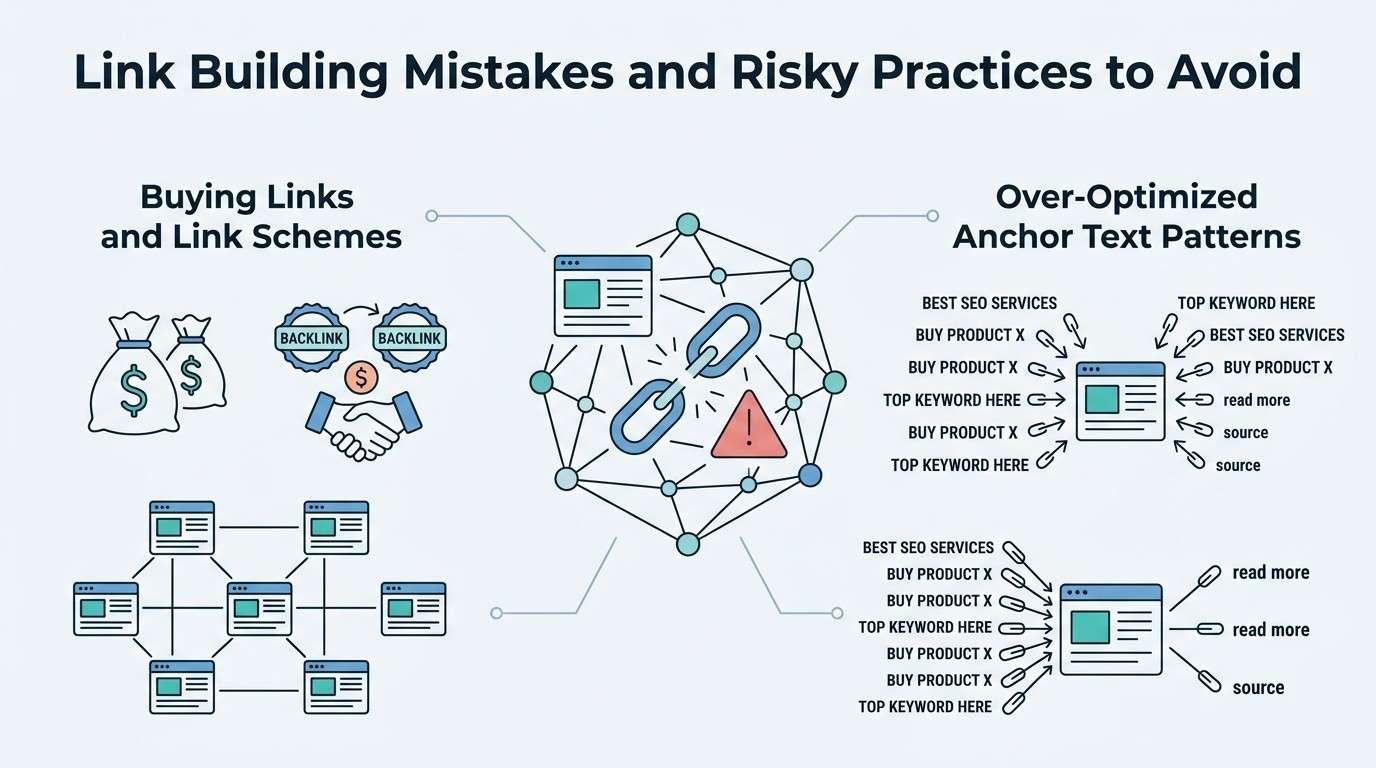
Buying Links and Link Schemes
Buying links means paying specifically for a backlink placement without any genuine editorial or content justification for the link existing. Private blog networks and bulk link packages fall squarely into this category, and I steer every client away from them regardless of how cheap or tempting they look.
Over-Optimized Anchor Text Patterns
Over-optimized anchor text happens when a disproportionate share of a site’s backlinks use the exact same keyword-rich phrase instead of natural variations. A healthy link profile shows branded anchors, naked URLs, and generic phrases mixed in alongside keyword-relevant anchors.
How Long Does Link Building Take to Show Results?
Link building typically takes three to six months to produce measurable ranking movement, though competitive industries can extend that timeline to nine months or longer. The Ahrefs study referenced earlier found that pages needed a median of two years to reach the top 10 for competitive terms, with link acquisition playing a major role in that overall speed.
Patience matters more in link building than almost any other SEO discipline, because search engines intentionally weight new links gradually rather than instantly. Rushing the process with bulk-purchased links tends to backfire rather than speed anything up.
How Much Does Link Building Cost?
Link building costs in the US typically range from $1,000 to $5,000 per month for agency-managed campaigns, though high-authority digital PR placements can run considerably higher per link. Freelancers and smaller in-house efforts can cost less, but usually trade off scale, speed, or the quality of prospecting.
Cost per link varies enormously depending on the target site’s authority, with placements on major publications sometimes costing several thousand dollars for a single mention. I always tell clients that link building budget is really a proxy for outreach time and relationship quality, not a direct purchase of the link itself.
In-House vs. Agency vs. Freelance Link Building
Choosing between in-house, agency, and freelance link building depends on internal bandwidth, existing relationships, and how quickly a business needs to scale its campaign. In-house teams offer the most brand control but usually lack established publisher relationships that agencies have built over years.
Agencies bring existing media relationships, proven outreach systems, and the ability to run multiple campaigns simultaneously at a pace most in-house teams can’t match. Freelancers sit in between, offering lower cost than agencies but typically less capacity and fewer established publisher contacts.
Tools for Managing a Link Building Strategy
Managing a link building campaign effectively requires tools for prospecting, tracking backlinks, and measuring the resulting ranking impact. Ahrefs, Semrush, and Google Search Console cover most of what a typical campaign needs across these three functions.
Semrush’s Link Building Tool and Ahrefs’ Site Explorer both allow direct comparison of competitor backlink profiles to identify realistic prospecting opportunities. Outreach-specific platforms like Pitchbox or BuzzStream then help manage the actual email sequences and relationship tracking at scale.
How Link Building Fits Into a Broader SEO Strategy
Link building works best as one component inside a broader SEO strategy that also includes technical optimization and content built around real search demand. A site with excellent backlinks but broken technical foundations, like slow load speeds or poor mobile experience, still struggles to convert that link equity into rankings.
Content and links reinforce each other in a cycle where strong content earns links, and those links help the content rank well enough to earn even more organic visibility. I always sequence technical fixes first, content second, and link acquisition third, because links amplify good foundations rather than fixing broken ones.
Conclusion
Link building strengthens the trust and authority signals search engines use alongside technical SEO and content quality. It works best as part of a coordinated organic strategy, not a standalone tactic.
We build link strategies grounded in real outreach, quality prospecting, and measurable results. Partner with White Label SEO Service to build authority that lasts.
Frequently Asked Questions
How many backlinks do I need to rank on page one?
There’s no fixed number of backlinks required to rank on page one, since quality and relevance matter more than raw count. Competitive keywords often need dozens of high-authority links, while low-competition terms may need very few.
Is link building still effective in 2025?
Link building remains effective in 2025 because search engines continue using backlinks as a core trust and relevance signal. The tactics have shifted toward genuine relationship building and away from manipulative bulk link schemes.
Can I do link building myself without an agency?
Yes, you can do link building yourself if you have the time for consistent prospecting, outreach, and relationship management. Most businesses find it more efficient to outsource once campaigns need to scale beyond a few links per month.
What is a good backlink profile?
A good backlink profile shows links from relevant, high-authority domains with a natural mix of anchor text and both follow and nofollow links. Diversity in link sources matters as much as the overall volume of links.
How do I know if a backlink is high quality?
A high-quality backlink comes from a relevant, trustworthy domain with real organic traffic and editorial standards rather than a site built purely to sell links. Checking the linking domain’s authority score, traffic, and content quality answers this quickly.
Does guest posting still work for link building?
Guest posting still works when the target site has genuine topical relevance and real readership rather than being chosen solely for its metrics. Search engines have gotten better at discounting guest posts placed purely for link value.
What’s the difference between link building and link earning?
Link building refers to any proactive strategy to acquire backlinks, including outreach and content promotion, while link earning specifically means links that come naturally without direct request. Most effective strategies combine both approaches rather than relying on just one.