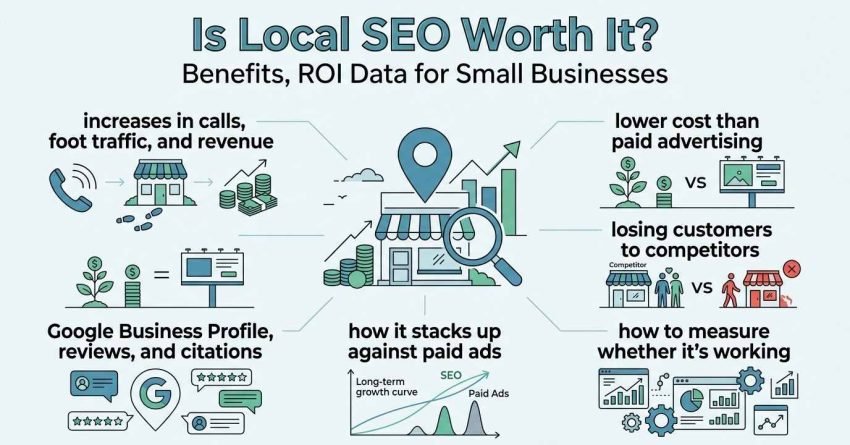
Local SEO is a set of optimization practices that help a business appear in geographically relevant search results, and it is worth it for most small businesses because it drives measurable increases in calls, foot traffic, and revenue at a lower cost than paid advertising. I’ve watched this play out across dozens of client accounts, and the pattern holds regardless of industry.
Ignoring local search visibility now means losing customers to competitors who already rank. Every month without it compounds the gap.
This guide covers what local SEO actually costs and returns, the core mechanics behind Google Business Profile, reviews, and citations, how it stacks up against paid ads, and how to measure whether it’s working for your specific business.
What Is Local SEO and How Does It Differ From Traditional SEO?
Local SEO is the practice of optimizing a business’s online presence to rank higher in geographically-targeted search results, such as “plumber near me” or “best coffee shop in Austin.” Traditional SEO targets broader, often non-geographic search intent, while local SEO leans heavily on proximity, Google Business Profile signals, and localized content.
I think of local SEO as a subset discipline with its own ranking logic. It cares less about domain-wide authority and more about how relevant and prominent a business is within a specific area.
Core Components of Local SEO
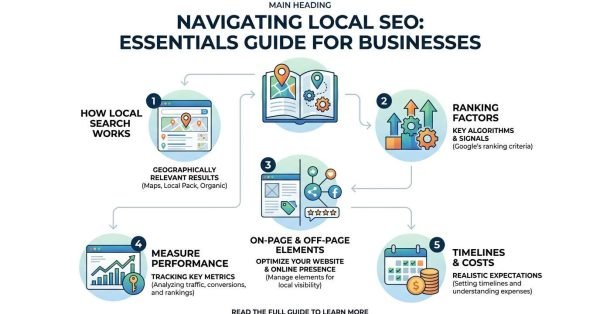
The core components include Google Business Profile optimization, online reviews, local citations, on-page geographic signals, and localized link building. Each of these functions as its own lever, and I rarely see a business succeed by pulling just one.
Google Business Profile carries the most weight of these components for most small businesses, which we’ll get into shortly.
How Much Does Local SEO Cost for a Small Business?
Local SEO for a small business typically costs between $300 and $2,000 per month when working with an agency, according to Ahrefs’ 2024 SEO pricing survey. Costs vary based on competition level, number of locations, and the current state of the business’s online presence.
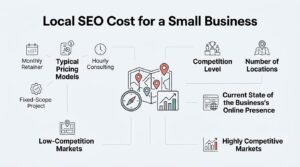
Businesses in low-competition markets sometimes see meaningful movement within a few months at the lower end of that range. Highly competitive markets, like personal injury law or HVAC in major metros, often require sustained investment at the higher end.
Typical Pricing Models
Agencies generally price local SEO through a monthly retainer, a fixed-scope project, or hourly consulting. Monthly retainers dominate the small business segment because local SEO requires ongoing maintenance, not a one-time fix.
A retainer model also aligns incentives. The agency stays accountable for rankings and visibility over time instead of walking away after a single audit.
What ROI Can Small Businesses Expect From Local SEO?
Small businesses investing in local SEO can expect a median ROI of 200% to 500% within 12 months, based on BrightLocal’s 2024 Local Consumer Review Survey, which found that 87% of consumers used Google to evaluate local businesses in the prior year. That volume of local search demand is the foundation the ROI is built on.
ROI compounds because local rankings, once earned, keep generating calls and visits without an ongoing per-click cost. This is fundamentally different from paid advertising, where the traffic stops the moment you stop paying.
Average Timeframes to See Results
Most small businesses start seeing measurable ranking movement within three to six months, with stronger, compounding results appearing between six and twelve months. Businesses in low-competition local niches sometimes move faster.
I’ve seen new Google Business Profile listings gain traction in weeks when the competition is thin. Denser urban markets almost always take longer.
What Are the Core Benefits of Local SEO?
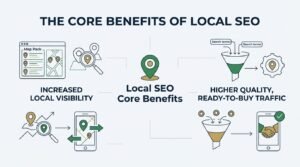
The core benefits of local SEO are increased local visibility, higher-intent traffic, lower cost-per-acquisition over time, and stronger trust signals through reviews and citations. These benefits stack together rather than functioning independently.
Increased Local Visibility
Increased local visibility means appearing in the Google Map Pack, local organic results, and “near me” searches where in-market customers are actively looking. This visibility is what separates a business customers can find from one that stays invisible during the exact moment someone needs it.
Map Pack placement alone drives a disproportionate share of local clicks compared to organic listings below it.
Higher Quality, Ready-to-Buy Traffic
Local search traffic tends to convert at a higher rate than generic organic traffic because the searcher has already expressed geographic and purchase intent. Someone searching “emergency electrician near me” is closer to a buying decision than someone researching “how electrical panels work.”
This is why local SEO leads often close faster and require less nurturing than broader inbound traffic.
How Does Google Business Profile Impact Local SEO Success?
Google Business Profile is the single most influential ranking factor in local search, directly powering Map Pack placement and heavily influencing organic local rankings. A complete, active, and regularly updated profile signals relevance and trustworthiness to Google’s local algorithm.
Businesses that post updates, respond to reviews, and keep hours and categories accurate tend to outperform competitors who set up a profile once and abandon it. Profile completeness alone can be the deciding factor between two otherwise similar competitors in the same area.
How Do Online Reviews Affect Local Search Rankings?
Online reviews affect local search rankings by contributing directly to Google’s prominence signal, one of the three core local ranking factors alongside proximity and relevance. Review count, average rating, recency, and keyword content within reviews all factor into this signal.
A steady stream of new, detailed reviews tends to outperform a large stack of old ones. Google appears to weight recency because it reflects current customer experience rather than historical performance.
What Role Do Local Citations and NAP Consistency Play?
A local citation is any online mention of a business’s name, address, and phone number, commonly abbreviated as NAP, and citation consistency across directories is a foundational trust signal for local search algorithms. Inconsistent NAP data across platforms like Yelp, Facebook, and industry directories can confuse ranking algorithms and suppress visibility.
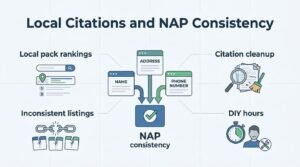
I treat citation cleanup as one of the first steps in any local SEO engagement because it’s foundational rather than optional. Fixing inconsistencies rarely produces dramatic gains alone, but it removes a ceiling on everything built after it.
How Does Local SEO Compare to Paid Local Ads (PPC)?
Local SEO delivers compounding, long-term visibility at a lower cost per lead over time, while paid local ads deliver immediate visibility that stops the moment spending stops. The two channels serve different timelines and often work best together rather than as substitutes.
Cost Comparison Table
The table below compares typical cost structures and characteristics between local SEO and local PPC advertising.
| Factor | Local SEO | Local PPC (Google Ads) |
| Typical monthly cost | $300–$2,000 | $500–$10,000+ |
| Time to results | 3–6+ months | Immediate |
| Cost after stopping | Rankings persist | Traffic stops instantly |
| Trust perception | Higher (organic) | Lower (labeled “Ad”) |
| Long-term cost-per-lead | Decreases over time | Stays constant or rises |
Businesses with immediate revenue needs often run both channels simultaneously, using PPC for short-term volume while local SEO builds toward sustainable, lower-cost visibility.
Which Types of Small Businesses Benefit Most From Local SEO?
Service-area businesses, brick-and-mortar retailers, healthcare providers, and multi-location franchises benefit most from local SEO because their customers overwhelmingly search with geographic intent. Restaurants, dentists, plumbers, salons, and law firms are among the categories I see generate the fastest and clearest returns.
Purely e-commerce businesses without a physical or service-area presence generally see less direct benefit, since their customers aren’t searching by location in the same way.
What Are the Biggest Risks of Ignoring Local SEO?
The biggest risks of ignoring local SEO are losing visibility to competitors in the Map Pack, appearing untrustworthy due to inconsistent business information, and missing high-intent customers at the exact moment they’re ready to buy. These risks compound quietly because a business rarely notices the customers it never appeared to.
Competitors who actively manage their local presence capture that lost demand by default, not because they’re necessarily better, but because they’re visible.
How Do You Measure Local SEO Performance and ROI?
Local SEO performance is measured through keyword rank tracking, Google Business Profile insights, website traffic from local queries, and conversion actions like calls, direction requests, and form submissions. Google Search Console and Google Analytics provide the traffic and conversion layer, while Google Business Profile Insights covers profile-specific engagement.
Key Metrics to Track
The most important metrics to track are Map Pack rankings for target keywords, monthly phone calls generated from the Business Profile, direction requests, website clicks from the profile, and review growth rate. Tracking these consistently over a 90-day rolling window reveals trend direction better than any single monthly snapshot.
What Local SEO Ranking Factors Matter Most in 2026?
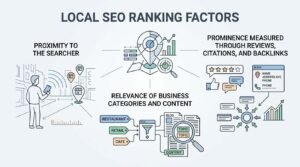
The three core local ranking factors are proximity, relevance, and prominence, and all three are weighted together by Google’s local algorithm to determine Map Pack placement. No single factor overrides the others; a highly prominent business still loses to a closer, equally relevant competitor in many searches.
Proximity, Relevance, and Prominence
Proximity measures the physical distance between the searcher and the business, relevance measures how well the business matches the search query, and prominence measures overall reputation and authority signals like reviews and backlinks. Businesses can’t change proximity for a given searcher, which makes relevance and prominence the two factors worth actively optimizing.
Is Local SEO Worth It for Multi-Location or Franchise Businesses?
Local SEO is worth it for multi-location and franchise businesses because it scales efficiently once a repeatable process exists for each location’s Google Business Profile, citations, and localized content. The investment per additional location typically decreases as processes and templates mature.
The main challenge multi-location brands face is duplicate content and cannibalization between location pages, which requires more careful technical planning than a single-location business.
Should You Do Local SEO In-House or Hire an Agency?
Whether to do local SEO in-house or hire an agency depends on available time, existing expertise, and how quickly results are needed. In-house teams save on agency fees but often lack specialized tools and experience with algorithm changes.
Agencies bring dedicated tools, cross-client pattern recognition, and faster execution, which usually offsets their cost for businesses without a dedicated marketing hire. I’ve seen in-house attempts stall simply from lack of consistent time investment, not lack of knowledge.
Common Mistakes That Waste Local SEO Investment
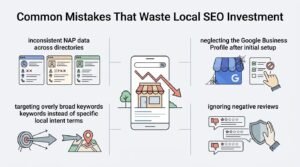
The most common mistakes are inconsistent NAP data across directories, neglecting the Google Business Profile after initial setup, ignoring negative reviews, and targeting overly broad keywords instead of specific local intent terms. Each of these mistakes quietly caps performance even when other parts of the strategy are executed well.
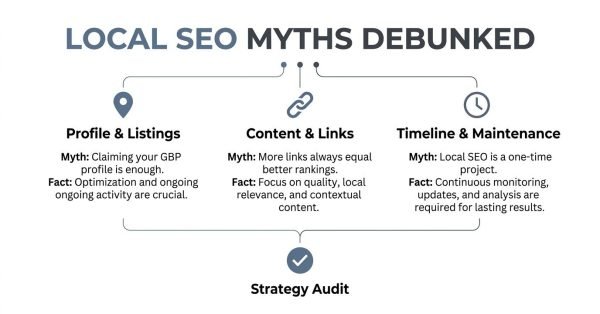
Businesses that treat local SEO as a “set it and forget it” project consistently underperform those that treat it as ongoing maintenance.
How Long Before Local SEO Pays for Itself?
Most small businesses reach payback on their local SEO investment within six to nine months, once ranking improvements translate into consistent lead volume. The exact breakeven point depends on average customer value and current conversion rates from local traffic.
A business with a $3,000 average customer value breaks even faster than one selling $50 products, even with identical ranking performance, because fewer conversions are needed to cover the investment.
Conclusion
Local SEO connects Google Business Profile strength, reviews, citations, and ranking factors into one system that drives visible, trackable business results. The broader SEO landscape keeps evolving, and dedicated local strategy remains central to that growth.
We help businesses turn local visibility into measurable revenue. Partner with White Label SEO Service to build a local SEO strategy that pays for itself.
Frequently Asked Questions
Is local SEO really worth the investment for a small business?
Yes, local SEO is worth it for most small businesses because it delivers a median ROI of 200-500% within 12 months. The compounding nature of organic rankings makes it more cost-effective than paid ads over time.
How much should a small business budget for local SEO?
Small businesses should budget $300 to $2,000 per month for local SEO services. Costs increase with competition level and the number of business locations involved.
How long does it take to see results from local SEO?
Most businesses see measurable results within three to six months. Highly competitive markets can take longer, while low-competition niches sometimes show movement within weeks.
What’s the difference between local SEO and regular SEO?
Local SEO targets geographically-specific search intent using Google Business Profile, reviews, and citations. Regular SEO focuses on broader, often non-location-based search visibility.
Can local SEO replace paid advertising entirely?
Local SEO can reduce reliance on paid ads but rarely replaces them entirely for businesses needing immediate visibility. Many businesses run both channels together for short-term and long-term results.
What is the single most important local SEO factor?
Google Business Profile completeness and activity is widely considered the most influential local ranking factor. It directly powers Map Pack placement, which drives the majority of local clicks.
Do online reviews actually affect local search rankings?
Yes, reviews directly contribute to Google’s prominence signal, one of three core local ranking factors. Review count, rating, and recency all influence local visibility.