Voice search has quietly become one of the biggest drivers of local discovery, and Google Business Profile sits at the center of every answer a voice assistant gives. When someone asks their phone or smart speaker “who’s the best plumber near me,” the response almost always traces back to a business’s GBP listing. I’ve watched this shift happen fast, and it’s rewriting what local SEO success looks like.
Businesses that ignore this shift lose visibility to competitors who show up instantly. We’re seeing voice queries convert faster because they carry higher intent.
This guide covers what voice search actually pulls from your GBP, the profile elements and content that influence whether you get read aloud, how reviews and citations reinforce your authority, and the technical and measurement pieces that tie it all together.
What Is Voice Search and Why Google Business Profile Powers It
Voice search is a method of querying search engines through spoken language instead of typed text, and it relies heavily on structured, verified local business data to generate a single spoken answer. Unlike traditional search, there’s no scrollable results page. The assistant picks one answer, and that answer usually comes straight from a business’s GBP.
Voice assistants pull answers from local business data by cross-referencing Google’s index of business listings, review content, and structured attributes rather than crawling a full webpage the way traditional search does. This means a business with a thin or outdated profile simply won’t get read aloud, no matter how strong its website is.
Google Business Profile is the primary source for voice-based local queries because it’s the most consistently structured, verified dataset Google has on a business. I always tell clients that your GBP is functioning as your voice search homepage now, whether you’ve optimized it that way or not.
How Voice Search Is Changing Local SEO in 2026
Voice search adoption has moved from novelty to daily habit, with smart speaker and voice assistant usage becoming a standard part of how people find local businesses. A Backlinko analysis of voice search behavior found that over 20% of mobile queries in the US are now voice-initiated, and that share keeps climbing.
Voice search adoption trends among US consumers show heavier reliance on hands-free queries during driving, cooking, and multitasking moments. These are high-intent windows. Someone asking “find a dentist open now” is closer to acting than someone casually browsing a search results page.
The shift from typed keywords to conversational queries changes how content and profile data need to be structured. People don’t type “plumber Chicago hours.” They ask “what time does the plumber near me open?” That’s a fundamentally different query shape, and it rewards businesses whose GBP data answers questions directly rather than just listing facts.
I’ve noticed this shift is forcing a rethink of keyword strategy across every local vertical. It’s not going away, and it’s accelerating.
How Google Business Profile Data Feeds Voice Search Results
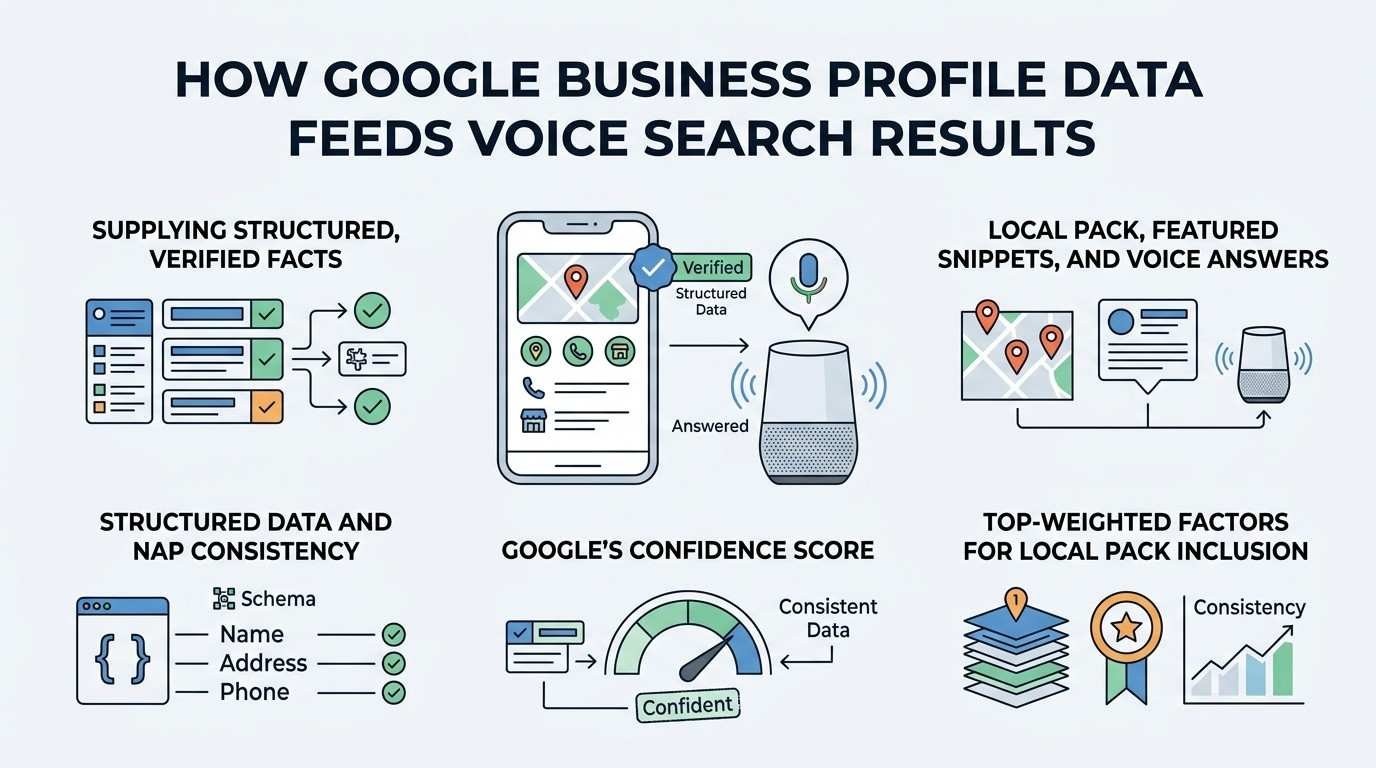
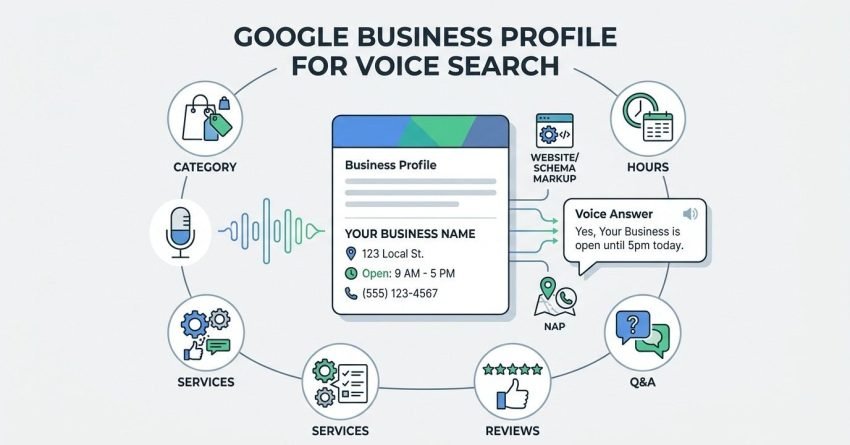
Google Business Profile feeds voice search results by supplying the structured, verified facts that voice assistants read aloud when a local query is detected. The connection between your profile and what comes out of a smart speaker is more direct than most business owners realize.
The local pack, featured snippets, and voice answers are connected through a shared data layer. Google’s local pack (the map and three-listing block) already draws from GBP, and voice search essentially reads the top result from that same pack aloud, often merging it with a featured snippet if one answers a related question.
Structured data and NAP consistency play a central role in voice retrieval because voice assistants need to be confident in a single, unambiguous answer. Name, address, and phone number inconsistency across the web creates doubt in Google’s confidence score, and Moz’s local search ranking factors study confirms that consistency signals remain one of the top-weighted factors for local pack inclusion.
This is why a profile that looks fine to a human can still fail to get chosen for voice answers if the underlying data doesn’t match citations elsewhere.
Core Google Business Profile Elements That Influence Voice Search
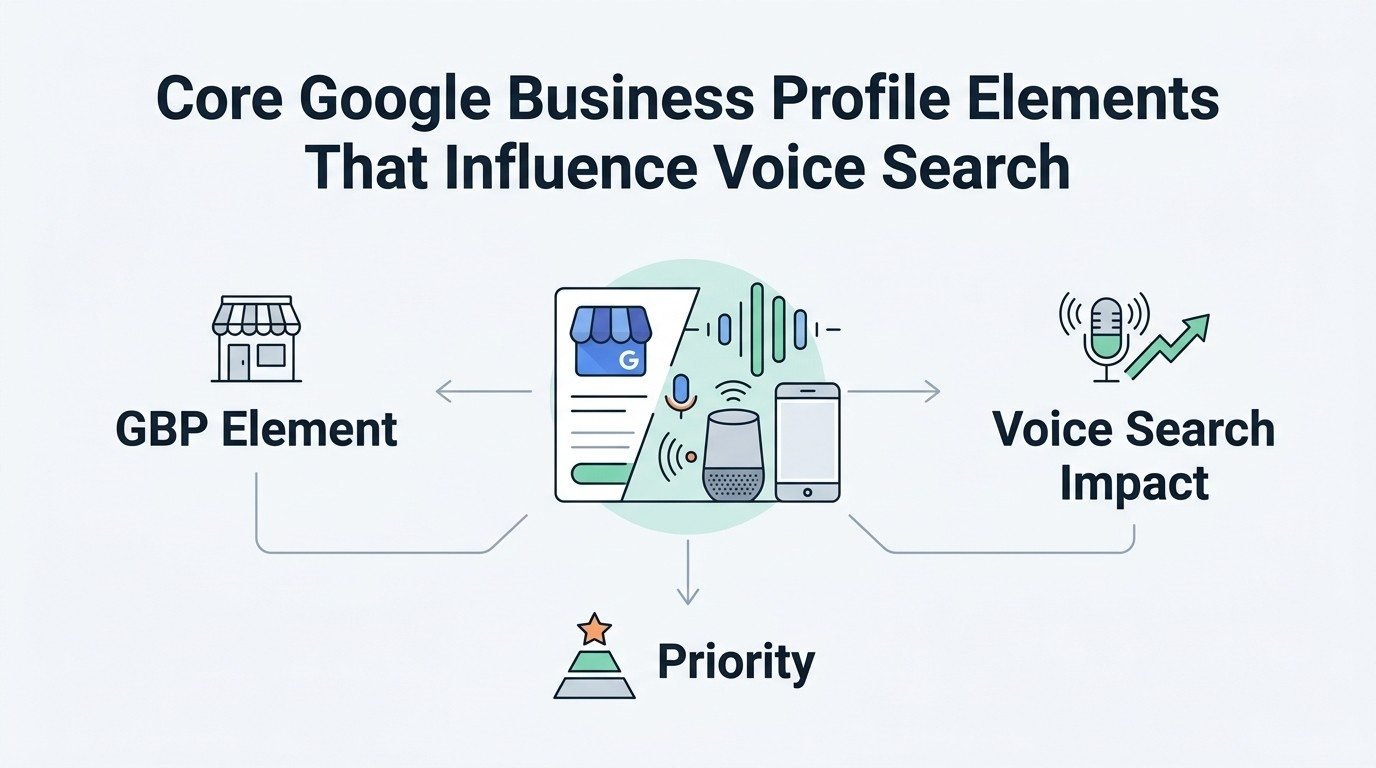
Several specific fields inside your GBP directly shape whether an assistant selects your business for a spoken answer, and each one carries different weight.
Business name, categories, and attributes give Google the semantic signals it needs to match a voice query to your listing. Choosing a precise primary category rather than a broad one increases the odds your business surfaces for specific spoken queries like “24-hour emergency locksmith.”
Hours, location, and service area accuracy determine whether your business gets suggested for time-sensitive and proximity-based voice queries. A wrong holiday hours entry is a common reason a business gets skipped in favor of a less accurate but “safer” competitor listing.
Products, services, and Q&A sections add depth that assistants can pull from for more specific spoken questions. This is where a business gets to preemptively answer the kinds of questions people actually ask out loud.
| GBP Element | Voice Search Impact | Priority |
| Primary category | High — direct query matching | Critical |
| Hours accuracy | High — time-sensitive queries | Critical |
| NAP consistency | High — confidence scoring | Critical |
| Q&A content | Medium — long-tail matching | Important |
| Photos | Low-Medium — engagement signal | Supporting |
Optimizing Your GBP for Conversational and Long-Tail Queries
Optimizing a Google Business Profile for conversational queries means writing profile content the way a person would actually ask a question out loud, rather than in clipped keyword phrases. This is the single biggest shift I coach clients through.
Writing business descriptions in natural language means favoring full sentences that mirror spoken phrasing over keyword-stuffed fragments. “We repair furnaces and install new HVAC systems across the north side” reads and matches better than “HVAC furnace repair install north side.”
Matching Q&A content to real voice search phrasing means anticipating the exact questions someone would ask a smart speaker and answering them directly in the Q&A section. Long-tail voice queries tend to be full questions, so profile content shaped like an answer performs better than content shaped like a label.
The Role of Reviews in Voice Search Optimization
Reviews influence voice search because Google uses review content and sentiment as a trust signal when selecting which business to read aloud for ambiguous queries. A business with strong review volume and specific, descriptive review text tends to outperform a competitor with only star ratings and no context.
How review content influences voice assistant answers comes down to keyword-rich, descriptive language. Reviews that mention specific services, neighborhoods, or outcomes give Google more contextual data to match against spoken queries than generic five-star ratings alone.
Review response strategy for local authority matters too, since active, specific responses signal an engaged, legitimate business. I always recommend responding with real detail rather than a copy-pasted thank-you.
Local Citations, NAP Consistency, and Voice Search Accuracy
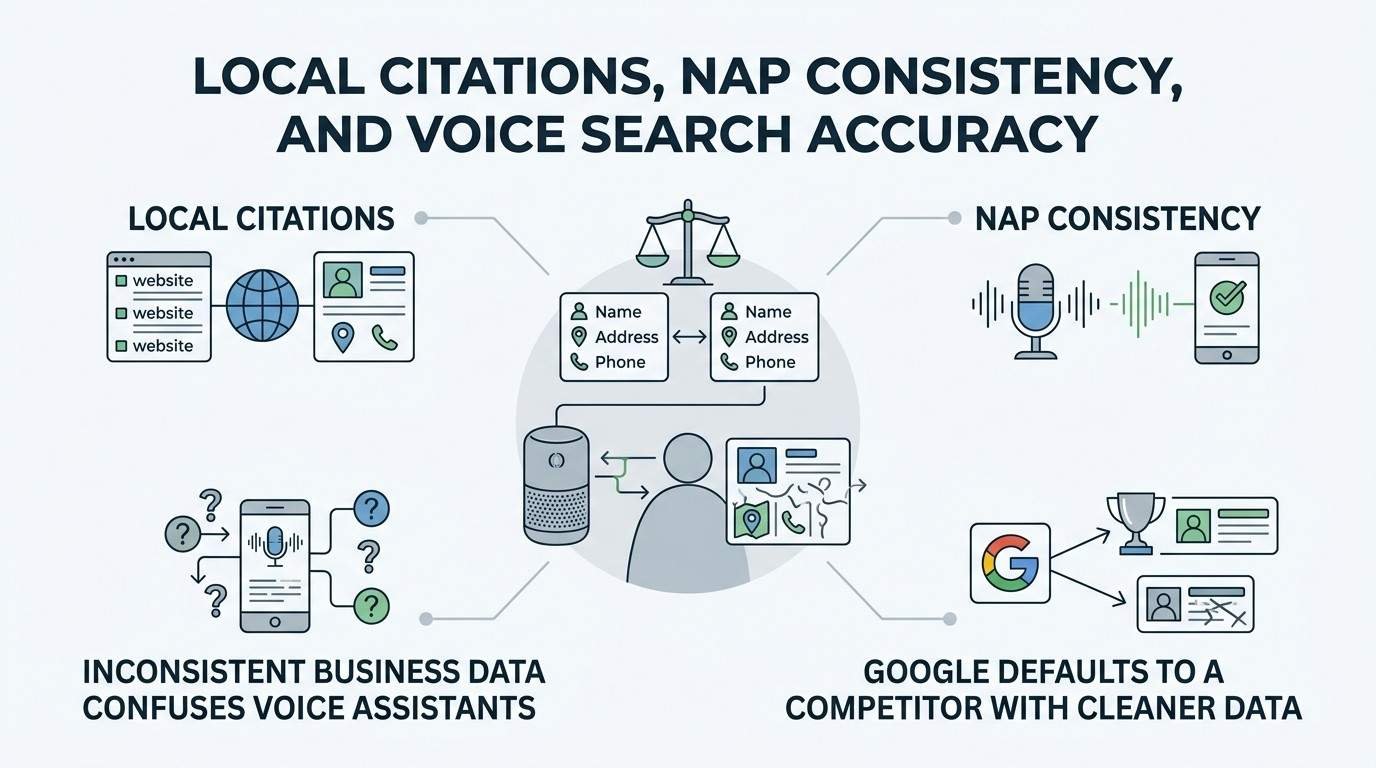
Local citations are mentions of your business name, address, and phone number across other websites and directories, and their consistency directly affects voice search accuracy. Every mismatched citation chips away at Google’s confidence in your listing.
Inconsistent business data confuses voice assistants because the system is trying to resolve a single correct answer from potentially conflicting sources. When your address is formatted three different ways across the web, Google has to guess which one is authoritative, and it often defaults to a competitor with cleaner data instead.
GBP Posts, Photos, and Engagement Signals for Voice Visibility
GBP posts, photos, and engagement metrics act as freshness and relevance signals that indirectly support voice search visibility. They won’t get you read aloud on their own, but they reinforce the profile’s overall authority.
Regularly updated posts and recent, high-quality photos correlate with more active, better-maintained profiles, and Google has consistently rewarded freshness signals across its local ranking systems. Engagement metrics like clicks, calls, and direction requests feed back into how Google evaluates a listing’s real-world relevance.
Technical Factors That Support Voice Search Readiness
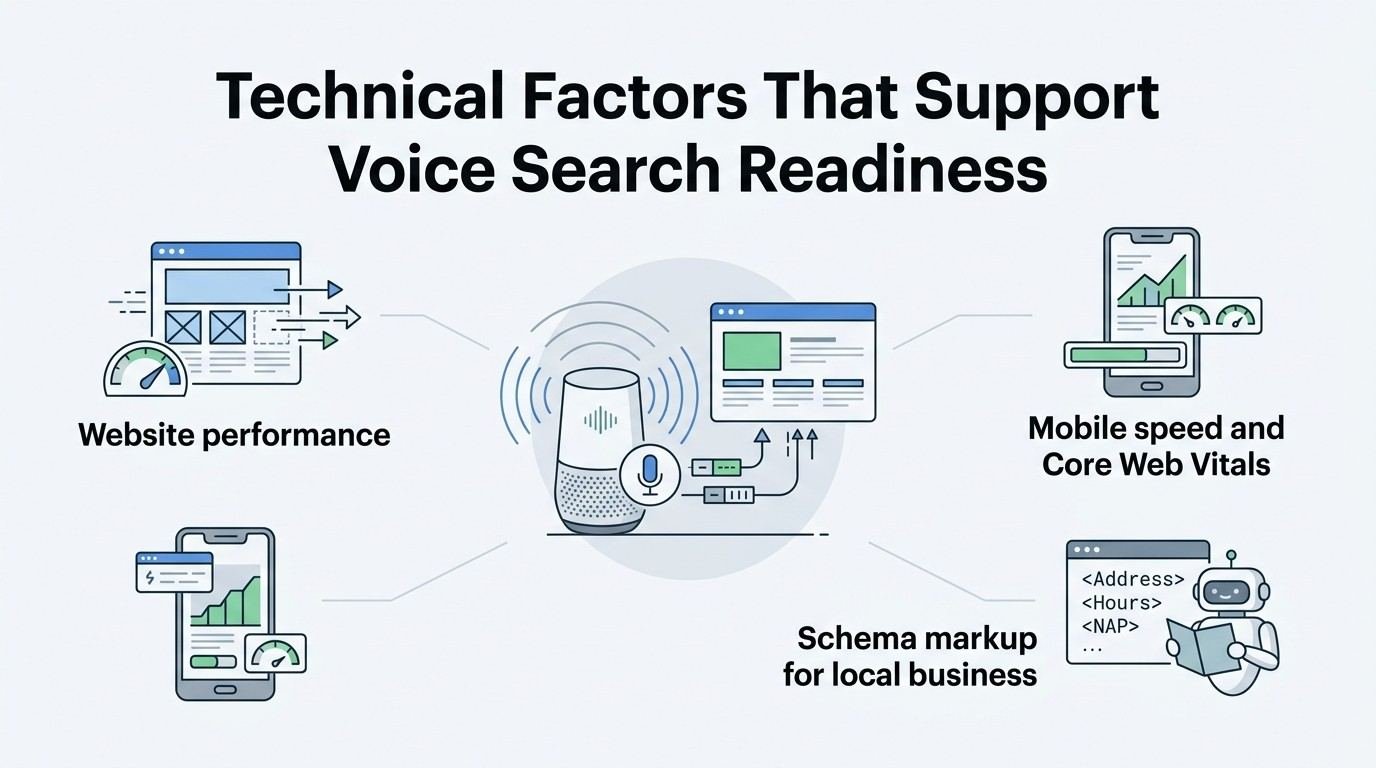
Website performance still matters for voice search because many voice answers reference on-site structured data, not just GBP fields alone. A slow, poorly structured site can undercut an otherwise strong profile.
Mobile speed and Core Web Vitals affect whether Google can confidently pull supplementary information from your website to enrich a voice answer. Google’s own Core Web Vitals documentation ties page experience directly to ranking eligibility across mobile-first indexing, which underpins most voice results.
Schema markup for local business gives search engines explicit, machine-readable confirmation of your NAP, hours, and services, reducing the ambiguity that often causes voice assistants to skip a listing.
How to Measure Voice Search Performance for Your GBP
Measuring voice search performance means tracking indirect signals, since Google doesn’t yet report voice-specific query data directly inside GBP Insights. This makes measurement a bit more detective work than a simple dashboard pull.
Tracking tools and metrics that signal voice visibility gains include GBP Insights direction requests, call volume from the profile, and Google Search Console queries phrased as full questions. A rise in question-style queries appearing in Search Console is often the clearest proxy signal available for growing voice visibility.
Common Google Business Profile Mistakes That Hurt Voice Search Rankings
Outdated hours, inconsistent NAP data across directories, and vague business categories are the three mistakes I see most often undermining voice visibility. Each one on its own can be the deciding factor between a business getting read aloud and getting skipped entirely.
Thin or missing Q&A sections and stale photo libraries round out the list. Both signal a profile that isn’t actively maintained, which pushes Google toward a more current-looking competitor.
Voice Search Optimization Checklist for Local Businesses
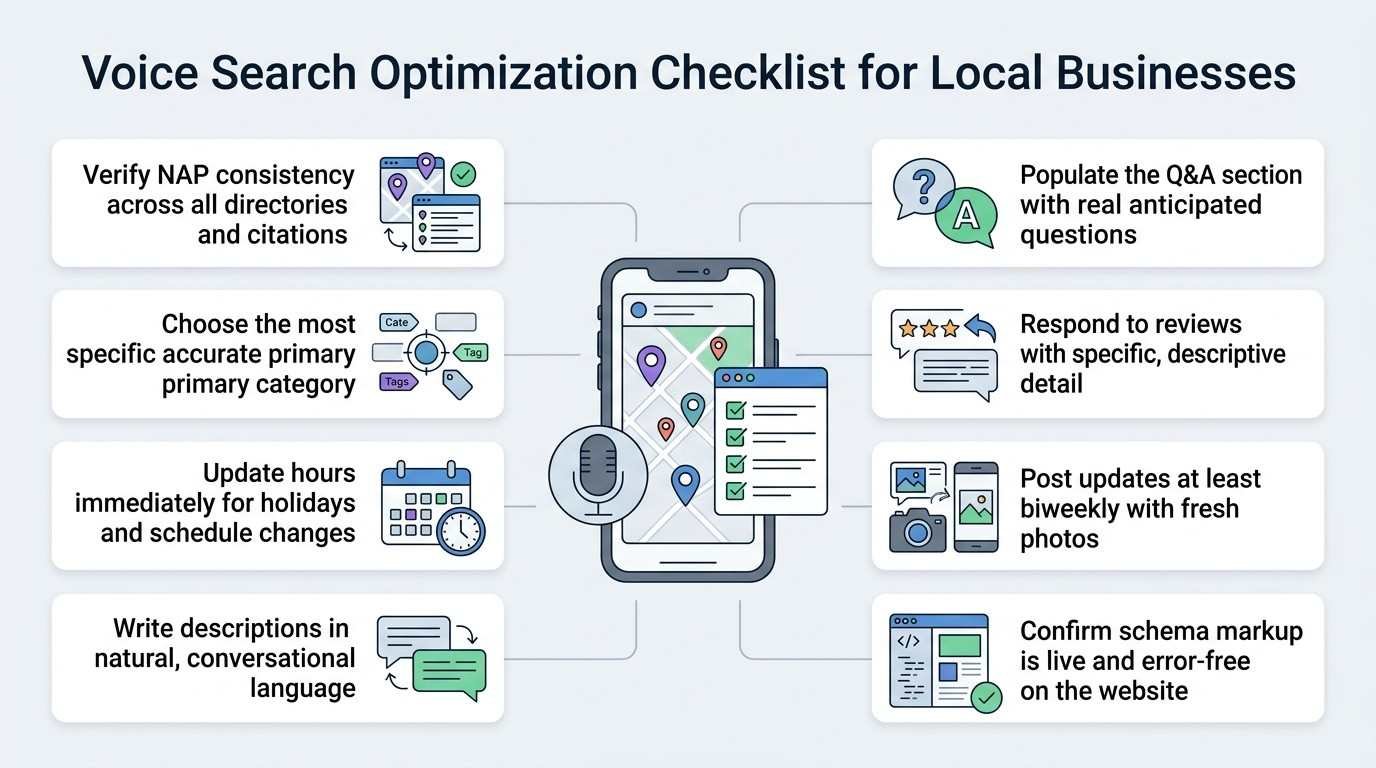
A focused, recurring checklist keeps a profile voice-ready without requiring constant guesswork:
- Verify NAP consistency across all directories and citations
- Choose the most specific, accurate primary category
- Update hours immediately for holidays and schedule changes
- Write descriptions in natural, conversational language
- Populate the Q&A section with real anticipated questions
- Respond to reviews with specific, descriptive detail
- Post updates at least biweekly with fresh photos
- Confirm schema markup is live and error-free on the website
How Voice Search Fits Into a Broader Local SEO Strategy
Voice search optimization isn’t a separate strategy from local SEO, it’s an extension of the same fundamentals applied to a more conversational query format. The businesses that treat it as an add-on rather than a core layer tend to fall behind faster.
Local SEO strategy already prioritizes NAP consistency, review generation, and structured data, all of which double as voice search fundamentals. Getting the foundation right for one strengthens the other automatically.
Conclusion
Voice search rewards businesses with accurate, structured, and consistently verified Google Business Profile data. Reviews, citations, and technical readiness reinforce every spoken answer.
Voice queries will keep growing as smart speakers and assistants become standard. This connects to broader local SEO priorities.
We help businesses build GBP and local SEO strategies that hold up under this shift. Reach out to White Label SEO Service to get started.
Frequently Asked Questions
What is Google Business Profile voice search optimization?
It’s the practice of structuring your GBP data, reviews, and content so voice assistants can confidently select your business for spoken local search answers. It focuses on accuracy, consistency, and conversational content.
How does Google choose which business to read aloud for voice search?
Google selects the business with the strongest combination of accurate NAP data, relevant category match, review quality, and proximity to the searcher. Confidence in the data matters as much as relevance.
Do I need a website to rank in voice search results?
No, a website isn’t strictly required, since GBP data alone can generate a voice answer. A well-optimized website with schema markup does strengthen your chances significantly.
How long does GBP voice search optimization take to show results?
Most businesses see measurable shifts within 60 to 90 days of consistent optimization. Full authority-building, including reviews and citations, often takes three to six months.
Does GBP optimization help with Siri and Alexa searches too?
Yes, both Siri and Alexa pull heavily from mapping and business data sources that overlap with Google’s local index. Strong GBP data improves cross-platform voice visibility.
What GBP attributes matter most for voice search?
Primary category, business hours, NAP consistency, and Q&A content carry the most weight. These fields directly answer the specific questions voice queries ask.
How often should I update my Google Business Profile for voice search?
Weekly to biweekly updates, including posts and photo additions, keep a profile signaling activity. Hours and NAP data should be checked immediately whenever anything changes.