Google Business Profile is a free listing that controls how a business appears across Google Search, Maps, and increasingly, AI-generated search summaries. I’ve watched this single profile become one of the most influential ranking inputs a local business controls, and most owners still treat it as an afterthought. That’s a mistake with real financial consequences.
AI Overviews now pull directly from GBP data to answer local queries before a user even clicks a result. Businesses that ignore this are handing visibility to competitors who didn’t.
This guide covers what a Business Profile actually is and why it matters for AI search, the ranking factors and data signals that drive visibility, the hands-on optimization steps for categories, photos, reviews, and posts, and how to track performance and avoid the mistakes that quietly suppress rankings.
What Is a Google Business Profile?
A Google Business Profile is a free business listing that displays your company’s name, location, hours, reviews, and other key details across Google Search and Google Maps. I think of it as the digital front door most customers walk through before they ever visit a website.
Google rebranded this tool from “Google My Business” in 2021, folding profile management directly into Search and Maps instead of a standalone app. The name changed, but the underlying data structure and ranking mechanics stayed largely intact.
How GBP Differs From Google My Business
Google My Business was the old management dashboard; Google Business Profile is the current, simplified system built into Search itself. I manage most client profiles now by simply searching the business name in Google and editing directly from the knowledge panel that appears.
This shift mattered because it removed a layer of friction. Business owners no longer need a separate app to update hours or respond to a review.
Core Components of a Business Profile
Every profile is built from a consistent set of data fields, and I’ve found that gaps in any one of them quietly cap visibility. Business name, address, and phone number sit at the foundation, alongside categories, attributes, hours, photos, posts, and the review section.
Each field feeds a different part of how Google and AI systems interpret the business. Skipping the description or leaving attributes blank isn’t neutral. It’s a missed signal.
Why Google Business Profile Matters for AI Search
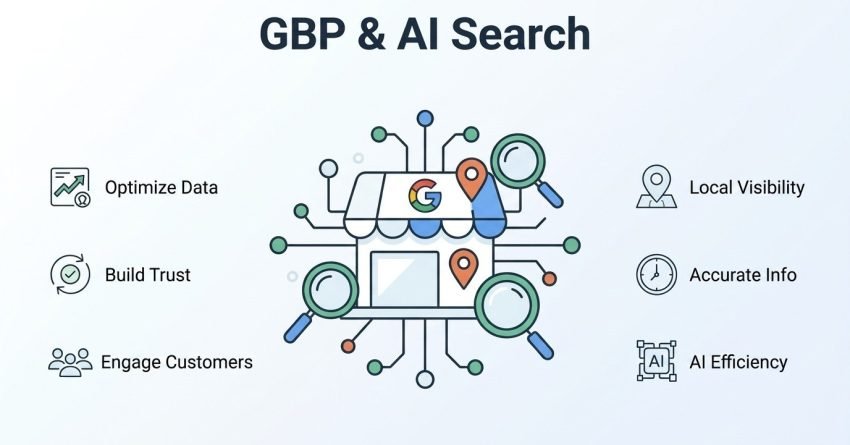
Google Business Profile matters for AI search because Google’s AI Overviews pull local business data directly from GBP to construct answers to location-based queries. I’ve noticed this shift accelerate through 2024 and into 2025, where a well-optimized profile now influences whether a business gets mentioned in an AI-generated summary at all.
Search behavior has changed. People ask AI-driven results direct questions like “best plumber near me open now,” and the answer engine reaches into structured local data, not just web pages, to respond.
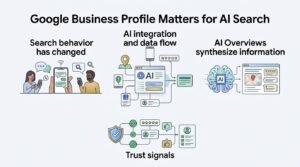
How AI Overviews Pull From Local Business Data
AI Overviews synthesize information from multiple sources, and Business Profile fields, particularly categories, attributes, and reviews, feed that synthesis directly. I see this most clearly when a business’s GBP description matches the exact phrasing an AI Overview later uses in its summary.
This isn’t a coincidence. The overview engine favors structured, unambiguous data over guesswork pulled from a poorly written website.
GBP as a Trust Signal for AI-Driven Answers
Trust signals like review volume, review recency, and response rate appear to weigh heavily in what AI systems surface first. A BrightLocal study found that 98% of consumers read online reviews for local businesses in 2024, reinforcing how central this data has become to any automated summary engine.
I treat review management as inseparable from AI search visibility now. The two used to feel like separate disciplines. They aren’t anymore.
How Google Business Profile Data Feeds AI Search Results
Google Business Profile data feeds AI search results through structured attributes, categorized business information, and review content that language models can parse and cite with confidence. Structured data removes ambiguity, and ambiguity is exactly what AI summarization systems struggle with most.
I’ve audited dozens of profiles where the business type was technically correct but too generic, and that vagueness showed up as a missed citation in AI-generated local answers.
Structured Data vs. GBP Attributes
| Data Type | Where It Lives | Primary Function |
| Schema markup | Website code | Confirms business identity to crawlers |
| GBP categories | Business Profile | Defines business type for local/AI matching |
| GBP attributes | Business Profile | Adds specific qualifiers (wheelchair accessible, free wifi) |
| Reviews | Business Profile | Supplies sentiment and trust signals |
This table shows how each data type plays a distinct role, and I make sure schema markup and GBP categories say the same thing. Contradicting signals between a website and a profile create confusion that neither traditional rankings nor AI systems reward.
The Role of Reviews and Q&A in AI Summaries
Review text often gets pulled into AI-generated answers almost verbatim, especially when a reviewer describes a specific service or outcome clearly. I’ve seen a single well-written five-star review shape how an entire AI Overview characterizes a business’s specialty.
The Q&A section works similarly, and unanswered questions sitting on a profile for months look neglected to both users and ranking systems.
The Connection Between Local SEO and AI Search Visibility
Local SEO and AI search visibility are connected because both rely on the same underlying trust and relevance signals, meaning strong local optimization directly improves AI citation odds. I don’t treat these as separate strategies anymore; they’ve merged into one discipline with two visible outputs.
A business ranking well in the local pack tends to also appear in AI-generated summaries for the same query, because the ranking inputs largely overlap.
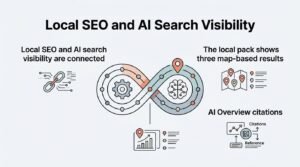
Local Pack Rankings vs. AI Overview Citations
The local pack shows three map-based results ranked by relevance, distance, and prominence. AI Overview citations pull from a wider pool and prioritize clarity, structured detail, and review sentiment over pure proximity.
I’ve watched businesses rank outside the top three in the local pack while still earning an AI Overview mention, because their profile data answered the query’s intent more precisely.
Key Google Business Profile Ranking Factors
Google Business Profile ranking factors include relevance, distance, and prominence, alongside behavioral signals like click-through rate, review velocity, and profile completeness. Google has confirmed these three pillars for years, but the behavioral layer underneath them has grown heavier.
I prioritize completeness first with new clients because an incomplete profile handicaps every other ranking input working against it.
Relevance, Distance, and Prominence Explained
| Factor | What It Measures | How to Influence It |
| Relevance | How well the profile matches the search query | Accurate categories, keyword-rich description |
| Distance | Physical proximity to the searcher | Fixed by location; can’t be manipulated |
| Prominence | How well-known and reputable the business is | Reviews, citations, backlinks, media mentions |
This table breaks down the three pillars Google has publicly confirmed, and I focus my energy on relevance and prominence since distance is fundamentally unchangeable.
Behavioral Signals That Influence Rankings
Click-through rate, direction requests, and call clicks all feed into how Google perceives a profile’s real-world value to searchers. I monitor these weekly for active clients because a sudden drop often signals a listing issue before it shows up anywhere else.
How to Claim and Verify Your Google Business Profile
Claiming and verifying a Google Business Profile requires creating or claiming the listing through Google, then confirming ownership via postcard, phone, email, or instant verification. This step is non-negotiable, since an unverified profile carries far less ranking weight and can even get suspended.
I always check first whether a listing already exists, created automatically by Google or a data aggregator, before starting a new one from scratch.
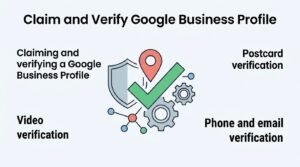
Common Verification Methods
Postcard verification remains the most common method, arriving by mail within five to fourteen days with a unique code. Phone and email verification, when available, can be completed in minutes but aren’t offered to every business category.
Video verification has expanded for service-area businesses without a public storefront, requiring a live walkthrough of proof-of-business documents.
Optimizing Your Business Profile Categories and Attributes
Optimizing Business Profile categories and attributes means selecting the most precise primary category available and layering in relevant secondary categories and attributes that match services offered. I treat category selection as the single highest-leverage field on the entire profile.
Getting this wrong is common. A “general contractor” who primarily does kitchen remodels should likely have that specialty as the primary category, not a broader label.
Primary vs. Secondary Categories
The primary category carries the most ranking weight and should describe the core of what the business does. Secondary categories capture additional services without diluting the primary signal, and I typically add three to five where genuinely relevant.
Writing an Effective Business Description for GBP
An effective Business Profile description clearly states what the business does, who it serves, and what makes it distinct, written in natural language within the 750-character limit. I write these the way I’d explain the business to a new employee on their first day, direct and specific.
Keyword stuffing here backfires. Google’s systems and AI summarization tools both favor natural, readable descriptions over forced repetition of a target phrase.
Google Business Profile Photos and Visual Content Optimization
Photos on a Google Business Profile influence both click-through rate and perceived legitimacy, with profiles featuring high-quality images receiving significantly more engagement than those without. I push every client to upload real photos of their team, location, and completed work rather than stock imagery.
Google’s own guidance and independent local SEO research consistently show that profiles with more photos generate more direction requests and website clicks than sparse ones.
Managing and Responding to Google Reviews
Managing Google reviews effectively means responding to every review, positive or negative, within a reasonable timeframe while maintaining a professional, solution-oriented tone. Review management has become one of the clearest ranking and trust signals a business can control directly.
I schedule review responses weekly at minimum for active clients, since response rate itself appears to factor into local ranking calculations.
Why Review Response Rate Impacts Visibility
A business that responds to reviews signals active management to both users and Google’s ranking systems. I’ve seen profiles improve local pack visibility within weeks of establishing a consistent response habit, independent of any new reviews being added.
Handling Negative Reviews Strategically
A calm, solution-focused response to a negative review often does more for trust than the review itself does damage. I never argue publicly with a reviewer; I acknowledge the concern and move the conversation offline.
Using Google Posts to Stay Active and Relevant
Google Posts are short updates published directly to a Business Profile that appear in search results, functioning similarly to social media posts but with direct ranking relevance. I use these to announce promotions, events, and new services on a near-weekly cadence.
Profiles that post consistently tend to show stronger engagement metrics, and inactive profiles can look abandoned even when the business itself is thriving.
Google Business Profile Q&A Optimization
Optimizing the Q&A section means proactively seeding common customer questions with clear answers rather than waiting for users to ask and leaving gaps unanswered. I add the five to ten questions I know every new customer asks, answered directly by the business itself.
Unanswered public questions sitting for weeks create a poor impression, and competitors have been known to answer questions on a rival’s profile incorrectly.
NAP Consistency and Its Role in Local and AI Search
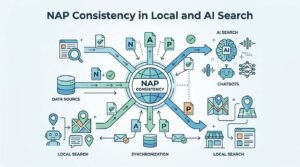
NAP consistency refers to keeping a business’s name, address, and phone number identical across every online directory, website, and citation source. Inconsistent NAP data confuses both traditional local ranking systems and the AI models now synthesizing that same data into search answers.
I run a citation audit early in any engagement because a single mismatched suite number across directories can measurably suppress local visibility.
Tracking Google Business Profile Performance and Insights
Tracking Business Profile performance means regularly reviewing the built-in Insights dashboard for metrics like search queries, customer actions, and photo views. I check this monthly at minimum, comparing trends rather than reacting to single-week fluctuations.
Key Metrics to Monitor Monthly
Search views, map views, website clicks, call clicks, and direction requests form the core metrics worth tracking consistently. I flag any metric dropping more than 20% month-over-month for immediate investigation, since that usually points to a specific, fixable cause.
Common Google Business Profile Mistakes to Avoid
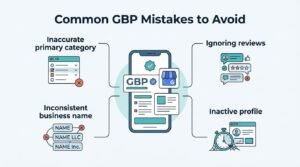
The most common Google Business Profile mistakes include choosing an inaccurate primary category, ignoring reviews, using an inconsistent business name, and letting the profile sit inactive for months. I see these same four errors repeated across nearly every audit I run.
Each mistake is fixable in under an hour, yet the ranking damage can take months to fully recover from once the pattern sets in.
How Google Business Profile Fits Into a Broader SEO Strategy
Google Business Profile functions as one input within a broader SEO strategy that also includes technical SEO, on-page content, and link building working together toward sustainable visibility. I never treat GBP as a standalone tactic; it works best layered into a complete organic growth plan.
A business with a flawless profile but a weak, slow website will still underperform, because local ranking systems and AI summarization increasingly cross-reference both.
Conclusion
Google Business Profile now sits at the center of local rankings and AI-generated search answers, driven by categories, reviews, and consistent data. Mastering it means treating every field as a deliberate signal, not paperwork.
This profile works best as one piece of a larger organic strategy spanning technical SEO, content, and authority building across the web.
We help businesses turn their Google Business Profile into a genuine growth engine. Reach out to White Label SEO Service to build a strategy that compounds.
Frequently Asked Questions
How long does it take to rank a Google Business Profile?
Most profiles see measurable ranking movement within 4 to 12 weeks of consistent optimization. Full competitive results in dense markets can take three to six months.
Does Google Business Profile affect AI Overview results?
Yes, GBP data directly feeds AI Overview answers for local queries. Categories, attributes, and reviews are commonly cited sources.
Is Google Business Profile free to use?
Yes, creating and managing a Google Business Profile costs nothing. Google generates revenue instead through ads and paid features shown alongside listings.
How often should I post updates to my profile?
Weekly posting is a reasonable minimum for maintaining visible activity. More frequent posting during promotions or events tends to increase engagement further.
Can I have more than one Google Business Profile?
Only if a business has genuinely separate physical locations. Duplicate profiles for a single location violate Google’s guidelines and risk suspension.
What happens if my business information is inconsistent online?
Inconsistent NAP data confuses ranking algorithms and can suppress local visibility. It also undermines the accuracy of AI-generated summaries pulling from that data.
Do reviews really impact local search rankings?
Yes, review count, recency, and sentiment are confirmed ranking factors. They also strongly influence whether AI Overviews cite a business favorably.