SEO penalty recovery is the process of diagnosing why a website’s rankings collapsed, then correcting the underlying cause whether a manual action, an algorithmic update, or a technical failure to restore search visibility. I’ve watched this exact scenario play out dozens of times: a client’s traffic falls off a cliff, panic sets in, and nobody on the team knows if Google flagged the site directly or if an algorithm update simply reassessed its quality.
Getting this wrong costs months. Businesses often chase the wrong fix, disavow links that never hurt them, or rewrite content that was never the issue.
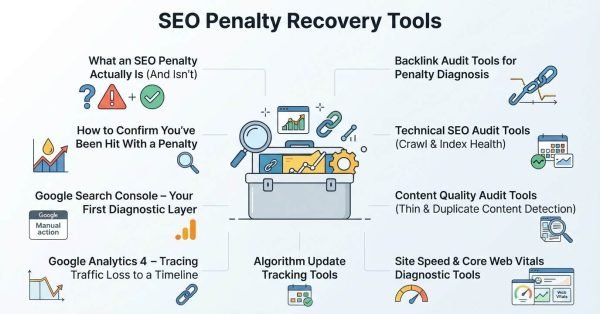
This guide covers how to tell a real penalty apart from a normal ranking fluctuation, the different manual actions and algorithm updates that cause drops, a full diagnostic and recovery process, and what realistic timelines and costs look like. We also cover when a professional recovery team earns its cost.
What Is an SEO Penalty (and What It Isn’t)
An SEO penalty is a deliberate ranking demotion or removal applied by a search engine, either through a manual action from a human reviewer or an algorithmic reassessment, because a site violated webmaster guidelines. Not every drop in rankings is a penalty, and I think this distinction gets lost constantly in client conversations.
A genuine penalty means Google identified something specific: unnatural links, thin content, or spam tactics. A normal ranking fluctuation, on the other hand, might just mean a competitor’s page got better, or a core update reweighted quality signals across the board.
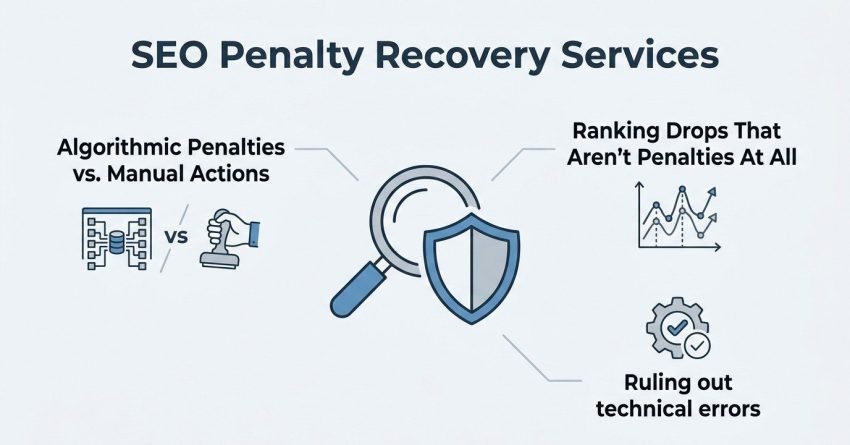
Algorithmic Penalties vs. Manual Actions
Algorithmic penalties happen automatically when a broad update devalues sites that no longer meet quality thresholds, with no direct notice sent to the site owner. Manual actions are different: a human reviewer at Google inspected the site and applied a flag visible directly inside Google Search Console.
I always check Search Console’s Manual Actions report first, because it removes the guesswork immediately. If nothing shows there, the drop is almost certainly algorithmic rather than a manual penalty.
Ranking Drops That Aren’t Penalties At All
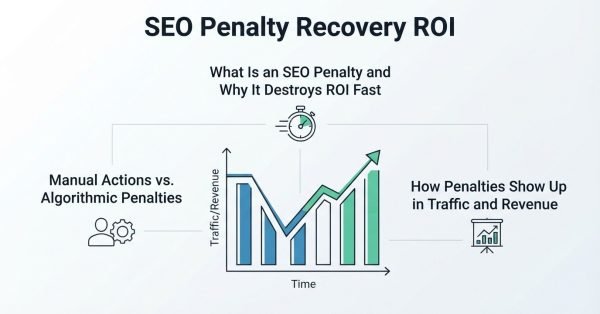
Plenty of ranking drops have nothing to do with penalties. Seasonal demand shifts, a competitor publishing stronger content, a site migration gone wrong, or even incorrect canonical tags can all mimic penalty symptoms without any guideline violation occurring.
I’ve had clients convinced they were penalized when the real cause was a broken robots.txt file blocking crawlers after a site redesign. Ruling out technical errors always comes before assuming Google took punitive action.
How to Tell If You’ve Been Hit by a Google Penalty
You can confirm a Google penalty by checking the Manual Actions report in Google Search Console, which explicitly states whether a manual action exists and names the violation type. If that report is clean, the drop likely stems from an algorithmic update or a technical problem rather than a targeted penalty.
I walk through a consistent pattern-matching process with every client who suspects a penalty, because the shape of the drop tells its own story.
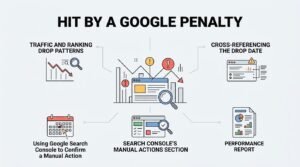
Traffic and Ranking Drop Patterns
A sudden, sharp overnight drop across most keywords usually points to a manual action or a major algorithm rollout. A gradual decline over weeks often signals eroding content quality or a slow technical issue compounding over time.
Cross-referencing the drop date against Google’s documented algorithm update history tells me almost immediately whether timing aligns with a known rollout. If the dates match a broad core update, I treat it as algorithmic first and investigate manual causes second.
Using Google Search Console to Confirm a Manual Action
Search Console’s Manual Actions section lists the exact violation Google applied, along with example URLs affected by the issue. This report is the single most reliable diagnostic source because it comes directly from Google rather than inferred from ranking behavior.
I also cross-check the Performance report, comparing impressions and average position before and after the suspected penalty date. A collapse in impressions alongside a position drop confirms visibility loss at the index level, not just a click-through problem.
Types of Manual Actions Google Issues
A manual action is a specific penalty applied by a Google reviewer after identifying a guideline violation, and Google categorizes these into distinct types listed directly inside Search Console. Knowing which type applies changes the entire recovery approach.
| Manual Action Type | Common Cause | Typical Fix |
| Unnatural links to your site | Paid or manipulative backlinks | Disavow + removal outreach |
| Unnatural links from your site | Selling links without nofollow | Remove or nofollow outbound links |
| Thin content with little value | Auto-generated or scraped pages | Content consolidation or removal |
| Pure spam | Aggressive spam tactics, cloaking | Full site remediation |
| User-generated spam | Spammy comments or forum posts | Moderation and cleanup |
Unnatural Links (Incoming and Outgoing)
Unnatural links penalties target link schemes designed to manipulate PageRank rather than earn it editorially. This includes purchased links, excessive link exchanges, and automated link-building programs that Google’s link spam systems can detect at scale.
I treat every unnatural links penalty as a full backlink audit trigger, since Google rarely flags just one or two links in isolation.
Thin Content and Pure Spam Actions
Thin content penalties apply to pages offering little original value, often auto-generated, doorway pages, or scraped duplicates. Pure spam actions are more severe and typically indicate aggressive, large-scale manipulation like cloaking or automatically generated gibberish content.
Recovering from a pure spam action usually demands near-complete site remediation rather than a page-by-page fix.
Structured Data and Cloaking Violations
Structured data penalties occur when markup misrepresents page content to manipulate rich results, like faking review star ratings that don’t reflect real user reviews. Cloaking violations happen when a site shows different content to search engines than to actual visitors.
Both violation types are treated seriously because they directly attempt to deceive the ranking system itself.
Major Algorithmic Updates That Cause Ranking Loss

An algorithmic ranking drop happens when a broad Google update reassesses site quality signals at scale, without any manual reviewer ever touching the specific site. These updates roll out periodically and reshuffle rankings across entire industries at once.
| Update Type | Primary Focus | Recovery Difficulty |
| Core Updates | Overall content relevance and quality | Moderate to high |
| Helpful Content Update | Content written for search engines vs. people | High |
| Spam Updates | Auto-generated and manipulative content | Moderate |
| Link Spam Updates | Manipulative link networks | Moderate |
| Product Review Updates | Thin, non-expert review content | Moderate |
Core Updates and Broad Relevance Shifts
Google’s core updates reassess how content relevance, expertise, and overall quality get weighted across the entire index, rather than targeting a specific violation. Sites affected by a core update didn’t necessarily do anything wrong; Google’s model of “quality” simply shifted underneath them.
Recovery from a core update hit requires genuinely improving content depth and expertise, not just reverting a technical mistake.
Helpful Content and Spam Updates
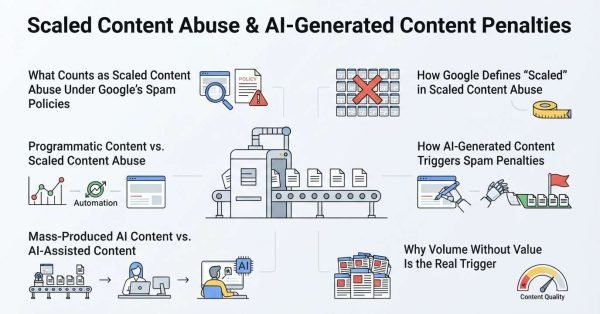
The helpful content system specifically targets content created primarily to rank in search rather than to serve a genuine reader need. Spam updates target scaled content abuse, including AI-generated content published at volume with minimal human oversight.
I’ve seen sites lose 60-80% of organic traffic overnight from these updates when content was built around search volume rather than genuine reader value.
Link Spam and Product Review Updates
Link spam updates devalue manipulative link schemes at the algorithmic level, working alongside manual unnatural link actions. Product review updates specifically penalize thin affiliate content lacking first-hand testing or genuine expertise.
Both updates reward original research, testing evidence, and demonstrable first-hand experience over aggregated or reworded content.
Diagnosing the Root Cause of a Ranking Drop
Diagnosing a ranking drop requires cross-referencing the exact drop date against known algorithm update timelines, checking Search Console for manual actions, and auditing recent site changes in that order. Skipping this sequence leads to fixing problems that were never the actual cause.
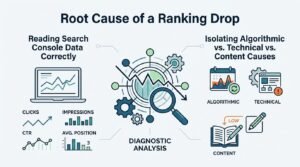
Reading Search Console Data Correctly
Search Console’s Performance report shows impressions, clicks, and average position trends over time, and a genuine penalty typically shows impressions collapsing alongside position loss. If clicks dropped but impressions stayed flat, that points toward a CTR problem rather than a ranking penalty.
I export this data into a spreadsheet and overlay it against the documented update timeline to spot exact correlation.
Isolating Algorithmic vs. Technical vs. Content Causes
A structured diagnostic process rules out causes in this order:
- Check Search Console Manual Actions report for explicit flags
- Compare the drop date against documented algorithm rollout dates
- Audit recent technical changes: redirects, robots.txt, canonical tags
- Review recent content changes or removals
- Audit backlink profile growth for suspicious spikes
- Check server logs for crawl anomalies or indexing drops
- Confirm the drop isn’t isolated to seasonal or competitive shifts
This sequence prevents wasted effort chasing link cleanup when the real issue was a broken canonical tag.
The SEO Penalty Recovery Process, Step by Step
SEO penalty recovery follows a structured sequence: diagnose the exact cause, remediate the violation directly, document the changes, then request reconsideration or wait for algorithmic reassessment. Rushing any step in this order typically extends recovery time rather than shortening it.
- Confirm penalty type through Search Console and timeline analysis
- Audit the full backlink profile for toxic or manipulative links
- Remediate flagged content, links, or technical issues directly
- Document every remediation action taken with evidence
- Submit a reconsideration request if a manual action applies
- Monitor rankings and impressions for recovery signals
- Reinforce with ongoing quality improvements to prevent recurrence
Auditing the Backlink Profile
A backlink audit involves exporting the full link profile from Search Console and a third-party tool, then flagging links with spam signals like irrelevant anchor text, low-quality domains, or clear paid-link patterns. This step alone often takes longer than every other recovery step combined.
I categorize every flagged link into “definitely toxic,” “borderline,” and “safe,” since disavowing too aggressively can remove links that were actually helping.
Content Quality and E-E-A-T Remediation
Content remediation means rewriting, consolidating, or removing pages that lack genuine expertise, experience, authoritativeness, or trustworthiness signals. This often includes adding author credentials, citing original research, and removing thin or duplicate pages entirely.
Google’s quality rater guidelines describe E-E-A-T as central to how raters judge page quality, and I treat this as the backbone of any content-related recovery.
Technical Cleanup and Reindexing
Technical cleanup addresses crawl errors, broken redirects, incorrect canonical tags, and any cloaking or structured data violations flagged during diagnosis. Once fixed, submitting affected URLs through Search Console’s URL Inspection tool speeds up reindexing.
I always verify the fix rendered correctly using the “Test Live URL” feature before requesting reindexing, since resubmitting a broken fix wastes another crawl cycle.
Disavowing Toxic Links Correctly
A disavow file tells Google to ignore specific backlinks when evaluating a site, and it should only be used after confirming those links caused genuine harm through a manual action or clear spam pattern. Overusing the disavow tool on borderline links can remove link equity that was never a problem.
When a Disavow File Is Actually Necessary
A disavow file is genuinely necessary when Search Console shows an unnatural links manual action, or when a backlink audit reveals a clear negative SEO attack using spam link networks. It is rarely necessary for algorithmic ranking drops alone, since Google’s algorithms already devalue most spam links automatically without manual disavowal.
I reserve disavow files for confirmed manual actions or documented negative SEO campaigns rather than applying them preemptively.
Submitting a Reconsideration Request
A reconsideration request is a formal report submitted through Google Search Console asking a human reviewer to re-evaluate a site after a manual action has been remediated. Google only responds to reconsideration requests tied to an actual manual action; there’s no reconsideration process for algorithmic ranking drops.
What Google Expects in a Reconsideration Report
A strong reconsideration report documents exactly what violation existed, what specific actions were taken to fix it, and evidence proving the fix, such as before-and-after link disavow files or content change logs. Vague reports claiming “we fixed everything” without specifics get rejected far more often than detailed, evidence-backed submissions.
I include screenshots, dated changelogs, and disavow file exports directly in every report I help prepare, since specificity speeds up reviewer approval.
How Long Does SEO Penalty Recovery Take
SEO penalty recovery typically takes anywhere from four to twelve weeks for manual action reversals, while algorithmic recovery can take several months since it depends on the next major update refresh. Manual action recovery moves faster because a human reviewer directly re-evaluates the site once a reconsideration request is submitted.
Algorithmic recovery has no fixed timeline because rankings only recalculate meaningfully when Google reprocesses signals during a future update cycle, which might be weeks or months away.
Negative SEO Attacks and How They Differ From Self-Inflicted Penalties
A negative SEO attack is a deliberate attempt by a third party, often a competitor, to damage a site’s rankings using spam links, scraped content duplication, or fake negative reviews. This differs fundamentally from a self-inflicted penalty because the site owner never took the harmful action themselves.
Distinguishing between the two matters because the remediation strategy shifts: a negative SEO attack calls for disavow files and documentation proving the links weren’t self-built, while a self-inflicted penalty calls for direct content or link removal.
Preventing Future Penalties Through Sustainable SEO
Preventing future SEO penalties means building link profiles and content strategies that comply with search engine guidelines by default, rather than relying on shortcuts that require future cleanup. Sustainable practices cost more upfront but eliminate the recovery cycle entirely.
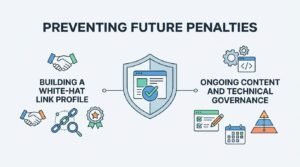
Building a White-Hat Link Profile
A white-hat link profile grows through genuine outreach, digital PR, and content worth linking to naturally, rather than paid placements or automated link networks. I track link velocity and source diversity monthly to catch any unnatural spike before it becomes a pattern Google’s systems flag.
Ongoing Content and Technical Governance
Content governance means regularly auditing published pages for outdated information, thin sections, and declining E-E-A-T signals before a helpful content update catches them. Technical governance means routine crawl audits, log file reviews, and canonical tag checks on a recurring schedule rather than only after a drop occurs.
Recovery Costs and What Influences Them
SEO penalty recovery costs vary widely based on site size and violation severity, typically ranging from a few thousand dollars for a small manual action fix to tens of thousands for large-scale link removal and content remediation. The biggest cost driver is usually the backlink audit and removal outreach phase, since contacting webmasters to remove toxic links takes significant manual effort.
Content remediation costs scale with how many pages need rewriting or removal, while technical cleanup costs depend on how deeply the issue is embedded in the site’s architecture.
When to Bring in a Professional Recovery Team
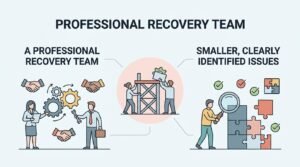
A professional recovery team becomes worth the investment when the penalty involves a large-scale manual action, a complex negative SEO attack, or when in-house diagnosis has failed to identify the root cause after multiple attempts. Smaller, clearly identified issues like a single thin content page can often be fixed internally without specialized help.
I’ve seen businesses lose months attempting DIY recovery on penalties that a specialized team would have diagnosed correctly within days, simply due to pattern recognition built from handling dozens of similar cases.
Conclusion
Diagnosing ranking loss means separating manual actions, algorithmic shifts, and technical errors before touching a single fix. Recovery success depends on precise diagnosis, disciplined remediation, and honest timelines rather than shortcuts.
We built our recovery process around exactly this discipline. If your rankings dropped and you need clarity fast, White Label SEO Service is ready to diagnose the real cause and rebuild your visibility.
Frequently Asked Questions
How do I know if my ranking drop is a penalty or just a normal fluctuation?
Check Google Search Console’s Manual Actions report first. If it’s clean, compare your drop date against known algorithm update timelines before assuming any penalty occurred.
Can I recover from a Google penalty without professional help?
Yes, smaller and clearly identified issues, like a single thin content page, are often fixable in-house using Search Console diagnostics and direct remediation.
Does disavowing links guarantee recovery from a penalty?
No, disavowing links only helps when unnatural links caused the specific manual action. Algorithmic drops rarely improve from disavow files alone.
What’s the difference between a manual action and an algorithmic penalty?
A manual action is applied directly by a Google reviewer and shows explicitly in Search Console. An algorithmic penalty happens automatically during a broad update with no direct notification.
How often does Google review reconsideration requests?
Google doesn’t publish a fixed review schedule, but most manual action reconsideration requests receive a response within several weeks of submission.
Will my rankings fully recover once a penalty is lifted?
Rankings often improve significantly after remediation, though full recovery to prior positions depends on competitive changes that occurred during the penalty period.
Can a competitor cause my site to get penalized?
Yes, through negative SEO attacks like spam link networks or scraped content, though Google’s spam systems are designed to detect and discount most manipulative attempts automatically.