A Google penalty recovery service is a specialized engagement that diagnoses why a site lost rankings or received a manual action, then executes the technical and outreach work needed to reverse it. I’ve watched businesses lose 60-90% of their organic traffic overnight after an algorithmic update, and the panic that follows almost always leads to the same question: what does fixing this actually cost, and what am I paying for?
That panic is expensive. Every week spent guessing costs revenue, and the wrong recovery approach can extend the damage instead of fixing it.
This guide breaks down what these engagements typically include, how pricing tiers scale with penalty severity and site complexity, what separates entry-level packages from enterprise retainers, and where recovery work ends and ongoing SEO begins. We’ll also cover how to evaluate a provider’s pricing so you’re not overpaying for guesswork.
What a Penalty Recovery Service Actually Does
A penalty recovery service diagnoses the specific cause of a ranking drop or manual action, then builds and executes a remediation plan to reverse it. This isn’t a generic SEO audit; it’s forensic work aimed at one outcome: identifying what triggered Google’s action and proving to Google (or to the algorithm) that the issue has been resolved.
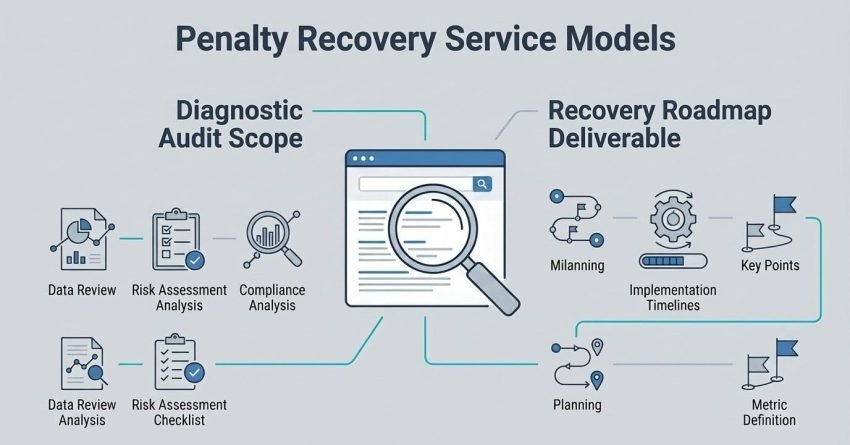
The diagnostic phase usually involves pulling backlink profiles, crawling historical content changes, and cross-referencing traffic drop dates against Google’s confirmed algorithm update timeline. Most providers deliver a recovery roadmap that outlines the suspected cause, the evidence supporting it, and the specific steps planned to address it before any outreach or disavow work begins.
Diagnostic Audit Scope
The diagnostic audit typically covers backlink toxicity analysis, content quality review against Google’s helpful content guidelines, and technical crawl health. This scope stays consistent across most pricing tiers; what changes between tiers is depth and speed, not whether the audit happens at all.
Recovery Roadmap Deliverable
Every legitimate engagement produces a written roadmap document before execution starts. This document names the suspected penalty trigger, lists remediation steps in sequence, and sets a realistic timeline for reassessment.
Types of Google Penalties This Service Model Addresses
Penalty recovery services generally address two distinct categories: manual actions issued directly by Google’s search quality team, and algorithmic penalties triggered automatically by ranking systems like the helpful content system. The recovery approach differs significantly depending on which type a site is dealing with.
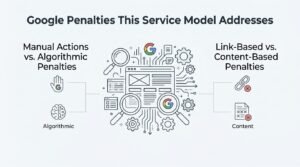
Manual actions appear directly in Google Search Console’s Manual Actions report and require a formal reconsideration request once fixed. Algorithmic penalties show up only as unexplained traffic drops correlated with known update dates, and recovery depends on broad content or link profile improvements rather than a single submitted request.
Manual Actions vs. Algorithmic Penalties
A manual action is a penalty applied by a human reviewer at Google after detecting a violation of webmaster guidelines on a specific site. Algorithmic penalties, by contrast, are automatic ranking suppressions triggered by systems like the helpful content update without any human review involved.
Link-Based vs. Content-Based Penalties
Link-based penalties stem from unnatural or manipulative backlink patterns, while content-based penalties trace back to thin, duplicated, or low-value pages. Most service providers scope their pricing around which category or combination applies to a given site.
Core Deliverables Included in Penalty Recovery Engagements
Core deliverables across nearly every penalty recovery engagement include a backlink audit, a disavow file, and reconsideration request documentation when a manual action is involved. These three components form the baseline scope that separates a real recovery engagement from a repackaged SEO audit.
Ahrefs’ backlink analysis of penalized domains commonly shows spam score concentrations well above healthy site averages, which is why link auditing sits at the center of almost every recovery scope regardless of pricing tier.
Backlink Audit & Toxic Link Identification
A backlink audit involves pulling the complete link profile and scoring each referring domain against spam signals like link farms, PBNs, and irrelevant anchor text patterns. This step produces the raw data that everything else in the engagement depends on.
Disavow File Preparation
Disavow file preparation means compiling the confirmed toxic domains into the exact format Google’s Disavow Links tool requires before submission. Getting this file wrong disavowing too broadly or too narrowly is one of the more common reasons recovery attempts stall.
Reconsideration Request Documentation
Reconsideration request documentation is the written submission explaining what caused the manual action, what was done to fix it, and evidence supporting the cleanup. Google’s search quality team reviews this document manually, so vague or unsupported submissions tend to get rejected on the first pass.
Common Pricing Models for Penalty Recovery Services
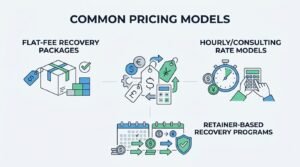
Penalty recovery services are typically priced through three models: flat-fee packages, hourly consulting rates, and ongoing retainers. Each model fits a different penalty scope, and picking the wrong one often means paying for capacity you don’t need or getting less depth than the situation requires.
Flat-fee models suit well-defined manual actions with a clear scope. Hourly models suit ambiguous situations where the cause isn’t confirmed yet. Retainer models suit sites with recurring or severe algorithmic damage requiring sustained content and link profile rebuilding over several months.
Flat-Fee Recovery Packages
A flat-fee recovery package is a fixed-price engagement scoped around a specific, diagnosed manual action with a defined start and end point. This model works best when the penalty cause is already confirmed, and the remediation path is predictable.
Hourly/Consulting Rate Models
Hourly consulting models charge for diagnostic and remediation time without a fixed total, which suits situations where the penalty cause isn’t yet confirmed. This model shifts more risk onto the client but avoids overpaying for a scope that turns out smaller than expected.
Retainer-Based Recovery Programs
Retainer-based programs bill monthly for ongoing recovery work, typically covering algorithmic penalties that require sustained content rebuilding rather than a one-time fix. Sites recovering from helpful content system demotions usually need this model since the recovery timeline stretches across multiple algorithm refresh cycles.
Entry-Tier Recovery Packages: Scope & Price Range
Entry-tier recovery packages generally cover a single confirmed manual action with a straightforward link cleanup and reconsideration request, priced lower because the diagnostic work is minimal. These packages work when the cause is already known and documented in Search Console.
I’ve seen entry-tier scopes work well for smaller sites with a contained, obvious spam link issue rather than a sprawling algorithmic problem.
Best Fit Business Profile
Entry-tier packages fit small sites with a single, clearly identified manual action and a limited backlink profile under a few hundred referring domains. Anything more complex tends to outgrow this tier’s scope quickly.
Mid-Tier Recovery Packages: Scope & Price Range
Mid-tier recovery packages expand the scope to include both link cleanup and content quality remediation, addressing sites with either an ambiguous algorithmic issue or a manual action combined with thin content problems. This tier typically runs over a longer engagement window than entry packages.
Best Fit Business Profile
Mid-tier packages suit growing sites with moderate content volume and a link profile complex enough to require deeper triage before a disavow file can be finalized.
Enterprise-Tier Recovery Packages: Scope & Price Range
Enterprise-tier recovery packages cover large sites with thousands of pages, extensive historical link profiles, and often multiple overlapping penalty causes requiring parallel workstreams. Pricing at this tier reflects the sheer diagnostic volume involved, not just the remediation complexity.
Best Fit Business Profile
Enterprise-tier packages fit organizations with large content libraries, multi-year link histories, or e-commerce catalogs where a single algorithmic update can affect tens of thousands of indexed pages at once.
How Penalty Severity Affects Pricing Tier Selection
Penalty severity is measured by traffic drop magnitude, the number of affected pages, and whether the issue is a single manual action or a compounding algorithmic demotion, all of which push pricing tier selection up or down. A 20% traffic dip from one flagged page looks nothing like a 70% collapse across an entire subdomain.
A Search Engine Journal analysis of major helpful content update impacts found some sites lost over 70% of organic traffic in a single update cycle, which is the kind of severity that pushes a case straight into enterprise-tier scope regardless of site size.
Site Size & Link Profile Complexity Factors
Site size and link profile complexity directly determine diagnostic time, since auditing ten thousand backlinks takes meaningfully longer than auditing three hundred. Providers price around this diagnostic load first, then layer remediation costs on top.
Timeline Expectations Across Service Tiers
Timeline expectations for penalty recovery range from a few weeks for a straightforward manual action to several months for algorithmic demotions tied to broad content quality issues. Manual actions resolve faster because there’s a defined submission-and-review cycle; algorithmic penalties don’t have that same clear endpoint.
Manual Action Review Turnaround
Google’s manual action review process typically takes a few weeks after a reconsideration request is submitted, though Google’s own documentation notes review times vary by case volume and complexity.
What’s Typically Excluded from Pricing Tiers
Most penalty recovery pricing tiers exclude ongoing content production, new link building, and general technical SEO maintenance once the specific penalty has been resolved. Recovery pricing covers fixing what’s broken, not building what comes next.
Ongoing SEO vs. One-Time Recovery Scope
Ongoing SEO involves continuous content and authority building over time, while recovery scope is bounded by the specific penalty and ends once rankings stabilize or reconsideration is granted. Confusing these two scopes is one of the most common billing disputes in this space.
How to Evaluate a Penalty Recovery Provider’s Pricing
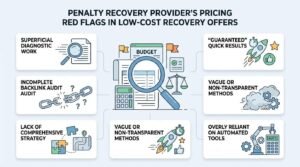
Evaluating a provider’s pricing means checking whether the quoted scope matches the diagnosed penalty type, whether reporting and documentation are included, and whether the price seems disconnected from any actual diagnostic work. A quote that skips the diagnostic phase entirely is a scope built on guesswork.
Red Flags in Low-Cost Recovery Offers
Low-cost recovery offers that promise guaranteed reinstatement or skip the backlink audit entirely are a red flag, since no provider can guarantee Google’s decision and no legitimate recovery skips diagnosis. Price alone doesn’t indicate quality, but a price with no diagnostic line item usually does.
Reporting & Post-Recovery Monitoring Deliverables
Reporting deliverables after a recovery engagement typically include before-and-after traffic comparisons, a record of the submitted reconsideration request outcome, and a monitoring period to confirm rankings stabilize. Recovery isn’t confirmed until rankings hold steady across at least one full reporting cycle.
Ranking Restoration Tracking
Ranking restoration tracking involves monitoring keyword positions and organic traffic in Google Search Console’s Performance report for several weeks after resolution to confirm the recovery held.
When Recovery Ends and Ongoing SEO Begins
Recovery work ends once rankings stabilize and the specific penalty cause has been resolved and confirmed; everything after that point content expansion, new link acquisition, ongoing technical maintenance falls under general SEO rather than recovery scope.
Penalty Recovery vs. General SEO Audits: Key Differences
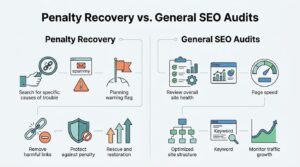
A penalty recovery engagement is diagnostic and remediation-focused around a specific traffic loss event, while a general SEO audit reviews overall site health without assuming any penalty has occurred. I get asked constantly whether these are the same service, and they’re not: an audit looks for opportunities; recovery work looks for a specific cause.
We find that businesses sometimes commission a general audit when what they actually need is penalty diagnosis, which wastes both budget and time during an active traffic crisis.
Budgeting for Penalty Recovery as Part of an SEO Investment
Budgeting for penalty recovery means treating it as an unplanned but often necessary line item within a broader SEO investment, since the cost of inaction and continued ranking suppression usually exceeds the recovery fee itself. We think of recovery spend as protecting the SEO investment already made, not as a separate expense.
I’ve seen businesses delay recovery to save money short-term, only to lose months of compounding organic traffic that costs far more than the service would have.
Conclusion
Penalty recovery pricing scales with severity, site size, and penalty type, spanning flat-fee packages to enterprise retainers. Deliverables consistently include audits, disavow files, and reconsideration documentation.
Recovery is one phase within a larger SEO lifecycle, resolving the immediate crisis while ongoing strategy protects future visibility across algorithm cycles.
We help businesses diagnose penalties accurately and price recovery correctly. Reach out to White Label SEO Service to get a clear, honest recovery scope today.
Frequently Asked Questions
What does a penalty recovery service typically cost?
Costs vary widely based on penalty severity and site size, ranging from smaller flat fees for a single manual action to substantially higher retainers for enterprise sites. The exact price depends on diagnostic complexity and remediation scope.
How long does Google penalty recovery take?
Manual action recovery often takes a few weeks after submitting a reconsideration request. Algorithmic penalty recovery typically takes several months since it depends on broader content and authority rebuilding.
What’s included in a backlink disavow deliverable?
A disavow deliverable includes the completed list of toxic referring domains formatted for Google’s Disavow Links tool. It also includes the audit data supporting why each domain was flagged.
Can I recover from a penalty without hiring a service?
Yes, recovery is possible without a service if you can accurately diagnose the cause and execute the cleanup yourself. Most businesses hire help because diagnosis requires specialized tools and experience.
What’s the difference between a manual action and an algorithmic penalty?
A manual action is a human-reviewed penalty visible in Search Console requiring a reconsideration request. An algorithmic penalty is an automatic ranking suppression with no formal review process.
How do I know which pricing tier I need?
The Pricing tier depends on site size, link profile complexity, and whether one or multiple penalty types are involved. A diagnostic audit typically determines the right tier before a final quote is given.
Do penalty recovery services guarantee reinstatement?
No legitimate service can guarantee reinstatement since Google makes the final decision. Providers can only guarantee the diagnostic and remediation work performed on their end.