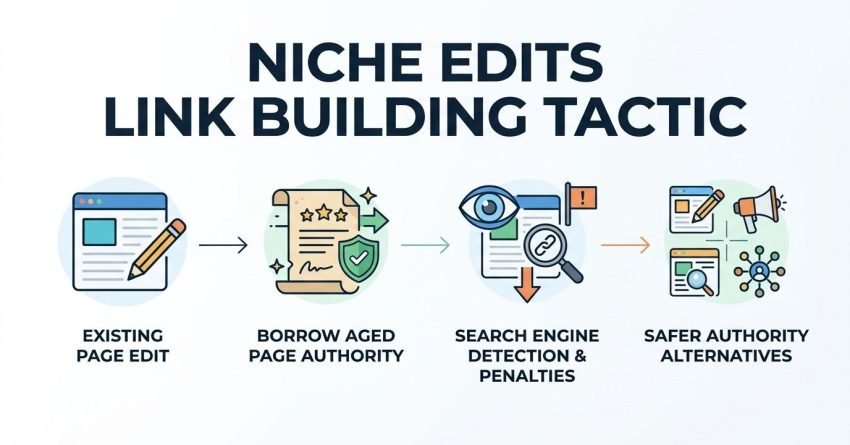
Niche edits are a link building tactic where an existing published article gets edited to insert a new link, rather than creating a brand new page for it. A niche edit is a paid or negotiated link insertion into an already-indexed page, and I’ve watched this tactic swing from “smart shortcut” to “penalty risk” faster than almost any other SEO method. Website owners like this approach because it borrows an already-aged page’s authority instead of waiting for a new one to earn trust.
Search engines have gotten sharper at spotting inserted links. I’ve seen sites lose rankings fast once a pattern of unnatural insertions gets flagged.
This guide covers what niche edits are and how the acquisition process works, the specific risks and detection signals Google uses, how niche edits stack up against other link building methods, and which alternatives build authority without the exposure.
What Are Niche Edits in Link Building?
A niche edit is a link acquisition method where an SEO or marketer pays to insert a hyperlink into an existing, already-published piece of content instead of publishing new content. We’re talking about links added retroactively into someone else’s aged, indexed page, which is exactly what makes them attractive and risky at the same time.
The appeal comes from borrowing existing page authority. A three-year-old article with steady traffic and backlinks already carries trust signals that a brand-new guest post doesn’t have on day one.
Niche Edits vs. Guest Posts vs. New Content Links
Guest posts involve writing a brand-new article for a third-party site, with a link included naturally as part of that new content. Niche edits skip the content creation step entirely and insert a link into content that already exists and already ranks.
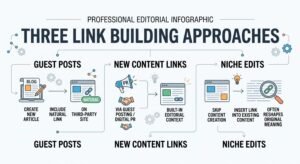
New content links, whether through guest posting or digital PR, come with editorial context built in from the start. A niche edit link gets slotted into a sentence someone else wrote, often reshaping the paragraph’s original meaning to fit the anchor text.
How Niche Edits Actually Work
The niche edit process starts with finding relevant, already-ranking pages, then negotiating a fee with the site owner or their outreach contact for a link insertion. We see this happen through direct outreach, marketplaces, or agencies that specialize in bulk niche edit placements.
The Typical Niche Edit Acquisition Process
The process generally follows four steps: identify a topically relevant page with existing authority, contact the owner or use a marketplace, agree on placement and anchor text, and confirm the link goes live and stays indexed.
Speed is the main selling point here. A niche edit link can go live within days, while a guest post might take weeks between pitching, writing, and editorial review.
Why Marketers Use Niche Edits
Marketers turn to niche edits because they’re faster and often cheaper than producing new content for every single backlink. I get why the appeal is strong when a client wants results in a tight quarter.
Cost savings show up because there’s no need to write, design, or publish new content on the target site. You’re paying purely for access to an existing page’s authority and its position in search results.
Authority transfer is the other draw. An aged page that’s accumulated its own backlinks and trust signals passes some of that equity through the inserted link, at least in theory, and that theory is exactly where the risk starts.
The Core Risks of Niche Edits
The core risk of niche edits is that Google explicitly classifies paid link insertions into unrelated or thin content as a link scheme violation. Google’s Search Essentials guidelines state that “buying or selling links that pass PageRank” violates their spam policies, and niche edits sit squarely in that category when payment is involved.
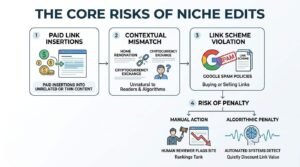
Contextual mismatch is the most common giveaway. A niche edit inserted into a paragraph about home renovation that suddenly links to a cryptocurrency exchange reads as unnatural to both readers and algorithms.
Google’s Stance on Manipulative Link Insertions
Google’s link spam policies define “unnatural links” as any link intended to manipulate a site’s ranking rather than serve genuine reader value. This covers link insertions where payment or reciprocal arrangements exist without disclosure.
Manual Action & Algorithmic Penalty Exposure
Manual actions happen when a human reviewer at Google flags a site for violating link scheme guidelines, and they can tank rankings for the linked-to domain, not just the site hosting the link. Algorithmic detection through systems like SpamBrain works continuously, without human review, and can quietly discount link value rather than issuing a visible penalty.
I’ve worked with businesses that never got a manual action notice yet still saw a mysterious ranking drop, because the algorithm simply stopped counting those links.
How Google Detects Manipulative Niche Edits
Google detects manipulative niche edits primarily through footprint analysis, which flags unnatural patterns across anchor text, link placement, and surrounding content relevance. Google’s Search Central documentation explicitly lists “excessive link exchanges” and paid link schemes as detectable spam patterns.
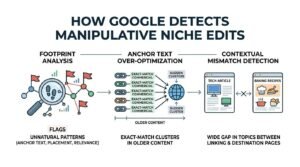
Anchor text over-optimization is one of the clearest signals. A sudden cluster of exact-match commercial anchors pointing to one domain, especially inserted into older content, stands out against natural linking patterns that tend to be messier and more varied.
Contextual mismatch detection compares the topic of the linking page against the topic of the destination page. A wide gap between the two topics is one of the easiest patterns for both algorithms and human reviewers to catch.
Niche Edit Red Flags to Watch For
The clearest red flag is a link inserted into a paragraph where it doesn’t logically belong, disrupting the original sentence’s meaning just to fit an anchor. I always tell clients that if a sentence reads awkwardly after the edit, a reviewer will notice it too.
Sudden topical shifts within an article signal manipulation. A blog post about kitchen renovation that abruptly links out to a personal injury law firm has no organic reason to exist.
PBN (private blog network) signals show up as thin content, minimal original traffic, and a pattern of the same site selling links to multiple unrelated buyers. Checking a domain’s traffic history and outbound link profile before buying a niche edit catches most of these red flags early.
Editorial history matters too. A site that’s clearly been edited dozens of times just to slot in new links, with no genuine content updates, is a pattern-based red flag.
The Financial & Reputational Cost of Risky Link Building
The direct financial cost of a penalty recovery effort often exceeds what businesses originally spent acquiring the risky links in the first place. Recovery involves auditing every backlink, requesting removals, and filing disavow requests, which eats weeks of specialist time.
Ranking loss compounds the damage since traffic and lead generation drop while the recovery process plays out. I’ve seen recovery timelines stretch three to six months before rankings stabilize again.
The disavow tool lets site owners tell Google to ignore specific backlinks when requesting removal directly hasn’t worked. It’s a defensive measure, not a fix, and it doesn’t undo any damage that’s already occurred.
Niche Edits vs. Other Link Building Methods
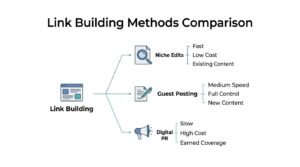
Niche edits differ from guest posting and digital PR primarily in how the link gets created: inserted into old content versus built into brand-new, purpose-written content. Each method carries a different risk-to-effort ratio depending on execution quality.
| Method | Speed | Cost | Risk Level | Content Control |
| Niche Edits | Fast (days) | Low-Medium | High | None (existing content) |
| Guest Posting | Medium (weeks) | Medium | Medium | Full (new content) |
| Digital PR | Slow (weeks-months) | High | Low | Full (earned coverage) |
Niche Edits vs. Guest Posting
Guest posting requires writing original content for a third-party site, giving full control over context, anchor placement, and topical relevance from the outset. Niche edits offer none of that control since the surrounding content already exists and wasn’t written with the new link in mind.
Niche Edits vs. Digital PR
Digital PR earns links through original research, data, or newsworthy angles that journalists and publishers link to voluntarily. This approach carries the lowest risk of the three because links come from genuine editorial interest rather than payment.
Safer Alternatives to Niche Edits
The safest alternatives to niche edits are link building methods rooted in original value creation, such as digital PR, proprietary research, and genuine relationship-based contributions. These approaches take longer to show results but don’t carry manual action exposure.
Digital PR & Linkable Asset Creation
Digital PR involves creating a newsworthy asset (original data, a survey, an industry report) and pitching it to journalists and publishers for organic coverage. A Backlinko analysis of 11.8 million Google search results found that content earning links from unique, authoritative domains consistently outperformed content relying on manipulated link sources.
This method takes more upfront investment in research and outreach, but every resulting link comes from a publisher choosing to cite the work voluntarily.
Original Data & Research-Driven Content
Publishing original survey data, industry benchmarks, or proprietary research gives other sites a genuine reason to link back without any payment involved. I’ve found that a single well-promoted data study can out-earn dozens of niche edits over a year, purely through organic citation.
Relationship-Based Guest Contributions
Building actual relationships with site owners and editors in a niche, then contributing genuinely useful content, produces links that read naturally because the content was written specifically for that audience. This takes longer than a transactional niche edit purchase, but the resulting link carries zero manipulation footprint.
How to Evaluate a Link Building Opportunity Safely
A safe link building opportunity passes three checks: topical relevance to your business, verifiable organic traffic on the linking page, and a transparent editorial process rather than a pay-for-placement transaction. Skipping any of these checks raises risk substantially.
Traffic verification means checking whether the linking page actually gets organic search visits, not just domain-level metrics that can be inflated by unrelated pages. Tools that show page-level organic traffic estimates catch most inflated-authority domains.
Editorial standards separate legitimate placements from manipulative ones. A site with a genuine editorial review process, where content gets rejected if it isn’t a good fit, behaves very differently from one that accepts any paid insertion.
Building a Sustainable Link Acquisition Strategy
A sustainable link acquisition strategy prioritizes earned links from original content over purchased placements, building authority that compounds instead of carrying ongoing penalty risk. This shift in approach takes patience but removes the constant exposure that comes with paid tactics.
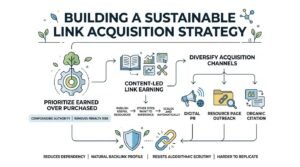
Content-led link earning works by publishing genuinely useful resources, tools, or data that other sites want to reference on their own. We build this into every long-term SEO strategy because it scales without needing continuous manual outreach for every single link.
Diversifying acquisition channels across digital PR, resource page outreach, and organic citation reduces dependency on any single risky tactic. A backlink profile built from varied, natural sources is also far harder for competitors to replicate and far less likely to trigger algorithmic scrutiny.
When (If Ever) Niche Edits Might Be Low-Risk
Niche edits carry the lowest relative risk when the placement is genuinely editorial, topically relevant, and the site owner treats it as a real content update rather than a pure transaction. This scenario is rare but does exist among niche edit purchases.
Genuine relevance means the linking page’s topic closely matches the destination page’s topic, so the insertion reads as a natural addition rather than a forced anchor. A site owner who reviews and sometimes rejects niche edit requests based on fit behaves more like a legitimate editorial partner than a link marketplace.
Even in these lower-risk cases, the transactional nature of the arrangement means some exposure always remains, since payment for links (disclosed or not) sits inside Google’s spam policy definitions.
Conclusion
Niche edits offer speed and borrowed authority, but they carry real detection risk through footprint analysis and contextual mismatch signals. Digital PR, original research, and genuine editorial relationships build authority that lasts.
Every link-building decision connects back to the same question: does this earn trust or borrow it temporarily? Sustainable growth favors the former every time.
We help businesses build link acquisition strategies that grow rankings safely. White Label SEO Service turns sustainable link building into predictable, long-term organic growth.
Frequently Asked Questions
What is a niche edit in link building?
A niche edit is a paid link inserted into an already-published, indexed article rather than new content. It borrows the existing page’s authority and traffic history.
Are niche edits against Google’s guidelines?
Yes, when payment is involved. Google’s spam policies classify paid link insertions that pass ranking value as a link scheme violation.
Can niche edits get a website penalized?
Yes, through manual actions or algorithmic link discounting. Detection often comes from anchor text patterns and contextual mismatches between the linking and destination pages.
How much do niche edits typically cost?
Niche edit pricing varies widely based on the linking domain’s authority, typically ranging from $50 to $500+ per placement. Higher-authority, more relevant sites command higher prices.
What’s the difference between niche edits and guest posts?
Niche edits insert links into existing content someone else already wrote. Guest posts involve writing entirely new content specifically for the link placement.
What are the safest alternatives to niche edits?
Digital PR, original research content, and genuine editorial relationships are the safest alternatives. These earn links organically instead of purchasing insertion into existing pages.
How do I know if a niche edit link is high quality?
Check for topical relevance, verified organic traffic on the linking page, and a genuine editorial review process. Red flags include thin content and unrelated topic clusters.